Google Jules 3.0 Major Upgrade: API, Memory System, and Free AI Coding Agent Explained

Google Jules 3.0 upgrades with API, CLI, memory system, and free async AI coding agent capabilities.
Google has significantly upgraded its async AI coding agent Jules, launching an API for deep integration with Slack, Jira, and GitHub Actions, a memory system that learns developer coding preferences, a CLI tool for terminal workflows, and Google Stitch integration bridging design-to-code pipelines. Jules is completely free with 15 daily tasks powered by Gemini 2.5 Pro, marking its architectural leap from standalone tool to programmable development platform.
Google recently rolled out a comprehensive upgrade to its autonomous coding agent Jules, introducing an API interface, CLI tools, a memory system, and several other major features. As a completely free asynchronous AI coder, Jules 3.0 is evolving from a standalone tool into an intelligent development partner that can be deeply embedded throughout the entire software development lifecycle.
Notably, Jules' positioning as an "asynchronous AI coder" represents an important evolutionary direction for AI programming tools. Unlike "synchronous completion" tools such as GitHub Copilot, asynchronous agents can independently execute complex, time-consuming tasks in the background—such as refactoring across multiple files, implementing complete feature modules, or generating automated tests—without requiring real-time developer supervision. This architecture borrows from the "task queue" concept in software engineering, decoupling the AI's execution process from foreground interaction, allowing developers to work on other tasks in parallel and review results once the AI finishes.
Jules API: From Standalone Tool to Fully Integrated Development Platform
The most strategically significant change in this update is the official launch of the Jules API. This means Jules is no longer limited to being a manually operated programming assistant—it's now an automation engine that can be programmatically invoked by any system.
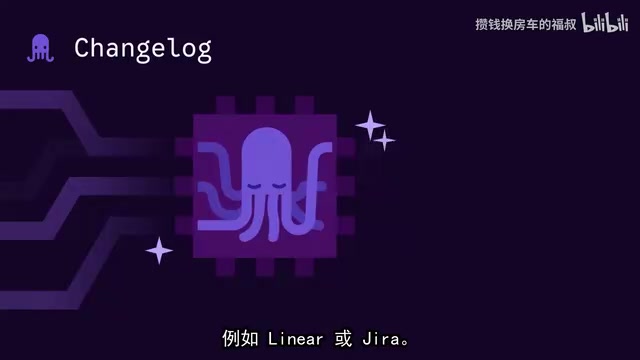
Developers can now achieve various deep integration scenarios through the API:
- ChatOps Integration: Connect Jules to Slack and assign coding tasks directly from chat windows
- Project Management Automation: Integrate with Linear, Jira, and other tools to automatically fix bugs and implement feature requests
- CI/CD Pipeline Embedding: Embed Jules directly into continuous integration/deployment workflows via GitHub Actions
ChatOps is a DevOps philosophy proposed by GitHub engineers around 2013, with the core idea of unifying team collaboration, tool invocation, and automated workflows within chat platforms (such as Slack or Teams). Connecting Jules to a ChatOps system means developers can issue coding instructions in natural language directly from chat windows, dramatically reducing friction in using AI tools. CI/CD (Continuous Integration/Continuous Deployment) is a core practice in modern software engineering, using tools like GitHub Actions to chain code commits, testing, building, and deployment into automated pipelines. Once embedded in CI/CD, Jules can automatically respond to test failures, fix bugs, and submit PRs within the pipeline, truly enabling a "self-healing" development workflow.
Google also provides a concise usage example—a single API request is all it takes to launch a new task (i.e., a "session"), making the integration barrier extremely low. On a deeper level, Jules is upgrading from a "tool" to "infrastructure," gradually becoming an indispensable AI developer role in the modern software development lifecycle.
CLI Tool: Precise Control at the Command Line Level
Jules simultaneously launched a brand-new command-line interface (CLI) tool, providing developers who prefer terminal operations with direct control over the AI coding agent.
Through the Jules CLI, developers can:
- Create and manage coding tasks
- List all active sessions
- Preview and apply code patches locally before committing to GitHub
- Test generated code in real time
Installation is straightforward, supporting npm install or direct execution via npx. The CLI fully supports scripting and composability, and can be combined with traditional command-line tools like grep, jq, and curl to build more complex automated workflows. For engineers accustomed to developing in terminal environments, this is an extremely practical productivity tool.
Memory System and Environment Variables: Making AI Truly Understand Your Project
One of the most noteworthy features in this upgrade is the introduction of the Memory System. Jules can now learn each developer's interaction patterns, coding preferences, and workflow habits on a per-repository basis.
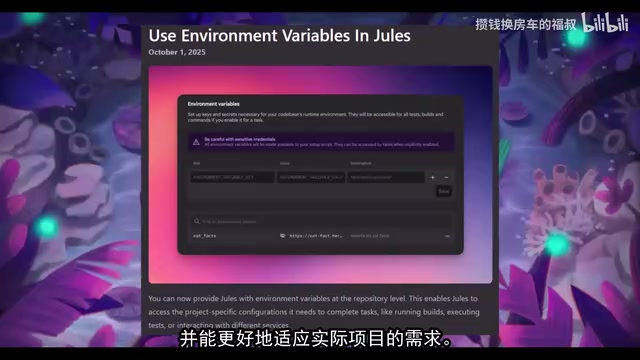
Understanding this feature requires some technical background on AI memory systems. Traditional large language models are fundamentally "stateless"—each conversation starts from scratch with no ability to retain context across sessions. Jules' repository-level memory system simulates "long-term memory" by structuring and storing developers' historical interactions, coding style preferences, and project conventions, then automatically injecting this context when each new task begins. Technically, this is typically implemented through a combination of vector databases (for semantic retrieval of historical records) and structured configuration files (for storing explicit rules and preferences). The repository-level granularity is also highly pragmatic—different projects often have entirely different tech stacks and conventions, and isolated storage prevents cross-project memory contamination.
This means that when you execute similar tasks within the same repository, Jules leverages accumulated contextual memory to anticipate needs, operate according to your established coding style, and achieve more accurate results with fewer instructions. This feature can be flexibly enabled or disabled in the "Knowledge" section of repository settings.
Complementing the memory system is environment variable support. Developers can configure repository-level environment variables for Jules, enabling it to access project-specific configuration information to execute builds, run tests, and interact with external services. Once enabled, Jules maintains access to these variables throughout the entire project lifecycle, ensuring continuity in complex task workflows.
The combination of these two features transforms Jules from a "stateless code generator" into a "long-term coding partner with memory and context."
File Picker and Image Upload: More Precise Task Control
The new File Picker feature addresses a common pain point: developers no longer need Jules to scan the entire codebase—they can manually select specific files for editing, debugging, or documentation generation. This is especially critical in large projects, saving processing time while significantly improving output precision.

The Image Upload feature adds visual understanding capabilities to Jules. Developers can upload images in JPG, PNG, and other formats when creating tasks, suitable for these typical scenarios:
- Sharing screenshots of frontend UI bugs to help AI quickly locate issues
- Providing prototypes or design mockups as development references
- Sharing visual assets to help AI more accurately understand product requirements
Enhanced Code Review and Stitch Integration
Jules' code review capabilities have also been significantly enhanced. The new side-by-side diff view displays changes across multiple files vertically on a single screen, providing clearer context and a more efficient code review experience. Additionally, the code evaluation agent now displays its reasoning process in real time within the interface, allowing developers to step through how the AI assesses code quality and identifies potential errors or logical flaws.
Most noteworthy is the Jules and Stitch integration. Google Stitch is Google's AI-powered UI design generation tool that allows users to quickly generate frontend interface prototypes through natural language descriptions or sketches. The Jules-Stitch integration is essentially building a "Design-to-Code" automation pipeline—a concept that has been explored in frontend engineering for years, but previously relied mainly on semi-automated tools like Figma plugins that still required significant manual intervention. Connecting an AI design tool with an AI coding agent means the entire workflow from product prototype to runnable code can be completed without manually writing code. This aligns closely with the approach of competitors like Vercel's v0 and Lovable, but Google's differentiation lies in bringing both the design side (Stitch) and the development side (Jules) into its own ecosystem, forming a closed loop that reduces cross-platform data transfer friction.
Through this integration, developers can complete user interface design in Stitch, then hand off the design directly to Jules for automatic backend code construction, dramatically shortening the cycle from design to deployment.
Free Tier and Usage Recommendations
Jules is currently completely free to use. The free tier provides 15 tasks per day, supports 3 concurrent tasks, all powered by Gemini 2.5 Pro. Users who participated in the beta can also enjoy three months of Pro version access with additional usage quotas.
Gemini 2.5 Pro is Google DeepMind's flagship multimodal large language model launched in 2025, ranking at the top of multiple programming benchmarks (such as SWE-bench and HumanEval). Its core advantages include an ultra-long context window (supporting million-level tokens), native multimodal understanding (mixed text, image, and code input), and enhanced reasoning capabilities. For coding agents like Jules that need to understand large codebases and analyze cross-file dependencies, the ultra-long context window is particularly critical—it allows the model to "see" the entire project's code structure in a single inference pass without relying on Retrieval-Augmented Generation (RAG) for chunked processing, dramatically improving the consistency and accuracy of code modifications. Providing Gemini 2.5 Pro compute power at a free tier also reflects Google's intense investment in the developer ecosystem competition.
From a practical value perspective, 15 daily tasks combined with Gemini 2.5 Pro's powerful capabilities are quite generous for individual developers and small teams. Developers are encouraged to try the Jules API and CLI tools early, integrate them into their development workflows, and take full advantage of the current free window.
Summary
The Jules 3.0 upgrade isn't a simple feature stack—it's an architectural leap from "tool" to "platform." The open API allows it to be embedded in any system, the memory system makes it increasingly attuned to your coding habits over time, and the Stitch integration bridges the complete pipeline from design to development. As competition among AI coding assistants intensifies, Google's choice to rapidly capture the developer ecosystem with a completely free strategy is a move that every developer should keep a close eye on.
Key Takeaways
- Jules API officially launched, supporting deep integration with Slack, Jira, GitHub Actions, and other tools—evolving from a standalone tool into a programmable automation development platform
- New memory system and environment variable support allow Jules to learn developer coding preferences and maintain context throughout the project lifecycle
- CLI command-line tool launched, supporting local patch preview and scripted operations, seamlessly fitting into existing development workflows
- Integration with Google Stitch enables end-to-end AI development: frontend design automatically handed off to backend code construction
- Completely free to use with 15 daily task quotas, powered by Gemini 2.5 Pro; beta users get three months of Pro access
Related articles
 Tech Frontiers
GitHub Agent HQ Launch: AI Coding Tools Enter the Era of Platform Competition
GitHub Universe unveils Agent HQ platform for unified coding agent management, Copilot upgrades with multi-model support. OpenAI completes restructuring, Anthropic tests new model, NVIDIA open-sources AI models.
 Tech Frontiers
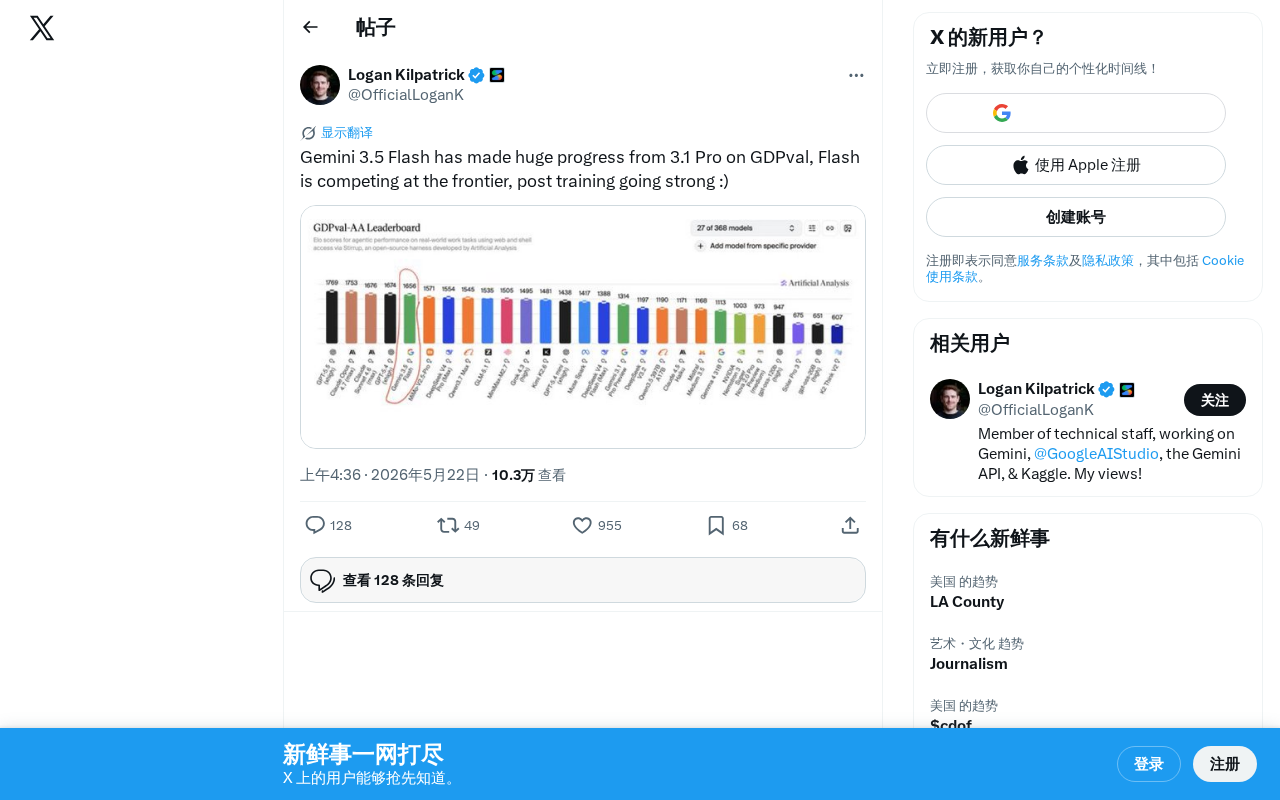
Gemini 3.5 Flash Achieves a Massive Leap on the GDPval Benchmark
Google Gemini 3.5 Flash surpasses Gemini 3.1 Pro on the GDPval benchmark. The lightweight Flash model leverages post-training techniques to approach frontier-level performance, redefining the balance between quality and cost.
 Tech Frontiers
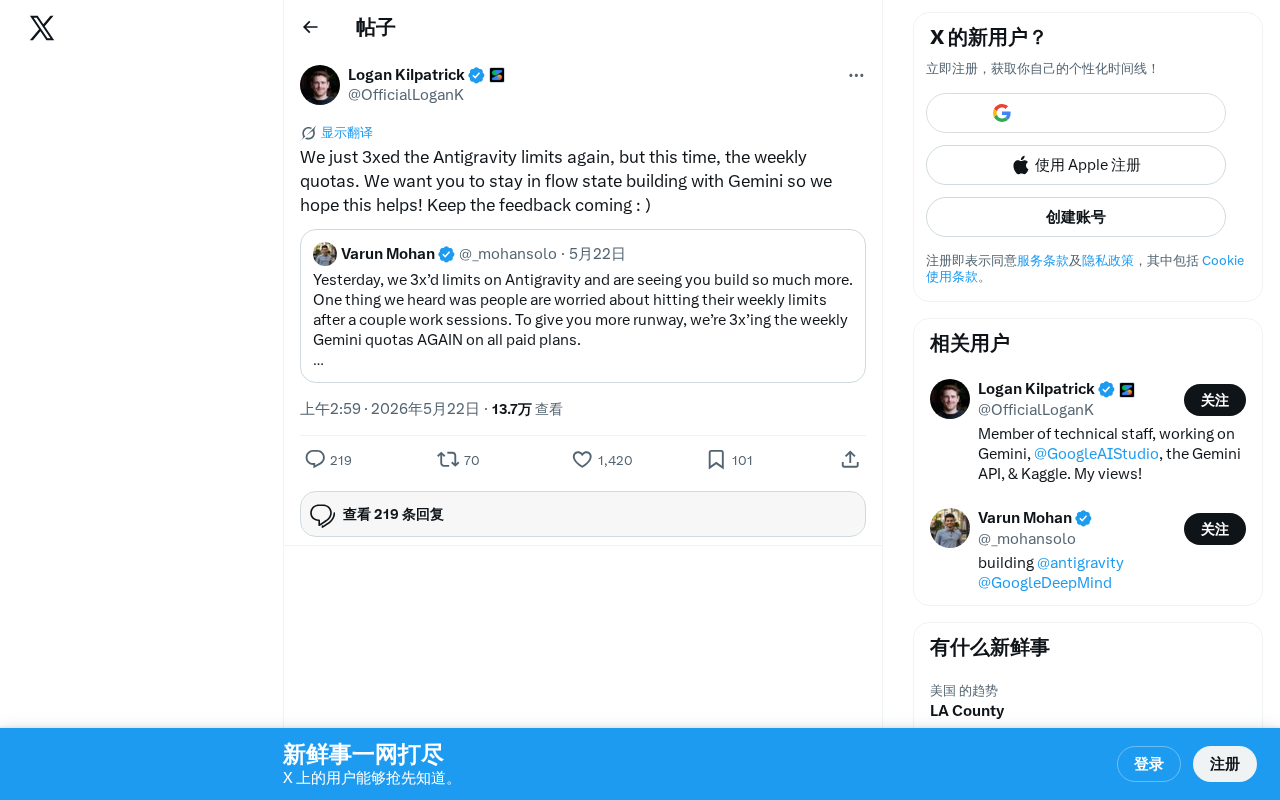
Google Gemini Antigravity Weekly Quota Tripled — AI Coding Without Limits
Google Gemini triples Antigravity weekly quotas following a prior daily quota boost. Analyzing the impact on developers and its strategic significance in AI coding.