Google Summer of Building: A New Developer Training Program for the AI Era
Google explores Summer of Building, an AI-focused developer program for students and early-career builders.
Google is exploring a new initiative called "Summer of Building" aimed at helping students and early-career developers leverage AI tools like Gemini API and Vertex AI to build real projects. Positioned as an AI-era evolution of Google Summer of Code, the program serves Google's strategic goal of building developer ecosystem loyalty while lowering barriers to AI development for newcomers.
Google Plans to Launch "Summer of Building" Program
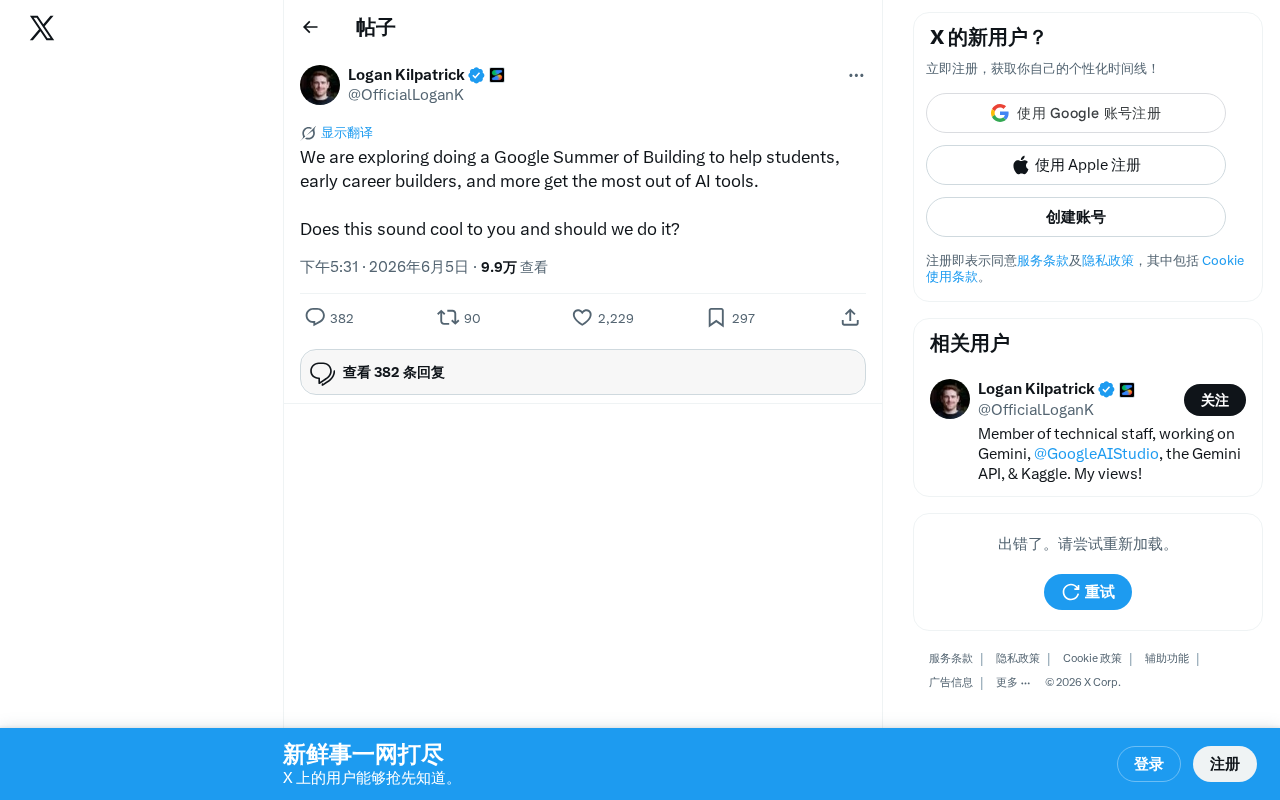
Recently, Google revealed on social media that it is exploring a new initiative called "Google Summer of Building," designed to help students, early-career developers, and other groups better leverage AI tools for project development.
Google wrote in its post: "We're exploring launching Google Summer of Building to help students, early career builders, and more make the most of AI tools. Does this sound cool? Should we do it?"
Connection to Google Summer of Code
Developers familiar with the open-source community are certainly no strangers to "Google Summer of Code" (GSoC). This program, which has been running for nearly 20 years, funds students worldwide each year to participate in open-source software development and has cultivated a large number of outstanding open-source contributors.
The newly proposed "Summer of Building" is clearly an AI-era upgrade of this classic model. Based on its naming and positioning, the new program has several notable characteristics:
Focus on AI Tool Application
Unlike GSoC, which emphasizes traditional open-source code contributions, Summer of Building explicitly centers on "AI tools." This means participants will learn and use Google's AI product ecosystem—including Gemini API, Google AI Studio, Vertex AI, and more—to build real projects.
Broader Target Audience
The program isn't just for students; it specifically mentions "early career builders." This positioning expands the scope of participation, indicating that Google aims to reach everyone from current students to developers just entering the field, and possibly even professionals transitioning into AI.
The Strategic Intent Behind It
Building a Developer Ecosystem Moat
In today's intensely competitive AI platform landscape, Google's move has a clear ecosystem-building purpose. By getting more young developers to deeply engage with Google's AI toolchain during their learning phase, the company can cultivate long-term platform loyalty and usage habits. This aligns with Microsoft's strategy of capturing developers through GitHub Copilot and OpenAI's approach through the ChatGPT API.
Lowering the Barrier to AI Development
While current AI tools are powerful, there's still a learning curve for novice developers. Through a structured "summer project" format, potentially paired with mentorship and community support, the barrier to entry can be effectively lowered, accelerating the adoption of AI applications.
Gathering User Feedback to Validate Demand
Here's a subtle detail: Google released this news in a "request for feedback" format, which is itself a product validation strategy. By using community feedback to gauge demand intensity, they simultaneously generate discussion and buzz.
Potential Value for Developers
If this program ultimately launches, its value to the target audience could include:
- Hands-on experience: Applying AI tools in real projects and building a portfolio
- Learning resources: Access to official Google tutorials, documentation, and potentially mentor support
- Community connections: Collaborating and exchanging ideas with peers worldwide
- Career development: Program experience as a resume highlight demonstrating AI application skills
Outlook and Expectations
The program is currently still in the exploration phase, with specific details about timelines, participation methods, and whether financial support will be provided yet to be announced. However, judging from community response, developers have shown strong interest.
In an era where AI skills are increasingly becoming essential for developers, structured learning programs led by major tech companies undoubtedly provide young developers with a fast track to growth. We'll continue to follow this project's developments.
Related articles
OpenCode In-Depth Review: Hands-On with a Free Open-Source AI Coding Assistant
In-depth review of OpenCode, an open-source AI coding assistant. Covers its three-layer architecture, setup, building a to-do app, and model comparisons with DeepSeek Flash and more.

How Wayfair Uses GPT Models to Process a Catalog of 40 Million Products
Deep dive into how Wayfair uses OpenAI GPT models for catalog enrichment across 40M SKUs, covering technical implementation, AI solutions for non-standardized product classification, and implications for e-commerce.
Codex AI Coding Agent Explained: What's the Real Difference from ChatGPT?
Deep dive into OpenAI's Codex coding agent, comparing Codex vs ChatGPT in programming scenarios and how AI agents are reshaping software development.