GPT-Rosalind: A Detailed Look at OpenAI's AI Model Built for Life Sciences
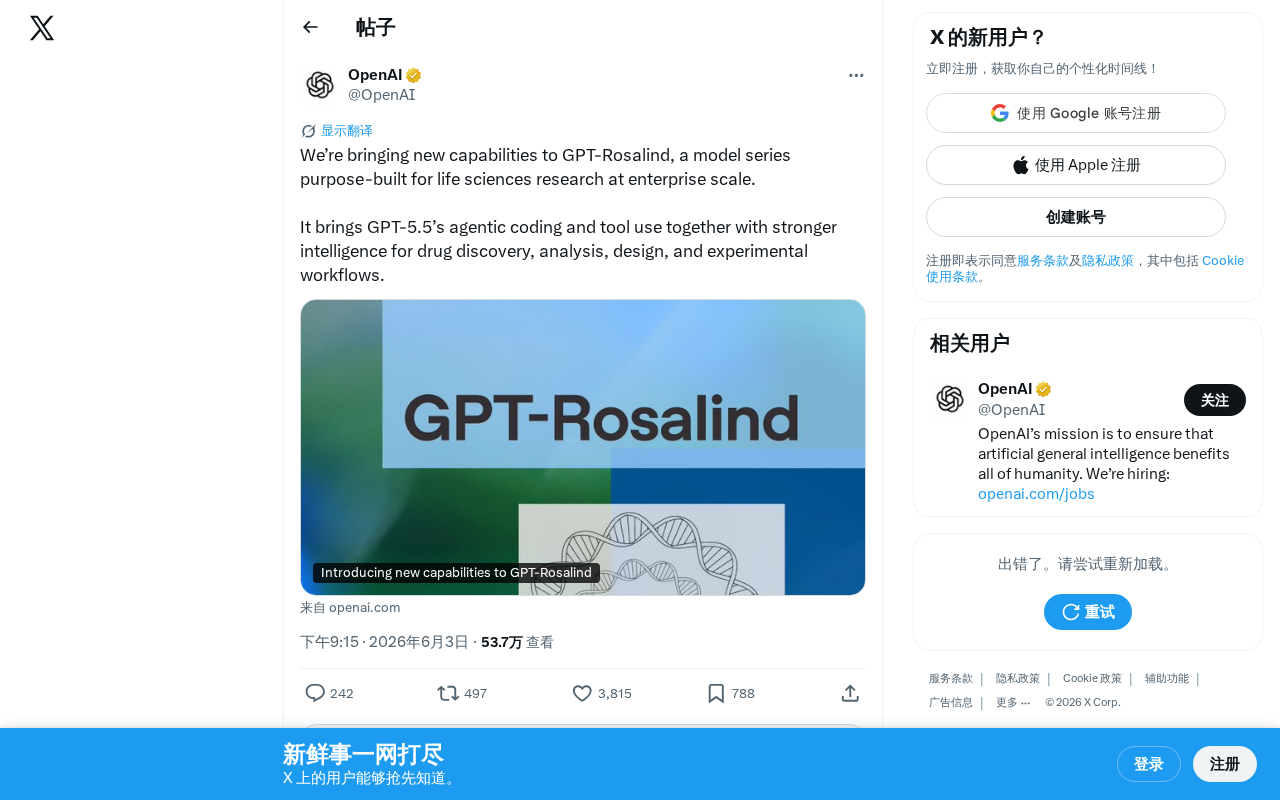
OpenAI launches GPT-Rosalind, a specialized AI model for enterprise life sciences research and drug discovery.
OpenAI has released GPT-Rosalind, a specialized AI model series built for enterprise-scale life sciences research. Integrating GPT-5.5's agentic coding and tool use capabilities, it targets drug discovery, molecular design, data analysis, and experimental workflows. The model represents the broader industry trend of AI shifting from general-purpose to domain-specific specialization, aiming to accelerate pharmaceutical R&D while addressing challenges around hallucination, accuracy, and data security.
Overview: Life Sciences Gets Its Own Dedicated AI Model
OpenAI recently announced a major capability upgrade for GPT-Rosalind. GPT-Rosalind is a model series specifically built for enterprise-scale life sciences research, designed to deeply integrate cutting-edge AI capabilities into drug discovery, analytical design, and experimental workflows. The model is named in honor of British physical chemist Rosalind Franklin (1920-1958), whose famous "Photo 51" captured through X-ray crystallography provided critical experimental evidence for revealing the DNA double helix structure. This naming choice not only reflects OpenAI's respect for the history of life sciences but also hints at the model's ambitious positioning in molecular structure analysis and fundamental biological research.
This move marks another significant step in OpenAI's vertical industry model strategy. Unlike the "jack-of-all-trades" positioning of general-purpose large models, GPT-Rosalind has chosen to go deep in life sciences—a high-value, high-barrier professional domain—reflecting the broader industry trend of AI moving from general-purpose to domain-specific specialization.
Core Capabilities of GPT-Rosalind
Integration of GPT-5.5's Agentic Coding and Tool Use
According to OpenAI's official introduction, GPT-Rosalind integrates GPT-5.5's agentic coding and tool use capabilities. This means the model not only understands specialized knowledge in life sciences but also possesses the ability to autonomously write code, call external tools and APIs, and function like a research assistant with programming skills—completing complex scientific tasks end-to-end.
From a technical perspective, agentic coding is one of the most important technical paradigms in AI during 2024-2025. Unlike traditional code completion, agentic coding means the AI model can autonomously plan tasks, write complete programs, debug errors, and iteratively optimize, forming a closed-loop autonomous workflow. Tool use (function calling) allows the model to dynamically invoke external APIs, database queries, computation engines, and other tools during reasoning, breaking through the limitations of pure text generation. When combined, the model can achieve end-to-end automated workflows such as "retrieve latest literature from PubMed → extract key data → write statistical analysis scripts → generate visualization reports."
The introduction of agentic coding capabilities is particularly critical. In life sciences research, researchers frequently need to process large volumes of genomic data, protein structure data, and compound screening data—work that often requires writing customized analysis scripts. GPT-Rosalind can automatically generate and execute code based on research needs, significantly lowering the technical barrier for scientists.
Four Enhanced Directions for Drug Discovery
GPT-Rosalind provides stronger intelligent support in four core directions:
- Drug Discovery: Assisting with key steps such as target identification and lead compound screening
- Analysis: Processing and interpreting complex biomedical data
- Design: Supporting the design and optimization of drug molecules
- Experimental Workflows: Helping plan and optimize experimental protocols
These four directions cover the core chain from basic research to preclinical development, demonstrating OpenAI's deep understanding of the entire life sciences R&D process.
It's worth noting that traditional drug development is a lengthy and costly process. The industry often uses the "double-ten rule" to describe it: on average, it takes over 10 years and over $1 billion in investment to bring a new drug to market, with an overall clinical trial success rate of less than 10%. The core value of AI in drug discovery lies in shortening early-stage R&D cycles and improving the success rate of candidate molecules. Currently, AI applications in drug discovery are primarily concentrated in target discovery and validation, virtual screening, lead compound optimization, ADMET property prediction (Absorption, Distribution, Metabolism, Excretion, and Toxicity), and clinical trial design optimization. AI pharmaceutical companies like Insilico Medicine and Recursion Pharmaceuticals already have multiple AI-discovered drug candidates in clinical trials. The launch of GPT-Rosalind signals OpenAI's formal entry into this fiercely competitive arena.
Industry Significance: Accelerating the Verticalization Trend of AI Models
The Inevitable Shift from General-Purpose to Domain-Specific
The launch of GPT-Rosalind reflects an important trend in the AI industry: top-tier general-purpose models are differentiating into vertical domains. Life sciences is a quintessential knowledge-intensive field where general-purpose models, despite having some scientific reasoning capabilities, often fall short in professional depth, data comprehension, and workflow integration.
Models specifically optimized for life sciences can gain significant advantages in the following areas:
- Precise understanding of specialized terminology and concepts: The terminology systems across interdisciplinary fields like biology, chemistry, and pharmacology are extremely complex
- Domain-specific reasoning patterns: Drug design requires specialized reasoning frameworks for structure-activity relationship analysis, toxicity prediction, and more. Structure-Activity Relationship (SAR) analysis is the core methodology of medicinal chemistry, studying the quantitative or qualitative relationships between a drug molecule's chemical structure and its biological activity. By systematically modifying a molecule's functional groups, scaffold structure, or stereoconfiguration, researchers can understand which structural features are critical for efficacy, selectivity, and safety, thereby guiding the optimization direction of lead compounds. Traditional SAR analysis heavily relies on the experience and intuition of medicinal chemists, while AI models can discover complex nonlinear SAR patterns that are difficult for humans to detect by learning from massive compound-activity data pairs, significantly accelerating the optimization iteration process.
- Deep integration with laboratory tool chains: Enterprise-level deployment requires seamless integration with existing systems like LIMS and ELN. LIMS (Laboratory Information Management System) manages processes including sample tracking, experimental data storage, quality control, and compliance reporting, ensuring data traceability and regulatory compliance. ELN (Electronic Laboratory Notebook) replaces traditional paper lab notebooks, supporting experimental protocol design, data recording, collaborative sharing, and intellectual property timestamping. Major vendors include LabWare, STARLIMS, Benchling, and others. For AI models to truly deliver value in enterprise scenarios, they must be able to exchange data and integrate processes with these existing systems rather than existing as isolated tools.
The Business Logic Behind Enterprise-Level Positioning
OpenAI has explicitly positioned GPT-Rosalind at "enterprise scale," and there's clear business logic behind this positioning. The global pharmaceutical industry invests over $200 billion annually in R&D, and AI-assisted drug discovery is considered one of the most promising directions for cost reduction and efficiency improvement. By providing specialized AI solutions, OpenAI is well-positioned to capture a favorable position in this high-value market.
Outlook and Reflections: Opportunities and Challenges Coexist
The release of GPT-Rosalind also raises several noteworthy questions. First, life sciences research demands extremely high model accuracy—any "hallucination" or erroneous reasoning could lead to enormous waste of R&D resources. How OpenAI ensures model reliability in professional scenarios will be a key challenge. The "hallucination" problem of large language models poses unique dangers in life sciences—in everyday conversation scenarios, hallucinations may only cause inconvenience, but in drug development, incorrect target recommendations could lead to millions of dollars in wasted experiments, incorrect toxicity predictions could endanger clinical trial participants' safety, and incorrect molecular design suggestions could waste months of synthetic chemistry resources. Therefore, life sciences AI models need to establish rigorous confidence assessment mechanisms, traceable reasoning chains, and closed-loop feedback systems with experimental validation—requirements that far exceed those of general-purpose scenarios in terms of model architecture and deployment approaches.
Second, pharmaceutical companies have extremely sensitive data security and intellectual property protection needs, and enterprise-level deployment solutions must provide adequate data privacy guarantees. Pharmaceutical companies' compound libraries, clinical data, and patent strategies constitute core trade secrets—any data breach could cause incalculable losses. This requires OpenAI to provide enterprise-grade security assurances in its deployment architecture, including private deployment, data isolation, and strict access controls.
Overall, GPT-Rosalind represents an important direction for AI empowering scientific research. When AI is no longer just a general-purpose chat assistant but becomes a specialized research partner in specific domains, the value it creates will far exceed our current imagination.
Related articles
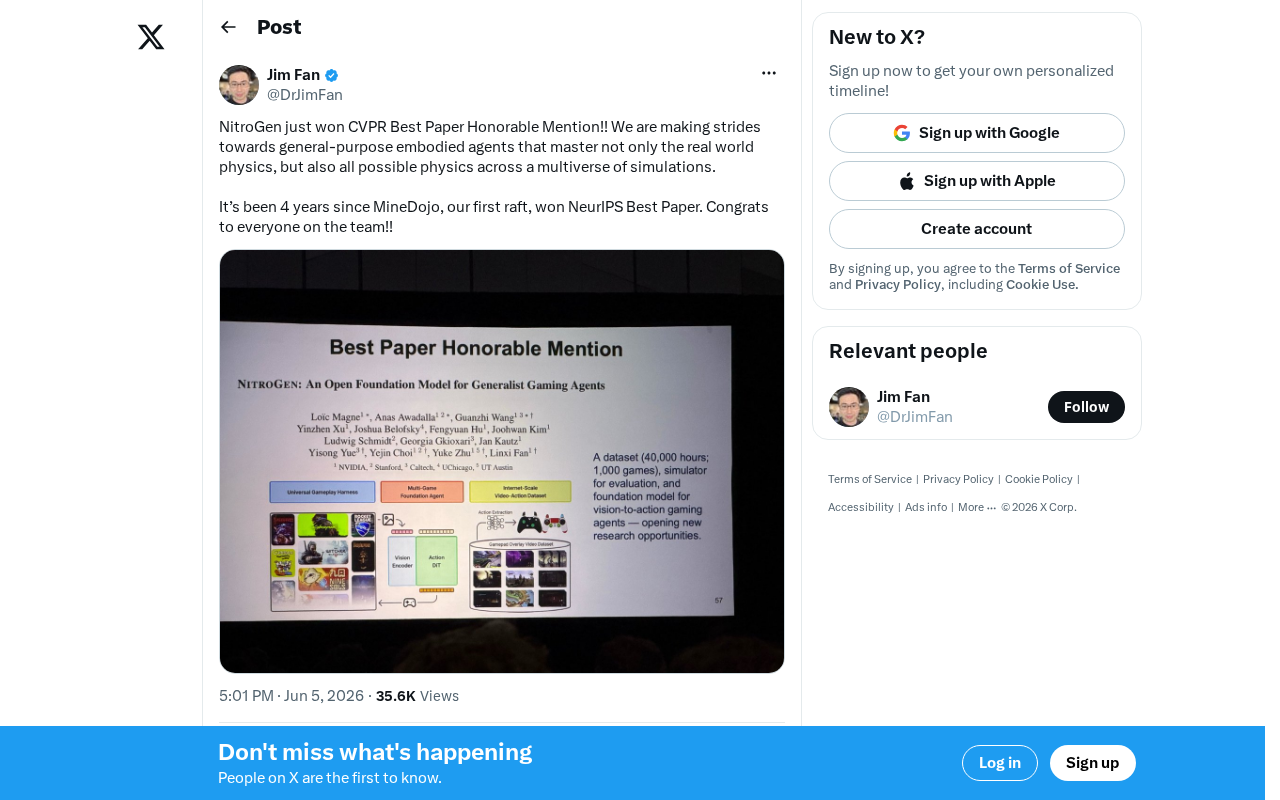
NitroGen Receives CVPR Best Paper Honorable Mention: A New Breakthrough for General-Purpose Embodied Agents
NitroGen wins CVPR Best Paper Honorable Mention for building general-purpose embodied agents across multi-physics worlds. Explore the four-year journey from MineDojo to NitroGen.
Auto-Editing Videos with Codex: A Complete Step-by-Step Workflow from Zero to One
Complete breakdown of using OpenAI Codex with HyperFrance plugin to auto-edit videos, covering plugin setup, prompts, storyboarding, style selection, 5 iterations, and Skills documentation.

OpenAI Codex Free Reset Card Test: Can Your Quota Really Be Fully Restored?
Hands-on test of OpenAI Codex free quota reset cards, verifying whether both weekly and 5-hour rolling quotas can be fully restored. Includes usage methods and invite-a-friend rules.