OpenAI Codex Free Reset Card Test: Can Your Quota Really Be Fully Restored?
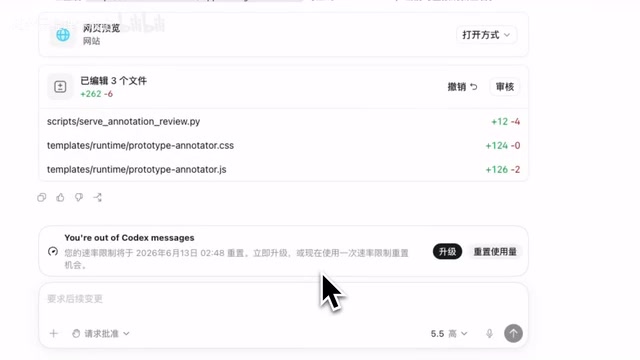
Testing OpenAI Codex's free reset card: both weekly and 5-hour quotas fully restored in one click.
A hands-on test confirms that OpenAI's free Codex quota reset card effectively restores both the weekly quota and 5-hour rolling quota simultaneously. OpenAI also launched an invite-friends feature where Plus/Pro users can invite up to 3 friends, earning a rate limit reset for both parties when the invitee sends their first message. These moves reflect OpenAI's active exploration of Codex commercialization and growth strategies.
Codex Quota Anxiety? OpenAI Delivers a Timely Solution
Developers who've used OpenAI Codex have probably experienced this: you're in the middle of debugging a complex feature, inspiration is flowing, and suddenly you realize your quota is running low. It's only mid-month, your weekly quota is nearly depleted, and your 5-hour rolling quota is completely exhausted. This frustrating "can't cook without ingredients" situation was recently resolved by a small but significant move from OpenAI — free quota reset cards.
A Bilibili content creator was developing a Skill to add editable annotations to a product prototype using Codex when they hit a quota crisis: 4 days until the weekly quota reset, only 15% remaining, and the 5-hour rolling quota completely zeroed out. Right at that moment, they received a free reset card from OpenAI, prompting a thorough hands-on test.
Hands-On Test: Does the Codex Reset Card Actually Work?
The Quota Crunch Before Reset
Before the reset, the user's quota status was quite dire:
- Weekly quota: Only 15% remaining, 4 days until natural reset (June 16)
- 5-hour rolling quota: Completely exhausted
- Ongoing Skill development work forced to halt
This is actually the norm for many heavy Codex users. Codex's rate limiting operates on two layers: a 5-hour rolling window for short-term quota, and a weekly long-term quota. When either is depleted, you can't continue using the service.
This dual-layer rate limiting mechanism is a common traffic control strategy in cloud services. The 5-hour rolling window is a short-term burst control that prevents users from consuming massive computing resources in a short period; the weekly quota is long-term allocation management that ensures fair resource distribution over a larger time scale. The term "rolling window" means the quota doesn't reset at a fixed point in time — instead, as time passes, the earliest consumed quota gradually releases back. For example, if you use some quota at 2 PM, that portion will automatically recover by 7 PM. This is fundamentally different from fixed window resets (like clearing at midnight every day); the rolling mechanism provides smoother control over resource usage peaks.
It's worth noting that the new Codex is no longer a simple code completion tool. It's positioned as a cloud-based asynchronous coding agent that can execute complete development tasks in an independent cloud sandbox environment — including reading codebases, writing code, running tests, and submitting PRs. Each task is called a "Skill," where users describe requirements in natural language, and Codex autonomously completes the development work in an isolated container environment. Since each task execution requires spinning up cloud compute instances and running extensive inference, its resource consumption far exceeds that of ordinary chat conversations — which is the fundamental reason for the relatively strict quota limits.
One-Click Reset, Full Quota Restoration
After clicking the reset button, the system briefly loaded, then the quota status changed dramatically:
- 5-hour quota: Jumped from 0 directly to 99%
- Weekly quota: Fully reset, with the expiration date updated to June 19
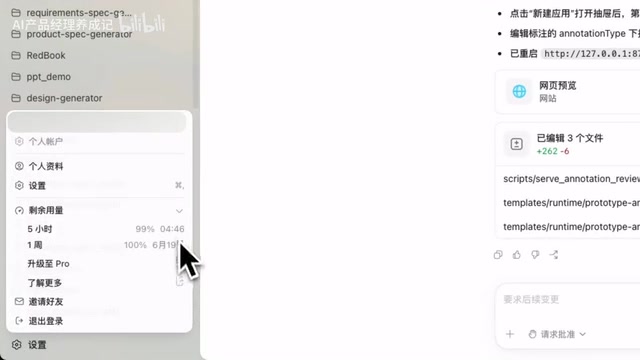
The hands-on test confirms that the free reset card actually works, and it resets both the weekly and 5-hour quotas simultaneously — essentially granting a brand new usage cycle. For developers racing to meet project deadlines, this is undoubtedly a lifesaver.
Invite Friends Mechanism: Social Viral Growth Goes Live
Beyond the free reset card, OpenAI simultaneously launched a new feature with distinct "social viral" characteristics — invite friends to earn additional reset opportunities.
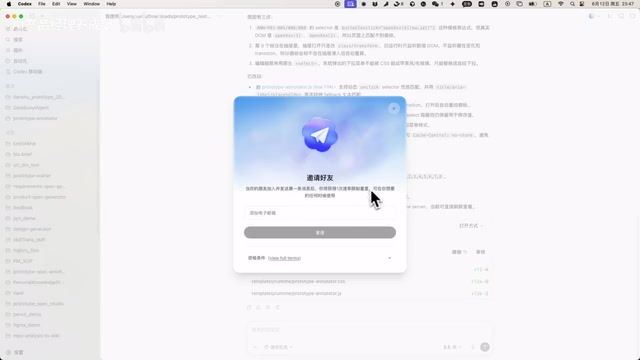
Invitation Rules Explained
- Plus and Pro users can invite up to 3 friends to try Codex within the next two weeks
- When an invited friend sends their first Codex message, both parties receive a rate limit reset
- This means you can theoretically earn up to 3 additional reset opportunities
The Product Logic Behind This Move
"Invite friends, both sides benefit" — this playbook is already ubiquitous in Chinese internet products, from Pinduoduo to various SaaS tools. Social viral growth is practically a standard growth strategy. OpenAI introducing this mechanism to Codex shows they're borrowing more mature operational tactics for user growth and engagement.
The viral loop is one of the core strategies in Growth Hacking. Its essence is turning users into distribution channels, achieving exponential spread through social relationship chains. The most classic example is Dropbox's early "invite a friend, both get 500MB of storage" campaign, which helped Dropbox grow from 100,000 to 4 million users in 15 months. OpenAI's "bilateral incentive" model is a direct replication of this classic paradigm. Notably, OpenAI chose "quota reset" rather than "extended subscription" as the incentive, showing they've precisely identified the biggest pain point for Codex users — it's not that they can't afford to pay, but that the quota isn't enough. This design of using scarce resources as viral currency is often more effective than direct monetary incentives because it addresses users' immediate anxiety.
From a product strategy perspective, this initiative serves at least three purposes:
- User acquisition: Leveraging existing users' social networks for low-cost new user acquisition
- Engagement: Quota resets incentivize continued usage, reducing churn caused by quota exhaustion
- Demand validation: Gauging users' hunger for quota to assess whether pricing or quota strategies need adjustment
Practical Implications for Developers
Codex Quota Management Tips
Based on Codex's current quota mechanism, here are some practical suggestions for developers:
- Plan your usage rhythm wisely: The weekly quota is a hard cap. Spread important debugging work throughout the week to avoid burning through it in the first few days
- Use reset opportunities strategically: Free reset cards and friend-invite resets are precious resources. Save them for when you truly need concentrated development time
- Stay updated on official announcements: OpenAI may periodically distribute similar perks. Staying informed can help you secure extra quota at critical moments
Reflections on Codex's Positioning
The quota mechanism design reveals that OpenAI still positions Codex as a development assistance tool, not a fully automated coding engine that replaces human programming. Rate limits exist partly for cost control, but also to guide users toward more strategic AI usage — think through your requirements first, then let Codex execute, rather than mindlessly trial-and-error.
This also reflects a commercialization dilemma facing the AI coding tool industry at large: the contradiction between high inference costs and users' expectation of unlimited usage. By industry estimates, a single complex Codex task execution may involve tens of thousands or even hundreds of thousands of tokens in inference consumption, plus cloud sandbox computing resources, putting per-task costs anywhere from a few cents to several dozen cents. Currently, AI coding tools in the market generally follow three business models: subscription-based (like GitHub Copilot's monthly fee), usage-based (like API call billing), and hybrid (subscription + quota caps). Codex currently uses the third model, which offers users predictable monthly expenses while allowing the platform to cap resource consumption. The distribution of free reset cards is essentially a dynamic quota adjustment mechanism — OpenAI can observe users' reset card usage frequency and timing to collect valuable demand elasticity data, informing future pricing strategy optimization.
The release of free reset cards and the launch of the invitation mechanism both indicate that OpenAI is actively exploring Codex's commercialization path and user growth strategy. For developers, while enjoying the benefits of AI-assisted programming, you also need to adapt to this "limited quota" work mode and truly integrate AI-assisted programming into your development workflow.
Key Takeaways
Related articles

AI Agent Learning Roadmap: A Four-Step Practical Guide from Zero to Job-Ready
A proven AI Agent learning roadmap covering four core elements, mainstream architecture patterns, multi-agent collaboration, and hands-on projects to go from zero to job-ready in three months.

HarmonyOS 7 Developer Beta Launches: A Deep Dive into System-Level Transformation for the Agent Era
HarmonyOS 7 developer Beta launches, claiming to be the world's first AI-native OS. Deep analysis of Xiaoyi Agent, StarShield security, Galaxy Interconnect, and the OS AI competition landscape.
Deploying a Multimodal AI Agent Locally on a 3080Ti: VRAM Management and a Deep Dive into All Five Modules
A detailed guide to deploying a multimodal AI Agent on a 3080Ti with 12GB VRAM, covering LLM, STT, TTS, image and video generation module selection, dynamic VRAM loading, and real-world performance.