AI Agent Learning Roadmap: A Four-Step Practical Guide from Zero to Job-Ready

A practical four-step roadmap to master AI Agent development from scratch in three months.
This guide presents a proven AI Agent learning roadmap for developers starting from scratch. It covers four key stages: understanding the core elements of AI Agents (planning, memory, tool use, action), mastering architecture patterns like ReAct and Chain, learning multi-agent collaboration and prompt engineering, and building real projects like intelligent customer service systems and personal knowledge bases. With focused effort, the path from beginner to enterprise-ready takes about three months.
For those looking to get started with AI Agent development, the biggest challenge is often not "should I learn this" but "where do I start." A developer who successfully made the transition shared his three-month learning path — from basic code to being actively recruited by companies — and his methodology is well worth studying.
An AI Agent refers to an artificial intelligence system capable of perceiving its environment, making autonomous decisions, and taking actions to achieve specific goals. Unlike traditional chatbots, Agents don't just respond to user input — they possess the ability to proactively plan, invoke tools, and execute continuously. This concept originates from the "intelligent agent" theory in AI research. In recent years, as large language models (LLMs) have made dramatic leaps in capability, Agents have evolved from an academic concept into engineering practice. Since 2023, companies like OpenAI, Google, and Anthropic have all released APIs and frameworks supporting Agent development, making this one of the fastest-growing areas in AI application development.
Core Premise: Direction Matters More Than Effort
The developer emphasized that with the right approach, you can reach enterprise-level competency in AI Agent development in about three months. But there are two prerequisites: you can't lose interest after three minutes, and you must choose the right direction.
Demand for AI Agent roles is growing rapidly, but the quality of available tutorials varies wildly. Many people waste time on outdated tech stacks. Choosing the right learning direction essentially means choosing the right technology path and practice priorities.
Step 1: Build the Foundation — Understand the Four Core Elements of AI Agents
The first mistake many beginners make is rushing to build systems while skipping foundational concepts. The four core elements of AI Agents form the bedrock of all hands-on work:
-
Planning: How an Agent breaks down complex goals into executable subtasks. Planning ability is the core feature that distinguishes AI Agents from simple Q&A systems. Technically, planning typically relies on the reasoning capabilities of large language models, using prompting techniques like Chain-of-Thought to have the model progressively decompose complex goals into executable subtasks. Classic planning methods include Task Decomposition, Goal Regression, and Hierarchical Task Networks (HTN). In real-world Agent systems, the planning module must handle task dependencies, resource constraints, and exception recovery — making it one of the most challenging aspects of engineering implementation.
-
Memory: Management mechanisms for short-term and long-term memory. An Agent's memory system draws from human memory models in cognitive science. Short-term memory (also called working memory) typically corresponds to the current conversation's context window, limited by the LLM's token length constraints. Long-term memory requires external storage systems, with common solutions including semantic memory stored in vector databases (such as Pinecone, Weaviate, Milvus) and factual memory stored in structured databases. Additionally, there's an "episodic memory" design pattern that records the Agent's past behaviors and outcomes, helping it make better decisions in similar scenarios. The core challenge of memory management lies in retrieval efficiency and relevance ranking.
-
Tool Use: How an Agent interacts with external APIs, databases, and other resources
-
Action: Translating plans into concrete operations and producing results

These four elements are interconnected and indispensable. It's recommended to spend 1–2 weeks at this stage reading paper abstracts and official documentation to build a clear cognitive framework, rather than rushing to write code.
Step 2: Master Mainstream Agent Architecture Patterns
After understanding the core elements, the next focus should be learning the mainstream Agent architecture patterns:
-
ReAct Pattern: Alternates between Reasoning and Acting, enabling the Agent to think and execute simultaneously. The ReAct pattern originated from a 2022 paper jointly published by Google Research and Princeton University: ReAct: Synergizing Reasoning and Acting in Language Models. The paper proposed a paradigm that interleaves reasoning traces with task execution actions. In traditional approaches, reasoning and action are often separated — the model completes all reasoning before executing, or acts purely on reactive strategies. ReAct's innovation lies in allowing the model to observe environmental feedback, reason, and then decide the next action at each step, forming a "Think-Act-Observe" loop. This pattern significantly improves accuracy and interpretability in complex tasks.
-
Chain Pattern: Links tasks into a sequential chain workflow, suitable for linear processes
-
Agent Pattern: A more autonomous decision-making mechanism where the Agent independently determines the next operation
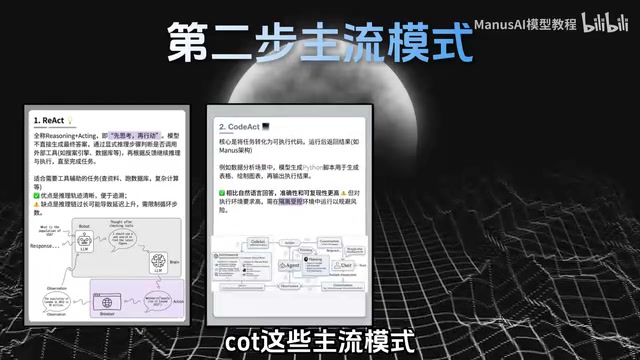
The core value of these architecture patterns is giving Agents the ability to autonomously decompose complex tasks. For example, when faced with a request like "write me a competitive analysis report," the Agent needs to plan multiple steps on its own — information gathering, data comparison, report writing — and execute them one by one.
Learning Recommendations
It's recommended to practice with LangChain or similar frameworks. Start with a single pattern, understand each pattern's applicable scenarios and limitations, then try combining them. LangChain is one of the most popular AI Agent development frameworks today, created by Harrison Chase in 2022. It provides a set of modular components for building LLM-based applications, including prompt template management, chain call orchestration, Agent decision loops, memory management, and tool integration. LangChain supports multiple model providers including OpenAI, Anthropic, and Google, and has a rich community ecosystem. Similar frameworks include LlamaIndex (focused on retrieval-augmented data), AutoGen (from Microsoft, focused on multi-agent collaboration), and CrewAI (specialized in multi-Agent role-playing collaboration). Framework selection should be based on project requirements and team tech stack.
Step 3: Multi-Agent Collaboration and Prompt Engineering
A single Agent has its limits. Real production-grade applications often require multiple Agents working together with a division of labor. This step focuses on two areas:
Multi-Agent Collaboration: Having different Agents handle different responsibilities — for example, one for information retrieval, one for content generation, and one for quality review. The key is designing proper communication protocols and task allocation mechanisms between Agents.
Multi-Agent Systems (MAS) are a classic research area in distributed artificial intelligence that has gained renewed vitality in LLM-driven Agent development. Mainstream collaboration patterns include: Hierarchical, where a primary Agent assigns tasks to sub-Agents; Peer-to-Peer, where multiple Agents negotiate as equals to complete tasks; and Adversarial, where debate and opposition between Agents improve output quality. In engineering implementation, inter-Agent communication is typically handled through shared message queues, event-driven mechanisms, or direct function calls. Key challenges in designing multi-agent systems include avoiding infinite loops, handling conflicting decisions, controlling token consumption costs, and ensuring overall system observability.
Prompt Optimization: This is a critical step that many people overlook. Good prompt design directly determines the stability and quality of Agent output.
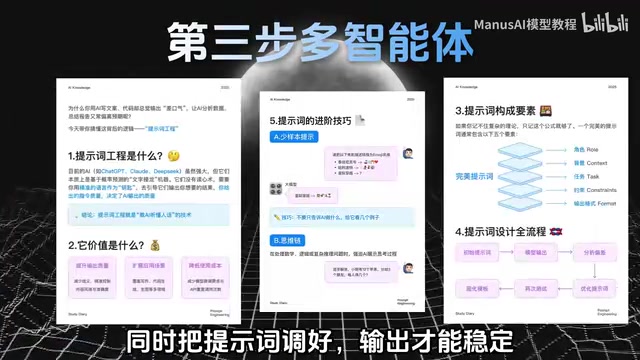
Prompt Engineering has evolved from a collection of "tricks" into a systematic engineering discipline. Core methodologies include: Few-shot Prompting, which guides model output format and style through examples; Chain-of-Thought Prompting, which requires the model to show its reasoning process to improve accuracy on complex tasks; and System Prompt design, which sets the Agent's role, constraints, and behavioral boundaries. In production environments, prompt stability is critical — the same prompt can produce vastly different results across different model versions and temperature parameters. Therefore, mature teams typically establish prompt version management, A/B testing, and automated evaluation pipelines.
Prompt engineering isn't simply "writing instructions" — it requires iterative testing and refinement to find expressions that consistently produce high-quality model output. It's recommended to dedicate 2–3 weeks specifically to honing this skill.
Step 4: Project Practice — Complete the Full AI Agent Development Cycle
The final step is to dive in and build 2–3 complete projects. Recommended starter projects include:
-
Intelligent Customer Service System: Covers intent recognition, knowledge base retrieval, and multi-turn dialogue management
-
Personal Knowledge Base: Involves document parsing, vector storage, semantic retrieval, and generative Q&A. The core technology behind this project is RAG (Retrieval-Augmented Generation). The basic principle: documents are converted into high-dimensional vectors using embedding models (such as OpenAI's text-embedding-ada-002 or open-source BGE series models) and stored in a vector database. When a user asks a question, the query is similarly converted into a vector, and the most relevant document fragments are retrieved using algorithms like cosine similarity or Euclidean distance. These fragments are then provided as context to the LLM to generate answers. RAG effectively addresses the knowledge cutoff limitation and hallucination problems of large language models, making it one of the most widely adopted architecture patterns in enterprise AI applications.
-
Automated Workflow: Using Agents to automate repetitive daily tasks
The value of these projects isn't in how complex the features are, but in connecting everything learned in the first three steps into a complete development cycle. Once you've run through this entire process, you'll have the core competencies required for 90% of AI application roles.
Final Thoughts
The barrier to entry for AI Agent development isn't as high as you might think, but it's also not something you can master by watching a few videos. The key lies in this cycle: understand the principles → master the frameworks → practice repeatedly → validate through projects. The three-month timeline is achievable, provided you maintain effective daily study time and always stay oriented toward "building something that works" rather than staying at the theoretical level.
Related articles
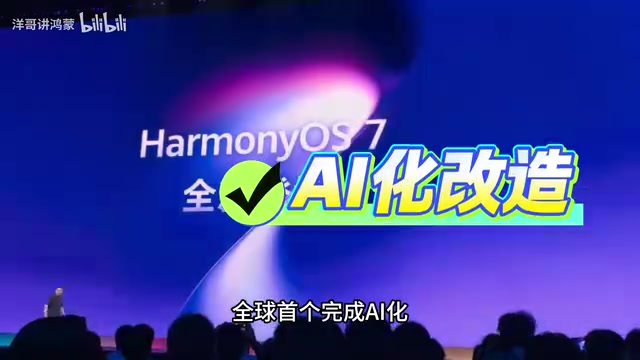
HarmonyOS 7 Developer Beta Launches: A Deep Dive into System-Level Transformation for the Agent Era
HarmonyOS 7 developer Beta launches, claiming to be the world's first AI-native OS. Deep analysis of Xiaoyi Agent, StarShield security, Galaxy Interconnect, and the OS AI competition landscape.
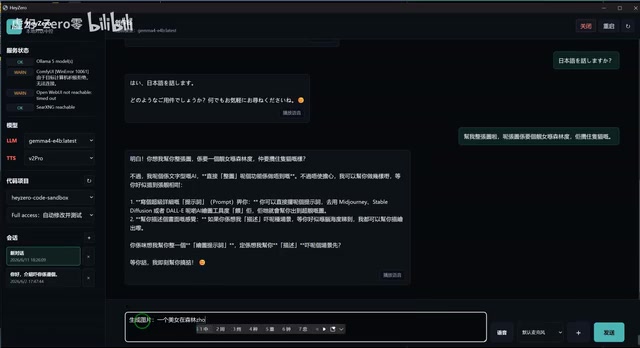
Deploying a Multimodal AI Agent Locally on a 3080Ti: VRAM Management and a Deep Dive into All Five Modules
A detailed guide to deploying a multimodal AI Agent on a 3080Ti with 12GB VRAM, covering LLM, STT, TTS, image and video generation module selection, dynamic VRAM loading, and real-world performance.
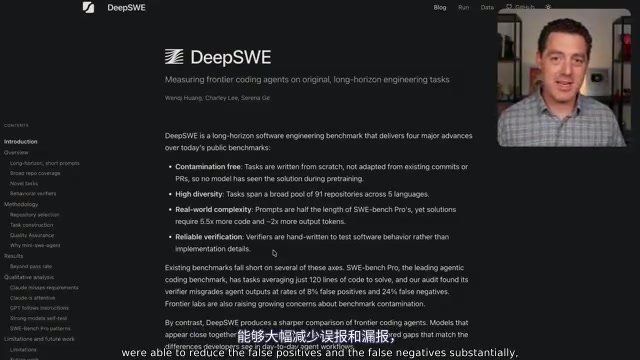
DeepSWE Benchmark Reveals the Truth: GPT 5.5 Leads Opus 4.7 by a Wide Margin
DeepSWE long-horizon benchmark shows GPT 5.5 leads Opus 4.7 by 15+ points with 70% pass rate at one-third the cost. Deep dive into contamination-free testing and AI coding implications.