Grill Me Skill: Let AI Interrogate You to Rapidly Extract Tacit Knowledge and Boost Project Efficiency
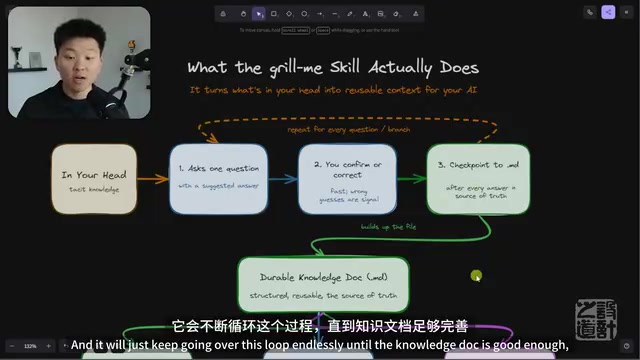
Grill Me lets AI systematically interrogate you to extract tacit knowledge and dramatically improve project outcomes.
The Grill Me skill is a simple yet powerful prompt that turns AI into a relentless interviewer, extracting tacit knowledge through Socratic questioning. Enhanced with checkpoint mechanisms that save insights to external documents, it overcomes context window limitations and builds continuously evolving knowledge bases. By front-loading thorough requirements extraction, it boosts first-iteration success rates from ~70% to ~90%, embodying the principle that context quality determines AI output quality.
Core Philosophy: Context Quality Determines AI Output Quality
When everyone is using the same model (say, Claude Opus 4), identical prompts naturally produce identical outputs. The real differentiator isn't the model itself—it's the context you inject into it: your aesthetics, tone, and decision-making logic.
This philosophy is known in the AI field as "Context Engineering." Unlike traditional Prompt Engineering, Context Engineering focuses not just on designing prompts for a single conversation, but on how to systematically build, manage, and optimize all information fed to a large language model—including system prompts, conversation history, external knowledge bases, user preference profiles, and other multi-layered information. When two people use the same model but get drastically different results, the difference usually lies in the richness and precision of their context.
This creator spent months distilling all his knowledge into what he calls an "AiOS" system. He found that the biggest challenge has always been information extraction: how to systematically funnel the tacit knowledge in your head into an AI system, letting skills invoke it and continuously optimize context quality.
The concept of Tacit Knowledge was first proposed by philosopher Michael Polanyi, referring to experiential knowledge that's difficult to articulate explicitly—like a senior designer's intuitive judgment of what "looks good," or an operations expert's prediction of user behavior. We all possess vast amounts of such knowledge, but when asked "how do you make decisions," we often can't explain clearly. Systematically extracting and encoding this type of knowledge into AI-understandable formats is one of the core challenges in AI application deployment today.
This brings us to today's protagonist—the Grill Me skill.
What Is the Grill Me Skill
Origin and Core Logic
Grill Me was originally developed by Matt Pocock. Matt is a well-known educator and developer in the TypeScript community, famous for his TypeScript tutorials and open-source contributions. He developed this skill against the backdrop of rapidly proliferating AI-assisted coding tools (like Claude Code, Cursor, GitHub Copilot)—tools that transformed how developers work but also exposed a critical problem: the quality of AI-generated code is highly dependent on the precision of requirement descriptions.
Grill Me is essentially an extremely simple prompt, just 4-5 sentences:
- Grill me on every aspect of this plan until we reach consensus
- Go deep down every branch of the decision tree
- Resolve dependencies between decisions one by one
- Provide your recommended answer with each question
- Ask only one question at a time
- If a question can be resolved by looking at the codebase, just go look at the codebase
The instruction to "go deep down every branch of the decision tree" borrows from decision tree analysis in decision science. A decision tree is a structured tool that breaks complex decisions into a series of binary or multi-choice selections, where each node represents a decision point and each branch represents a possible choice path. In AI systems, this structured knowledge representation shares similarities with Knowledge Graphs—both organize scattered information into logically connected network structures, enabling AI to reason and retrieve along relationship chains.
The elegance of this design lies in: A skill doesn't have to be a super complex automated workflow—it can simply be a prompt you don't want to type out every time. At its core, Grill Me is a "requirements elicitation" tool that uses the Socratic Method to help users transform vague ideas into precise specifications. The essence of Socratic questioning isn't providing answers, but helping the other person discover gaps and contradictions in their own thinking through layered inquiry.
What Problem Does It Solve
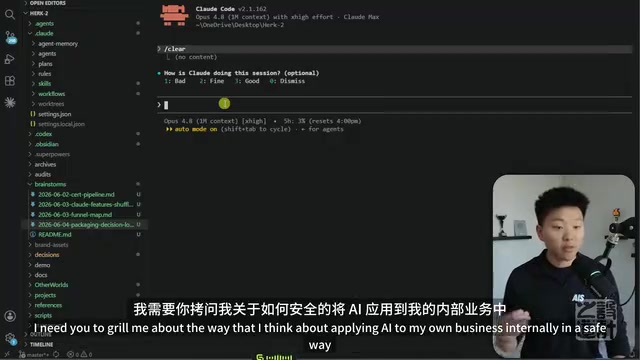
Many people might think "spending 5 minutes dumping ideas into Claude Code is good enough," but in reality, it's never enough. Grill Me's purpose is to continuously ask you questions, interrogating you until it fully grasps every detail of the entire workflow. This is the difference between a 95% success rate system and an 80% success rate system.
Especially when serving clients, you need to keep probing for process details—probing to the point where the other person might get irritated. This is precisely what must be done—and Grill Me lets AI play the role of this "annoying interrogator." Humans in social settings often stop asking questions out of concern for the other person's feelings, but AI has no such psychological burden. It can tirelessly dig into every detail until information is completely exhausted.
Improved Grill Me: Adding Checkpoint Mechanisms
Why Checkpoints Are Needed
The original Grill Me has a problem: if you're being grilled continuously for over an hour (which does happen), as the context window gradually fills up, the AI might misremember your earlier answers.
This involves an important technical limitation of large language models. The Context Window is the maximum text length a model can process at once—for Claude, this can reach 200K tokens (approximately 150,000 words). Although the window is large, research shows models exhibit a "Lost in the Middle" phenomenon—when context becomes too long, the model's attention to middle portions drops significantly, favoring content at the beginning and end. This means in a conversation spanning tens of thousands of words, a critical answer you gave at minute 15 might be "forgotten" or confused by minute 50.
The creator found himself manually telling the AI "write this to a document," creating a checkpoint each time. So he integrated this functionality directly into the skill.
Improved Workflow
The improved Grill Me skill will:
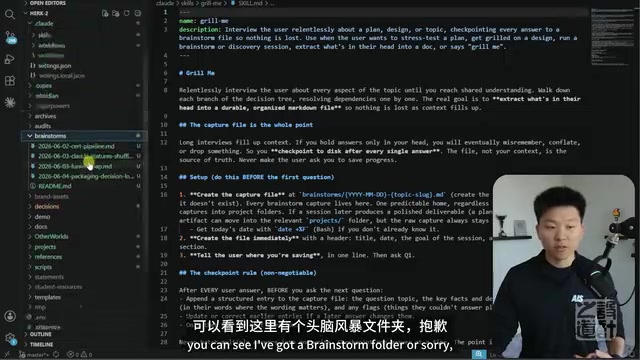
- Automatically create a brainstorm folder: placed in the project root directory
- Generate Markdown files: containing key decisions, complete Q&A steps, question logs, answer records, and key takeaways
- Set up discovery notes: summarizing key decisions, Q&A logs, and open flags
- Flag knowledge gaps: when it discovers you can't fully explain a certain process, the system flags content that requires reaching out to relevant stakeholders for information
After each answer, the AI establishes a checkpoint, writes all content back to the knowledge document, then continues the loop until the knowledge document is sufficiently complete with no knowledge gaps remaining.
This checkpoint mechanism is essentially an "external memory" strategy, similar to the knowledge base update mechanism in RAG (Retrieval-Augmented Generation) architecture. RAG is one of the most mainstream architectures in current AI applications, with the core idea of letting models retrieve from external knowledge bases when generating answers, rather than relying solely on parameterized knowledge learned during training. Grill Me's checkpoint mechanism writes newly generated knowledge from conversations into external documents in real-time, ensuring that even if the conversation exceeds the model's effective attention range, critical information won't be lost.
The Mathematical Logic of Efficiency Gains
Traditional Iteration vs. Grill Me Iteration
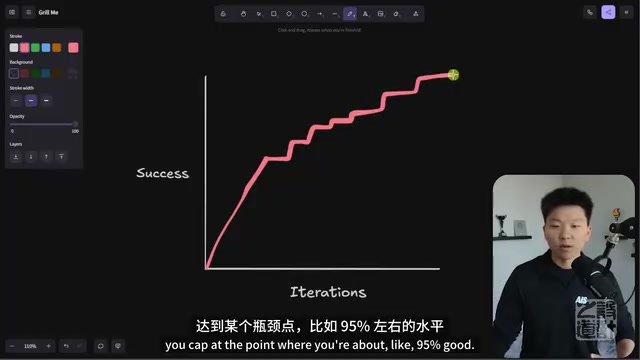
The creator used a simple diagram to illustrate the efficiency difference:
Traditional approach:
- First iteration: ~70% success rate
- Each small improvement: ~5% gain
- Requires 10-30 iterations to reach a stable 95% level
Using Grill Me:
- First iteration: jumps directly to ~90% due to thorough preparation
- Still requires some iterations, but reaches the target faster
- More opportunities to find better iteration paths
This efficiency difference can be understood through the classic "defect cost curve" in software engineering. IBM's Systems Sciences Institute discovered as early as the 1980s that the cost of finding and fixing a defect at the requirements stage is 1x, at the design stage 5x, at the coding stage 10x, at the testing stage 15x, and in production as high as 100x. Grill Me essentially front-loads "requirements validation" to the earliest stage of a project, ensuring requirement completeness and consistency through exhaustive questioning. This aligns with the "Spike" (technical probe) concept in agile development and the "hypothesis validation" philosophy in lean startup—all using low-cost early exploration to avoid high-cost late-stage rework.
This brings to mind the classic analogy: "If I had 6 hours to chop down a tree, I'd spend 4 hours sharpening the axe." Upfront preparation may indeed be tedious and repetitive, but it's a necessary process for obtaining complete context, dramatically improving the efficiency of subsequent workflows.
Practical Application Scenarios
Continuously Evolving Knowledge Base
The creator demonstrated a real case: when a grilling session about "packaging" concluded, the AI proactively suggested, "I noticed you have packaging guidelines and a packaging skill, but many details we discussed aren't included in them—would you like to update them?" This ability to proactively identify knowledge gaps keeps the entire system continuously evolving.
He also conducted a comprehensive business review: "I want you to fully understand every detail of this business," then walked through all decisions and processes from start to finish. The result was that the entire operating system gained a deeper understanding of how the business operates.
This "continuously evolving knowledge base" pattern is known in knowledge management as a "Living Document" strategy. Unlike traditional one-time document writing, living documents are continuously updated as the business develops and new information is acquired. Combined with AI's proactive detection capabilities, the system can automatically identify gaps between existing documentation and actual operations, forming a positive feedback loop: more usage → more knowledge gaps discovered → more complete documentation → higher AI output quality → more usage.
Flexible Usage Patterns
- You can ask 5 questions or 30, until both parties feel they've reached the same level of knowledge
- All content is saved as documents, available for review and updates at any time
- When there's a major breakthrough, you can return to the document and say "quiz me again, here's something new I discovered"
Key Insight: Front-Loading Investment for Long-Term Returns
The creator admits he believes skills will never reach 100% perfection, because as the business develops and personal growth continues, skills keep evolving. Skills he's been using for months are still being frequently adjusted.
But the core philosophy is clear: Rather than repeatedly patching things later, invest time upfront for thorough knowledge extraction. The Grill Me skill is precisely the efficient tool for achieving this goal—it transforms "asking yourself questions," an action that should be proactively done by humans, into an AI-driven systematic process.
From a broader perspective, Grill Me represents a new paradigm in human-AI collaboration: AI is no longer just a passive executor but an active knowledge facilitator. It leverages two unique advantages of AI—tireless patience and systematic thinking structures—to compensate for humans' natural weaknesses in knowledge externalization (tendency to omit, vague expression, lack of systematicity). This "AI as thinking coach" model may become a standard tool for future knowledge workers.
For anyone looking to build AI-assisted workflows, this simple yet powerful skill is worth trying immediately.
Related articles

AI Aggregator Platforms Tested: A Complete Guide to Using GPT 5.5 and Other Top Models for Free
A hands-on guide to using GPT 5.5, Gemini 3.1 Pro, and Grok 4.2 for free via AI aggregator platforms, covering cross-model context memory, account pool mechanisms, and key security risks.
Vibe Coding in Practice: A Junior Student Uses Cursor to Build a Multi-Agent System with 51 AI Officials Based on the Three Departments and Six Ministries Framework
A junior student uses Cursor and Vibe Coding to build a multi-agent system with 51 AI officials modeled on China's Three Departments and Six Ministries, featuring task distribution, approval workflows, and Token cost visualization.
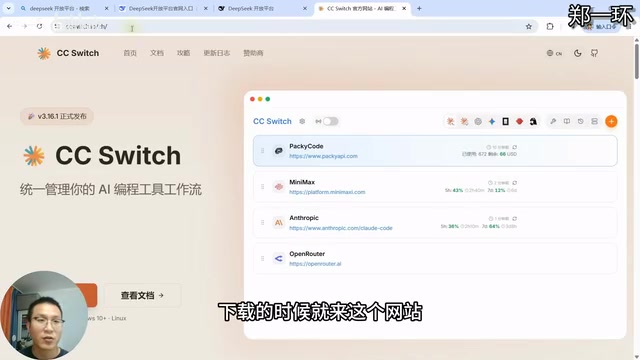
How to Connect Codex to DeepSeek Models: Free Switching via CC Switch
Learn how to connect OpenAI Codex to DeepSeek models via CC Switch, enabling free switching between DeepSeek and GPT with complete setup and routing guide.