Hermes Agent Deep Dive: An Open-Source AI Digital Worker That Learns

Hermes Agent uses a memory-skill-tool trinity to evolve AI from a Q&A tool into a learning digital worker.
Hermes Agent is an open-source agent framework by NousResearch that distinguishes itself from traditional AI chat tools through its built-in learning loop. Its dual-notebook memory system (working memory + user profile) solves the "every session feels like a new coworker" problem, its three-level skill loading system turns experience into reusable workflows, and it features a comprehensive tool system with tiered security. Supporting multi-platform integration, scheduled tasks, and multi-agent collaboration, it represents the trend of AI evolving from chat tools into digital workers.
Why an Agent Isn't Just ChatGPT with a New Name
Most people still think of AI as a "Q&A tool" — you ask a question, it gives an answer. But Hermes Agent represents an entirely different paradigm: it doesn't just answer you — it plans, takes action, and accumulates experience.
Here's an intuitive analogy: ChatGPT is like ordering at a restaurant — you say "I'll have the kung pao chicken," the kitchen makes it and serves it to you. The output quality is high, but it fundamentally revolves around single-turn input. An AI agent, on the other hand, is like grocery shopping and cooking for yourself — you just say "I want something spicy," and it breaks down the task, finds tools, executes actions, and even remembers that you don't eat cilantro.
Most AI assistants today have one very obvious pain point: every session feels like onboarding a new coworker. You open a new conversation and have to re-introduce who you are, what the project is, and what your preferences are. The formatting you dialed in last time, the pitfalls you encountered, the server details — none of it automatically becomes long-term knowledge.
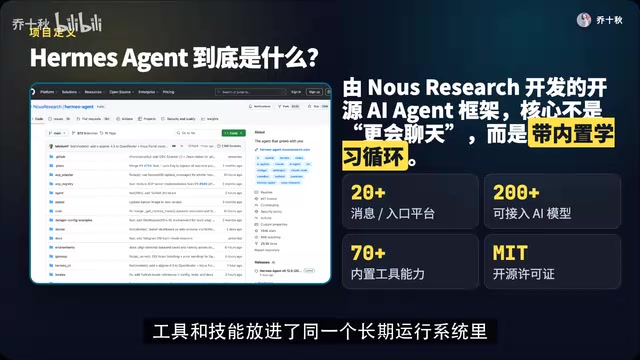
Hermes Agent was built to solve exactly this problem. It's an open-source agent framework developed by NousResearch, and its core value isn't "better conversation" — it's a built-in learning loop that puts memory, tools, and skills into a single long-running system.
The Memory System: A Two-Notebook Design Philosophy
Working Notes and User Profile
Hermes Agent's memory system can be understood as two notebooks:
- memory.md (Working Notes): Records project information, tech stack, lessons learned, server configurations, and common workflows
- user.md (User Profile): Records your role, preferences, preferred formats, and things to avoid
What should be remembered? "I prefer TypeScript" should go into the user profile; "This server runs Ubuntu with Docker installed" should go into working memory; when you correct it with "don't use sudo," that's also worth remembering. What shouldn't be stored? General knowledge easily found online, temporary debug logs, one-off throwaway messages, and outdated context.
A good memory system doesn't store everything — it knows what's worth keeping long-term.
History Search: The Ability to Look Things Up
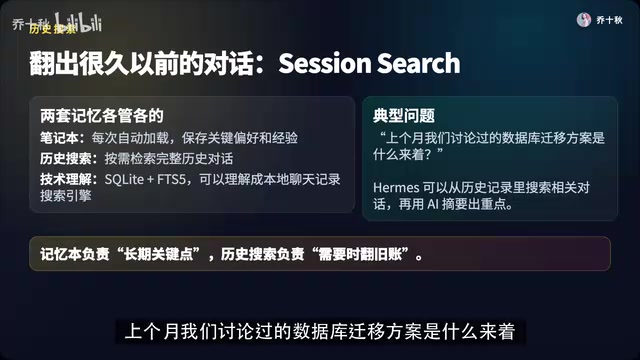
The two notebooks only save key points, so what about historical conversations that weren't written down? That's where Session Search comes in — think of it as a local chat history search engine.
For example, if you ask "What was that database migration plan we discussed last month?", Hermes Agent can search through historical records for relevant conversations and then use AI to summarize the key points. The notebooks handle long-term essentials; history search handles digging up the past when needed.
The Skill System: Turning Experience into Reusable Workflows
Skills Aren't Apps — They're Operating Manuals
A Skill in Hermes Agent is more like an operating manual that tells the agent what steps to follow when it encounters a certain type of task. When might a Skill be generated? After completing a complex reusable task, after hitting pitfalls and finding the correct approach, or after you've corrected its method.
Its core value is turning something done once into a reusable workflow for next time.
Three-Level Loading: A Clever Token-Saving Design
Skills also have a very practical design — a three-level loading mechanism:
- Level 0: Only see the name and description — like reading just the book title and blurb
- Level 1: Open the full content only when actually needed
- Level 2: View reference files and attachments when further detail is required
Most of the time you don't need to stuff all skills into the context window. Instead, they expand on demand — which is critical for controlling token consumption.
The Tool System and Security Boundaries
The tool system is Hermes Agent's "hands" — it can read/write files, execute terminal commands, search the web, operate a browser, update memory, invoke skills, and connect to external systems via MCP (such as GitHub, databases, or internal enterprise services).
But the more powerful the tools, the more important security becomes. Hermes Agent implements a tiered design here: dangerous commands require approval by default, and catastrophic commands are forcibly blocked. This "capability with constraints" design philosophy is a necessary condition for agents moving into production environments.
From Zero to Functional: A Practical Deployment Guide
Installation and Configuration
The core is a single installation command, then launching Hermes Agent. The first launch typically guides you through selecting a model provider, configuring your API key, enabling tools, and setting up messaging platforms.
An important reminder: server costs and model API costs are two separate things. A $5 cloud server is just the runtime environment — it doesn't mean calling the LLM is free.
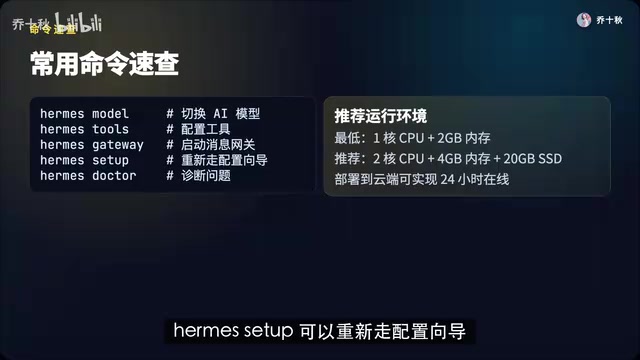
Common commands are very concise:
hermes model: Switch modelshermes tools: Configure toolshermes gateway: Start the messaging gatewayhermes setup: Re-run the configuration wizardhermes doctor: Diagnose issues
The recommended environment doesn't need to be extravagant — two cores, 4GB RAM, and 20GB disk is enough to cover most personal use cases.
Three Real-World Use Cases
Personal Knowledge Butler: Helps you organize notes, documents, and meeting records, continuously optimizing output quality based on existing memory.
24/7 Online Assistant: Once deployed to the cloud, you can check server status, daily reports, and alerts from your phone at any time. Supports integration with Telegram, Discord, Slack, WhatsApp, DingTalk, Feishu, WeCom, and over ten other platforms.
Content Creation Partner: Remembers your writing style and rewrites papers, news, or project materials into versions for WeChat Official Accounts, Xiaohongshu, Twitter, and more.
The common thread: instead of starting from scratch every time, it reuses preferences and workflows that have already been accumulated.
Advanced Practice: Custom Skills and Multi-Agent Collaboration
Writing Custom Skill Templates
Why write custom skills by hand? Because auto-generated Skills aren't always precise, and handwriting lets you control every step. A good Skill template typically contains four sections:
- When to use: Explains when it should be triggered, avoiding false activations
- Procedure: Clearly documents the specific steps
- Pitfalls: Records common traps, such as unconfigured paths or timezone errors
- Verification: Explains how to confirm the result is correct
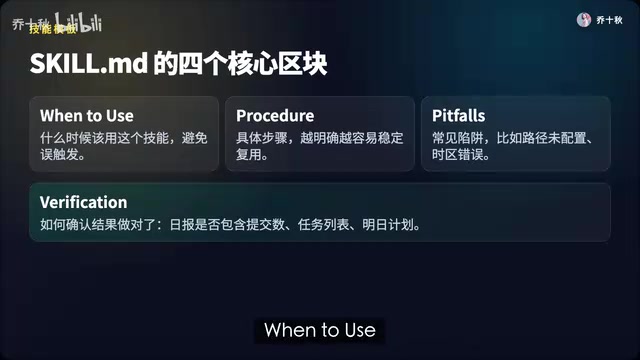
The more explicit the skill, the more reliably it can be reused. Its essence is writing team standard procedures into manuals that the agent can reuse.
Scheduled Tasks and Multi-Agent Parallelism
Scheduled tasks let the agent work automatically. You can simply say in natural language: "Every morning at 9 AM, check Hacker News for AI news, compile a summary, and send it to Telegram." Real-world scenarios include daily work reports, competitor website monitoring, server health checks, and AI news aggregation.
Multi-agent parallelism splits a large task across multiple isolated task threads. For example, you say "Help me simultaneously research competitor pricing, organize user feedback, and write a product weekly report." It doesn't clone multiple personalities — instead, different subtasks execute independently, with results consolidated at the end. This reduces mutual interference and improves processing efficiency for complex tasks.
Honest Assessment: Strengths and Risks Coexist
Hermes Agent's advantages are clear: built-in learning loop, open-source and free (MIT license), numerous entry platforms, flexible model integration, and a complete tool and skill ecosystem. It supports 20+ messaging entry points, 200+ simulation frameworks, 20+ model integrations, and 70+ tool capabilities.
But the risks need to be acknowledged:
- Plagiarism controversy still lacks an authoritative conclusion
- Memory limits are not large and require careful management
- Native Windows support is still in early stages
- Rapid iteration may introduce instability
- There's a certain barrier for non-technical users
Conclusion
The trend Hermes Agent represents is: AI is evolving from a chat tool into a digital worker. It doesn't just answer questions — it remembers key preferences. It doesn't just execute commands — it accumulates reusable experience. It doesn't just work at your computer — it stays online long-term across multiple platforms.
For developers and tech enthusiasts who want to experience the next generation of open-source agents, Hermes Agent's memory-skill-tool trinity architecture provides a reference implementation well worth deep exploration. It may not be perfect yet, but the direction it points toward — transforming AI from a "disposable tool" into a "continuously growing collaborative partner" — is undoubtedly the right one.
Related articles
 Deep Dives
Deep Dive into How OpenClaw (Open-Source Crayfish) AI Agent Works
Deep analysis of OpenClaw AI Agent internals: System Prompt, tool calling, SubAgents, Skill system, memory, and Context Engineering explained.
 Deep Dives
Demystifying Transformer: A Word-Continuation Function, Deconstructed
Understand Transformer through the lens of word continuation. Breaking down language generation into Embedding, Transformer Block, and Probability output modules for intuitive understanding.
 Deep Dives
Five Core Differences Between Claude Code and Regular AI Chat
A detailed comparison of Claude Code vs regular AI chat across five dimensions: interaction, context understanding, execution, memory, and tool integration.