Hermes Agent Practical Guide: From Installation to Feishu Integration
Hermes Agent Practical Guide: From Ins…
Hermes Agent is a multi-modal AI coding agent supporting CLI, SDK, and Feishu integration.
Hermes Agent is a developer-oriented AI coding agent framework supporting CLI, Python SDK, and Feishu integration. Its core architecture includes an AI Agent engine, Skill extension mechanism, and MCP protocol integration layer for task understanding, planning, and automated execution. The article demonstrates Hermes' practical value through three hands-on cases: Feishu team collaboration, AI news push bot, and Python SDK integration.
What is Hermes Agent?
Hermes Agent is a rising AI coding agent tool. It can run as a standalone CLI tool, integrate into existing projects as a Python library, or connect with enterprise collaboration platforms like Feishu (Lark) to build automated workflows. For engineers looking to incorporate AI coding capabilities into their daily development, Hermes offers a fairly complete solution.
This article is based on a systematic Hermes hands-on course, covering its core architecture, installation, configuration, and typical use cases to help developers get started quickly.
Background: What is an AI Agent? AI Agents represent a major evolution in large language model applications. Unlike traditional single-turn Q&A AI, Agents can autonomously plan, invoke tools, and execute multi-step tasks. Their core architecture typically includes a perception layer (receiving input), a reasoning layer (task decomposition via LLM), and an execution layer (calling external tools). Since 2023, with the proliferation of powerful foundation models like GPT-4 and Claude, and frameworks like LangChain and AutoGPT, AI Agents have rapidly moved from lab concepts to engineering practice. Hermes is a developer-oriented, practical Agent framework born from this wave.

Hermes Architecture Overview
The best way to understand a tool is to see the big picture first. Hermes Agent's architecture can be broken down into three layers:
Core Engine Layer
At its foundation, Hermes is an AI Agent engine responsible for task understanding, planning, and execution. It supports multiple LLMs and extends its capabilities through a Skill mechanism. Developers can define different Skills to make Hermes more specialized in specific domains.
The Technical Essence of Skills: Hermes' Skill mechanism is essentially a combination of structured Prompt Engineering and tool binding. Each Skill defines behavioral specifications for a given scenario, including system prompts, available tool sets, and input/output format constraints. This shares the same design philosophy as OpenAI's Function Calling and Anthropic's Tool Use. Through modular Skill design, developers can encapsulate domain knowledge into reusable configurations, avoiding repetitive context descriptions and significantly improving Agent stability and expertise in vertical scenarios.
Interface and Integration Layer
Hermes offers multiple usage modes: CLI, desktop client, Python SDK, and integration interfaces with platforms like Feishu. This multi-layered interface design makes Hermes suitable for both individual developers working in the terminal and teams deploying on collaboration platforms.
MCP Services and Extension Layer
Hermes supports MCP (Model Context Protocol) services, connecting to external tools and data sources to greatly expand its capabilities. Combined with the Skill mechanism, developers can build feature-rich automated workflows.
MCP Protocol Background: Model Context Protocol (MCP) is a standardized open-source protocol proposed by Anthropic in late 2024, designed to solve interoperability issues between AI models and external tools/data sources. Before MCP, every AI application needed custom integration for each tool, resulting in high maintenance costs. MCP defines a unified client-server communication specification, enabling any MCP-compatible AI system to plug-and-play with file systems, databases, API services, and other external resources. Hermes' native MCP support means developers can directly leverage hundreds of existing service connectors in the MCP ecosystem.
Installation and Basic Configuration
Installing Hermes
Hermes offers both CLI and desktop installation options. The CLI version suits developers comfortable with terminal operations; the desktop version provides a graphical interface with a lower barrier to entry.
Configuring the LLM
Hermes requires an underlying LLM configuration to function. The course covers how to configure a Slim Model, allowing developers to choose appropriate models based on their needs and resources, balancing inference performance against API costs.
Lightweight Model Trade-offs: In AI Agent scenarios, model selection directly impacts response speed and operational costs. Lightweight models like GPT-4o mini, Claude Haiku, and Qwen-turbo have significantly lower parameter counts and inference latency than flagship models, yet can handle most structured tasks and code generation needs. For high-frequency automated workflows (such as scheduled news pushes), lightweight models can reduce API costs by 60%-80%, making them a common choice in engineering practice.
Building Skills
Skills are Hermes' core extension mechanism. By defining Skills, you tell Hermes how to act in specific scenarios—which tools to call and what rules to follow. Think of it as writing a detailed "job description" for an AI assistant—defining responsibilities, workflows, and output standards so the Agent can reliably execute tasks without supervision.

Hands-on: Feishu Integration for Team Collaboration
Integrating Hermes with Feishu is a highly practical scenario. Once connected, team members can interact with Hermes directly in Feishu group chats for code queries, task assignments, and information retrieval—no need to switch to a terminal.
This integration is especially suited for:
- Team collaboration: Invoke AI capabilities directly in group chats, reducing communication overhead
- Non-technical users: Product managers and operations staff can interact with AI using natural language
- Automated notifications: Automatically push AI processing results to designated groups
Enterprise IM Bot Technical Principles: Enterprise platforms like Feishu, DingTalk, and Slack all provide open Bot APIs, allowing third-party applications to receive message events and reply via Webhooks or persistent connections. The core of Hermes' Feishu integration is: listen for Feishu message events → forward user messages to the Agent engine → write Agent output back to the conversation via Feishu API. This "message bus + Agent processing" architecture seamlessly embeds AI capabilities into existing team communication habits, significantly lowering the adoption barrier.
Hands-on: Building an AI News Push Bot
This is a highly practical project from the course—building an AI news push bot with Hermes.
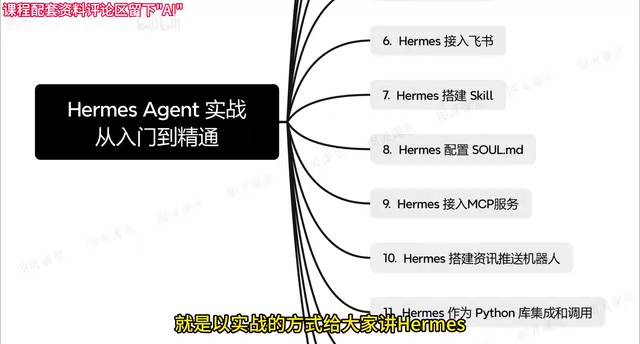
Core Features
The bot's core logic: periodically crawl trending AI news, filter and summarize it through Hermes' AI capabilities, then automatically push to channels like Feishu groups. The entire process requires no manual intervention, achieving fully automated information delivery.
Technical Highlights
- Scheduled triggers: Execute news crawling at configured intervals via scheduled tasks
- Smart filtering: Leverage Hermes' AI to select high-quality content from massive information streams
- Formatted output: Organize raw information into structured push messages
- Multi-channel distribution: Support pushing to Feishu groups, WeChat groups, and other platforms
This project effectively demonstrates Hermes' value in automated workflows—it's not just a coding assistant, but an AI agent capable of independently executing complex tasks. From information gathering to content processing to distribution, the entire pipeline embodies the complete Agent loop of "perceive-reason-execute."
Hands-on: Python SDK Integration into Existing Projects
Hermes can be directly integrated into existing projects as a Python library, providing developers with great flexibility.
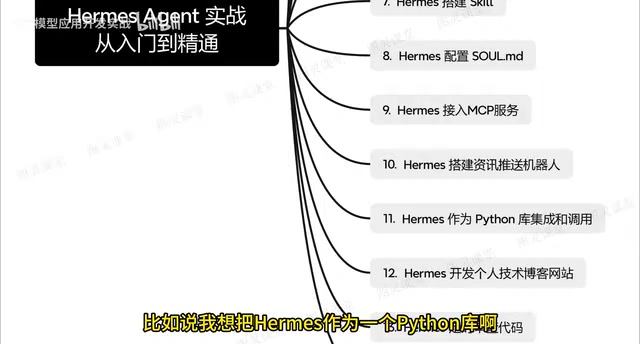
Through the Python SDK, developers can invoke Hermes' AI capabilities within their own applications, for example:
# Example: Integrating Hermes into a project
import hermes

# Initialize Agent and execute a task
agent = hermes.Agent()
result = agent.run("Analyze performance bottlenecks in this code
Related articles
 Tutorials
Cursor + Codex Dual-IDE Collaboration: A Practical Methodology for Open-Source Project Customization
A complete methodology for open-source project customization based on real-world experience, detailing the Cursor+Codex dual-IDE workflow, seven-stage process, MVP validation, and AI source code reading techniques.
 Tutorials
Cursor Multi-Agent in Practice: Building a Full-Stack Next.js Blog in 50 Minutes
Build a full-stack blog in 50 minutes using Cursor IDE's multi-Agent mode with Next.js, Clerk auth, and Supabase. Learn the 4-phase AI Agent workflow and key integration pitfalls.
 Tutorials
Building an AI Software Factory from Scratch: A Cursor Engineer's Hands-On Experience with Multi-Agent Collaboration
Cursor engineer Eric shares practical insights on building an AI software factory: automation levels, guardrail design, parallel Agent management, and scaling to 1000+ Agents for 24/7 development.