Hermes Agent in Practice: A Complete Breakdown from ReAct Loop to Autonomous Skill Evolution

Hermes Agent achieves autonomous decision-making via ReAct loops with memory and Skill evolution capabilities.
This article covers four progressive hands-on cases with Hermes Agent: terminal ReAct loop execution, Feishu platform integration, four-layer persistent memory architecture, and three-stage autonomous Skill evolution. The fundamental difference between Agents and chatbots is that Agents actually execute tasks rather than just generating text. The Skill system adopts Extraping's open standard enabling cross-platform migration to Claude Code or Cursor, with 122 verified Skills available and native DeepSeek support reducing costs for Chinese developers.
Agent Isn't Just Chatting — It's Actually Getting Work Done
Give an Agent a single instruction, and it reads source code, checks dependencies, inspects security configurations, then delivers a complete project analysis report in 90 seconds — 32 tool calls throughout the entire process, all autonomously decided by the Agent with no pre-scripted workflow. This is the capability Hermes Agent demonstrates: based on the ReAct loop (Think → Select Tool → Execute → Observe), cycling repeatedly until the task is complete.
The fundamental difference from a chatbot is this: it doesn't just reply with text — it actually does the work. A Chatbot is essentially an "input-output" text generation system whose capabilities are confined to the language layer — answering questions, generating copy, translating text — but it cannot truly operate external systems. An Agent possesses a complete "perceive-decide-execute" closed loop: it can perceive environmental state (such as reading the file system or querying APIs), make autonomous decisions based on objectives (selecting tools and execution order), and genuinely change the state of the external world through tool calls (such as writing files, sending requests, or modifying configurations). From a computer science perspective, an Agent is closer to an autonomously running software process, while a Chatbot is more like an interactive text interface.
This article is based on a B-site (Bilibili) creator's comprehensive Hermes Agent hands-on course, distilling the core takeaways from four progressively advanced practical cases to help readers understand the complete path from basic Agent operation to autonomous evolution.
Four Progressive Cases: From Beginner to Advanced
Case 1: Terminal Agent — Watch the ReAct Loop Run in Real Time
The first case is the most fundamental and intuitive: running Hermes Agent in the terminal and directly observing the complete execution of the ReAct loop.
ReAct (Reasoning + Acting) is the dominant Agent architecture paradigm today, first proposed by Google Research and Princeton University in their 2022 paper. Its core innovation lies in interweaving the large language model's reasoning capability (Chain-of-Thought) with external tool-calling capability (Action), forming a closed-loop decision system. Before ReAct, the industry mainly had two approaches: one was the pure reasoning route (like CoT), where the model only performed internal logical deduction but couldn't interact with the external environment; the other was the pure action route (like early tool-calling Agents), where the model directly executed actions but lacked intermediate reasoning processes, easily losing direction in complex tasks. ReAct unifies both, letting the model "think clearly" before "taking action" at each step, and adjust subsequent strategies based on execution results. This architecture has become the underlying paradigm for virtually all mainstream Agent frameworks today (including LangChain, AutoGPT, OpenAI Function Calling, etc.).
The core process breaks down into four steps:
- Reason: The Agent analyzes the current task state and decides what to do next
- Act: Selects the most appropriate tool from the available toolset
- Execute: Calls the tool and obtains the returned result
- Observe: Analyzes the execution result and determines whether the task is complete
If the task isn't complete, it loops back to step one. Taking the project analysis report as an example, the Agent completed 32 tool calls within 90 seconds, each one the result of autonomous decision-making. This terminal-level observability allows developers to clearly understand the Agent's decision logic, laying the foundation for subsequent debugging and optimization.
Case 2: Feishu AI Assistant — Get an Agent on Your Phone in 15 Minutes
The second case moves the Agent from the terminal to Feishu (Lark), implementing an AI assistant accessible anytime on your phone. The core value of this case lies in demonstrating the Agent's platform migration capability — the core logic remains unchanged; you only need to connect different message channels.
The 15-minute setup time indicates that Hermes Agent's integration cost is quite low. For enterprise scenarios, Feishu is one of the mainstream collaboration platforms in China. Deploying an Agent to Feishu means team members can interact with the Agent directly through their everyday tools, dramatically lowering the usage barrier. This "Agent-as-a-Service" deployment model essentially exposes the Agent's capabilities as a response endpoint for message channels through Webhooks or API gateways. Feishu's open platform provides a bot message callback mechanism — the Agent only needs to listen for message events, process requests, and return results without worrying about the complexity of front-end interactions.
Case 3: Four-Layer Persistent Memory — Exit and Return, It Still Remembers You
The memory system is the key capability that evolves an Agent from a "one-time tool" into a "long-term assistant." Hermes Agent implements a four-layer persistent memory architecture, ensuring that when users exit and re-enter, the Agent still remembers the previous interaction context.
This solves a core pain point of traditional LLM applications: limited context windows and forgetting once the conversation ends. A large language model's context window typically ranges from 128K to 200K tokens, and historical information exceeding the window length gets truncated and lost. Persistent memory systems solve this limitation through external storage mechanisms. Common technical approaches include: vector databases (such as Pinecone, Milvus) for semantic retrieval of conversation history, key-value stores for saving structured user preferences, relational databases for recording task execution history, and knowledge graphs for maintaining long-term entity relationships.
The four-layer memory architecture draws partial design inspiration from the hierarchical model of human memory in cognitive science — sensory memory, short-term memory (working memory), and long-term memory each serve distinct functions, collaborating through different encoding and retrieval mechanisms. In an Agent system, this might include short-term conversation memory, user preference memory, task history memory, and long-term knowledge memory, with information of different granularities stored and retrieved at different layers. This design enables the Agent to continuously accumulate understanding of users and tasks across multiple interactions, with service accuracy improving over time.
Case 4: Three-Stage Skill Evolution — Same Type of Task Gets Faster Every Time
The Skill system is Hermes Agent's most forward-looking design. After the Agent completes a task, it can abstract the solution into a reusable Skill. The next time it encounters a similar task, it calls the Skill directly without re-reasoning from scratch. This achieves true autonomous evolution.
The Skill system's design philosophy is aligned with "design patterns" and "code reuse" in software engineering, but it elevates the level of reuse from code to workflows. Traditional automation tools (such as RPA, Robotic Process Automation) require manually written scripts to define workflows, while the Skill system lets the Agent itself distill reusable templates from successful experiences. This "learn-abstract-reuse" capability is known in academia as an engineering implementation of "Meta-Learning."
The three-stage evolution path is as follows:
- Stage 1: First-time task execution — runs the full ReAct loop with step-by-step reasoning and trial-and-error
- Stage 2: Distills the successful execution path into a Skill template, forming reusable experience
- Stage 3: Subsequent similar tasks directly match and invoke existing Skills, dramatically improving execution efficiency
From an efficiency perspective, the Agent might need dozens of tool calls and multiple rounds of trial-and-error when executing a task for the first time, while a Skill-ified version of the same task type might only require a few calls to complete. Inference costs (token consumption and API call counts) drop significantly. This mechanism allows the Agent's capabilities to continuously strengthen over time rather than starting from zero every time.
Open Ecosystem: Skills Aren't Locked Into a Single Tool
Two highlights of Hermes Agent at the ecosystem level deserve special attention:
First, there are already 122 officially verified Skills, covering scenarios like code review, LLM fine-tuning, and YouTube content extraction — ready to use out of the box. Users don't need to train an Agent from scratch; they can build directly on the community's accumulated foundation.
Second, these Skills adopt an open standard led by Extraping. The strategic significance of this far exceeds its technical significance — Skills generated in Hermes can be copied to Claude Code or Cursor and run just the same. What users accumulate isn't experience tied to a single tool, but portable workflow assets.
Vendor Lock-in is one of the core concerns enterprises have when adopting AI tools. When users accumulate large amounts of custom configurations, workflows, and experience data on a platform, the cost of migrating to another platform becomes extremely high, creating a de facto binding relationship. In the AI Agent space, this problem is particularly acute — different Agent frameworks' tool definition formats, Prompt templates, and memory storage methods are often mutually incompatible. The open standard led by Extraping attempts to establish a universal description specification at the Skill level, similar to the OCI standard in the container technology space or the OpenAPI specification in the API space, allowing workflow definitions to flow across platforms. If this standardization effort succeeds, it will catalyze a Skill-sharing ecosystem similar to npm or Docker Hub, dramatically accelerating community-driven accumulation of Agent capabilities.
In today's landscape of rapidly iterating AI tools and intense platform competition, this open-standard design philosophy is especially important. It reduces users' migration costs and ensures that the ecosystem value of Skills won't be zeroed out by the rise or fall of any single platform.
DeepSeek Direct Connection: Agent Practice with a Chinese LLM
Hermes Agent supports direct connection to DeepSeek, which is a practical signal for Chinese developers. DeepSeek, developed by DeepSeek AI, has its V3 and R1 series models performing exceptionally well in mathematical reasoning, code generation, and other tasks. In particular, DeepSeek-R1's long-chain reasoning capability trained through reinforcement learning has reached levels comparable to GPT-4o and Claude 3.5 Sonnet on multiple international benchmarks.
For Agent scenarios, the model's tool-calling capability (Function Calling) and instruction-following capability are two key metrics — Agents need the model to accurately understand tool parameter formats, correctly generate call instructions, and maintain logical consistency across multi-step reasoning. DeepSeek's support for these capabilities, combined with its API pricing advantage (typically 1/10 to 1/5 the cost of comparable overseas models), enables Chinese developers to build and run Agent systems at significantly lower costs. Additionally, using a domestic model avoids compliance risks associated with cross-border data transmission, which is particularly important for enterprise scenarios involving sensitive business data. Hermes Agent's native support for DeepSeek means Chinese developers can build complete Agent workflows without depending on overseas APIs.
Summary and Reflections
Hermes Agent's four cases present a clear Agent capability evolution path: from basic ReAct loop execution, to cross-platform deployment, to persistent memory and autonomous Skill evolution. Three trends most worth noting:
- Agents are shifting from "conversational" to "execution-oriented" — the real value lies in completing tasks, not generating text
- Memory and Skill systems give Agents "growth potential" — the more they're used, the stronger they become
- Open standards make workflow assets portable — avoiding lock-in to any single platform
For developers looking to implement Agent technology in real-world work, Hermes Agent provides a reference framework worth deep exploration. It not only demonstrates the current capability boundaries of Agent technology but also points the way from being a tool user to becoming a workflow builder.
Related articles
 Tutorials
Cursor + Codex Dual-IDE Collaboration: A Practical Methodology for Open-Source Project Customization
A complete methodology for open-source project customization based on real-world experience, detailing the Cursor+Codex dual-IDE workflow, seven-stage process, MVP validation, and AI source code reading techniques.
 Tutorials
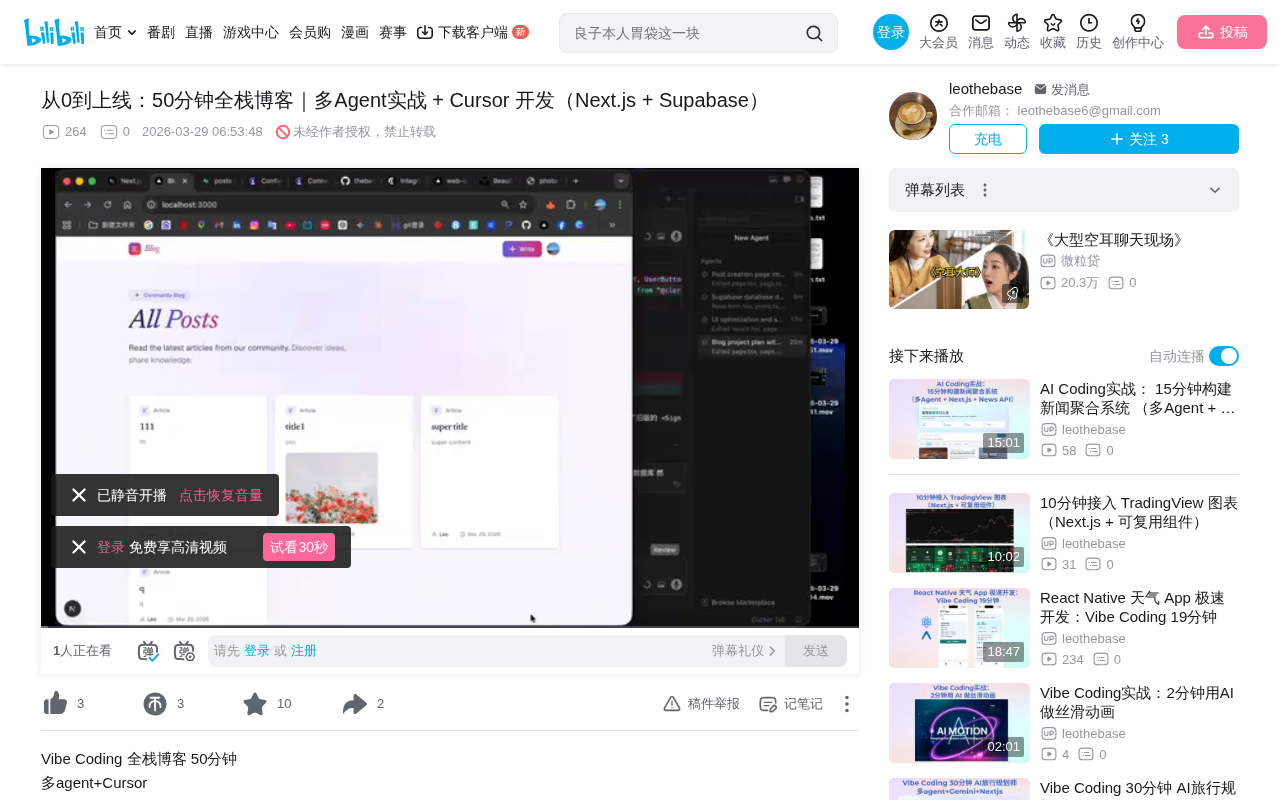
Cursor Multi-Agent in Practice: Building a Full-Stack Next.js Blog in 50 Minutes
Build a full-stack blog in 50 minutes using Cursor IDE's multi-Agent mode with Next.js, Clerk auth, and Supabase. Learn the 4-phase AI Agent workflow and key integration pitfalls.
 Tutorials
Building an AI Software Factory from Scratch: A Cursor Engineer's Hands-On Experience with Multi-Agent Collaboration
Cursor engineer Eric shares practical insights on building an AI software factory: automation levels, guardrail design, parallel Agent management, and scaling to 1000+ Agents for 24/7 development.