HiClaw Open-Source Multi-Agent Collaboration System: A New Paradigm for Human-AI Collaboration Based on the Matrix Protocol
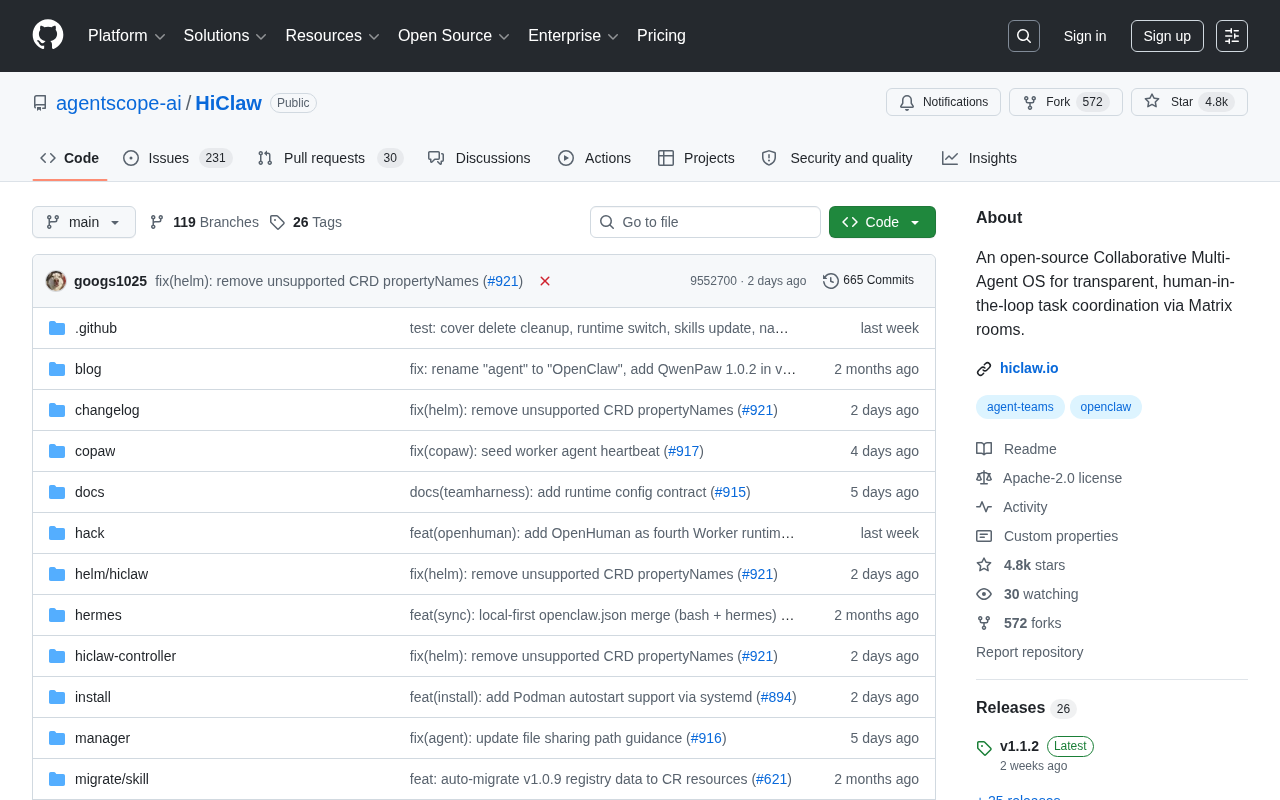
HiClaw is an open-source multi-Agent OS using Matrix protocol for transparent human-AI collaborative task coordination.
HiClaw is an open-source collaborative multi-Agent operating system built on the Matrix protocol, developed in Go by the agentscope-ai team. It implements a Human-in-the-Loop design that balances Agent autonomy with human controllability, using chat rooms as observable collaboration units. Positioned at L3 autonomy level, it fills the gap between fully autonomous and fully manual AI systems for enterprise deployment.
Project Overview
HiClaw is an open-source collaborative multi-Agent operating system developed by the agentscope-ai team, designed to enable transparent, human-involved task coordination through Matrix chat rooms. The project has garnered nearly 4,800 stars on GitHub, is developed in Go, and demonstrates a new paradigm for multi-agent systems in real-world collaboration scenarios.
In the current landscape of rapidly evolving AI Agents, most systems either run fully autonomously without sufficient controllability, or rely too heavily on manual intervention resulting in low efficiency. HiClaw attempts to strike a balance between the two—allowing multiple Agents to autonomously collaborate on complex tasks while ensuring humans remain in the decision loop, achieving both efficiency and safety. It's worth noting that this pursuit of "controllable autonomy" is not unique to HiClaw's vision, but rather a collective reflection across the entire AI Agent industry following the "full autonomy" wave of 2023-2024. From academia to industry, an increasing number of voices are emphasizing that truly deployable Agent systems must find a precise balance between autonomy and controllability.
Core Design Philosophy
Human-in-the-Loop: The Key Mechanism for Human-AI Collaboration
HiClaw's most prominent design philosophy is Human-in-the-Loop. Throughout the entire task execution process, human operators can intervene, review, and adjust Agent behavior at any time. This design is particularly critical in security-sensitive enterprise applications, effectively mitigating the potential risks of AI systems operating as "black boxes" while fully preserving the efficiency advantages of multi-Agent collaboration.
The concept of Human-in-the-Loop (HITL) originally emerged from cybernetics and human factors engineering, referring to maintaining human participation nodes within the decision or execution loop of automated systems. In machine learning, HITL is commonly seen in Active Learning scenarios—where models proactively request human annotation when encountering low-confidence samples, thereby achieving maximum model improvement with minimal annotation cost. In autonomous driving, HITL corresponds to L2-L3 level assisted driving, where the system performs most operations but humans are ready to take over at any time. Two related concepts exist: Human-on-the-Loop, where humans only supervise without directly participating in execution; and Human-out-of-the-Loop, where the system operates fully autonomously. HiClaw's choice of the HITL model essentially acknowledges that current LLM-driven Agents have not yet achieved fully trustworthy reasoning reliability, using human intervention at critical nodes as a safety net—a near-mandatory requirement in high-risk industry scenarios such as finance, healthcare, and legal.
Transparent Communication Architecture Based on the Matrix Protocol
The project chose the Matrix open protocol as its underlying communication infrastructure—a forward-thinking technical decision. Matrix is a decentralized real-time communication protocol with core features including end-to-end encryption, message persistence, and federation interoperability. Building multi-Agent collaboration on Matrix brings three key advantages:
- Full-process transparency: All inter-Agent communications can be audited and traced by humans, ensuring explainable decision processes
- Ecosystem openness: Seamless integration with existing Matrix clients (such as Element), reducing adoption costs
- Decentralized deployment: Avoiding single points of failure with native support for distributed architecture
The Matrix protocol is maintained by the Matrix.org Foundation, initially launched in 2014 by an internal team at Amdocs before becoming an independent open-source project. Its core architecture is based on the Federation Model: each organization can run its own Homeserver (such as Synapse or Dendrite), with different Homeservers synchronizing messages through the federation protocol—similar to how different email servers interoperate. This fundamentally differs from centralized communication platforms like Slack, Discord, or WeChat—in centralized solutions, all data passes through a single service provider's servers, while Matrix's federated architecture allows data sovereignty to remain entirely under the deployer's control. For this reason, Matrix has been adopted as the official communication protocol by the French government (Tchap), the German Federal Armed Forces (BwMessenger), and certain NATO institutions. HiClaw's choice of Matrix over building a custom communication layer not only inherits these large-scale validated security features, but more importantly makes every message between Agents an auditable structured record, providing natural infrastructure support for subsequent behavior analysis, fault tracing, and compliance review.
High-Performance Architecture Powered by Go
Developing in Go reflects the team's emphasis on performance and concurrency handling capabilities. Go's goroutine model is naturally suited for parallel task scheduling in multi-Agent scenarios, and the compiled language's characteristics provide excellent runtime performance—critical for scenarios requiring simultaneous coordination of large numbers of Agents.
Go's concurrency model is based on CSP (Communicating Sequential Processes) theory, proposed by computer scientist Tony Hoare in 1978. Unlike traditional multi-threading with shared memory and locks, Go achieves concurrency through goroutines (extremely lightweight coroutines with an initial stack of only about 2-8KB, compared to 1-8MB for OS threads) and channels (type-safe communication pipes), with the core philosophy of "don't communicate by sharing memory; share memory by communicating." In the multi-Agent operating system scenario, each Agent's running instance, each message's send/receive processing, and each task's state synchronization can be mapped to independent goroutines. Go's runtime scheduler (based on the GMP model) can efficiently schedule hundreds of thousands of goroutines on a small number of OS threads, enabling the system to maintain low latency and high throughput even when facing large-scale Agent concurrency. It's worth mentioning that the two cornerstones of cloud-native infrastructure—Docker and Kubernetes—are also developed in Go, which to some extent validates Go's maturity and reliability in building large-scale distributed systems.
In-Depth Technical Architecture Analysis
Core Positioning as a Multi-Agent Operating System
HiClaw positions itself as a Multi-Agent OS, meaning it's not merely a development framework or toolkit, but provides a more complete runtime environment. Similar to how traditional operating systems manage processes and resources, HiClaw uniformly manages the lifecycle, resource allocation, and inter-communication of multiple Agents, providing standardized collaboration capabilities for upper-layer applications.
The concept of a "Multi-Agent Operating System" marks the evolution of Agent infrastructure from the "framework layer" to the "platform layer." Current mainstream Agent development tools mostly remain at the framework level: LangChain provides LLM call chain orchestration capabilities, CrewAI and AutoGen provide abstractions for multi-Agent role definition and dialogue orchestration, but they are essentially still libraries or frameworks—developers must handle Agent deployment, monitoring, fault tolerance, and resource isolation on their own. An "operating system" level of abstraction means HiClaw attempts to take over these underlying concerns: just as the Linux kernel provides process scheduling, memory management, file systems, and network stacks for applications, a Multi-Agent OS provides lifecycle management (creation, suspension, resumption, termination), resource quota control (such as API call rate limiting and token consumption budgets), inter-process communication (structured message passing between Agents), and permission management (which Agents can perform which operations) for upper-layer Agent applications. This deeper system abstraction allows developers to focus on Agent business logic design while delegating the complexity of coordination, scheduling, and governance to the operating system layer. From an industry trend perspective, as the number of Agents deployed by enterprises grows from single digits to dozens or even hundreds, this operating system-level management capability will shift from "nice to have" to "must have."
Chat Room-Driven Task Coordination Model
At the task coordination layer, the system leverages the Matrix chat room concept to decompose tasks into observable collaboration units. Each task or subtask corresponds to one or more chat rooms where Agents exchange decisions, synchronize state, and report progress. This design makes originally complex multi-Agent workflows intuitive and easy to monitor.
This "chat room as workspace" design pattern essentially applies the software engineering principle of "separation of concerns" to the Agent collaboration domain. In traditional multi-Agent systems, inter-Agent communication is often accomplished through internal API calls or message queues—interactions that are invisible "dark communications" to external observers. HiClaw makes each collaboration context explicit as a chat room, bringing several deep advantages: First, it naturally achieves context isolation—Agent conversations for different tasks don't interfere with each other, avoiding information contamination. Second, the chat room's message timeline provides a complete decision audit trail, which is crucial for meeting financial industry compliance requirements (such as SOX Act, GDPR). Finally, human operators can join any task chat room just like joining a regular chat group, observing Agents' reasoning processes in real-time and sending commands to intervene when necessary—greatly reducing the cognitive barrier for human-machine interaction.
Application Prospects and Industry Value
As AI Agent technology continues to mature, market demand for enterprise-level multi-Agent collaboration systems continues to grow. HiClaw's emergence fills an important technical gap—providing a practical middle path between fully autonomous operation (such as AutoGPT-class systems) and fully manual control.
AutoGPT burst onto the scene in March 2023 as one of the earliest fully autonomous AI Agent projects to attract widespread attention. Its core concept was to give GPT-4 self-prompting capabilities: users only need to set a high-level goal, and the Agent automatically decomposes tasks, executes steps, evaluates results, and iteratively optimizes—all without human intervention. However, problems exposed during actual operation were equally prominent—Agents easily fell into infinite loops, produced hallucinatory reasoning, consumed large amounts of tokens without converging to effective results, and more seriously lacked safety boundaries when performing actual actions involving file operations and network requests. These issues spawned industry discussions about Agent autonomy levels, similar to the L0-L5 classification system for autonomous driving: L0 for purely manual operation, L1-L2 for human-led with AI assistance, L3 for AI-led with human oversight, and L4-L5 for full autonomy. Under this framework, AutoGPT attempted to jump directly to L5, while HiClaw prudently positions itself at L3—Agents autonomously execute most work, but humans maintain oversight authority and veto power over critical decisions. From an enterprise adoption perspective, L3-level systems offer the best risk-reward ratio given current technology maturity.
The project's 573 forks also indirectly confirm the developer community's strong interest in this type of solution. For enterprises needing to deploy controllable AI collaboration systems, HiClaw's open-source nature significantly lowers the barriers to technical validation and production adoption.
Conclusion
HiClaw represents an important evolutionary direction in multi-Agent system design: rather than blindly pursuing full autonomy, it prioritizes transparency and human controllability. Against the backdrop of increasing industry attention to AI safety and explainability, this human-AI collaboration-first design philosophy is likely to become the mainstream development path for enterprise-level AI Agent systems.
From a broader perspective, the technical approach represented by HiClaw aligns closely with current global AI governance policy directions. The EU's AI Act explicitly requires high-risk AI systems to have human oversight mechanisms, and the US White House's 2023 AI Executive Order similarly emphasizes AI system explainability and auditability. A multi-Agent operating system with built-in transparent communication, human intervention, and complete audit trails naturally satisfies these regulatory requirements—this will become a significant competitive advantage for HiClaw in the enterprise market.
Key Takeaways
Related articles
Five Common Claude Code Mistakes — How Many Are You Making?
Five common Claude Code mistakes developers make: copy-pasting code, skipping CLAUDE.md, inefficient prompting, ignoring docs, and poor context management — with fixes.
Andrew Ng's New Course Explained: A Practical Guide to Using OpenAI's O1 Reasoning Model
Deep dive into Andrew Ng and OpenAI's Reasoning with O1 course covering test-time scaling, new prompting paradigms, multi-model orchestration, and practical applications for developers.

Learning AI After College Entrance Exams: A Complete Path from Zero to Freelancing
How to efficiently learn AI skills during summer break after exams? A complete path from mastering prompts and hands-on projects to freelancing on platforms.