Complete Guide to Cultivating and Dominating with Four Elite Prism Tanks in Red Alert Team Battles
Complete Guide to Cultivating and Domi…
Full tactical breakdown of cultivating elite Prism Tanks to dominate in Red Alert 2 team battles.
This article analyzes an 8-player Red Alert 2 team battle, breaking down the complete tactical chain from early-game building garrison rushes and resource control, through mid-game engineer war factory captures and spy infiltration upgrades, to late-game cultivation of four elite Prism Tanks combined with Rocketeers and IFVs forming a layered defense system that overwhelms opponents—demonstrating the snowball conversion of economic, technological, and military advantages.
Introduction
In competitive matches of the Red Alert series, the Prism Tank has always been the core long-range damage unit for the Allied faction. The Prism Tank is an advanced Allied combat unit in Command & Conquer: Red Alert 2 and its expansion Yuri's Revenge, requiring a Battle Lab before it can be produced. Its weapon is based on prism technology—firing a high-energy focused light beam that deals devastating damage to targets. In terms of game mechanics, the Prism Tank boasts one of the longest attack ranges among all ground units, but has extremely weak armor, making it a classic "glass cannon." When multiple Prism Tanks focus fire on a single target, a beam stacking effect occurs, causing damage to increase exponentially.
When a Prism Tank reaches elite (three-star) veterancy, its terrifying damage output is enough to change the course of an entire battle. Red Alert 2 uses a three-tier veterancy system: Regular (no stars), Veteran (one star), and Elite (three stars). Units level up by accumulating experience from destroying enemy units. Veteran status grants increased fire rate, enhanced armor, and a slight range increase; Elite status provides massive all-around improvements, including doubled damage, further range increase, significantly enhanced armor, and self-healing capability. Infiltrating an enemy barracks or war factory with a spy grants all subsequently produced units of the corresponding type automatic veteran (one-star) status—a crucial shortcut to rapidly building elite forces.
This article provides an in-depth analysis of an exciting 8-player team battle, breaking down how tactical coordination was used to cultivate four elite Prism Tanks and steamroll the opposition to victory.
Map and Opening Strategy: Resource Warfare on the Chip Map
Map Characteristics
This match was played on an 8-player map called "A Chip," which resembles a computer chip when viewed from the satellite perspective. In the Red Alert 2 multiplayer community, map design has a decisive impact on competitive balance. The Chip map is a symmetrical 8-player map designed to create conflict focal points through central resource contestation. The map divides 8 players into four pairs, with each pair cooperating together. The center of the map features numerous gem ore patches and a key garrisonable building (fortress), and control over these resource points directly determines early-game economic advantage.
Gem ore has a much higher collection value than regular yellow ore, yielding significantly more credits per load. Controlling gem ore areas therefore means achieving several times the economic growth rate of your opponents. This map design encourages players to aggressively contest resources from the opening rather than turtling.
Opening Building Garrison Rush
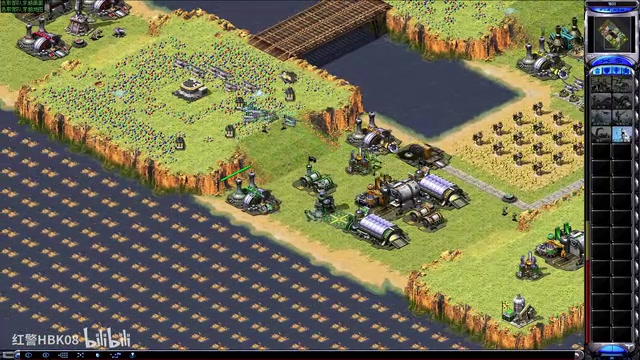
During the opening phase, the player employed the classic "dog rush for buildings" strategy:
- Producing multiple attack dogs, using their speed advantage to kill the opposing Soviet dogs first
- Teammates then sending infantry into the central fortress
- Using beacon signals to remind teammates to fully garrison the fortress, maximizing defensive firepower
Once the fortress was fully garrisoned, any enemy ore miners approaching to harvest would be destroyed, directly cutting off the opponent's access to central gem ore resources. This single move laid the foundation for the team's economic dominance throughout the game.
Mid-Game Harassment and Economic Domination
Engineer Raids to Cut Off Tank Production
After securing the central resources, the player demonstrated exceptional tactical awareness:
- Stealing the War Factory: Using an engineer to traverse the map and directly capture the pink player's war factory, preventing them from producing tanks
- Forcing base relocation: The red player was forced to pack up their MCV and flee, unable to deploy their war factory for an extended period
- Spy infiltration: Subsequently sending a spy to infiltrate the light blue player's war factory, upgrading all friendly tanks to veteran status (one star)
After a spy infiltrates an enemy war factory, all vehicle units produced from your own war factory automatically come with one-star veteran status. This means newly produced Prism Tanks start with higher fire rate, longer range, and stronger armor from the moment they roll off the assembly line, greatly reducing the difficulty of reaching elite status—since the experience required to go from one star to three stars is far less than starting from zero.
This series of harassment operations left two opposing players completely without tank production during the early-to-mid game, creating a massive military vacuum.
Building the Economic Infrastructure
By controlling the central gem ore, the player rapidly accumulated funds to construct:
- Battle Lab
- Gap Generator (counter to spy satellites)
- Multiple ore miners to expand harvesting operations
Cultivating and Deploying Elite Prism Tanks
Why Prism Tanks Need Frontline Protection
Although Prism Tanks possess terrifying long-range firepower, their fragile armor means they cannot operate alone. In numerical terms, the Prism Tank has only 150 HP (for comparison, the Soviet Rhino Tank has 400, and the Apocalypse Tank has 800), meaning even a few regular Rhino Tanks at close range can instantly destroy them. The player's core tactical philosophy was crystal clear:
"Without IFVs for protection, Prism Tanks can't hold their ground"
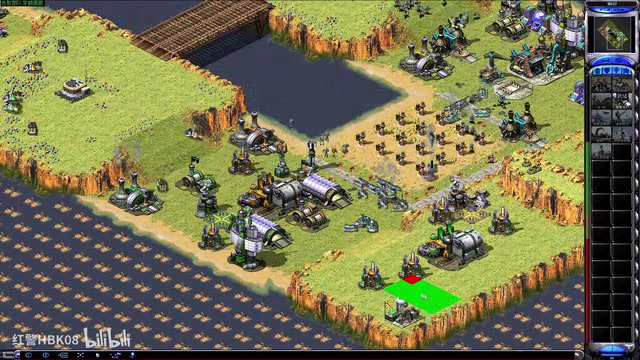
Therefore, the player first mass-produced IFVs as frontline meat shields and anti-air support, then gradually added Prism Tanks as backline damage dealers. The IFV (Infantry Fighting Vehicle) is one of the most versatile units in the Allied arsenal. When empty, the IFV comes equipped with anti-air missiles, serving as the Allies' primary mobile anti-air capability. In this article's tactical framework, IFVs serve two primary roles: providing anti-air coverage to protect Prism Tanks from aerial threats, while their relatively fast movement speed and moderate armor allow them to serve as frontline damage sponges.
Anti-Air Strategy Against Kirov Airships
Seeing the growing number of Prism Tanks, the opponents deployed Kirov Airships to attempt bombing runs. The Kirov Airship is the Soviet ultimate aerial strike unit, possessing extremely high HP and devastating bomb-dropping capability—a single Kirov can destroy a base building in short order. However, its fatal weakness lies in its extremely slow movement speed and inability to attack air units. In high-level play, Kirovs are typically viewed as a psychological pressure tool—forcing opponents to allocate significant resources to anti-air defense.
But the player had already prepared a large number of Rocketeers (including elite three-star ones). Elite Rocketeers, with their doubled damage, are extremely efficient at shooting down Kirovs, easily neutralizing the aerial threat.
Tempo Control Against the Iron Curtain
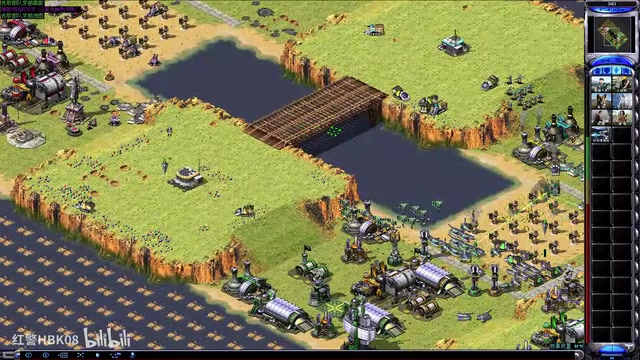
The light blue player constructed an Iron Curtain, attempting to force a push with invincible tanks. The Iron Curtain is one of the Soviet faction's superweapons. Once fully charged, it can grant brief complete invulnerability to friendly vehicles within a certain area (approximately 45 seconds duration, with about 5 minutes charge time). In practice, an Iron Curtain tank push is one of the most threatening Soviet late-game tactics—invincible Apocalypse or Rhino Tanks can ignore all firepower and directly crush enemy defensive lines.
The player's counter-strategy was textbook-perfect:
- Actively pressuring before the Iron Curtain finished charging, forcing premature use
- Immediately retreating once the opponent used Iron Curtain defensively at home
- Counter-attacking after the invulnerability effect expired
This "force Iron Curtain → retreat → counter-attack" tempo control demonstrated exceptional competitive awareness. The core philosophy of countering the Iron Curtain lies in time management: either attack during the charging period to deny the opponent the chance to use it, or immediately disengage when it's activated and wait for the effect to expire, avoiding direct engagement during the invulnerability window. The Prism Tank's extreme range played a crucial role in this tactic—it can apply pressure from maximum distance and quickly disengage when retreat is needed.
The Dominance of Four Elite Prism Tanks
Elite Among Elites: Three-Star Prism Tank Stat Advantages
After accumulating experience through multiple engagements, the player ultimately cultivated four three-star Prism Tanks plus two three-star IFVs as an elite strike force. The core advantages of elite Prism Tanks:
- Extreme range, allowing safe damage output from elevated positions
- Massive damage, instantly destroying anti-air vehicles the moment they appear
- Self-healing ability making them increasingly dominant in prolonged engagements
- Combined with Rocketeers providing vision, forming a perfect long-range strike system
From a numerical perspective, a three-star Prism Tank's attack power is doubled compared to its base state, range increases by approximately 20%, and combined with fire rate improvements, its damage per second is roughly 3-4 times that of a regular Prism Tank. The focused fire of four elite Prism Tanks, combined with the beam stacking effect, is sufficient to destroy any ground unit in a single volley—including a full-health Apocalypse Tank.
Final Push and Total Domination
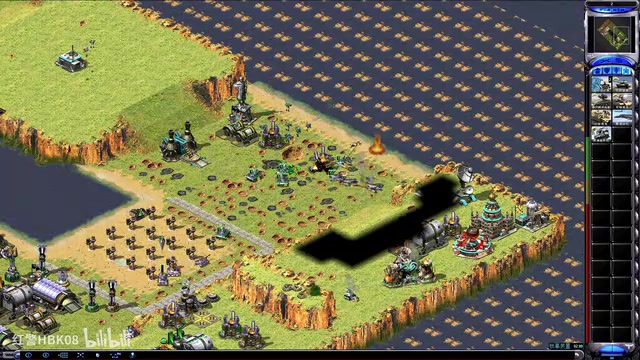
After defeating the light blue and yellow players, the player faced the remaining pink and red opponents:
- Re-garrisoning the fortress to full capacity, blocking attack routes
- Gap Generator concealing the home base, denying enemy vision
- Elite Prism Tanks positioned on high ground for continuous bombardment
- Teammate's repair vehicle maintaining Prism Tank health
Although the opponents' War Miners (armed ore trucks) could threaten Prism Tanks, they couldn't get close under the combined fire of the fortress and Rocketeers. The War Miner is a special Soviet unit that combines ore harvesting and combat functions, possessing thick armor and respectable firepower that poses a serious close-range threat to fragile Prism Tanks. However, under this match's layered defense system—fortress providing forward firepower, Rocketeers providing vision and supplementary damage, IFVs serving as a buffer layer—War Miners simply couldn't breach the multiple defensive lines to reach the Prism Tanks' firing range. Pink and red ultimately surrendered in succession, as the elite Prism force completed a dominant performance.
Tactical Summary: A Complete System from Resource Control to Total Domination
This match's victory wasn't simply due to the Prism Tank's raw power, but rather a complete tactical system:
- Early-game building garrison and resource control: Using the fortress to lock down enemy economy
- Mid-game harassment and production denial: Engineer captures of war factories, spy infiltration for tech upgrades
- Late-game elite domination: Three-star Prism Tanks + Rocketeers + Fortress forming a layered defense
The essence of this tactical system lies in the "snowball" effect—early economic advantage converts into mid-game technological advantage, and mid-game technological advantage (spy upgrades) accelerates the cultivation of late-game elite forces. Every phase accumulates advantages for the next, forming a clear path to victory.
As the player said, these three-star Prism Tanks are "the elite among elites"—they represent not only the maximum combat power of the unit, but also the accumulated tactical advantages built throughout the entire match. Behind every elite tank lies the crystallization of countless precise micro-management decisions and strategic choices.
Related articles
 Tutorials
Cursor + Codex Dual-IDE Collaboration: A Practical Methodology for Open-Source Project Customization
A complete methodology for open-source project customization based on real-world experience, detailing the Cursor+Codex dual-IDE workflow, seven-stage process, MVP validation, and AI source code reading techniques.
 Tutorials
Cursor Multi-Agent in Practice: Building a Full-Stack Next.js Blog in 50 Minutes
Build a full-stack blog in 50 minutes using Cursor IDE's multi-Agent mode with Next.js, Clerk auth, and Supabase. Learn the 4-phase AI Agent workflow and key integration pitfalls.
 Tutorials
Building an AI Software Factory from Scratch: A Cursor Engineer's Hands-On Experience with Multi-Agent Collaboration
Cursor engineer Eric shares practical insights on building an AI software factory: automation levels, guardrail design, parallel Agent management, and scaling to 1000+ Agents for 24/7 development.