Red Alert 2 Tibet Plateau 2v2 Battle: Soviet-Allied Coordination & Pincer Attack Tactics Breakdown
Red Alert 2 Tibet Plateau 2v2 Battle: …
Red Alert 2 Tibet Plateau 2v2 analysis: Soviet-Allied coordination and comeback tactics
This article analyzes a 2v2 battle on the Red Alert 2 RBR map Tibet Plateau, showcasing classic Soviet-Allied coordination. The match features an opening War Factory snipe to establish advantage, mid-game ore control exploiting elevation differences to strangle enemy economy, and after a teammate's misused Iron Curtain leads to base destruction, a comeback through tank rushes cutting power and precision Rocketeer strikes on the Iron Curtain and refineries — summarizing key 2v2 principles including raid priorities, focus fire, and power-cut tactics.
Map Overview: The Unique Terrain of Tibet Plateau
This episode features a 2v2 battle analysis on the classic RBR map — Tibet Plateau — in Red Alert 2. RBR (Red Alert 2 Battle Royal) is a popular competitive map pack for Red Alert 2: Yuri's Revenge, carefully designed by veteran community mapmakers with an emphasis on balance and tactical depth. Unlike the game's built-in maps, RBR maps typically feature more deliberate strategic elements — such as ore distribution, oil derrick placement, and elevation differences — forcing players to make more tactical decisions.
As a classic 2v2 map in the pack, Tibet Plateau's defining feature is "high altitude bases, ore down below," perfectly simulating the stepped terrain characteristic of the Tibetan Plateau's edges. There's a key oil derrick in the center, with additional oil derricks near each player's base. The elevation differences mean ore miners must descend to lower ground to harvest — creating excellent harassment opportunities for attackers, since miners at lower elevations lack the protection of high-ground defensive structures and are extremely vulnerable to raids.
In terms of faction composition, this match uses the classic Soviet + Allied combination. In Red Alert 2's competitive 2v2 scene, this "Soviet-Allied coordination" is a classic pairing that balances early-game flexibility with late-game burst potential. Pure Soviet, while boasting tough tanks and a powerful Iron Curtain, lacks aerial harassment options; pure Allied, while having versatile units like Rocketeers and Mirage Tanks, often can't match the cost-effectiveness of Soviet Rhino Tanks in head-on armor engagements. Soviet-Allied coordination lets both factions complement each other's strengths: the Soviet player deploys the Iron Curtain for late-game burst power and frontal steel-wave pushes, while the Allied player uses flexible units (Rocketeers, IFVs) for harassment, anti-air support, and reconnaissance. This Soviet-Allied pairing often outperforms pure Soviet or pure Allied compositions on RBR maps.
Opening Strategy: Stealing the War Factory to Establish Economic Advantage
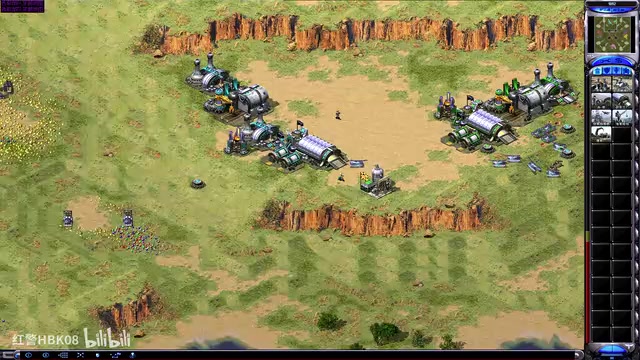
During the opening phase, facing an enemy raid, the streamer demonstrated clear priority judgment. When the green enemy came to snipe the ore refinery, the streamer chose not to fall back on defense, but instead went straight to steal the other opponent's (light blue) War Factory. The logic behind this decision is crystal clear:
- Ore Refinery stolen: Limited loss — just deploy a new refinery to resume mining (refineries build quickly and cost relatively little)
- War Factory stolen: The opponent can't produce tanks, completely losing early combat capability (the War Factory is the sole production facility for all ground vehicles — without it, they have zero armored power)
"Stealing my refinery is useless — you'd need to steal my War Factory or my power plants to actually hurt me." This statement captures the core principle of raiding in Red Alert — if you're going to snipe buildings, target the critical ones. Refineries, which can be quickly rebuilt, have the lowest priority. In competitive play, this "offense as defense" mindset is crucial: rather than spending time defending a low-value target, exploit the enemy's forces being away from base to counter-snipe their high-value buildings, achieving a favorable strategic trade.
Mid-Game Ore Control: Leveraging Terrain Advantage to Suppress Opponents
Having successfully destroyed the enemy's War Factory, the opposing team found themselves in the awkward situation of "one player has tanks, one doesn't." The streamer and their teammate grouped up, using their numerical advantage to repeatedly strike enemy ore miners.
The essence of the Tibet Plateau map lies in this: all the ore is below — control the lower ore fields, and your opponents can't develop their economy. This "ore control" approach is similar to the classic "economic strangulation" tactic in RTS games — rather than rushing to destroy the enemy base, you cut off their income and let them slowly suffocate. The duo coordinated continuous harassment of enemy War Miners (the Soviet harvesting unit — armed with a machine gun but helpless against tank groups), until the green player's economy collapsed, all War Miners were eliminated, and they were knocked out first.
Key operations during this phase included:
- Deploying a Repair Vehicle to promptly fix smoking tanks, preserving combat strength (the Repair Vehicle can field-repair damaged vehicles on the spot, preventing tanks from being destroyed due to low HP and greatly extending the tank group's sustained combat capability)
- Grouping up to eliminate enemy defensive bunkers
- Allied player producing IFVs (Infantry Fighting Vehicles) to support Soviet tank advances (IFVs change function based on the infantry loaded inside; when empty, they carry anti-air missiles, making them the Allied faction's most versatile multi-role vehicle)
Teammate's Mistake: The Cost of Using Iron Curtain in the Wrong Direction
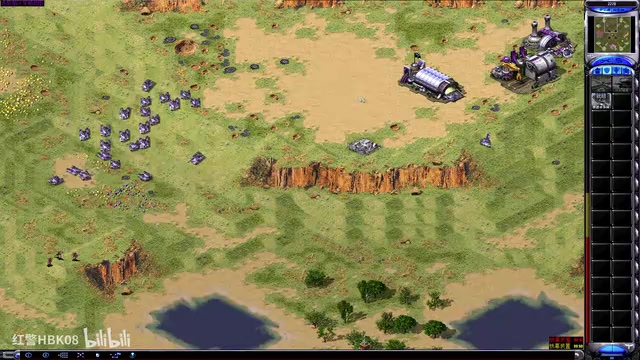
The biggest turning point of this match came from the teammate's Iron Curtain usage. The Iron Curtain is one of the Soviet superweapons in Red Alert 2 — once fully charged, it grants invincibility to friendly vehicles within a certain radius for approximately 45 seconds. Units covered by the Iron Curtain are immune to all damage for the duration, making it the Soviet faction's core late-game burst tool. The Iron Curtain has a long charge time (approximately 5-7 minutes), so every use must be carefully calculated — using it in the wrong direction is equivalent to wasting an entire strategic window.
At that point, the situation was favorable. Red and blue were the real threats, while pink was essentially "dead" (teammate eliminated, no tanks). However, the teammate used the precious first Iron Curtain charge to push downward against pink.
This strategic blunder triggered a chain reaction:
- The Iron Curtain was wasted on a non-threatening target, squandering 5-7 minutes of charge time
- Red and blue seized the opportunity to counterattack the streamer's base, knowing the Iron Curtain had been used and couldn't be deployed again soon
- Red, holding their own Iron Curtain, charged directly in and destroyed the streamer's base
"Come up and help me!" — this call highlights the most important principle in 2v2 coordination: focus fire on the primary threat; don't split forces to mop up a defeated opponent. In 2v2, both players' forces must work in concert. When one player goes after an irrelevant target, the other is left outnumbered.
Comeback from Behind: Rocketeer Raid Turns the Tide
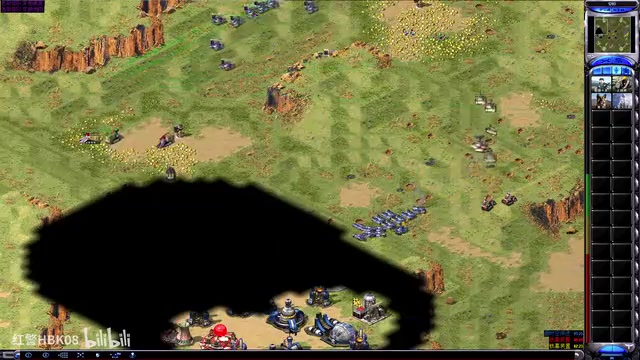
After losing the base, the streamer didn't give up, instead executing a series of brilliant comeback plays:
Step 1: Tank rush to destroy power plants. Willing to sacrifice over a dozen tanks to break through and destroy Red's Nuclear Reactor, cutting their power. In Red Alert 2, the power system is the foundation for all advanced building operations. When a player's power supply is insufficient ("low power" state), several severe consequences occur: superweapons stop charging or even reset their timers; anti-air buildings react much more slowly with sluggish rotation and firing; radar goes offline making the minimap unusable; and construction speed drops significantly. Therefore, a power cut means the Iron Curtain can't be used and anti-air response becomes sluggish — exactly the tactical window the streamer needed to create.
Step 2: Precision Rocketeer strikes. Exploiting the window while Red was powered down and anti-air was sluggish, Rocketeers quickly destroyed Red's Iron Curtain device and Blue's ore refinery. Rocketeers are the Allied faction's aerial infantry unit, capable of flying over all terrain obstacles to reach their targets — their greatest counters being anti-air buildings and anti-air vehicles. With the enemy powered down and anti-air buildings responding slowly, Rocketeers could strike virtually unopposed. One operation solved two problems simultaneously — eliminating the enemy's Iron Curtain threat and cutting Blue's economic lifeline.
Step 3: Dogs counter Magnetrons. Facing Red's Magnetrons, the teammate cleverly deployed attack dogs as a counter. The Magnetron is a signature unit of Yuri's faction, capable of firing magnetic waves to lift and drag enemy vehicles toward friendly lines, or dealing sustained damage to buildings. Its unique characteristic lies in its attack mechanism — it can only target vehicles and buildings, and cannot attack infantry units. Attack dogs are fast-moving and cost only 200 credits, and Magnetrons are completely helpless against them, able only to be passively chewed apart. This exploitation of unit counters was perfectly executed — using the cheapest possible unit to neutralize the enemy's high-tech threat.
Final Push: The Last Strike Through Perfect Coordination
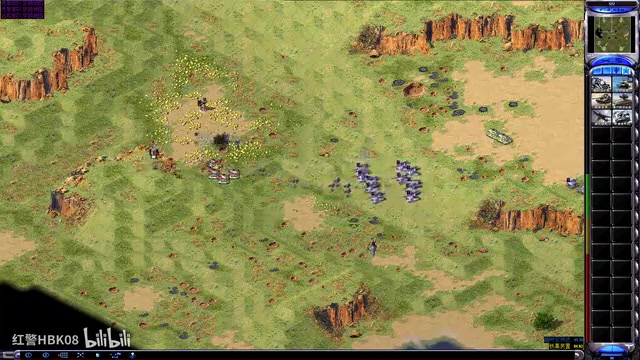
In the final phase, an interesting strategic exchange developed. Red attempted a base trade (abandoning defense of their own base to rush the opponent's base, creating a mutual destruction scenario), but the streamer decisively pinged their teammate with a beacon (the in-game map marking function used for quick tactical communication), and both players pushed toward the enemy base together, denying the base-trade opportunity.
The teammate's Iron Curtain combined with the streamer's tank group for a frontal push, while Rocketeers struck refineries and key buildings from the flank, forming a perfect "two-pronged pincer attack." This multi-directional pressure left the opponents unable to respond to everything — falling back meant being crushed by Iron Curtain tanks head-on, while not falling back meant economic facilities being picked off one by one by Rocketeers. Red couldn't handle the multitasking, their economy collapsed, and they ultimately surrendered.
Battle Summary: Core Principles of 2v2 Coordination
Although this match went through significant ups and downs, the team ultimately achieved a comeback through correct strategic judgment and flexible tactical execution. Several core lessons are worth noting:
- Raid Priority: War Factory > Power Plants > Ore Refinery — always snipe critical buildings. The War Factory determines whether the opponent can produce tanks, power plants determine whether their high-tech can function, while refineries can be quickly rebuilt with minimal loss.
- Focus on the Primary Threat: Don't waste resources on an already-collapsed opponent. The core of 2v2 is creating local numerical superiority — splitting forces to mop up a defeated player only weakens your main push.
- Soviet-Allied Role Division: Soviet deploys Iron Curtain for burst damage, Allied deploys Rocketeers for harassment. Each faction plays to its strengths — Soviet provides unstoppable frontal pushing power, Allied provides flexible flanking strikes and intelligence support.
- Power-Cut Tactics: Destroy power plants to cripple the enemy's high-tech buildings. This is a "leverage" tactic — the loss of a few power plants can cause the entire enemy base to malfunction, creating windows for follow-up strikes.
- Unit Counters: Dogs counter Magnetrons, Rocketeers exploit weak anti-air zones. Understanding every unit's attack mechanics and counter relationships, and using the lowest-cost solution to neutralize high-value threats, is essential knowledge for high-level play.
Key Takeaways
- The core of the Tibet Plateau map is controlling the lower ore fields, using elevation differences to suppress enemy economy
- In Soviet-Allied coordination, the optimal division of labor is Soviet handling Iron Curtain burst while Allied handles Rocketeer harassment
- In 2v2, critical abilities like Iron Curtain must be used against the primary threat — never waste them on already-collapsed opponents
- Power-cut tactics (destroying power plants) can disable the enemy's Iron Curtain and slow their anti-air response, creating breakthrough windows for Rocketeers
- When behind, the combination of tank rushes + precision Rocketeer strikes can effectively turn the tide
Related articles
 Tutorials
Cursor + Codex Dual-IDE Collaboration: A Practical Methodology for Open-Source Project Customization
A complete methodology for open-source project customization based on real-world experience, detailing the Cursor+Codex dual-IDE workflow, seven-stage process, MVP validation, and AI source code reading techniques.
 Tutorials
Cursor Multi-Agent in Practice: Building a Full-Stack Next.js Blog in 50 Minutes
Build a full-stack blog in 50 minutes using Cursor IDE's multi-Agent mode with Next.js, Clerk auth, and Supabase. Learn the 4-phase AI Agent workflow and key integration pitfalls.
 Tutorials
Building an AI Software Factory from Scratch: A Cursor Engineer's Hands-On Experience with Multi-Agent Collaboration
Cursor engineer Eric shares practical insights on building an AI software factory: automation levels, guardrail design, parallel Agent management, and scaling to 1000+ Agents for 24/7 development.