How the Large Hadron Collider Works: The Science Behind One Billion Collisions Per Second
How the Large Hadron Collider Works: T…
How the LHC uses E=mc² and multi-level triggers to find new particles in a billion collisions per second
Through an interview with Fermilab physicist Don Lincoln, this article systematically explains how the Large Hadron Collider works. Starting from the mass-energy conversion principle of E=mc², it explains why extremely high-energy collisions are needed to create new particles, details the LHC's multi-stage acceleration strategy, its vast superiority over the Tevatron in energy and collision rate, and how a three-level trigger system filters approximately one billion collisions per second down to about 1,000 valuable events for analysis.
Introduction: From the Higgs Boson to Particle Colliders
The theoretical prediction of the Higgs boson began in 1964 and became a key component of the Standard Model by 1967. The Standard Model is the theoretical framework describing fundamental particles and their interactions, encompassing three fundamental forces: the strong force, the weak force, and electromagnetism. In 1964, Peter Higgs, François Englert, and other physicists independently proposed the Higgs mechanism, explaining why W and Z bosons have mass while photons do not. The Higgs field permeates all of space, and particles acquire mass through their interaction with it—similar to how moving through syrup creates resistance. The Higgs boson is the quantum excitation of this field, with a mass of approximately 125 GeV/c², requiring extremely high-energy collisions to produce. This is precisely why humanity needed to build such enormous accelerators.
After the theoretical prediction, physicists spent decades building increasingly powerful particle accelerators to find it. Don Lincoln, a senior physicist at Fermilab, revealed the stunning engineering and physics principles behind large particle colliders in an in-depth interview—from the deeper meaning of E=mc² to the data-processing miracle of filtering through one billion collisions per second.
The True Meaning of E=mc²: The Conversion Between Energy and Matter
Everyone has heard Einstein's equation E=mc², but few truly understand its deeper implications. Don Lincoln points out that this equation reveals a "thoroughly fascinating concept": energy and matter are equivalent, and you can convert kinetic energy into mass.
Einstein first proposed the mass-energy equivalence in 1905 as a corollary of special relativity. In this equation, c² (the speed of light squared) is an extraordinarily large number (approximately 9×10¹⁶ m²/s²), meaning that a tiny amount of mass corresponds to an astonishing amount of energy. In particle physics, the reverse application of this equation is even more critical: by concentrating enough kinetic energy, new particles with mass can be created from nothing. This completely contradicts everyday experience—we're accustomed to a world where matter is conserved, but at subatomic scales, the boundary between energy and matter is fluid.
This principle was predicted as early as 1928—the Dirac equation predicted the existence of antimatter, which is one direct consequence of mass-energy equivalence—and is now beyond dispute. Here's how it works: take two point-like particles (fundamental particles with no internal structure) and collide them from opposite directions with enormous energy. At the moment of collision, their momenta cancel each other out, and all the energy must "go somewhere"—it literally creates new particles.
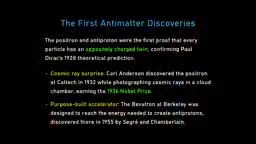
There's a fundamental rule here: if a collision produces a particle, it must simultaneously produce a corresponding antiparticle to maintain balance. The antimatter electron (positron) was discovered in 1932, and the antiproton was discovered in 1955 at Berkeley's Bevatron. This process is also reversible—when matter meets antimatter, they convert into pure energy.
How Particle Accelerators Work: From Fermilab to CERN
The "Gear Shifting" Strategy of Multi-Stage Acceleration
Major particle physics laboratories don't have just one accelerator. Fermilab once had five different accelerators, much like driving a manual transmission car—you can't go from zero to top speed directly; you must increase energy in stages. CERN's Large Hadron Collider (LHC) similarly employs a multi-stage accelerator complex.
Particle accelerators use electric fields to accelerate charged particles and magnetic fields to bend particle trajectories so they circulate in ring-shaped orbits. Different energy ranges require differently designed accelerators because low-energy particles undergo large velocity changes (requiring frequent adjustment of the accelerating field frequency), while high-energy particles traveling near the speed of light barely change velocity (primarily gaining relativistic mass). The LHC's acceleration chain includes: the linear accelerator Linac4 (accelerating protons to 160 MeV), the Proton Synchrotron Booster PSB (2 GeV), the Proton Synchrotron PS (26 GeV), the Super Proton Synchrotron SPS (450 GeV), and finally injection into the LHC main ring reaching 6.5–7 TeV. Each stage has optimized magnet strength and radio-frequency cavity design for its specific energy range.
Fermilab vs. CERN: The Battle of Energy and Collision Rate
Fermilab's Tevatron was once the world's most powerful particle collider, discovering the top quark in 1995. But today, the LHC surpasses the Tevatron in every respect:
- Energy: The LHC's collision energy is approximately 7 times that of the Tevatron
- Collision rate: The LHC's collisions per second are approximately 100 times that of the Tevatron
- Combined capability: Approximately 1000 times that of the Tevatron

Don Lincoln used a vivid comparison to illustrate this gap: when the top quark was discovered in 1995, his team spent six months to a year collecting data, and the final paper contained only 38 top quark candidate events, half of which were background noise—meaning there were possibly only 19 real top quarks. Now at the LHC, one top quark is produced every second. The top quark has gone from a Nobel Prize-level discovery to background noise that needs to be "cleaned away."
The top quark is the heaviest of the six quarks in the Standard Model, with a mass of approximately 173 GeV/c², close to the mass of a gold atom—extraordinarily heavy for a fundamental particle. What makes the top quark special is its extremely short lifetime (approximately 5×10⁻²⁵ seconds); it decays before the strong interaction has time to confine it into hadrons, making it the only quark that can be studied as a "bare quark." The top quark has the strongest coupling to the Higgs boson, making it an important window for studying Higgs physics.
The Antiproton Production Process
Producing antiprotons is extremely expensive. When Fermilab was operating, approximately 100,000 protons had to strike a target to produce a single antiproton. Fermilab used a 120 GeV proton beam to create antiprotons, while CERN currently uses only 26 GeV (because its experimental goals are different and don't require as many antiprotons). Fermilab ceased antiproton production in 2011, shifting to neutrino physics research.
Antiproton production is an extremely inefficient process. When high-energy protons strike a fixed target (typically nickel or copper), the collision energy converts into various particle-antiparticle pairs via E=mc², of which only a tiny fraction are antiprotons. The produced antiprotons have various energies and directions and must be collected and compressed into a tight beam using "stochastic cooling" or "electron cooling" techniques. Stochastic cooling was invented by Simon van der Meer (Nobel Prize 1984); its principle involves detecting deviation signals in the particle beam and then applying correction pulses when the beam reaches the opposite side. The entire process takes hours and consumes enormous amounts of energy.
One Billion Collisions Per Second: The Miracle of LHC Data Filtering
The Physical Picture of Collisions
The particle beams in the LHC are not beams of light like lasers. Lincoln describes them as "little sticks thinner than spaghetti," roughly the width of a human hair. Two proton beams pass through each other from opposite directions, like two swarms of bees flying toward each other—most "bees" pass through without interfering, but occasionally some collide head-on.
There are approximately 40 million "time windows" per second, with about 20 collisions potentially occurring simultaneously in each window, totaling approximately one billion collisions per second. The detectors can distinguish between different collision events within the same time window to some extent by tracking the origin points of particle trajectories.
Giant Particle Detectors: CMS and ATLAS
The LHC has two giant detectors:
- CMS (Compact Muon Solenoid): 70 feet long, 50 feet high, 50 feet wide, weighing 14,000 tons—and this is "the small one"
- ATLAS: 150 feet long, 80 feet wide, weighing 7,000 tons. Four ATLAS detectors could fill a football field

These two detectors are essentially ultra-high-speed "cameras," taking 40 million "photographs" per second. There's a friendly competition between the two experimental groups—Lincoln humorously notes: "In particle physics, we genuinely want our competitors to do very well, just not better than us."
Modern particle detectors use an "onion layer" structure, from inside to outside: vertex detector (silicon pixel detector for precisely measuring particle production points), tracking chamber (tracking charged particle trajectories), electromagnetic calorimeter (measuring electron and photon energy), hadronic calorimeter (measuring hadron energy), and muon detector (outermost layer, since muons have the greatest penetrating power). The entire detector is immersed in a strong magnetic field (CMS uses a 4-Tesla superconducting solenoid) that bends charged particle trajectories, allowing momentum measurement through the radius of curvature. Different types of particles leave different signal patterns in each layer, enabling physicists to identify particle species.
Three-Level Trigger System: From One Billion Down to One Thousand
Facing the massive data generated by one billion collisions per second, physicists designed an elegant multi-level filtering system:
-
Level-1 Trigger (fast electronics): From the 40 million time windows per second, based on preset "trigger conditions" (such as large amounts of energy appearing in the detector, asymmetric energy distributions, etc.), approximately 100,000 interesting events are selected
-
Level-2 Trigger (computer farm): Using commercial processors running optimized analysis code for rapid preliminary analysis, further filtering down to approximately 1,000 events per second
-
Offline analysis: The recorded data is handed to analysis software and graduate students to search for the few events that might lead to the next Nobel Prize
The core challenge facing the trigger system is this: each collision produces approximately 1 MB of data, and one billion collisions per second means a raw data rate of approximately 1 PB/s (1000 TB/s), far exceeding the capacity of any storage system. The Level-1 trigger (L1) is implemented entirely with custom FPGA and ASIC hardware and must make decisions within 2.5 microseconds (because data can only be held in pipeline buffers for that long). It primarily looks for simple high-energy signatures, such as high-transverse-momentum muons or large energy deposits. The High-Level Trigger (HLT) runs on a computer farm consisting of tens of thousands of CPU cores, executing reconstruction algorithms approaching offline quality. The entire system must be designed to ensure that rare events containing new physics are not discarded, while effectively rejecting the vast majority of ordinary collisions.
This means that from the initial one billion collisions, ultimately only about one-thousandth of one-thousandth are retained for in-depth study.
Conclusion: A Tribute to the Builders of Particle Physics
As Don Lincoln remarks, achieving all of this requires paying tribute to the accelerator builders, detector builders, software developers, and engineers who manage the seamless flow of petabytes of data around the globe. Particle physics is not only a triumph of theory but also a pinnacle demonstration of human engineering capability—precisely capturing those rare events that reveal the universe's deepest secrets from the torrent of one billion collisions per second.
Key Takeaways
- Particle colliders use the E=mc² principle to convert kinetic energy into the mass of new particles—this is the core mechanism for discovering new particles
- The LHC produces approximately one billion collisions per second, with 7 times the energy and 100 times the collision rate of Fermilab's Tevatron
- The two giant detectors, CMS and ATLAS, weigh 14,000 tons and 7,000 tons respectively, taking 40 million 'photographs' per second
- A three-level trigger system filters one billion collisions per second down to approximately 1,000 valuable events for recording and analysis
- What once took a year to find 19 top quark events now happens at the LHC at a rate of one top quark per second
Related articles
 Deep Dives
Deep Dive into How OpenClaw (Open-Source Crayfish) AI Agent Works
Deep analysis of OpenClaw AI Agent internals: System Prompt, tool calling, SubAgents, Skill system, memory, and Context Engineering explained.
 Deep Dives
Demystifying Transformer: A Word-Continuation Function, Deconstructed
Understand Transformer through the lens of word continuation. Breaking down language generation into Embedding, Transformer Block, and Probability output modules for intuitive understanding.
 Deep Dives
Five Core Differences Between Claude Code and Regular AI Chat
A detailed comparison of Claude Code vs regular AI chat across five dimensions: interaction, context understanding, execution, memory, and tool integration.