How to Use Claude Code for Free Without Limits: A Zero-Cost Full Multimodal AI Solution
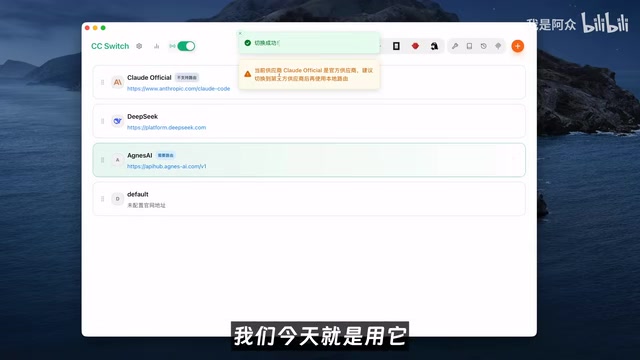
A complete guide to using Claude Code for free by routing it through Agnes AI's free multimodal models.
This guide shows how to use Claude Code at zero cost by combining three tools: Claude Code as the frontend agent, Agnes AI as a free model backend offering text, image, and video generation, and CC Switch as an open-source API proxy that routes requests between them. The article includes step-by-step setup instructions and real-world tests across all three modalities.
Claude Code Is Powerful, But Not Cheap to Use
Claude Code is widely regarded as one of the most powerful AI Agent tools available today. Whether it's writing code, performing data analysis, or generating copy, it excels across the board. An AI Agent is one of the hottest paradigms in artificial intelligence right now, and it's fundamentally different from traditional chatbots. Traditional chatbots can only handle single-turn or multi-turn conversations, while AI Agents are capable of autonomous planning, tool invocation, and task execution. Take Claude Code as an example — it doesn't just understand natural language instructions; it can independently break down tasks, read and write files, execute terminal commands, and call external APIs, forming a complete "perceive-decide-execute" loop. This capability makes it far superior to traditional code completion tools in scenarios like software development and data analysis.
The problem is that using it typically comes down to two options: subscribe to an official paid plan, or connect to a third-party API service — either way, it costs money. Major AI service providers (such as OpenAI, Anthropic, and Google) typically charge by the token — a token is the smallest unit of text a model processes, and one Chinese character corresponds to roughly 1-2 tokens. Taking GPT-4o as an example, it costs about $2.50 per million input tokens, with output tokens being even more expensive. For heavy users, monthly bills can easily exceed $100.
Recently, someone shared a method for using Claude Code completely free and without limits. The core idea is to use an open-source tool to switch Claude Code's backend to a free AI model platform. It's not just for writing code — you can also call image generation and video generation models, achieving a zero-cost full multimodal experience.
Three Core Tools: Each Playing Its Role
This free Claude Code solution involves three tools, each serving a different purpose.
Claude Code: The Frontend That Does the Work
Claude Code itself is a powerful AI Agent tool that's simple to install — just follow the one-line command in the official documentation. It handles receiving user instructions and executing tasks, but it needs a model backend to provide inference capabilities.
Agnes AI: The Backend Providing Free Models
Agnes AI is a free AI model platform with entirely self-developed models for text, image, and video — directly competing with the top tier like OpenAI and Google. Multimodal refers to an AI model's ability to simultaneously process multiple data types including text, images, audio, and video. Currently in the industry, OpenAI's GPT-4o, Google's Gemini, and Anthropic's Claude are all moving toward multimodal capabilities, though each has different areas of focus. Text generation is the most fiercely competitive field, image generation is dominated by tools like Midjourney, DALL·E 3, and Stable Diffusion, while video generation features products like Sora, Runway, and Kling, each with their own strengths. For a single company to simultaneously offer self-developed models across text, image, and video — all for free — is genuinely rare in the industry.
The key point is that Agnes AI has made its entire multimodal API completely free, with no time limits and no usage caps. According to reports, in the first week after opening for free on June 1st, its text model was called over 1 trillion times, with over 2 million images generated and over 2 million seconds of video produced.
While this business strategy may seem puzzling, there's deeper logic behind it. The "burn money for free" strategy in the AI industry isn't without merit: First, the marginal cost of AI models decreases as scale increases — the more users there are, the lower the average cost per inference becomes through batch processing and GPU utilization optimization. Second, massive user data and usage feedback are the core fuel for model iteration; real-world user interactions are more valuable than any synthetic data. Third, a free strategy can rapidly establish user habits and ecosystem moats — once users deeply integrate their workflows into a platform, the conversion rate to paid services increases significantly. Historically, from Dropbox's free storage to Zoom's free video conferencing, the playbook has been to lock in users with free services first, then monetize through premium features. Regardless of the reasoning, it's a genuine benefit for users.
CC Switch: The Bridge Connecting the Two
CC Switch is a free open-source project that can be understood as an API switcher. Which backend Claude Code connects to, what API endpoint to use, which model to call — CC Switch manages all of this centrally. Once configured, switching backends is just a single click.
From a technical perspective, what CC Switch does is essentially API proxying and request rewriting. Claude Code is designed to send requests to specific API endpoints, with requests containing the model name (e.g., claude-sonnet-4-20250514), conversation content, and parameters. CC Switch intercepts these requests, replaces the target address with Agnes AI's gateway address, maps the model name to Agnes 2.0 Flash, attaches Agnes's API Key, and forwards the request. This "man-in-the-middle" architecture is very common in development, similar to how an Nginx reverse proxy works — it makes the frontend tool completely unaware that the backend has been swapped.
In short: Claude Code does the work, Agnes AI provides the free models, and CC Switch connects them together.
Step-by-Step Configuration Guide
Here are the complete configuration steps. Follow them in order to get Claude Code running for free.
Step 1: Get Your Free Agnes AI API Key
An API Key is the identity credential for accessing AI model services, similar to a digital key. When users call a model through the API, each request must carry this Key, which the server uses to verify identity, meter usage, and bill accordingly (in Agnes's case, it's free metering). Here's how to get one:
- Open the Agnes API platform
- Click "API Keys" in the left sidebar
- Click "Create New Key" and give it any name you like
- Copy the generated API Key for later use
Step 2: Configure the Provider in CC Switch
- Open CC Switch and switch to "Cloud CLI" in the top toolbar (specifically for configuring Claude Code)
- Click the plus icon in the upper right to add a new provider
- Select "Cloud Provider" for the type, then choose "Custom Provider"
- Fill in the details:
- API Key: Paste the Key you copied from the Agnes platform
- Request URL: Enter Agnes's gateway address (this redirects Claude Code's requests to Agnes)
- API Format: Select the compatible format; leave everything else at default
- Click "Fetch Model List" — if a list of models appears, you're connected
Step 3: Model Mapping
Map all the models that Claude Code might call to Agnes 2.0 Flash. This way, no matter which model name Claude Code invokes, it actually routes through Agnes's free model. Confirm everything looks correct and click Save.
Step 4: Enable Route Forwarding
This step is crucial — configuring the provider isn't enough; you need CC Switch to actually forward the requests:
- Click "Settings" in the upper left corner to access the routing interface
- Enable "Local Routing"
- Turn on the Cloud routing switch
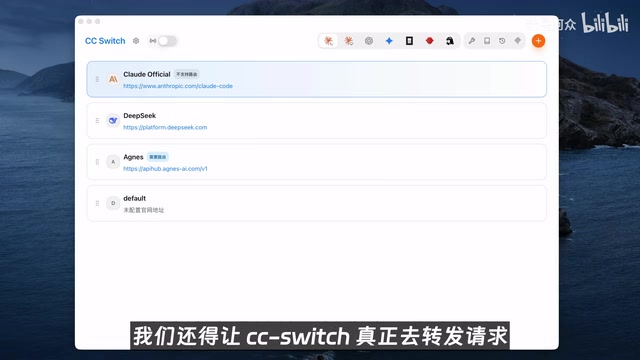
Once you return to the provider list, all of Claude Code's requests will be forwarded through CC Switch to Agnes's free gateway. Type the Claude command in your terminal and send a "hello" — if you get a response, the entire setup is complete.
Real-World Testing: Can the Free Model Actually Deliver?
Completing the configuration is just the first step. What matters more is how the free model actually performs. Here are test results across three dimensions: text, image, and video.
Text Model: From Data Spreadsheets to Business Landing Pages
The test used real video operations data — over 100 records spanning multiple platforms. Using Agnes 2.0 Flash through Claude Code, the task was to create an operations review dashboard based on this data.
The results were quite impressive: charts, filters, and detailed breakdowns were all present, with a clean layout that's perfectly usable for daily reviews. Next, it was upgraded into a business partnership landing page ready to send to brand partners, complete with data snapshots, featured works, and collaboration options — looking very professional.
From an ordinary data spreadsheet to a review dashboard, then to a page suitable for business negotiations — all powered by a free model. The level of completion genuinely exceeded expectations.
Image Model: Zero-Cost High-Quality AI Image Generation
Since Claude Code natively only supports text models, a dedicated Skill for calling Agnes's image generation model needs to be created. Usage is straightforward — just ask Claude Code to generate an image from a prompt in the chat, and it automatically invokes the Skill and saves the image to the project directory.
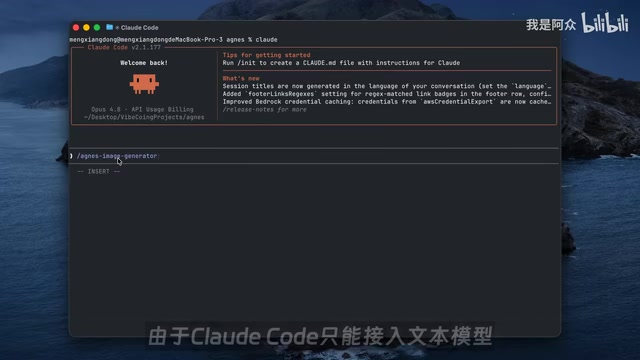
Text-to-Image Test: A prompt was used to generate a portrait photo in 35mm film direct-flash style. The results were impressive — film grain texture, flash highlights, skin texture, and pores were all clearly visible, with an overall street-sport vibe.
It's worth noting that AI image generation isn't cheap. Generating a single 1024×1024 resolution image on mainstream cloud providers requires an A100 GPU running for 5-15 seconds, translating to roughly $0.02-0.06 per image. But in practice, users often need multiple iterations to get a satisfactory result — known in the community as "pulling gacha." On average, a satisfactory result might require 5-20 generations, meaning the actual cost per satisfactory image could reach $0.10-1.00. For content creators who need to generate large volumes of assets, these costs add up quickly. With Agnes, you can generate as many as you want at zero cost — that advantage is very real.
Image-to-Image Test: Given a reference photo, the model was asked to create a derivative work based on it. The result was a standard professional headshot — half-body composition, natural expression, genuine smile, and most importantly, the face remained the same while the clothes, background, and lighting were completely changed.
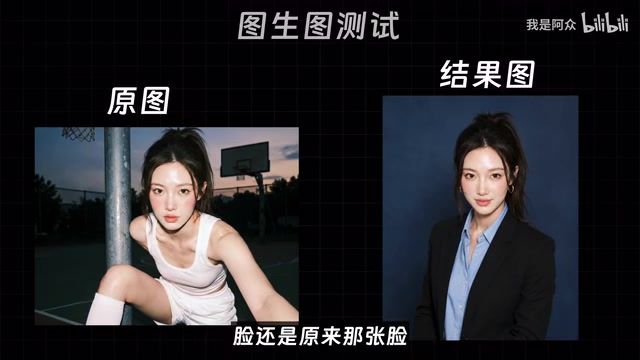
This "change the outfit, keep the face" capability is extremely practical: one casual photo plus a prompt can be transformed into a professional headshot suitable for resumes or LinkedIn profiles.
Video Model: Impressive Expression with Occasional Imperfections
A prompt was used to generate a short video of a female singer performing. The footage showed a close-up of a red-haired singer, with curly hair strands and backlit highlights rendered clearly. Most impressive was the progression of facial expressions — from calmly closing her eyes to build up emotion, to gradually getting into the zone and opening her mouth to sing, to slightly furrowing her brows while fully immersed in the emotion. The hand gripping the microphone, lip movements, and breathing rhythm were all coherent, without the stiffness commonly seen in AI-generated content.
Of course, the model occasionally produces minor issues. For example, in a nighttime street photography video of a woman, both the subject and the background cityscape looked very realistic, but upon closer inspection, a pedestrian on the left suddenly "split" into two people, as if cloned out of thin air. This phenomenon is technically known as "temporal inconsistency" — AI video generation is one of the most technically challenging areas of generative AI. Unlike image generation, video requires maintaining inter-frame consistency across the time dimension, meaning each frame's character appearance, pose, and lighting must transition smoothly; otherwise, flickering, deformation, or "splitting" artifacts occur. Currently, mainstream video generation models in the industry (such as OpenAI Sora and Kuaishou Kling) generally adopt the Diffusion Transformer architecture, modeling both spatial and temporal dimensions simultaneously in latent space to mitigate this issue, but complete elimination remains an open challenge.
However, the main subject remains stable, and when these issues occur, you can simply regenerate a few times — after all, it's completely free and unlimited.
Summary and Takeaways
The core value of this solution lies in gaining full multimodal AI capabilities at zero cost:
- Text: Data analysis, code generation, and copywriting — solid performance
- Image: Both text-to-image and image-to-image quality are impressive, saving significant image generation costs
- Video: Overall expressiveness is notable; occasional imperfections can be resolved through multiple generations
It's worth noting that how long Agnes AI's free strategy will last remains uncertain. This kind of "burn money to acquire users" approach isn't uncommon in the AI industry, so those interested should try it sooner rather than later. Also, since the model is mapped to Agnes 2.0 Flash rather than the original Claude model, performance on certain complex programming tasks may differ from the original — making it better suited for everyday use and lightweight development scenarios.
Related articles
SpaceX: A Multi-Dimensional Analysis of Engineering Marvels, Business Revolution, and the Mars Vision
A deep multi-dimensional analysis of SpaceX covering engineering breakthroughs, business revolution, organizational culture, and the Mars colonization vision that is redefining the boundaries of human space exploration.
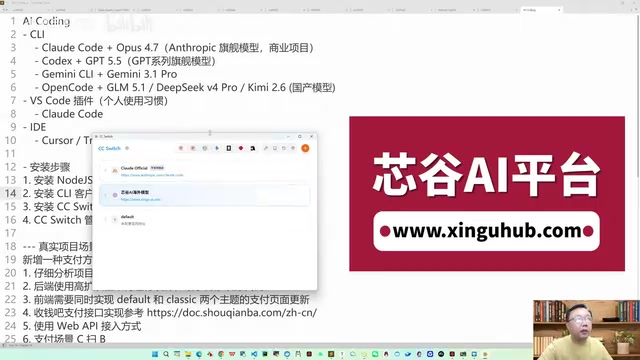
Claude Code Practical Guide: From Installation & Configuration to Production-Grade Project Delivery
Complete guide to Claude Code + Opus for production projects: CC Switch setup, engineering-minded prompting, and a real case study delivering a complex payment system in 4 hours.
Tutorial: Using Claude Code to Auto-Generate Video Chapter Progress Bar Animations
Use Claude Code's Skill mechanism and Remotion to auto-generate video chapter progress bar animations from subtitle files. Six built-in styles, custom stickers, and one-click rendering.