Huawei Hermes Agent Manual Explained: Five-Layer Memory Architecture and Multi-Agent Collaboration in Practice
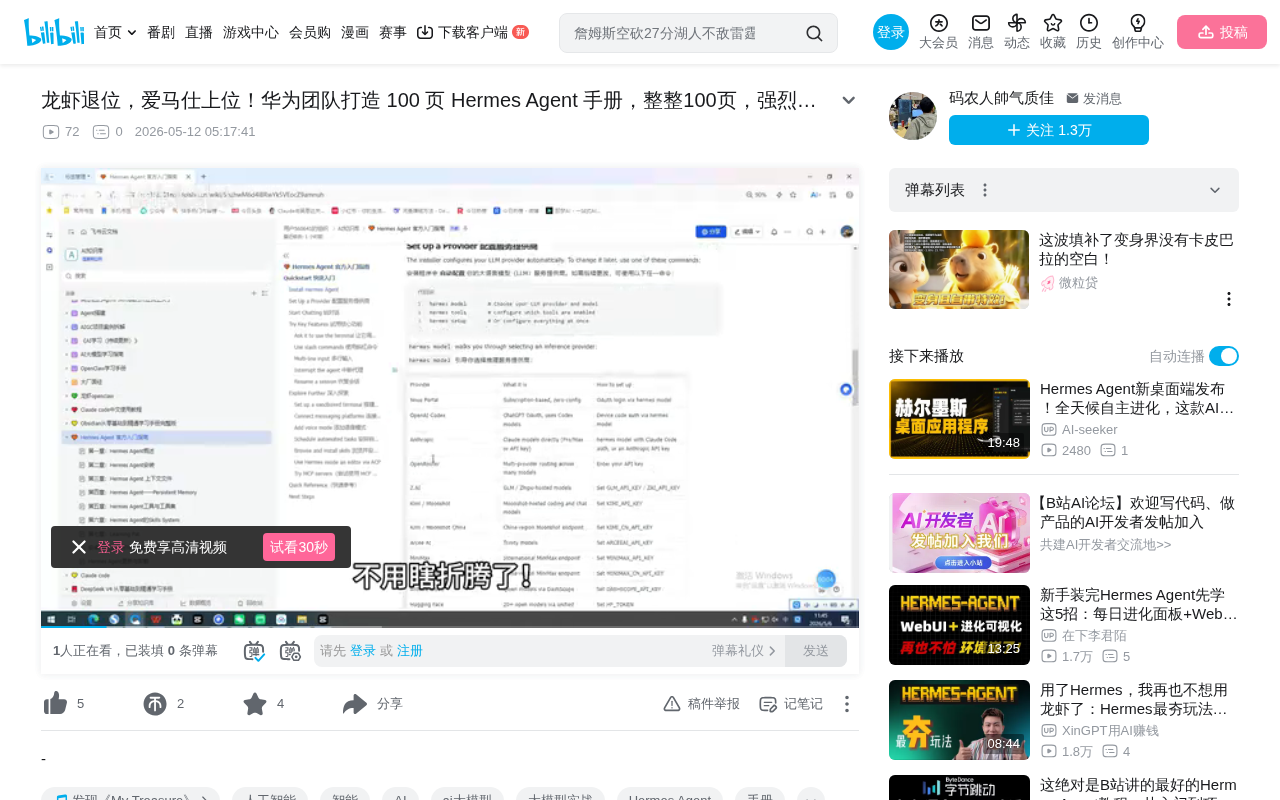
Huawei releases Hermes Agent manual detailing five-layer memory, self-evolution loops, and multi-agent collaboration.
Huawei's team released a 100-page Hermes Agent manual that systematically addresses core AI Agent development challenges from an engineering perspective. It proposes a five-layer memory architecture (inspired by computer memory hierarchy) to solve memory fragmentation caused by LLM statelessness, designs a metacognition-based self-evolution loop enabling Agents to continuously optimize through execution, reflection, distillation, and update stages, and provides in-depth analysis of hierarchical, peer-to-peer, and hybrid multi-agent collaboration patterns while emphasizing the criticality of communication protocol design. The manual offers differentiated learning paths for developers at all levels with a focus on engineering deployability.
Huawei's AI Agent Methodology
In the AI Agent development space, tutorials and frameworks are emerging constantly, but truly systematic resources with real engineering value remain scarce. Huawei's team released a comprehensive 100-page Hermes Agent manual that systematically covers everything from architecture design to production deployment, explaining how to build high-quality intelligent agent systems. The core value of this manual lies in the fact that it's not theoretical speculation—it's a hardcore summary drawn from frontline engineering practice.
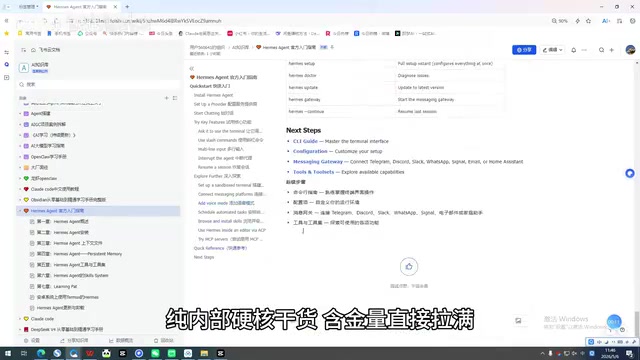
The name Hermes carries deep significance. In Greek mythology, Hermes was the messenger of the gods, responsible for transmitting information between different worlds. Huawei's team chose this name for their Agent framework, hinting at the system's core positioning in information delivery, task coordination, and multi-agent collaboration.
Five-Layer Memory Architecture: A Systematic Solution to AI "Amnesia"
Why Memory Management Is the Core Challenge in Agent Development
One of the most common pain points in current AI Agent development is "memory fragmentation." To understand the root cause of this problem, we need to start from the underlying architecture of large language models.
Large Language Models (LLMs) are architecturally stateless systems. Each inference call is essentially an independent forward propagation computation—model weights are completely frozen during inference and won't update based on conversation content. This means that so-called "memory" is actually just historical conversation text concatenated into the current input's Context Window. Once the window length limit is exceeded (e.g., GPT-4's 128K tokens), earlier information gets truncated and lost. This differs fundamentally from how human memory works: the human brain continuously updates neural connections through synaptic plasticity, while LLM "memory" is merely a temporary stack of context. This architectural characteristic dictates that any Agent system aiming for persistent memory capabilities must design an independent memory management layer outside the model.
The Hermes manual proposes a five-layer memory architecture to systematically address this problem. The layered design philosophy is similar to the Memory Hierarchy in computer systems—one of the core designs in modern computer architecture. The key idea is to balance performance and cost through gradient layering of speed and capacity. From L1 cache (nanosecond access, KB-level capacity) to RAM (microsecond, GB-level) to disk (millisecond, TB-level), each layer makes trade-offs between access speed and storage capacity. Hermes's five-layer memory architecture draws from this classic design philosophy, with different layers serving different responsibilities:
- Instant Memory Layer: Handles current conversation context, similar to CPU cache, pursuing ultra-low latency with vector caches stored directly in memory
- Short-term Working Memory: Maintains execution state and intermediate results for the current task
- Episodic Memory: Records key events and decisions from historical interactions
- Semantic Memory: Stores structured knowledge and skills
- Long-term Memory: Persistent experience accumulation and pattern summarization, persistable to vector databases (such as Pinecone, Weaviate) and retrievable on-demand through semantic search
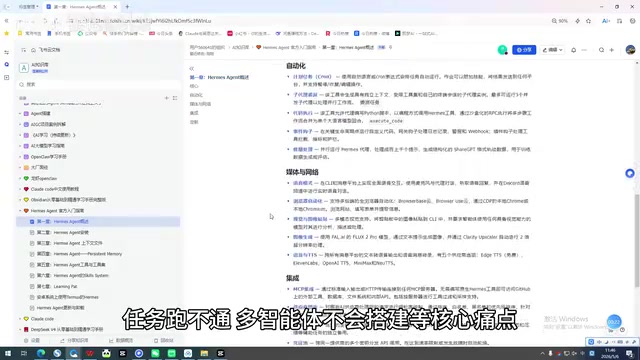
The elegance of this layered architecture lies in enabling Agents to manage information at different granularities—neither slowing response times due to memory overload nor causing task failures due to forgetting critical information.
Self-Evolution Loop: Making Agents Smarter Over Time
The Leap from Passive Execution to Active Learning
Traditional Agent systems are essentially "passive executors"—you give them instructions, they follow rules, and they're helpless when encountering new scenarios. The self-evolution loop mechanism proposed in the Hermes manual aims to give Agents the ability to learn from practice and self-optimize.
The core logic of the self-evolution loop can be summarized in four stages:
- Execute and Observe: The Agent performs tasks and records complete execution traces
- Reflect and Evaluate: Automatically evaluates execution results, identifying success patterns and failure causes
- Knowledge Distillation: Abstracts valuable experiences into reusable strategies and skills
- Strategy Update: Integrates newly learned knowledge into the decision-making framework
The key breakthrough in this loop lies in the "reflection" stage, whose theoretical foundation comes from the concept of Metacognition in cognitive psychology. Metacognition was proposed by psychologist John Flavell in the 1970s, referring to an individual's ability to monitor, evaluate, and regulate their own cognitive processes—in short, "thinking about thinking." In the AI Agent domain, the engineering implementation of metacognitive capabilities typically leverages LLM Self-Reflection mechanisms: having the model examine its own reasoning chain from a third-party perspective to identify logical gaps or suboptimal decisions. Stanford University's Reflexion framework, published in 2023, is a representative work in this direction, achieving Agent "learning" through language feedback rather than gradient updates. Hermes's self-evolution loop goes further by structuring reflection results into reusable strategy entries, enabling experience accumulation that transcends individual conversations and persists across tasks and sessions—this is its key engineering innovation compared to simple self-reflection mechanisms.
Multi-Agent Collaboration: From Solo Operations to Team Coordination
Engineering Implementation of Collaborative Operations
A single Agent's capabilities are ultimately limited, and complex business scenarios often require multiple Agents working together. But while "multi-agent collaboration" is easy to talk about, engineering implementation encounters numerous thorny problems: How are tasks allocated? How are conflicts resolved? How is information synchronized?
The Hermes manual provides an in-depth breakdown of collaborative operation logic, offering several core collaboration patterns:
- Hierarchical Collaboration: A master Agent handles task decomposition and scheduling, while sub-Agents handle specific execution
- Peer-to-Peer Collaboration: Multiple Agents collaborate as equals, sharing information through message-passing mechanisms
- Hybrid Collaboration: Dynamically switches collaboration modes based on task characteristics
The manual particularly emphasizes "communication protocol" design—a problem with deep theoretical foundations in the Multi-Agent System (MAS) field. FIPA (Foundation for Intelligent Physical Agents) established Agent Communication Language (ACL) standards as early as the 1990s, defining standard fields such as performative (speech act types), sender, receiver, and content. In modern LLM-based Agent frameworks, AutoGen, CrewAI, and others have each designed different message-passing protocols. The deeper challenge is that the classic CAP theorem constraints from distributed systems equally apply to multi-Agent systems: trade-offs must be made between consistency (all Agents have the same view of shared state), availability (Agents can respond promptly), and partition tolerance. The conflict arbitration rules emphasized in the Hermes manual are essentially an application-layer solution for achieving distributed consensus in multi-Agent systems—the information exchange formats, priority mechanisms, and conflict arbitration rules between Agents often determine the stability and efficiency of the entire system.
Engineering Implementation: The Complete Path from Principles to Practice
Differentiated Learning Paths for Different Developer Levels
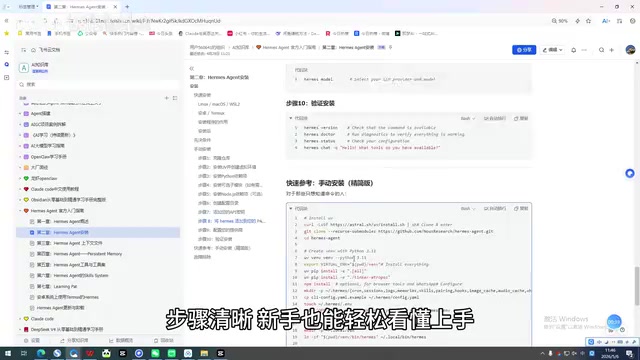
The most commendable aspect of this manual is its engineering orientation. It doesn't just explain "why" and "what"—more importantly, it explains "how." From environment configuration and source code analysis to skill training, every step has clear procedural instructions.
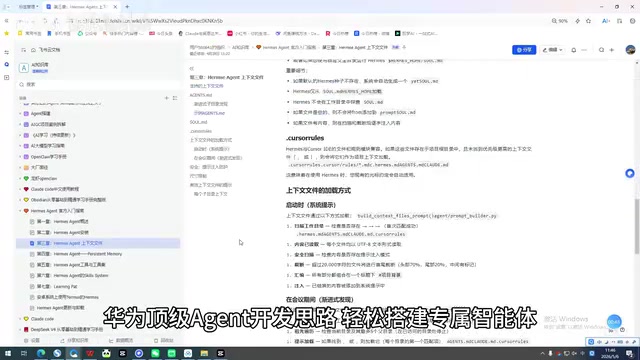
For developers at different levels, the manual provides differentiated learning paths:
- Beginners: Start with fundamental principles and environment setup; follow the manual step by step to build your first Agent
- Intermediate Developers: Focus on implementation details of the memory architecture and self-evolution mechanisms; understand the trade-offs behind the design
- Senior Engineers: Dive deep into multi-agent collaboration and system optimization; apply Hermes's design philosophy to your own projects
Summary and Reflections
The release of Huawei's Hermes Agent manual reflects the deep accumulation of domestic tech giants in AI Agent engineering. Unlike academic papers, this manual prioritizes "deployability," addressing the problems developers most commonly encounter in real projects.
From a technology trend perspective, AI Agents are evolving from "toys" to "tools." The five-layer memory architecture solves state management—essentially building a stateful external memory system outside the stateless LLM. The self-evolution loop solves continuous optimization—engineering metacognition theory into a cross-session strategy library. Multi-agent collaboration solves complex task decomposition—finding optimal Agent cooperation solutions under classic distributed system constraints. These three directions correspond precisely to the Agent evolution path from "usable" to "effective" to "scalable."
For developers looking to go deep in the AI Agent field, this manual provides not just specific technical solutions, but a systematic thinking framework. Once you understand the design philosophy behind Hermes, you'll be able to more clearly evaluate the strengths, weaknesses, and applicable scenarios of other Agent frameworks.
Key Takeaways
- Huawei's team released a 100-page Hermes Agent manual systematically covering the complete workflow from fundamental principles to engineering deployment
- Proposes a five-layer memory architecture (instant memory, short-term working memory, episodic memory, semantic memory, long-term memory) to solve AI Agent memory fragmentation, with design inspired by computer memory hierarchy theory
- The self-evolution loop mechanism, grounded in metacognition theory, enables Agents to learn from practice and self-optimize through four stages: execution, reflection, distillation, and update
- Provides in-depth breakdown of multi-agent collaborative operation logic with three core collaboration patterns: hierarchical, peer-to-peer, and hybrid; communication protocol design is essentially an application-layer solution to distributed consensus problems
- The manual offers differentiated learning paths for developers at different levels, emphasizing engineering deployability
Related articles
 Tutorials
Cursor + Codex Dual-IDE Collaboration: A Practical Methodology for Open-Source Project Customization
A complete methodology for open-source project customization based on real-world experience, detailing the Cursor+Codex dual-IDE workflow, seven-stage process, MVP validation, and AI source code reading techniques.
 Tutorials
Cursor Multi-Agent in Practice: Building a Full-Stack Next.js Blog in 50 Minutes
Build a full-stack blog in 50 minutes using Cursor IDE's multi-Agent mode with Next.js, Clerk auth, and Supabase. Learn the 4-phase AI Agent workflow and key integration pitfalls.
 Tutorials
Building an AI Software Factory from Scratch: A Cursor Engineer's Hands-On Experience with Multi-Agent Collaboration
Cursor engineer Eric shares practical insights on building an AI software factory: automation levels, guardrail design, parallel Agent management, and scaling to 1000+ Agents for 24/7 development.