In the Era of Incremental Model Upgrades, AI Platforms Are the Real Productivity Variable

AI platforms that eliminate human overhead matter more than incremental model upgrades.
AI model improvements are entering a phase of diminishing returns — the jump from Opus 4.6 to 4.8 barely registers for most users. The real game-changer is AI Agent platforms like Codex, which restructure workflows through task orchestration, cross-device collaboration, and automated execution. These platforms threaten low-code tools and shift competition from model superiority to platform integration.
The Diminishing Returns of Model Upgrades
After the release of Opus 4.8, social media lit up with another round of "model wars" hype. But let's pause and ask a sobering question: from 4.6 to 4.7 to 4.8, can average users actually feel a meaningful leap in productivity?
The honest answer is — probably not.
As Chinese tech content creator Achen pointed out, models are certainly improving, but the perceived difference for end users is getting weaker and weaker. It's like going from iPhone 14 to iPhone 15 — the chip benchmarks are higher, sure, but your daily experience of scrolling videos and texting feels virtually the same. AI models are entering a similar phase of incremental upgrades — specs keep climbing on paper, but real-world productivity gains are flattening out.
From a technical standpoint, this phenomenon has deep roots. Diminishing marginal returns is a classic concept in economics, and in AI it manifests as follows: as model parameters scale from hundreds of billions to trillions, each additional order of magnitude in compute yields a smaller performance improvement. In academia, this is known as the "ceiling effect" of Scaling Laws. OpenAI researcher Ilya Sutskever hinted as early as 2023 that the brute-force approach of stacking parameters may be approaching its physical limits. The industry consensus is clear: the leap from GPT-3 to GPT-4 was revolutionary, but subsequent improvements are more about refining performance on specific tasks rather than a qualitative jump in general capability.
This signals a critical inflection point: going forward, what truly differentiates the user experience won't be whose model is more advanced, but who can free users from being "human babysitters" for AI.
When It's Time for Real Work, Reliability Beats Chat Experience 100x Over
There's a particularly sharp observation worth noting: some tasks you'd confidently hand off to GPT 5.5 to run autonomously, but you'd never trust Opus 4.8 with them.
That's not to say Opus 4.8 is useless. It excels at polished UI and smooth conversation flow. But once you step into real work scenarios — writing code, running long tasks, monitoring terminals, reviewing logs — the kind of work that actually matters — reliability and task depth become infinitely more important than how "nice to chat with" a model is.

This exposes an overlooked dimension in how we evaluate AI tools: we're too fixated on how "smart" a model is, while ignoring the fact that in production environments, reliability, consistency, and task completion rate are the decisive factors. A system that can reliably complete 80% of tasks is far more practical than a temperamental "genius" model. There's an analogous concept in software engineering — the "five nines" (99.999% availability). Enterprise systems would rather sacrifice some peak performance to ensure stable, predictable service. AI tools are now facing the exact same trade-off.
Codex's Real Ambition: Restructuring the Entire Workflow
The most noteworthy change this cycle isn't in the models themselves — it's in the evolution of AI Agent platforms like Codex.
To appreciate the significance, we first need to understand the fundamental difference between AI Agents and traditional chatbots. AI Agents represent a new paradigm distinct from conventional chatbots. Traditional LLMs operate in a passive "ask one, answer one" mode, while Agents possess a complete closed-loop capability: perceiving the environment, formulating plans, invoking tools, and executing actions. Their core tech stack typically includes: a task planning module (breaking complex goals into subtasks), tool-calling interfaces (connecting to external APIs and applications), a memory system (maintaining long-term context), and a reflection mechanism (self-evaluation and error correction). As an Agent platform, Codex essentially builds an entire task execution engine on top of large language models, transforming AI from a "thinker" into a "doer."
Codex's latest update goes beyond just giving you a chat box. It weaves three things together:
- An AI assistant that can autonomously perform tasks
- A built-in browser
- A workspace for everyday operations

Here's a compelling example: even Google Docs — a document tool originally designed purely for humans — is growing native automation capabilities under the hood. This means the application itself can work directly alongside your AI assistant. You no longer need to leave your current interface and manually shuttle results into another tool to continue working.
Taking it further, this round of Codex updates also includes several critical capabilities:
- Controlling Windows desktops: AI can execute operations directly in your desktop environment
- Cross-device collaboration: Your phone can remote-control the same workspace to continue tasks
- Parallel task decomposition: Large tasks are automatically split into multiple threads for simultaneous execution
Each of these looks like a minor patch on its own, but together they represent a fundamental workflow restructuring — essentially cutting out an entire segment of "human relay work" from the process.
The Awkward Position of Low-Code Platforms
As platforms like Codex continue to grow more capable, who will feel the pressure first?
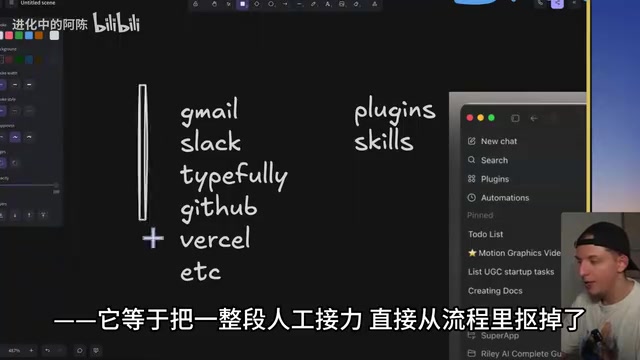
The answer: low-code platforms like Appable and Lovable that promise "one-click app building." Low-code/no-code platforms experienced rapid growth from 2020 to 2023, with Gartner predicting that 70% of new applications would be built using low-code technology by 2025. The core value proposition of these platforms lies in abstracting programming into visual drag-and-drop operations, enabling non-technical users to build applications. However, their business model is built on a "technical barrier gap" — and when AI Agents can generate and deploy applications directly from natural language, that gap gets dramatically compressed.
The dilemma they face:
- Before, users paid for the full packaging and deployment service — a fair value exchange
- Now, an increasing number of tasks can be kicked off with a single command in Codex
- Worse still, OpenAI is subsidizing its own model API calls, gradually eroding these platforms' cost advantage
This doesn't mean low-code platforms will vanish overnight, but they must rethink their value proposition. If their core selling point is simply "lowering the barrier to entry" and "packaging deployment," then once AI Agent platforms internalize these capabilities, the space left for the middleware layer will keep shrinking. It's similar to how website template companies faced an existential crisis once the WordPress ecosystem matured — when a platform swallows the middleware layer's core functions, the middleware must either move upward into deeper vertical niches or risk gradual marginalization.
The Real Cost Isn't the Model — It's the Human Overhead
Let's return to the core insight: in this round of AI competition, the most expensive overhead typically comes from manual data shuttling, manual fallback handling, and manual error correction — not from marginal differences in model specs.
Think about your daily experience using AI tools:
- Copy-pasting back and forth between different windows
- Manually checking whether AI output is correct
- Babysitting billing dashboards and error logs yourself
- Reformatting one tool's output to feed into another tool
The time and energy consumed by this "grunt work" far outweighs the impact of differences in model capability. Whoever eliminates these human-in-the-loop steps first will be 100x more valuable than a model that's just "slightly better on paper."
Final Thoughts
We are living through a pivotal shift in the AI industry: a paradigm transition from "model is king" to "platform is king."
This kind of paradigm shift has clear precedents in tech history. In the PC era, CPU performance competition (Intel vs. AMD) ultimately gave way to the battle over operating systems and ecosystems — Windows established dominance through its software ecosystem, not hardware specs. In the mobile era, chip benchmarks were similarly overshadowed by the iOS/Android platform ecosystems — when consumers choose phones, App Store richness often carries more weight than processor model numbers. The AI industry is replaying this pattern: as foundational model capabilities converge toward homogeneity, the new competitive battleground will be platform integration, developer ecosystems, and deep workflow lock-in. Microsoft embedding Copilot deeply into the entire Office suite is a textbook case of this trend.
This isn't to say models no longer matter — it's that model capability improvements have entered a phase of diminishing returns. What can truly transform the user experience is the platform layer built around models: task orchestration, tool integration, automated execution, and cross-device collaboration.
For everyday users, rather than agonizing over which model to choose, pay attention to which platform can genuinely reduce the time you spend "babysitting AI." For developers and entrepreneurs, pure model wrappers are no longer a good business — building irreplaceable workflow integration capabilities is where the real moat lies.
The "iPhone moment" of AI may not arrive with the launch of some particular model, but rather when a platform makes you truly feel for the first time that AI isn't just chatting with you — it's actually doing the work for you.
Related articles
Turn AI Into Your Personal Tutor with /teach: A Complete Guide to Stateful Skill Design
Deep dive into the /teach AI Skill's design and engineering: stateful vs. stateless Skill selection, ZPD pedagogy, interactive lesson generation, and onboarding potential.
Apple Opens WWDC26 Developer Survey: How to Participate and Share Your Feedback
Apple has opened the WWDC26 developer survey, inviting global developers to share feedback. Learn about the survey's background, this year's AI highlights, and how to participate.

AI Large Language Model Learning Roadmap: A Systematic Path from Zero to Project Implementation
A detailed AI LLM learning roadmap covering Transformer architecture, Prompt Engineering, RAG, Agent development, model fine-tuning & deployment, with enterprise project guides.