Integrating AI Agents into Project Management Tools: A Practical Upgrade from Chat Assistant to Task Execution
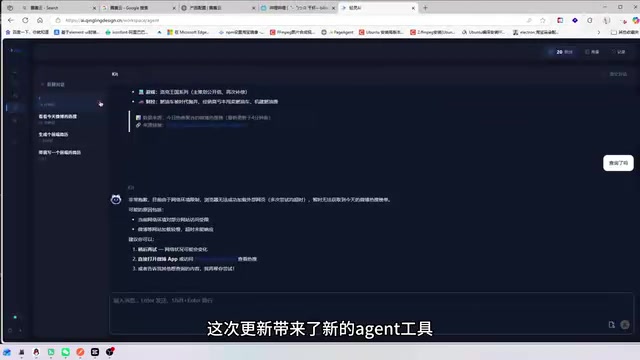
A project management tool evolves its AI from chatbot to task-executing Agent in one month.
A developer spent one month upgrading their project management tool's AI from a basic chat assistant to an intelligent Agent capable of querying data, generating PDF reports, and executing multi-step tasks autonomously. Built on Function Calling architecture, the Agent follows a perceive-decide-act loop, reflecting the broader industry trend of vertical tools integrating AI Agents as standard features.
From Simple Chat to Intelligent Agent
A developer spent one month upgrading the AI capabilities in their project management tool from a simple chat assistant to an intelligent Agent with multiple capabilities. The core change in this update: AI is no longer limited to Q&A conversations — it can now actually execute tasks, query data, and generate documents, truly becoming an indispensable part of the workflow.
The tool already had project management features and basic AI chat capabilities. This update introduces an Agent architecture that grants AI more operational permissions, enabling it to proactively invoke system tools to fulfill user commands.
To understand the significance of this upgrade, it's important to clarify the fundamental difference between AI Agents and traditional chat assistants. A traditional AI chatbot is essentially an "input-output" text generation system — users ask questions, the model generates answers based on training data, and the entire process stays confined within the language space without any real interaction with external systems. An AI Agent, on the other hand, introduces a "perceive-decide-act" loop. It not only understands user intent but can also autonomously plan execution steps, invoke external tools, retrieve real-time data, and dynamically adjust subsequent actions based on intermediate results. This concept originates from Agent theory in artificial intelligence, traceable back to multi-agent system research in the 1990s. However, it wasn't until large language models (LLMs) developed powerful reasoning and instruction-following capabilities that Agents became truly viable for engineering implementation.
Core Capabilities of the AI Agent
Data Querying and Intelligent Summarization
In the demo, the developer asked the AI assistant to query project information for the current account. The Agent automatically called system interfaces, retrieved created project data, and presented a summarized view to the user. Even when the current account had no projects created, the AI clearly communicated the query results rather than simply throwing an error or returning no response.
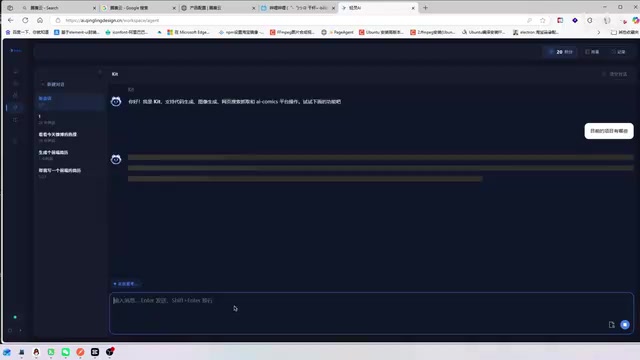
This capability means users no longer need to manually search through the interface for information. They simply describe their needs in natural language, and the Agent automatically handles data retrieval and organization. For teams managing multiple projects, this interaction model can significantly improve information access efficiency.
Automated Document Generation
Even more noteworthy is the Agent's document generation capability. When a user requests a PDF report, the AI automatically invokes relevant tools for processing, completing data integration, formatting, and layout steps, ultimately providing a visual preview and download link.
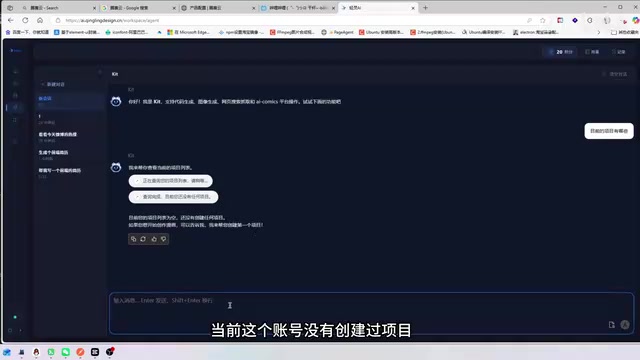
The entire process requires no manual multi-step operations from the user. The Agent autonomously plans the execution path, sequentially calling the necessary tools until the task is complete. This "command → execute → deliver" workflow dramatically reduces the time cost of repetitive operations.
Technical Implementation: Function Calling Architecture
Based on the demo, this AI Agent follows the mainstream Function Calling architecture. The overall process can be broken down into three key steps:
- Intent Recognition: Understanding the user's natural language command and determining the task type
- Tool Selection: Automatically matching the appropriate system tools or APIs based on task requirements
- Execution and Feedback: Invoking tools to complete the task and presenting results to the user in a user-friendly format
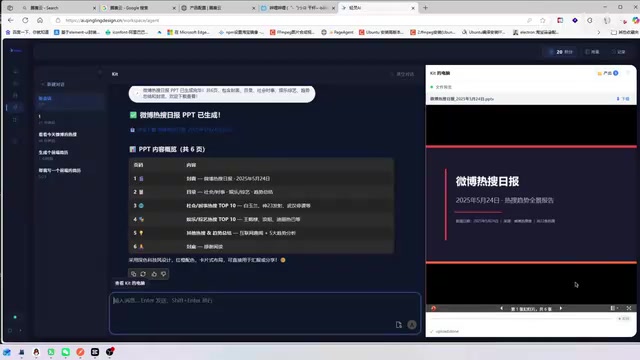
Function Calling was officially introduced by OpenAI in June 2023 alongside the GPT-3.5/GPT-4 API update, and was subsequently adopted by major LLM providers including Anthropic and Google. The core principle works as follows: developers predefine a set of functions (tools) with their names, parameter descriptions, and usage explanations, passing these definitions as part of the system prompt to the LLM. When a user makes a request, the model doesn't directly generate a text response — instead, it outputs a structured JSON object specifying which function to call and what parameters to pass. The application layer receives this call instruction, executes the actual function logic (such as database queries or API requests), then returns the execution results to the model, which generates the final natural language response. This mechanism elegantly combines the LLM's language understanding capabilities with deterministic program execution, solving the fundamental limitation of pure text generation models being unable to operate external systems.
This design transforms AI from an "information provider" into a "task executor" — a textbook example of the Agent-ification trend in current AI application development. Leveraging the LLM's Function Calling capabilities, Agents can flexibly combine multiple tool calls to handle relatively complex multi-step tasks.
Current Status and Industry Trends
The feature is currently in Beta, and the developer encourages users to actively try it out and submit issues and suggestions through the feedback portal. As a solo developer's project, completing the upgrade from basic AI chat to Agent architecture within one month is a testament to the maturity of today's AI development toolchain.
This rapid implementation is inseparable from the thriving open-source Agent framework ecosystem. LangChain is one of the earliest and most widely used Agent development frameworks, providing core components like tool abstraction layers, memory management, and chain-based invocations that let developers assemble Agent capabilities like building blocks. Additionally, Microsoft's AutoGen focuses on multi-Agent collaboration scenarios, CrewAI offers role-based Agent orchestration capabilities, and Vercel's AI SDK provides frontend developers with convenient integration for streaming responses and tool calling. These frameworks compress what would have taken months of Agent infrastructure development into days or even hours of setup time — this is precisely the technical foundation that enables independent developers to complete Agent architecture upgrades in such a short timeframe.
This also reflects a clear industry trend: an increasing number of vertical-domain tools are integrating AI Agents as standard features. Notion has gradually expanded from text-assisted writing to database queries and automated workflows. Slack has integrated AI assistants to automatically summarize channel messages and retrieve conversation history. In the project management space, Linear and Asana are actively introducing AI capabilities for automatic task assignment and progress report generation. Gartner predicts that by 2028, at least 15% of daily work decisions will be made autonomously by AI Agents.
User expectations for "AI that can do things" rather than "AI that can chat" are becoming a critical differentiator in product competitiveness. The driving force behind this trend is that users' pursuit of efficiency has shifted from "better interfaces" to "fewer operations" — ideally, users only need to express their intent, and the system automatically handles everything from understanding to execution. Going forward, whether AI can truly integrate into workflows and take on actual tasks will determine the differentiated value of project management tools and SaaS products at large.
Key Takeaways
Related articles
Five Common Claude Code Mistakes — How Many Are You Making?
Five common Claude Code mistakes developers make: copy-pasting code, skipping CLAUDE.md, inefficient prompting, ignoring docs, and poor context management — with fixes.
Andrew Ng's New Course Explained: A Practical Guide to Using OpenAI's O1 Reasoning Model
Deep dive into Andrew Ng and OpenAI's Reasoning with O1 course covering test-time scaling, new prompting paradigms, multi-model orchestration, and practical applications for developers.

Learning AI After College Entrance Exams: A Complete Path from Zero to Freelancing
How to efficiently learn AI skills during summer break after exams? A complete path from mastering prompts and hands-on projects to freelancing on platforms.