iOS 27 Time Allowances Explained: Developer Compliance Guide & New Child Screen Time Rules
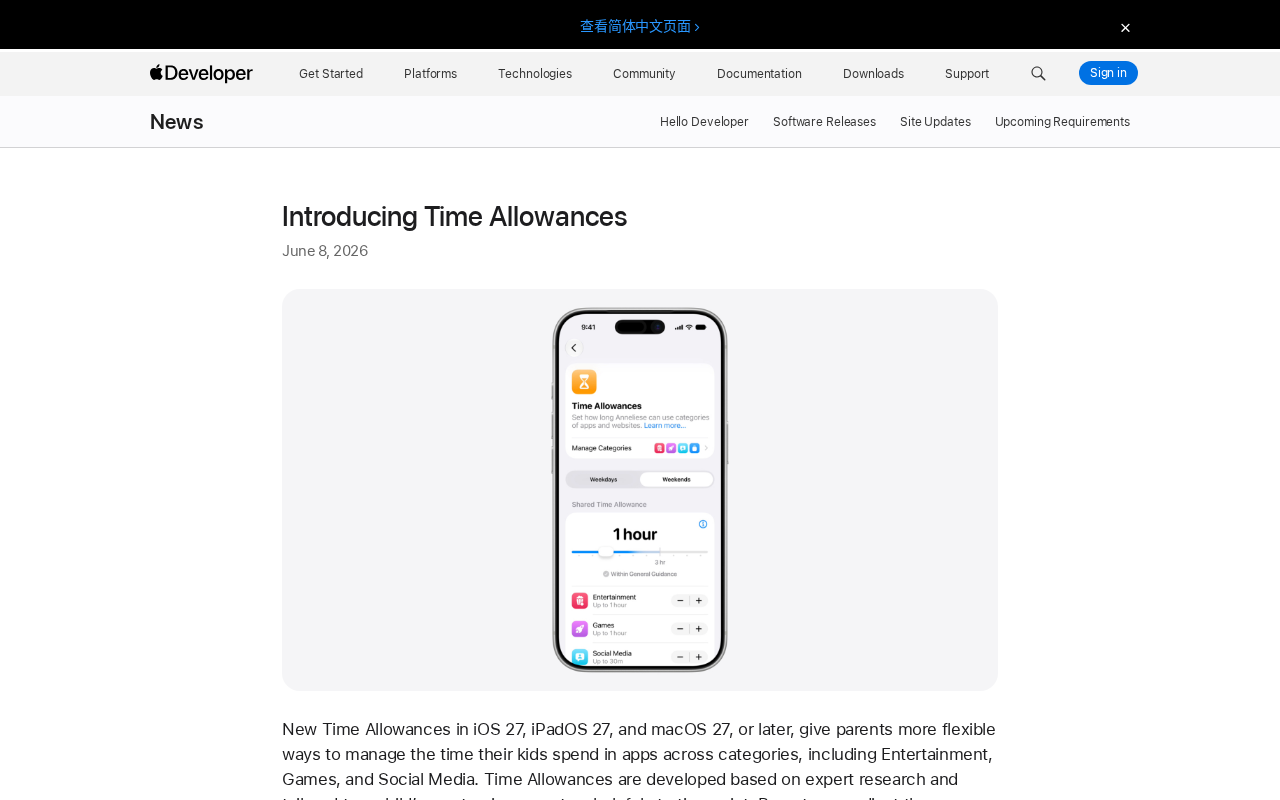
iOS 27 Time Allowances brings category-based screen time controls with new developer compliance rules.
Apple's iOS 27 introduces Time Allowances, a category-based screen time management system covering Entertainment, Games, and Social Media. Social media classification is based on app functionality, not App Store categories. Developers must declare social media features by September 2026, with two compliance paths available. The rules apply to alternative app marketplaces as well.
Overview
Apple has introduced a brand-new Time Allowances feature in iOS 27, iPadOS 27, and macOS 27, giving parents a more flexible way to manage how much time their children spend in different categories of apps. This feature covers three major categories — Entertainment, Games, and Social Media — and was developed based on expert research, with personalized adjustments according to the child's age.
Unlike the previous Screen Time feature, Time Allowances provides granular control by app category rather than a simple total time limit. Parents can allow children to spend more time on educational apps while strictly limiting social media usage — a design philosophy that better reflects real-world needs.
Classification for Entertainment and Games Categories
For developers, an app's classification within the Time Allowances system depends on the information provided in App Store Connect. The specific rules are as follows:
- Apps that list Entertainment or Games as their primary or secondary category in App Store Connect will be automatically placed into the corresponding Time Allowances category
- The Time Allowances category system is independent from the App Store category system used for user discovery
Developers don't need to take any additional action — the system automatically classifies apps based on existing category information. However, it's important to note that inaccurate category settings could affect how an app is classified within the Time Allowances system.
Social Media Category: Stricter Classification Criteria
The classification criteria for the Social Media category is the most noteworthy aspect of this update. Unlike Entertainment and Games, Social Media classification does not rely on the category selected in App Store Connect — instead, it's based on whether the app includes social media functionality.
Definition of Social Media Functionality
Apple has provided a clear definition: the ability to redistribute, amplify, or engage with user-generated content through a social feed or similar discovery mechanism, where content can be visibly spread to a large number of users.
This definition is quite broad, meaning many apps that aren't traditionally considered "social media" — such as games with community features or content platforms with comment interactions — could potentially fall into this category.
Developer Compliance Timeline
Apple has set a clear compliance schedule for developers:
- July 2026: The age rating questionnaire will be updated, allowing developers to indicate whether their app includes social media functionality
- September 2026: Mandatory requirement — when submitting new versions, updates, or distributing through alternative app marketplaces, developers must declare whether their app includes social media functionality
Two Compliance Paths to Choose From
For apps that include social media functionality, Apple offers two paths:
Path One: Full Declaration
- Declare that the app includes social media functionality
- The app will be classified under the Social Media Time Allowances category
- Automatically receives a minimum age rating of 13+
Path Two: Disable Social Features for Minors
- Declare that the app includes social media functionality, but disable it for users under 13
- The app will not be classified under the Social Media category for users under 13
- Must use at least the Declared Age Range API to verify user age ranges
- Age rating is determined by overall questionnaire responses and may be lower than 13+
- The app is still classified under the Social Media category for users 13 and older
Impact on the Developer Ecosystem
Compliance Costs and Technical Investment
The impact of this change on small and mid-sized developers should not be underestimated. Developers who choose Path Two in particular will need to integrate the Declared Age Range API, implement age verification logic, and ensure that social features can be dynamically enabled or disabled based on age groups. This adds significant development and testing complexity.
Challenges to Business Models
For apps that rely on user engagement and time spent (especially social media and games), the Time Allowances feature could directly impact core metrics. Once a parent sets a daily 30-minute social media limit for their child, the app's daily active time will be constrained at the system level.
Alternative App Marketplaces Are Also Subject to These Rules
Apple has explicitly stated that these requirements also apply to the notarization process for apps distributed through alternative app marketplaces. Even in markets like the EU where sideloading is permitted, developers cannot bypass this compliance requirement.
Summary
Apple's Time Allowances feature represents another major upgrade in child protection on mobile platforms. It evolves from simple time limits to granular management based on content categories, while keeping the definition of social media firmly in the platform's hands. Developers need to complete compliance preparations before September 2026. Those with social interaction features in particular should evaluate early whether their apps might be classified under the Social Media category and make the necessary technical and product strategy adjustments accordingly.
Related articles

Five Common Claude Code Mistakes — How Many Are You Making?
Five common Claude Code mistakes developers make: copy-pasting code, skipping CLAUDE.md, inefficient prompting, ignoring docs, and poor context management — with fixes.

Andrew Ng's New Course Explained: A Practical Guide to Using OpenAI's O1 Reasoning Model
Deep dive into Andrew Ng and OpenAI's Reasoning with O1 course covering test-time scaling, new prompting paradigms, multi-model orchestration, and practical applications for developers.

Learning AI After College Entrance Exams: A Complete Path from Zero to Freelancing
How to efficiently learn AI skills during summer break after exams? A complete path from mastering prompts and hands-on projects to freelancing on platforms.