Complete Learning Roadmap for Java Developers Transitioning to AI Engineering

Java developers can upgrade from CRUD to AI engineering through frameworks like Spring AI and RAG technology.
This article explains why Java developers must embrace AI and provides a complete learning roadmap. With LLM-related questions becoming mandatory in technical interviews, developers need both the ability to "teach AI" and "be accountable for AI output." The roadmap covers five phases: AI fundamentals, Java LLM application development (Spring AI, LangChain4j), RAG retrieval-augmented generation, Agent development, and production deployment—while emphasizing that solid Java fundamentals remain essential.
Why Java Developers Must Embrace AI
Technical interviews are undergoing a profound transformation. According to industry observations, questions related to large language models have become nearly mandatory in recent interviews, with requirements going beyond just "knowing how to use them" to emphasizing scenario-based capabilities and project experience.
The logic behind this is clear: developers' work has shifted from traditional CRUD development to "teaching AI how to do things" and "being responsible for AI's output." The core competencies that interviewers assess now fall into two major categories:
- The ability to teach AI: Integrating AI capabilities into products using Java frameworks
- The ability to be accountable for AI output: Having solid Java fundamentals to review AI-generated code and ensure it meets business requirements
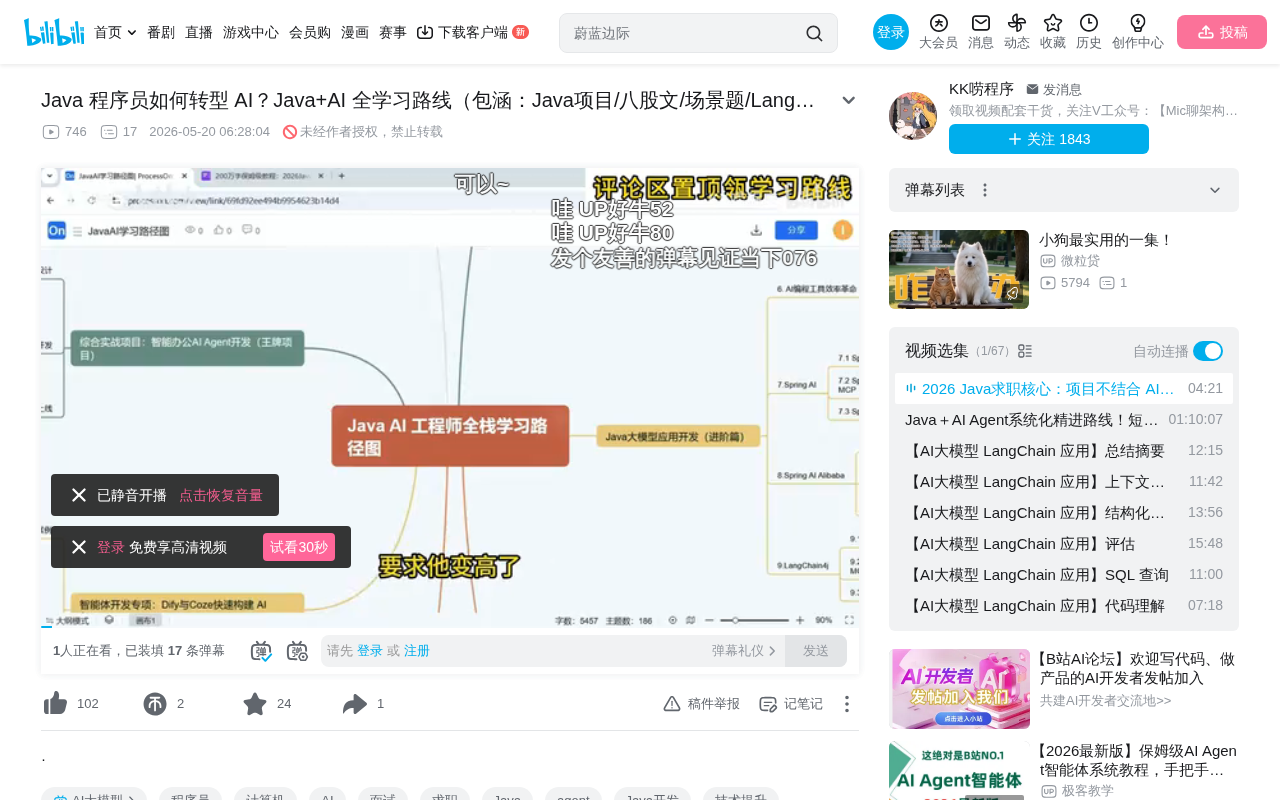
Complete Java+AI Engineer Learning Roadmap
Phase 1: AI Fundamentals
For Java developers, learning AI fundamentals doesn't require diving deep into underlying algorithms. Instead, focus on core concepts that align with the Java ecosystem:
-
Function Calling: Understanding how large models interact with external systems. Function Calling is the core mechanism for LLMs to interact with the outside world. Traditional LLMs can only generate text—they cannot directly operate databases, call APIs, or execute business logic. Function Calling allows developers to register a set of function definitions with the model (including function names, parameter descriptions, and return value specifications). The model determines when to call these functions during inference and generates structured call parameters. Java developers can register existing Service layer methods as callable functions, enabling the model to automatically trigger business logic execution during conversations—making the leap from "chatbot" to "intelligent business assistant."
-
Prompt Engineering: Mastering how to effectively "teach AI." The essence of prompt engineering is guiding LLMs to produce desired outputs through carefully designed text instructions. Core techniques include: role setting (System Prompt), few-shot learning (providing examples in the prompt), Chain of Thought (requiring the model to reason step by step), and output format constraints (requiring structured output like JSON). For Java developers, Prompt Engineering is more like a new form of "interface design"—you need to precisely define input/output specifications in natural language, much like designing an API contract.
-
Java Engineering Practices: Integrating AI capabilities into existing Java project architectures
The key in this phase is establishing the right cognitive framework. The vast majority of LLM tutorials online are Python-based, leaning toward algorithms and model fine-tuning, which don't align with Java developers' job requirements. What Java developers need is application-level AI engineering capability—not training models, but efficiently calling models, orchestrating model capabilities, and integrating them into enterprise systems in an engineering-sound manner.
Phase 2: Java LLM Application Development
Entering the hands-on phase, you need to master AI development frameworks and tools in the Java ecosystem:
Development Assistance Tools:
- GitHub Copilot: An AI programming assistant based on the OpenAI Codex model that auto-completes code based on code context and comments
- Cursor: An AI-driven code editor supporting conversational programming and codebase-level context understanding
- Other AI coding assistance tools
Core Java AI Frameworks:
-
Spring AI: Spring's official AI integration framework providing a unified API abstraction layer. Spring AI was officially launched by the Spring team in late 2023, following Spring ecosystem's consistent "convention over configuration" philosophy. It provides unified abstract interfaces like ChatClient and EmbeddingClient, allowing developers to switch underlying LLM providers (OpenAI, Anthropic, Tongyi Qianwen, etc.) through simple configuration—similar to how Spring Data abstracts different databases. Spring AI also has built-in support for vector stores, document parsing, and Prompt templates, deeply integrated with Spring Boot's auto-configuration mechanism, enabling Java developers to build AI applications using familiar annotation-driven approaches.
-
Spring AI Alibaba: Alibaba's extension based on Spring AI, adapted for the domestic Chinese LLM ecosystem. It deeply integrates the Tongyi Qianwen model series and the Bailian platform, providing more convenient configuration and Chinese documentation for domestic developers, while also adapting to Alibaba Cloud's vector retrieval services and other infrastructure.
-
LangChain4j: The Java implementation of LangChain, feature-rich with an active community. LangChain was originally the most popular LLM application development framework in the Python ecosystem. LangChain4j ports its core concepts to the Java world, providing advanced abstractions like AI Services (declarative AI service definitions), Memory (conversation memory management), and Tools (tool registration and invocation), supporting rapid construction of complex AI application pipelines through annotations.
These frameworks are the "bridge" for Java developers entering the AI field—they encapsulate LLM capabilities into programming paradigms familiar to Java developers, significantly lowering the learning barrier.
Phase 3: RAG (Retrieval-Augmented Generation) — Core Competency
RAG (Retrieval-Augmented Generation) is the core technology for enterprise AI applications today and the most critical part of this learning roadmap. RAG's core idea is to retrieve relevant information from an external knowledge base before the LLM generates an answer, injecting the retrieved results as context into the prompt so the model generates answers based on real data. This architecture solves three core pain points: model hallucination (generating non-existent information), knowledge staleness (training data has a cutoff date), and data privacy (enterprise data doesn't need to be uploaded to model providers for fine-tuning).
Specific learning content includes:
-
RAG Core Principles and Architecture: Understanding the working mechanism of retrieval-augmented generation. The complete RAG process is divided into offline indexing and online retrieval phases—the offline phase converts enterprise documents into high-dimensional vectors via Embedding models and stores them in a vector database; the online phase vectorizes user questions similarly, finds the most relevant document chunks through similarity search (e.g., cosine similarity), concatenates them, and feeds them to the LLM to generate the final answer.
-
Vector Database Hands-on: Using and tuning vector databases like Milvus. Milvus is an open-source cloud-native vector database designed for storing, indexing, and retrieving massive vector data. Unlike traditional relational databases based on exact matching, vector databases perform Approximate Nearest Neighbor (ANN) searches, finding semantically similar results from billions of vectors in milliseconds. Milvus supports multiple indexing algorithms (IVF_FLAT, HNSW, DiskANN, etc.), allowing flexible selection based on data scale and precision requirements. Both Spring AI and LangChain4j have built-in Milvus integration support, enabling Java developers to operate vector data through familiar Repository patterns.
-
Text Splitting Strategies: How to effectively chunk documents into retrievable segments. Text splitting (Chunking) directly impacts retrieval quality—chunks that are too large reduce retrieval precision and waste tokens, while chunks that are too small lose contextual semantics. Common strategies include fixed-size splitting (with overlapping windows), semantic-based splitting (by paragraph/section), and recursive character splitting. Different document types (PDF, code, tables) require different splitting strategies.
-
Enterprise-grade RAG System Full-cycle Development: Complete project practice from data processing to deployment. This includes document parsing (handling multiple formats like PDF, Word, web pages), data cleaning and preprocessing, Embedding model selection and deployment, retrieval strategy optimization (hybrid retrieval, Reranking), and evaluation system construction (metrics like retrieval recall rate and answer accuracy).
RAG is the key technology for deploying AI into enterprise business scenarios. Mastering RAG implementation within Java frameworks is the core competitive advantage of a Java AI engineer.
Phase 4: Agent Development — Advanced Practice
Agents represent the advanced form of AI applications—no longer simple "question and answer" but intelligent systems with autonomous planning, tool invocation, and iterative reasoning capabilities. Build competency through multiple hands-on projects:
-
Code Assistance Tool Development: Directly related to daily development work, such as building AI assistants that can understand project codebases, automatically generate unit tests, and perform code reviews
-
Intelligent Customer Service System: A typical enterprise AI application scenario involving intent recognition, multi-turn dialogue management, knowledge base retrieval, and ticket system integration—a complete end-to-end pipeline
-
Agent Development: Autonomous decision-making systems based on ReAct/Function Calling. ReAct (Reasoning + Acting) is currently the most mainstream Agent architecture pattern, with its core loop being: Thought → Action → Observation → Re-think. The Agent autonomously decomposes tasks based on user goals, selects appropriate tools to execute, observes execution results, then decides the next action until the task is complete. This pattern enables AI systems to handle complex multi-step tasks such as automated code refactoring and cross-system data integration.
-
Multi-Agent Collaboration: Using frameworks like Crew to implement multi-agent orchestration for complex tasks. In multi-Agent systems, different Agents play different roles (e.g., Product Manager Agent, Developer Agent, Tester Agent), collaborating through message passing and cooperation protocols to complete complex tasks—similar to service orchestration in microservice architectures.
Phase 5: Production Deployment and Commercialization
-
Performance Optimization: Response latency optimization (streaming output via SSE, async calls), concurrency handling (request queues, rate limiting and circuit breaking), Token cost control (Prompt compression, caching strategies, model routing—selecting different model tiers based on question complexity)
-
Security Protection: Prompt injection defense is one of the most serious security threats facing AI applications. Attackers craft input text to override the system's preset Prompt instructions, causing the LLM to perform unintended behaviors. Defense measures include input filtering and sanitization, output validation, principle of least privilege (limiting the resource scope accessible by Function Calling), and using dedicated security detection models to audit inputs and outputs. Additionally, data privacy protection (sensitive information masking, local deployment solutions) must be addressed.
-
Commercialization: Productization paths for AI features, including pay-per-call billing model design, gradual rollout strategies for AI features, user experience optimization (handling model response uncertainty), and ROI evaluation frameworks.
Java Fundamentals Remain Essential
"Being accountable for AI output" requires solid Java fundamentals. When AI generates asynchronous code using CompletableFuture or a solution involving distributed locks, developers must be able to judge its correctness and potential risks. Interview preparation should cover:
Technical Stack Depth:
- Spring/Spring MVC core principles: IoC container, AOP mechanisms, Bean lifecycle, DispatcherServlet request processing flow—these are the foundation for understanding Spring AI framework internals
- Advanced Redis applications: Beyond basic caching, master distributed locks, message queues (Stream), and vector search (Redis Stack supports vector similarity search and can serve as a lightweight vector database)
- Message queues (RocketMQ, etc.): In AI applications, message queues are commonly used for async processing of LLM calls, decoupling document indexing workflows, and implementing inter-Agent message communication
- Concurrent programming: CompletableFuture, virtual threads (Java 21), etc. are heavily used in AI applications—scenarios like parallel calls to multiple models and concurrent document vectorization
High-frequency Scenario Questions:
- Login system design
- E-commerce platform architecture
- Flash sale system design
- How to integrate LLM capabilities into projects
These are no longer simple rote memorization exercises but require genuine understanding of principles and the ability to make correct technical judgments in AI-assisted development scenarios.
Summary and Recommendations
For Java developers, the AI transition isn't a "career change"—it's an "upgrade." The core path is:
- Build on the Java ecosystem by learning frameworks like Spring AI and LangChain4j
- Focus on mastering RAG technology—it's a hard requirement for enterprise applications
- Master the advanced form of AI applications through Agent development
- Simultaneously strengthen Java fundamentals to ensure quality control of AI output
In the AI era, Java developers' value isn't being replaced—it's evolving from "people who write code" to "people who harness AI to write code." The sooner you build this compound capability, the more pronounced your competitive advantage in the job market.
Related articles
 Tutorials
Cursor + Codex Dual-IDE Collaboration: A Practical Methodology for Open-Source Project Customization
A complete methodology for open-source project customization based on real-world experience, detailing the Cursor+Codex dual-IDE workflow, seven-stage process, MVP validation, and AI source code reading techniques.
 Tutorials
Cursor Multi-Agent in Practice: Building a Full-Stack Next.js Blog in 50 Minutes
Build a full-stack blog in 50 minutes using Cursor IDE's multi-Agent mode with Next.js, Clerk auth, and Supabase. Learn the 4-phase AI Agent workflow and key integration pitfalls.
 Tutorials
Building an AI Software Factory from Scratch: A Cursor Engineer's Hands-On Experience with Multi-Agent Collaboration
Cursor engineer Eric shares practical insights on building an AI software factory: automation levels, guardrail design, parallel Agent management, and scaling to 1000+ Agents for 24/7 development.