Survival Strategies in Extreme Environments: A Complete Guide to Nature's Adaptive Wisdom
Survival Strategies in Extreme Environ…
Documentary Hostile Planet reveals diverse animal survival strategies under extreme environments and climate change.
Based on the documentary Hostile Planet, this article systematically examines animal survival strategies in Earth's most extreme environments: from newborn camouflage tactics and apex predators' high-risk hunts, to sophisticated group cooperation, desert creatures surviving at thermal limits, and the ecological balance maintained through parasitism and symbiosis. The article emphasizes that climate change is rapidly reshaping the rules of survival, and species' persistence depends on how quickly they can adapt.
Introduction: When Survival Conditions Become Unprecedentedly Harsh
The National Geographic documentary Hostile Planet captures stunning footage of animals struggling to survive in Earth's most extreme environments. From the African savanna to the Arctic ice sheet, from the deep sea to the desert, this documentary reveals a brutal truth: as climate change accelerates, species' survival capabilities face unprecedented challenges.
This article draws on the complete content of the documentary to examine the most representative extreme-environment survival strategies and explore what nature's adaptive wisdom can teach us about ecosystem resilience.
Born on the Battlefield: Life's First Survival Test
Thomson's Gazelle: The Instinct of Concealment and Camouflage
The African savanna is home to the highest density of large predators on Earth. Many Thomson's gazelle fawns don't even survive their first hour after birth. A mother's instinct is to lick her newborn clean of scent, but when a cheetah closes in, standing beside the fawn would only give away its position. The fawn's only option is to lie flat and stay motionless — a still fawn looks no different from a mound of dirt.
A cheetah's hunting instinct is triggered by movement, making this "playing dead" strategy, though primitive, remarkably effective. It is the first line of defense that natural selection has granted to the most vulnerable lives.
Barnacle Goose Chicks: A Leap of Faith on Arctic Cliffs
In the mountains north of the Arctic Circle, barnacle geese nest on 400-foot-tall rock pinnacles to escape predators. But this choice creates a fatal paradox: the chicks cannot fly, and food lies at a riverbank a mile away. If they don't eat within 36 hours, they will starve. The only solution is to jump off the cliff.
About 50% of chicks survive this "leap of faith." As seasons become increasingly unpredictable, survival rates continue to decline. This is natural selection at its most brutal and visceral.
Apex Predators: The Ultimate Hunting Gambit
Jaguar vs. Caiman: A High-Risk, High-Reward Strategy
In Brazil's Pantanal wetlands, a female jaguar demonstrates astonishing hunting prowess. Her target is not ordinary prey but a caiman — a prehistoric-grade reptile. The jaguar uses her precise bite force to pierce the crocodilian's skull, subduing it instantly. Kills of this magnitude are rarely documented, but a single success can provide food for days.
High risk brings high reward. In resource-scarce environments, the key to survival sometimes lies in "unreasonable ambition."
Snow Leopard Cliff Hunt: Remarkable Recovery After a 200-Foot Fall
Snow leopards depend on camouflage and agility for survival. While pursuing a bharal (blue sheep), a snow leopard tumbles 200 feet off a cliff, never releasing its grip on the prey the entire way down. Incredibly, just three days later, the severely injured snow leopard is back on its feet and hunting again.
For a predator that relies on agility to survive, injury can be fatal. Yet it is precisely this remarkable resilience that makes the snow leopard a symbol of vitality in Earth's most desolate environments.
Collective Intelligence and the Survival Advantage of Social Cooperation
Wolf Pack vs. Bison: A Winter Battle of Life and Death
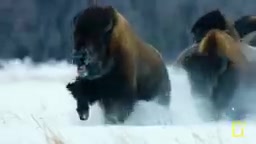
In the depths of winter on the North American Great Plains, temperatures plunge to minus 40 degrees. Bison dig through snow for dead grass with the nutritional value of cardboard — 23 pounds a day still isn't enough. They are starving.
This is also home to the world's largest wolves — a super pack of 25. The pack's strategy is to create panic, break the bison's formation, and expose the weak. But bison mothers risk their lives to protect their calves, pulling them back into the herd's protection time and again. As long as a calf can stay hidden within the ranks, it has a chance of survival.
The essence of this contest is: group cohesion versus coordinated attack.
Orca Cooperative Hunting: The Ocean's Most Sophisticated Team Tactics
In Norway's winter fjords, orca pods demonstrate the most sophisticated cooperative hunting in the ocean. Facing massive schools of billions of herring, orcas employ a "divide and conquer" tactic: drivers split the school into smaller clusters, then "strikers" slap the water surface with their tails, generating shockwaves that can stun up to 30 fish at a time.
But when humpback whales — six times the weight of an orca — arrive, the orcas wisely choose to relocate. Knowing when to cut your losses is itself a form of survival wisdom.
How Climate Change Is Reshaping Animal Survival Rules
The Polar Bear's Summer Survival Crisis
As ice continues to retreat, polar bears are stranded on land, barely surviving on fat reserves accumulated the previous winter. A hungry polar bear attempts to hunt beluga whales in shallow water — these agile cetaceans have rotatable necks that allow them to easily spot an approaching bear. Every failed dive burns precious energy.
Eventually, the bear shifts strategy, ambushing a young whale from the rocks. Flexibility and opportunism are the keys to success. But if ice-free periods continue to lengthen, even this adaptation may not be enough.
Desert Creatures: Surviving at the Thermal Limit
The Namib Desert's sand surface can reach 160°F (approximately 71°C) at midday. Different species have evolved their own unique coping mechanisms:
- Shovel-snouted lizards "dance" by alternately lifting their feet to avoid burns
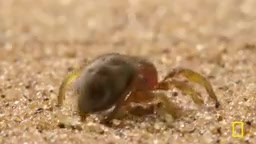
- Wheel spiders can withstand temperatures of 120°F and weave sand blankets to seal their burrow entrances for insulation
- Silver ants turn extreme heat into a competitive advantage — foraging when predators are forced to take shelter
Long legs keep the ants' bodies just one-fifth of an inch off the sand surface, but the temperature drops by 12 degrees at that height. They run fast enough to generate their own cooling airflow. This is precision survival at the edge of thermodynamic limits.
Ethiopian Gelada: Social Games of High-Altitude Survival
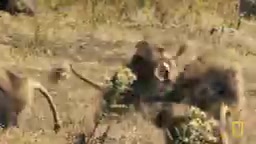
Rising temperatures are forcing mountain-dwelling species to migrate ever higher. In Ethiopia, as many as 1,200 geladas gather on highlands at 10,000 feet above sea level — one of the largest primate aggregations on Earth. They subsist almost entirely on grass, but grass is so nutritionally poor that they must feed for 10 hours a day.
Aging males must constantly cycle between feeding, migrating, and fighting, draining themselves completely. When the strongest young males mount a challenge, it is ultimately the loyalty of the female group that preserves the old leader's position. As the climate warms, the grasslands they depend on will continue retreating to higher elevations, and competition for survival will only intensify.
Parasitism and Symbiosis: The Hidden Balancing Mechanisms of Ecosystems
Cordyceps is one of nature's most terrifying survival strategies. A single spore lands on an ant, mycelial networks infiltrate its muscles, chemicals flood its brain, and the fungus forces its host to travel to a location with perfect humidity and light to perform the "death bite." Three weeks later, the Cordyceps erupts from the ant's body, releasing new spores to infect more ants.
Over 600 species of Cordyceps are known worldwide, and they can wipe out entire colonies. But from an ecosystem perspective, this parasitic relationship controls population sizes and maintains the balance of the jungle. Life blooming from death is one of nature's most profound paradoxes.
Conclusion: Adaptability Determines a Species' Future
From the silent camouflage of Thomson's gazelle fawns to the precision teamwork of orca pods; from a snow leopard's three-day recovery after a cliff fall to a polar bear's shift in hunting strategy — these "ultimate survivors" demonstrate the diverse pathways life takes to cope with extreme environments.
The documentary's core message is clear: Earth is becoming more "hostile," and whether species endure depends on how quickly they can adapt to change. Survival strategies that evolved over 50 million years are now being tested by climate upheaval unfolding over mere decades. Experience, memory, social bonds, flexibility, and opportunism — these qualities are not just the survival rules of the animal kingdom but also the key framework for understanding ecological resilience.
Related articles
 Deep Dives
Deep Dive into How OpenClaw (Open-Source Crayfish) AI Agent Works
Deep analysis of OpenClaw AI Agent internals: System Prompt, tool calling, SubAgents, Skill system, memory, and Context Engineering explained.
 Deep Dives
Demystifying Transformer: A Word-Continuation Function, Deconstructed
Understand Transformer through the lens of word continuation. Breaking down language generation into Embedding, Transformer Block, and Probability output modules for intuitive understanding.
 Deep Dives
Five Core Differences Between Claude Code and Regular AI Chat
A detailed comparison of Claude Code vs regular AI chat across five dimensions: interaction, context understanding, execution, memory, and tool integration.