Kiro Stops Providing Claude Model Services to Chinese Users: Impact and Alternatives
Kiro Stops Providing Claude Model Serv…
Amazon's Kiro will stop providing Claude models and Auto Agent to Chinese users
Amazon's AI coding tool Kiro announced that starting May 1, 2026, it will stop providing Claude models and Auto Agent functionality to users in China and other regions due to Anthropic's regional terms of service restrictions. The company recommends users switch to open-weight models and will refund paid users' April subscription fees. This event reflects the accelerating geopoliticization of AI tools, urging domestic developers to explore alternatives and build diversified toolchains.
Event Overview
Kiro, the AI coding tool owned by Amazon, recently sent an official email to users announcing that starting May 1, 2026, it will stop providing Claude models and Auto Agent functionality to users in China and other regions not supported by Anthropic. This news is undoubtedly a major blow to domestic users who rely on Kiro for their daily development work.
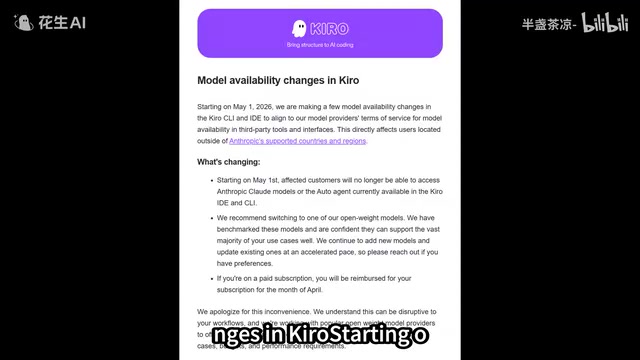
The email, titled "Model Availability Changes in Kiro," clearly states that this adjustment is to comply with the model provider's (i.e., Anthropic's) terms of service restrictions regarding model availability in third-party tools and interfaces. In other words, this is not Kiro's own proactive decision, but rather Anthropic imposing stricter regional restrictions on the use of its Claude models on third-party platforms.
Background on Anthropic and Claude Models: Anthropic is an AI safety company founded in 2021 by former OpenAI core researchers Dario Amodei, Daniela Amodei, and others, focused on building interpretable and alignable large language models. Its flagship Claude series employs a proprietary Constitutional AI training method—constraining model behavior through a set of explicit principles to achieve a better balance between safety and helpfulness. In terms of coding capabilities, Claude leverages its ultra-long context window (supporting up to 200K tokens) and powerful multi-step reasoning to handle complex tasks such as understanding large codebases, refactoring, and cross-file modifications, consistently ranking among the leaders on authoritative coding benchmarks like SWE-bench. This is precisely why Claude has become the preferred underlying model for many AI coding tools, and why Kiro has relied on it as a core capability pillar.
Scope of Affected Features
Which Features Will Become Unavailable?
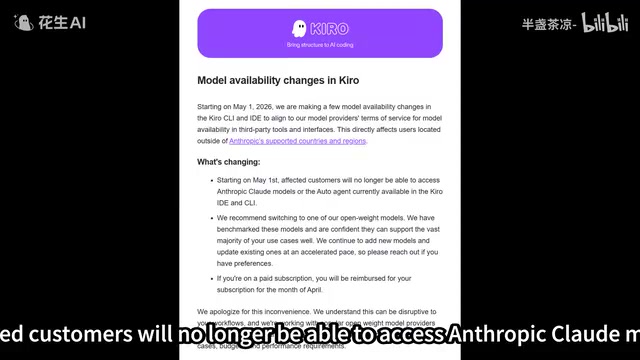
According to the email, affected users will no longer be able to access the following features in Kiro IDE and CLI:
- Anthropic Claude model series: Including all Claude models invoked through Kiro
- Auto Agent functionality: The automated AI agent capabilities currently offered by Kiro
Auto Agent Technical Background: Auto Agent (automated AI agent) is one of the most valuable differentiating features in current AI coding tools. Its core principle is building an autonomous task execution framework (Agentic Loop) based on large language models: the model not only generates code snippets but also autonomously decomposes complex programming tasks into multiple sub-steps, cyclically invoking external tools such as code execution, file read/write, terminal commands, and web searches, then automatically iterating and correcting based on execution results until the task is complete. This capability is highly dependent on the underlying model's instruction-following ability and long-range reasoning capability—which happens to be Claude's strength. Without Claude's support, Auto Agent's performance in complex scenarios such as cross-file refactoring, automated debugging, and dependency management will face noticeable degradation.
This means Kiro's most core AI coding capabilities will be significantly diminished for Chinese users. As Kiro's primary model, Claude's coding ability is industry-leading, and losing this model support will inevitably have a significant impact on user experience.
Official Alternatives Provided
In the email, Kiro officially recommends that affected users switch to the open-weight models it provides, stating:
- These models have been benchmarked and can support the vast majority of use cases
- The team is accelerating the addition of new models and updating existing ones
- User feedback on model preferences is welcome
- They are collaborating with major open-weight model providers to offer a broader selection of models
Open-weight Models Explained: Unlike fully closed-source commercial models like Claude and GPT-4, open-weight models refer to large language models where developers have publicly released the model parameter weight files. Representative products include Meta's Llama series, French company Mistral AI's Mistral/Mixtral series, and domestic options like DeepSeek Coder and Qwen Coder. "Open-weight" is not equivalent to fully open-source—some models only release weights for research, with commercial use still restricted—but the core advantage is that users can download and run models on local machines or their own cloud servers, fundamentally circumventing regional access restrictions. However, in terms of complex code reasoning, long-context understanding, and multi-step task execution, current mainstream open-weight models still have a perceptible capability gap compared to Claude 3.5/3.7 Sonnet, especially in enterprise-level scenarios requiring deep understanding of large codebases.
However, the gap between open-weight models and Claude in code generation, comprehension, and reasoning is an objective reality. For developers who heavily rely on Claude's capabilities, whether these alternatives can truly "meet most use cases" remains to be verified in practice.
Refund Compensation for Paid Users
For users who have already paid for subscriptions, Kiro states it will refund the April 2026 subscription fee. The email also apologizes for any disruption this change may cause to users' workflows.
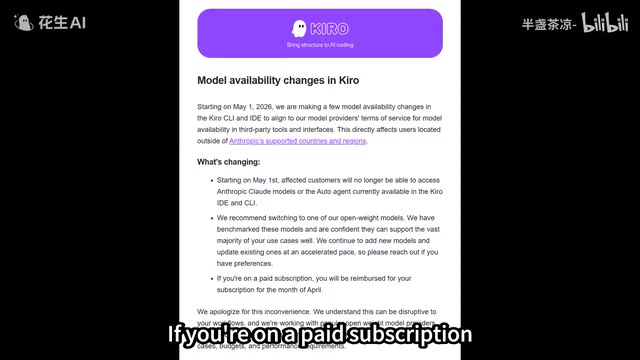
While the refund is a basic remedial measure, for teams that have deeply integrated Kiro into their development workflows, the migration costs and efficiency losses during the adaptation period far exceed what one month's subscription fee can compensate.
Deep Analysis of Underlying Causes
Anthropic's Regional Restriction Strategy
The fundamental cause of this event lies in Anthropic tightening its regional usage policies for Claude models. As Claude's developer, Anthropic has the right to determine the availability scope of its models on third-party platforms. Previously, domestic users could not directly access Anthropic's official services but could indirectly use Claude models through third-party channels such as AWS Bedrock and Kiro.
Notably, Anthropic has received funding from U.S. government-affiliated institutions and defense-sector investors, facing compliance pressures similar to OpenAI's, with increasingly strict regulatory expectations regarding model export controls. Transmitting restrictions downstream to third parties through terms of service is a common path for platform-based AI companies to mitigate compliance risks—shifting regional enforcement responsibility to API callers rather than having the model provider directly face end users. Now this pathway is also gradually narrowing.
Accelerating Geopoliticization of AI Tools
This event is not an isolated case. An increasing number of overseas AI services are implementing access restrictions for Chinese users, from OpenAI to Anthropic, from direct services to third-party integrations, with the scope of restrictions continuously expanding. This reflects how geopolitical factors in the AI field are profoundly affecting the global availability of technology products.
From a broader perspective, this trend is consistent with U.S. semiconductor export control policies toward China, extending from the hardware computing layer to the software model layer—first restricting high-end GPU exports, then limiting cloud computing services, and now further tightening to specific AI model third-party access permissions. AI coding tools are merely the latest manifestation of this structural trend.
Recommendations for Domestic Developers
Facing the change of Kiro discontinuing Claude model access, domestic developers can consider the following strategies:
- Pay attention to domestic AI coding tools: Domestic alternatives such as Tongyi Lingma and Doubao MarsCode are maturing rapidly and are worth trying
- Explore open-source coding models: Domestic open-source coding models like DeepSeek Coder and Qwen Coder perform well and can be used through local deployment or compatible IDE plugins
- Build a diversified toolchain: Avoid over-reliance on a single AI coding tool; use multiple tools in parallel to reduce single-point-of-failure risk
- Test Kiro's open-weight models: Before officially switching, first evaluate whether the alternative models provided by Kiro can meet core development needs
This event once again reminds us that when choosing AI coding tools, controllability and sustainability are just as important as powerful functionality. Relying on external services beyond one's own control always carries uncertainty risks.
Key Takeaways
- Kiro officially announced that starting May 1, 2026, it will stop providing Claude models and Auto Agent functionality to users in China and other regions not supported by Anthropic
- This adjustment stems from Anthropic's regional usage terms restrictions for Claude models in third-party tools
- The official recommendation is for users to switch to open-weight models as alternatives, with a commitment to accelerate the introduction of more model options
- Paid subscription users will receive a refund for their April 2026 subscription fee
- The event reflects the accelerating geopoliticization of AI tools, and domestic developers need to focus on alternatives and tool diversification
Related articles
 Tech Frontiers
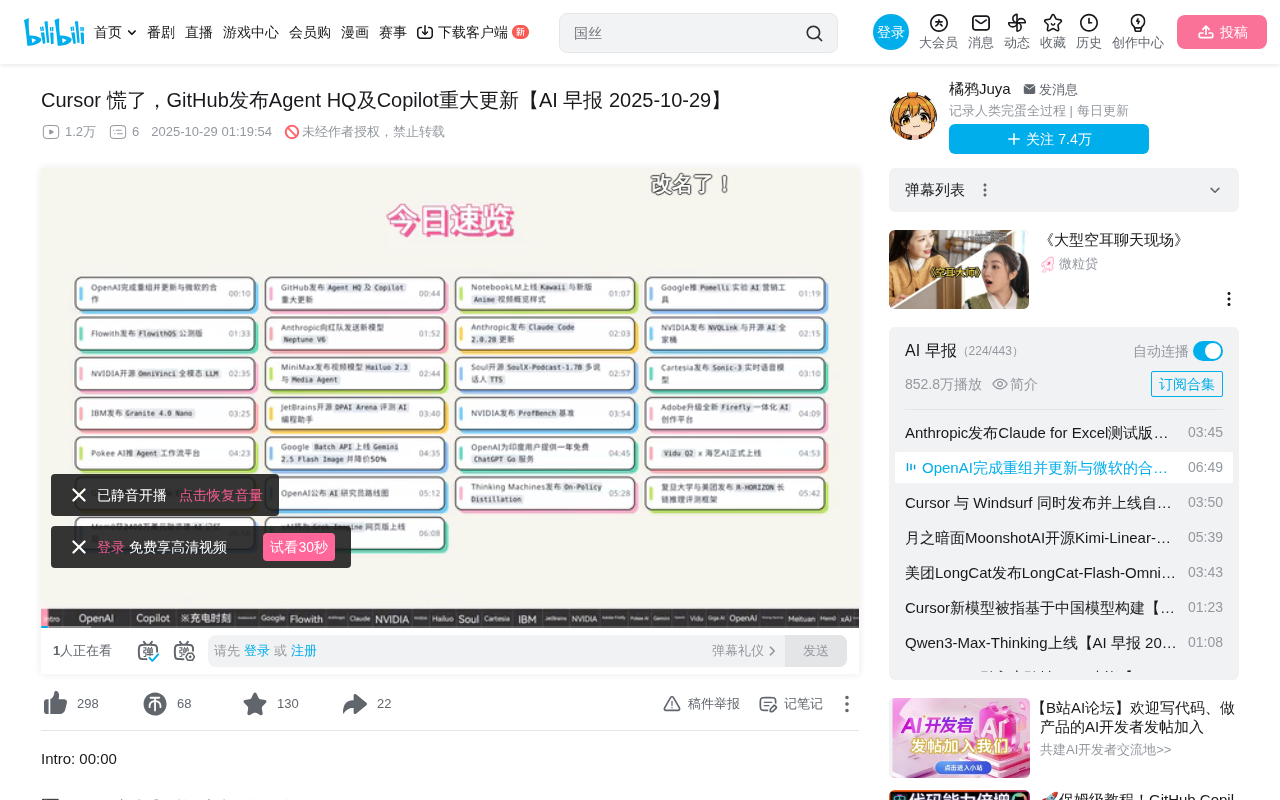
GitHub Agent HQ Launch: AI Coding Tools Enter the Era of Platform Competition
GitHub Universe unveils Agent HQ platform for unified coding agent management, Copilot upgrades with multi-model support. OpenAI completes restructuring, Anthropic tests new model, NVIDIA open-sources AI models.
 Tech Frontiers
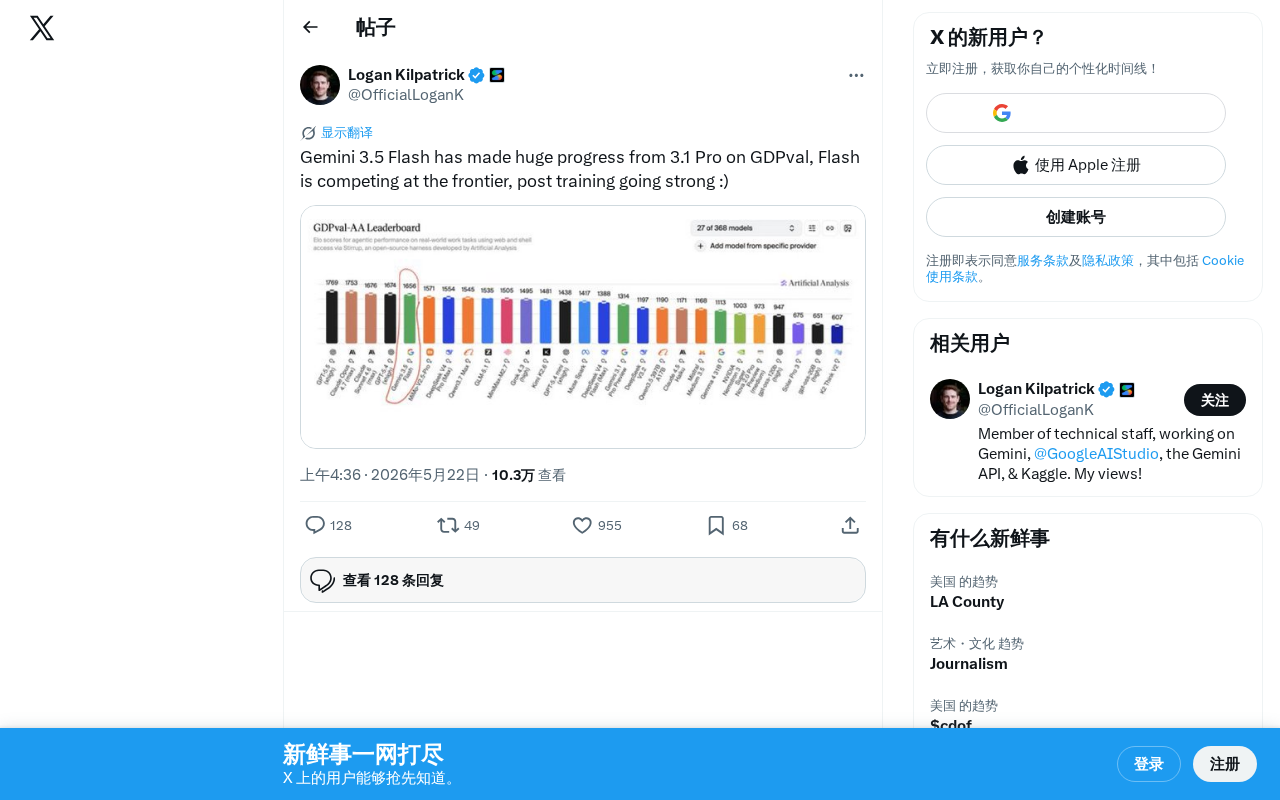
Gemini 3.5 Flash Achieves a Massive Leap on the GDPval Benchmark
Google Gemini 3.5 Flash surpasses Gemini 3.1 Pro on the GDPval benchmark. The lightweight Flash model leverages post-training techniques to approach frontier-level performance, redefining the balance between quality and cost.
 Tech Frontiers
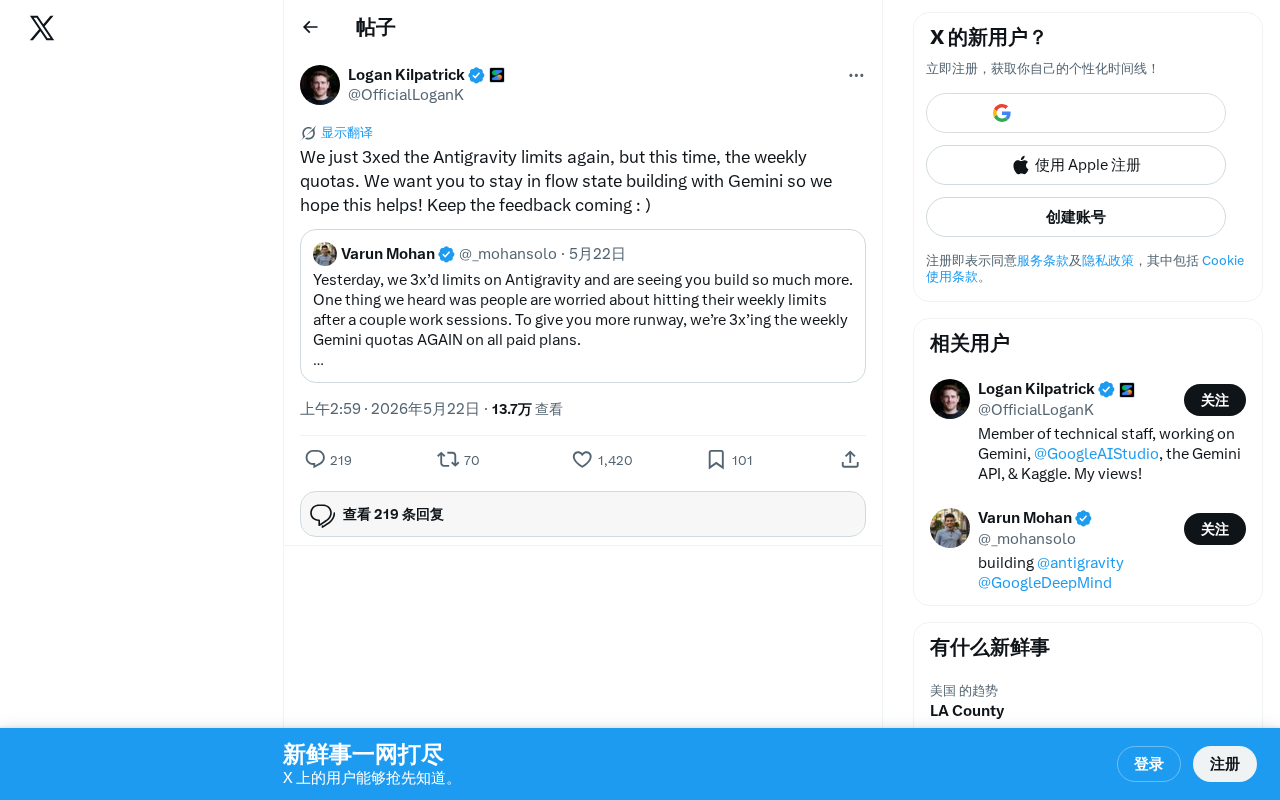
Google Gemini Antigravity Weekly Quota Tripled — AI Coding Without Limits
Google Gemini triples Antigravity weekly quotas following a prior daily quota boost. Analyzing the impact on developers and its strategic significance in AI coding.