LangChain 1.0 Complete Guide: Architecture, Core Modules, and Learning Path

LangChain 1.0 evolves into an Agent engineering platform with a three-layer architecture.
LangChain 1.0 has repositioned itself from an LLM calling tool to an Agent engineering platform, establishing a three-layer progressive architecture: LangChain (high-level abstraction), LangGraph (low-level State Graph engine), and Deep Agents (complex task handling). Its core components solve integration challenges across Models, Tools, and Memory, while building a vast ecosystem covering mainstream LLMs, embedding models, and toolchains. The official learning path progresses through four steps: semantic search, RAG, SQL Agent, and multi-agent collaboration.
Introduction: LangChain 1.0's Repositioning
LangChain 1.0 was officially released in October 2023, representing a significant upgrade from previous versions. The official positioning has become much clearer — LangChain is the platform for agent engineering, a dedicated engineering platform for building intelligent agents.
This means LangChain is no longer just a simple LLM chaining tool, but a complete Agent development framework built on top of large language models. This article systematically walks through its architecture design, core modules, and recommended learning path based on the official LangChain documentation, helping developers quickly build a comprehensive understanding.
Three-Layer Architecture: LangChain, LangGraph, and Deep Agents
The most important architectural change in LangChain 1.0 is the clearly defined hierarchical relationship between three core modules.
LangChain: High-Level Abstraction for Quick Start
LangChain itself is positioned as a High Level API layer. The official description calls it "the easiest way to start building agents and applications powered by LLM." If you need to quickly build an LLM-powered application, LangChain provides well-encapsulated interfaces that let you spin up an Agent with just a few lines of code.
In version 1.0, the Agent interface definition has been elevated to the LangChain layer (previously, Agent was placed under the LangGraph module), reflecting the team's emphasis on Agent as a core abstraction.
LangGraph: Low-Level Engine for Fine-Grained Control
LangGraph is positioned as Low Level, fully focused on Agent Orchestration. It's built on the State Graph data structure, addressing the inherent stateless and memoryless nature of LLMs.
A simple analogy: LangChain is automatic transmission, LangGraph is manual transmission. When you need more complex custom logic or dynamic workflows, you'll need to dive into the LangGraph layer. The relationship between the two is that LangGraph serves as both the underlying foundation for LangChain and can be used independently.
Deep Agents: Tackling Complex Tasks
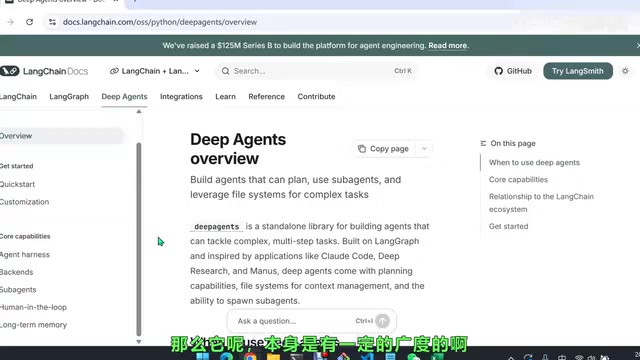
Deep Agents is a new concept introduced in 1.0, designed for building complex agents capable of planning, using Sub Agents, and operating on file systems. Built on top of LangChain and LangGraph, it provides the ability to handle higher-complexity tasks, including Human-in-the-Loop, long-term memory, and other advanced features.
The three layers form a clear progression: LangChain (broadest coverage) → LangGraph (deeper control) → Deep Agents (solving the most complex problems).
Core Components in Detail
LangChain's core components essentially solve an integration problem — integrating LLMs, integrating tools, and managing memory and context.
Models and Messages: The Foundation for LLM Interaction
The Models module encapsulates interface integrations with various LLMs. With hundreds of models on the market, each with its own specific API, LangChain abstracts away these differences through a unified interface layer — one of the framework's most valuable capabilities.
Messages define the message format for conversations with LLMs: users send User Messages, and the model returns Assistant Messages (or AI Messages), all following a unified Message protocol.
Tools: Extending Agent Capabilities
LLMs inherently lack tool-use capabilities, and the core of Agent development is enabling LLMs to call various tools. Search engines, custom functions, vector databases, PDF parsers — these all fall under the Tools category. LangChain has done extensive work on tool integration, achieving comprehensive coverage of mainstream tools.
Memory and Context: Compensating for LLM Limitations
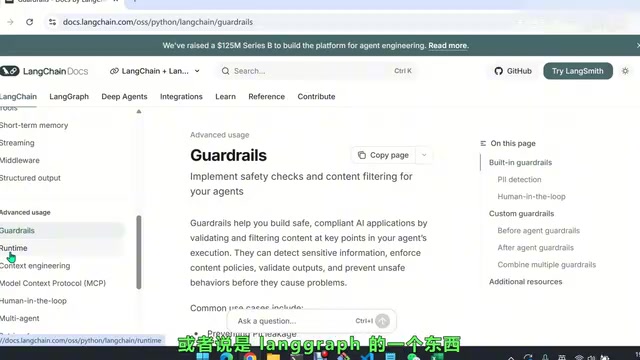
LLMs are inherently memoryless and stateless. LangChain's Memory mechanism gives them conversational memory capabilities. The concept of Memory is quite concrete — it's essentially chat history. Context is a broader concept that encompasses Memory, Tools, formatted output, and all other contextual information involved in LLM interactions.
Additionally, there's the MCP (Model Context Protocol), which addresses communication standards for tool integration. The Human-in-the-Loop mechanism introduces human confirmation at critical decision points, improving system reliability.
Integration Ecosystem: LangChain's Competitive Moat
LangChain's value lies not only in the development framework itself but also in the massive integration ecosystem it has built.
Chat Models Integration
Chat model integration is the most critical part. Mainstream models like DeepSeek, Qwen, GPT, Claude, and others are all supported. Developers don't need to worry about interface differences between models — they can call any of them using a unified API, significantly reducing development effort.
Embedding Models Integration
Embedding models are also a type of model, but much simpler than Chat Models — typically only a few hundred MB in size. Their purpose is to convert text into 768-dimensional (or other dimensional) vectors, quantifying semantics numerically and making semantic similarity calculations possible. Embedding models are foundational components for RAG and other retrieval-augmented applications.
Tools and Database Integration
From Anthropic and AWS to the Chroma vector database, from Ollama local deployment to DeepSeek, LangChain's integration coverage is extremely broad. This is an important reason to choose LangChain — it not only helps you build agents but also efficiently integrates your existing toolchain.
Recommended Learning Path
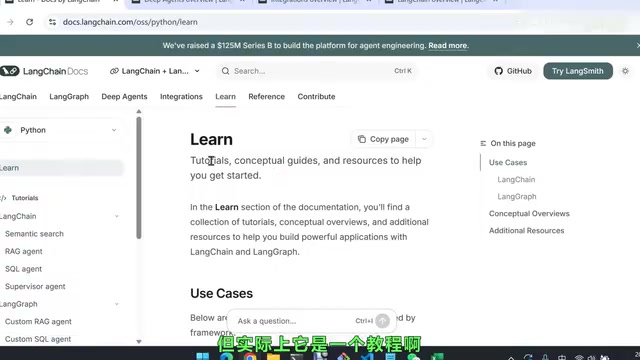
LangChain's official Learn section provides structured beginner tutorials with four progressively advanced complete examples:
Step 1: Semantic Search
Understand how embedding models convert text into vectors and learn the basics of vector database usage. When you see "Semantic," think vectors — this is the first key concept for getting started.
Step 2: RAG Agent (Retrieval-Augmented Generation)
Learn how to find relevant context through semantic retrieval, package it, and send it to the LLM so it can answer questions in specific scenarios. In LangChain 1.0, RAG is also encapsulated as an Agent, reflecting the framework's Agent-centric design philosophy.
Step 3: SQL Agent + Human-in-the-Loop
Enable your application to interact with SQL databases while introducing a human confirmation mechanism. Database operations involve data security and can't be entirely left to autonomous LLM decision-making — Human-in-the-Loop is especially important here.
Step 4: Supervisor Agent (Multi-Agent Collaboration)
Introduce a multi-agent architecture with Supervisor and Worker roles. Different Agents handle different tasks, coordinated by the Supervisor, solving complex problems that a single Agent cannot handle alone.
After completing these four examples, you can move into the LangGraph layer to learn Custom RAG Agent and Custom SQL Agent, mastering low-level customization capabilities.
Programming Language Choice
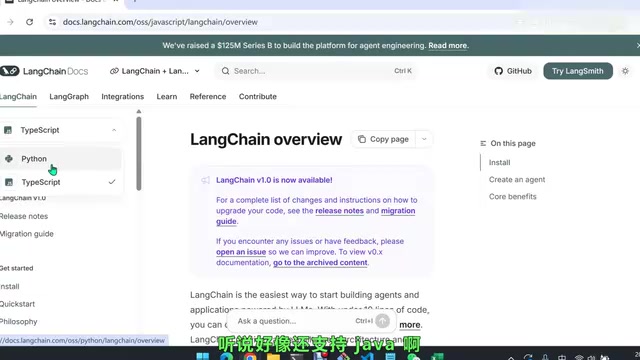
LangChain primarily supports Python, which offers the most complete ecosystem. TypeScript is the second option, suitable for teams with a unified front-end and back-end tech stack. There's reportedly Java support as well, but it hasn't been clearly showcased in the official documentation. For most AI application developers, Python remains the language of choice.
Conclusion
LangChain 1.0 marks the framework's evolution from an "LLM calling tool" to an "Agent engineering platform." Its three-layer architecture (LangChain → LangGraph → Deep Agents) provides complete development capabilities ranging from rapid prototyping to complex systems, while its massive integration ecosystem is its greatest competitive advantage.
For developers looking to systematically learn AI application development, starting with LangChain's four official examples and gradually diving into LangGraph's State Graph mechanism is a proven and efficient learning path.
Related articles
 Tutorials
Cursor + Codex Dual-IDE Collaboration: A Practical Methodology for Open-Source Project Customization
A complete methodology for open-source project customization based on real-world experience, detailing the Cursor+Codex dual-IDE workflow, seven-stage process, MVP validation, and AI source code reading techniques.
 Tutorials
Cursor Multi-Agent in Practice: Building a Full-Stack Next.js Blog in 50 Minutes
Build a full-stack blog in 50 minutes using Cursor IDE's multi-Agent mode with Next.js, Clerk auth, and Supabase. Learn the 4-phase AI Agent workflow and key integration pitfalls.
 Tutorials
Building an AI Software Factory from Scratch: A Cursor Engineer's Hands-On Experience with Multi-Agent Collaboration
Cursor engineer Eric shares practical insights on building an AI software factory: automation levels, guardrail design, parallel Agent management, and scaling to 1000+ Agents for 24/7 development.