LangChain Core Concepts Explained: A Complete Guide to Components, Chains, and Agents

LangChain is an open-source framework connecting LLMs to the external world for productized AI applications.
LangChain is an open-source framework that solves the pain points of LLMs being unable to access private data or execute external operations. Its architecture is built around three core concepts: Components provide a unified model interface enabling vendor-agnostic switching, Chains orchestrate multiple components into complete processing pipelines (such as RAG), and Agents leverage the ReAct paradigm to enable models to call external tools and interact with the environment. LangChain bridges the engineering gap from LLM capabilities to productized applications.
Why Do We Need LangChain?
If you've already learned how to call APIs from large language models like OpenAI or GLM and can build basic chatbot functionality, you've probably encountered this problem: simply calling LLM APIs has very limited capabilities.
Imagine this scenario: you want your chatbot to not only answer general questions but also extract information from your company's internal database, or even automatically send emails based on conversation content. These requirements simply cannot be achieved with LLM APIs alone.
The reason is straightforward—large language models derive their knowledge from training data, which primarily comes from publicly available internet information. Companies like JD.com, Alibaba, and Tencent would never expose their internal data on the internet, so LLMs naturally cannot access it. Let alone performing specific actions like "sending emails" or "searching the web."
It's worth noting that large language models also have an inherent limitation—Knowledge Cutoff. Every model's training data has a temporal boundary; mainstream models like GPT-4 and Claude typically have training data that ends at a specific point in time, meaning the model knows nothing about events that occurred afterward. This characteristic is particularly critical in enterprise scenarios: product prices change daily, policies and regulations are continuously updated, and competitor dynamics evolve in real-time—none of these can be covered by static training data. LangChain fundamentally solves this problem by connecting to external data sources.
What Problems Does LangChain Solve?
Connecting LLMs to the External World
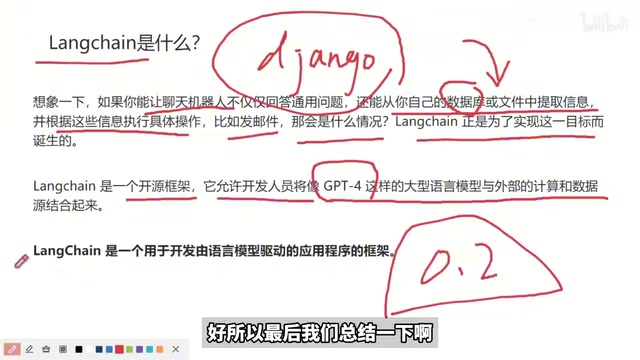
LangChain was born precisely to address these pain points. It's an open-source framework that allows developers to combine large language models like GPT-4 with external computational resources and data sources.
Here are several typical use cases:
- Enterprise Knowledge Base Q&A: Feed 100 industry research papers into the system, then perform precise Q&A based on those papers
- Intelligent Document Assistant: Have AI read Django's official documentation and answer specific questions about framework configuration and code implementation
- Automated Workflows: After a conversation ends, automatically send the Q&A records via email to a designated address
- Intelligent Customer Service & Sales Agents: Deliver smart customer service and marketing recommendations based on JD.com product data
The common thread across these scenarios is: the LLM is no longer an isolated Q&A tool, but becomes an intelligent hub capable of perceiving the external environment and executing specific tasks.
LangChain's Essential Positioning
In one sentence: LangChain is a framework for developing applications powered by language models.
If you have a Java development background, here's an analogy: LangChain is to LLM application development what Spring Boot is to Java web development, or what JDBC is to database operations. It provides a layer of abstraction that frees developers from worrying about differences between underlying LLMs, allowing them to focus on implementing business logic.
From an engineering perspective, LangChain's value lies not only in "what it can do" but also in "how to do it in a standardized way." Before LangChain, developers had to write custom adapter code for each LLM, manually handling prompt templates, conversation history management, error retries, and other tedious details. LangChain abstracts these common engineering concerns into standard modules, significantly lowering the barrier to AI application development and enabling developers to focus their energy on logic that delivers real business value.
One detail worth mentioning: after continuous iterations and upgrades, LangChain's compatibility has improved dramatically. It supports not only international models from OpenAI and Google but also fully supports domestic Chinese models like Baidu's ERNIE and Zhipu's GLM.
The Three Core Concepts of LangChain
LangChain's architecture is built around three core concepts: Components, Chains, and Agents. Understanding these three concepts means grasping LangChain's design philosophy.
Components: A Unified Model Interface
Components provide a unified interface wrapper for various large language models. This design philosophy is identical to JDBC drivers—JDBC provides a standard set of interfaces, and regardless of whether the underlying database is MySQL, Oracle, or PostgreSQL, the upper-layer code barely needs modification.
LangChain's model components work the same way: you write code against this abstraction layer and can freely switch between different LLMs with virtually no code changes. If OpenAI performs well today, use OpenAI; if tomorrow you discover a domestic model with better cost-effectiveness, just change a configuration for seamless switching.
This means your application won't be locked into any single LLM vendor, which carries significant strategic importance for technology selection and cost control.
Beyond the models themselves, LangChain's component system also encompasses key building blocks including Prompt Templates, Output Parsers, and Memory modules. Prompt Templates solve the problem of "how to communicate with models in a standardized way"; Output Parsers are responsible for structuring the model's natural language output into data formats that programs can process; Memory modules give applications cross-turn conversational context awareness—together, these three form the infrastructure layer for building complex AI applications.
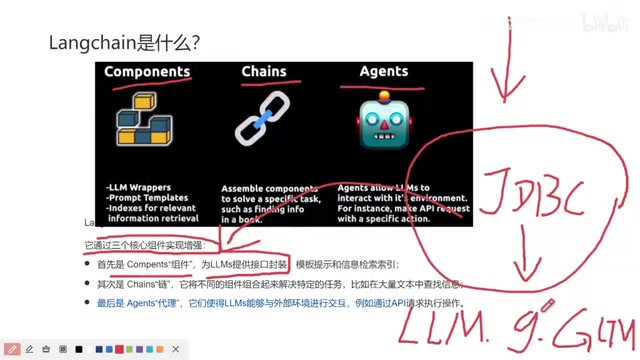
Chains: Orchestration and Composition of Components
Chains are where LangChain gets its name—"Lang" represents language models, and "Chain" represents chained composition.
In real-world AI product development, you might need to simultaneously use multiple components including LLMs, vector databases, data stores, and text embeddings. The role of chains is to connect these components in a specific logical sequence, forming a complete processing pipeline to solve concrete business tasks.
For example, a typical RAG (Retrieval-Augmented Generation) chain might include the following steps:
- Document Loading: Read local files or remote data sources
- Text Splitting: Break long documents into manageable chunks
- Vectorization & Storage: Convert text into vectors via an Embedding model and store them in a vector database
- Similarity Search: Retrieve the most relevant document chunks based on the user's question
- LLM Answer Generation: Pass the retrieved results along with the question to the LLM to generate the final answer
Each step is a component, and the chain is responsible for connecting them in an orderly fashion.
RAG (Retrieval-Augmented Generation) is currently the most mainstream technical approach for enterprise AI deployment and deserves deep understanding of its underlying design logic. RAG's core insight is: rather than trying to "stuff" all knowledge into model parameters (which requires expensive fine-tuning), it's better to dynamically "consult" external knowledge bases at inference time. This approach is analogous to the difference between open-book and closed-book exams—in an open-book exam, you don't need to memorize everything by rote; you just need to know where to find the answers. The vector database is the core infrastructure of the RAG chain: it converts text into high-dimensional numerical vectors via Embedding models and uses these as indices for semantic similarity retrieval. Unlike traditional keyword search, vector retrieval can understand semantic-level relevance—even if the user's question is worded completely differently from the original document text, as long as the semantics are similar, it can be accurately recalled. Chroma, Pinecone, Milvus, and Weaviate are currently mainstream vector database choices, and LangChain provides out-of-the-box integration support for all of them.
Agents: Interacting with the External Environment
Agents are the most imaginative part of LangChain. They enable large language models to interact with the external environment, truly breaking through the model's inherent capability boundaries.
Specifically, Agents can accomplish the following tasks:
- Calling External Tools: Search engines, calculators, code executors, etc.
- Accessing External Data: Company databases, API endpoints, web content, etc.
- Executing External Operations: Sending emails, manipulating files, calling third-party services, etc.
Take a Django documentation assistant as an example: the Agent first calls a tool to fetch content from Django's official documentation, then passes this data to the large language model, and finally answers the user's technical questions based on the documentation content. Throughout this process, the Agent serves as a "bridge" between the LLM and the external world.
The ability of Agents to achieve the above relies on a reasoning paradigm called ReAct (Reasoning + Acting). Its core approach is to have the LLM alternate through cycles of "Thought → Action → Observation" when answering questions, until it arrives at a final answer. For example: when a user asks "What should I wear given today's weather in Beijing?", the Agent won't guess directly. Instead, it first thinks "I need to know today's temperature in Beijing," then calls a weather query tool to get real-time data, observes the returned results, and then combines this with clothing recommendations to provide an answer. This mechanism evolves the LLM from a "static knowledge base" into a "dynamic decision engine." OpenAI has further introduced the Function Calling mechanism on top of this, allowing models to declare and invoke external functions in a structured manner. LangChain provides comprehensive wrapper support for both paradigms.
The Practical Value of Learning LangChain
A current reality in the AI industry is this: leading companies are mostly focused on training, tuning, and optimizing large models, while truly production-ready AI application products remain scarce. LangChain precisely fills the gap between "LLM capabilities" and "productized applications."
Mastering LangChain means you possess the engineering ability to transform LLM capabilities into actual products. Whether it's an enterprise-grade intelligent customer service system or a personal knowledge management tool, LangChain provides mature development paradigms and rich ecosystem support.
From an industry ecosystem perspective, since its open-source release in late 2022, LangChain has rapidly grown into one of the fastest-growing GitHub star projects in the AI application development space. A complete toolchain has formed around it, including LangSmith (a debugging and monitoring platform) and LangServe (an API deployment tool). Meanwhile, numerous companies both domestically and internationally have adopted LangChain as their standard tech stack for AI application development, with related job demand continuously rising. For developers looking to deepen their expertise in AI application development, LangChain has become an indispensable core skill.
Key Takeaways
- LangChain is an open-source framework that solves the core pain point of LLMs being unable to access enterprise private data or execute external operations
- LangChain's three core concepts: Components (unified model interface), Chains (component orchestration and composition), and Agents (external environment interaction)
- The component layer provides JDBC-like abstraction, enabling seamless switching between different LLMs and avoiding vendor lock-in; it also encompasses infrastructure like Prompt Templates, Output Parsers, and Memory modules
- RAG (Retrieval-Augmented Generation) is LangChain's most essential application paradigm, using vector databases for semantic retrieval to enable LLMs to dynamically generate answers based on private knowledge bases
- Agents leverage the ReAct reasoning paradigm, enabling LLMs to call external tools, access databases, send emails, and more—breaking through model capability boundaries
- LangChain bridges the engineering gap between LLM capabilities and productized applications, having formed a complete ecosystem toolchain including LangSmith and LangServe
Related articles
 Tutorials
Cursor + Codex Dual-IDE Collaboration: A Practical Methodology for Open-Source Project Customization
A complete methodology for open-source project customization based on real-world experience, detailing the Cursor+Codex dual-IDE workflow, seven-stage process, MVP validation, and AI source code reading techniques.
 Tutorials
Cursor Multi-Agent in Practice: Building a Full-Stack Next.js Blog in 50 Minutes
Build a full-stack blog in 50 minutes using Cursor IDE's multi-Agent mode with Next.js, Clerk auth, and Supabase. Learn the 4-phase AI Agent workflow and key integration pitfalls.
 Tutorials
Building an AI Software Factory from Scratch: A Cursor Engineer's Hands-On Experience with Multi-Agent Collaboration
Cursor engineer Eric shares practical insights on building an AI software factory: automation levels, guardrail design, parallel Agent management, and scaling to 1000+ Agents for 24/7 development.