LangGraph 0.5.3 + MCP Agent Development in Practice: Security Authentication & Deployment Guide
LangGraph 0.5.3 + MCP Agent Developmen…
LangGraph 0.5.3 adds MCP security auth and agent deployment, completing the enterprise AI agent stack.
LangGraph 0.5.3, released in July 2025, introduces two core features: MCP server security authentication (supporting OAuth 2.0, RBAC, etc.) and an agent server deployment solution (with visual testing and one-click packaging). Combined with Qwen3 8B's excellent performance in tool calling and MCP's standardization of tool integration, developers now have a complete technology stack for building production-grade AI agents.
Overview: What LangGraph 0.5.3 Brings to the Table
On July 17, 2025, LangGraph released version 0.5.3—the latest version of this agent development framework. This update introduces two noteworthy features: a security authentication mechanism for MCP servers, and a comprehensive agent server deployment and testing solution. These capabilities significantly enhance LangGraph's practicality for enterprise-grade AI agent development.
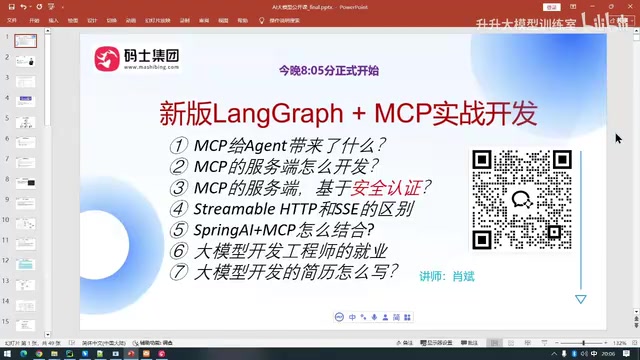
This article distills the key knowledge points from a course sharing session on building agents with LangGraph + MCP, helping developers quickly understand the core changes and practical essentials of the new version.
Two Major New Features in LangGraph 0.5.3
MCP Server Security Authentication
In previous MCP development practices, once a server exposed its interfaces, any client could call them freely—an obvious security risk in enterprise scenarios. The new LangGraph version introduces a complete security authentication and permission review mechanism:
- Authentication: Clients must pass strict identity verification before calling MCP server endpoints
- Authorization: Different clients can be assigned different calling permissions, enabling fine-grained access control
MCP server security has long been the primary barrier to production deployment. Early MCP specifications were designed primarily for local development scenarios and lacked comprehensive authentication standards. The MCP specification update released in March 2025 introduced an OAuth 2.0-based authorization framework, but implementation quality varied across frameworks. LangGraph 0.5.3 standardizes this capability, supporting multiple authentication methods including API Keys and JWT Tokens, and introduces Role-Based Access Control (RBAC). This allows a single MCP server to expose different tool permissions to different clients at varying granularities, truly meeting the needs of enterprise multi-tenant scenarios.
The significance of this feature is that MCP servers can finally be safely deployed in production environments without worrying about unauthorized access and calls. For enterprises that need to expose AI capabilities externally, this is a critical infrastructure capability.
Agent Server Deployment Solution
The second major update covers the complete lifecycle management of agents:
- Pre-deployment: Provides a visual testing interface supporting various debugging scenarios
- Post-deployment: Supports direct browser access as well as integration through APIs and other methods
Production deployment of agents faces challenges different from traditional web services: agent execution often involves long-running asynchronous tasks that require interrupt recovery, state persistence, and streaming output. LangGraph's deployment solution is built on its commercial product LangGraph Platform (formerly LangSmith), providing a runtime environment specifically designed for agents with built-in task queues, state storage, and observability tools. Developers can use the LangGraph CLI to package locally developed agents into standardized Docker images with one click, and integrate with frontend applications via REST API or WebSocket, dramatically lowering the engineering barrier from prototype to production.
This means that agents developed with LangGraph now have a complete engineering workflow from development, testing, to production deployment.
Technology Choice: Why Qwen3 for Agent Development
For the large language model selection, this practical session uses Alibaba's Qwen3 8B small model rather than overseas models like OpenAI or Claude.
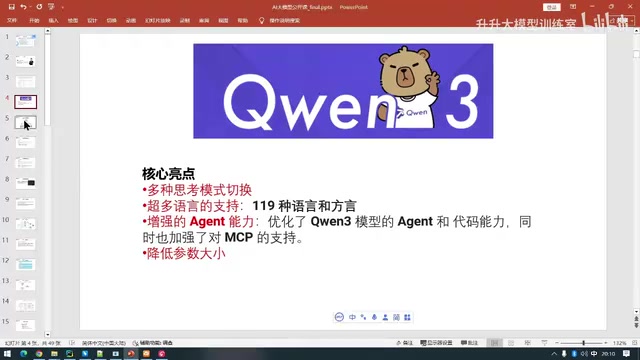
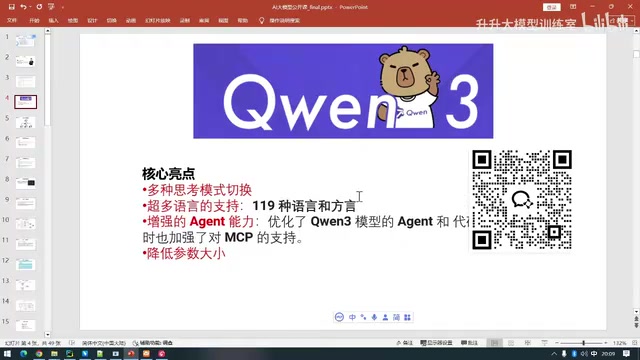
Qwen3 is Alibaba Cloud's next-generation large language model series released in April 2025, covering multiple parameter scales from 0.6B to 235B. One of its core innovations is the dynamic switching mechanism between "thinking mode" and "non-thinking mode"—automatically enabling deep reasoning (similar to DeepSeek-R1's Chain-of-Thought reasoning chains) for complex reasoning tasks while responding quickly for simple tasks, balancing quality and efficiency. The 8B version performs exceptionally well in Function Calling benchmarks, which is precisely the core capability requirement for agent development.
The reasons for choosing Qwen3 include:
- Strong agent compatibility: Qwen3 was specifically optimized for agent capabilities at launch, and after over a month of use, the error rate is extremely low
- Deep thinking support: In agent development scenarios, deep thinking capabilities can significantly improve the quality of complex task processing
- Cost-effective: The 8B model is sufficient for most agent development needs without requiring the top-tier 235B model
This choice also illustrates a trend: domestic Chinese LLMs have achieved sufficient practicality in the agent development domain, and developers don't need to rely on overseas models.
Agent Core Architecture and Its Relationship with MCP
Four Core Components of AI Agents
As the primary form factor for LLM applications, agents consist of four key components:
- Tools: Capability interfaces for agents to execute specific tasks
- Memory: Context management and historical information storage
- Plan: Task decomposition and execution strategy formulation
- LLM: Core reasoning and decision-making engine
LangGraph is an agent orchestration framework launched by the LangChain team in early 2024. Its core innovation lies in modeling agent execution flows as directed graphs, where each node represents a processing step and edges represent state transition conditions. Compared to earlier chain-based architectures, graph structures naturally support loops, conditional branching, and parallel execution, making them better suited for complex multi-step agent tasks. This graph-based design allows the collaboration relationships among the four components above to be precisely described and flexibly scheduled.
How MCP Integrates with Agents
MCP (Model Context Protocol) is a standardized protocol open-sourced by Anthropic in November 2024, designed to solve the fragmentation problem of integrating LLMs with external tools and data sources. Before MCP, every AI application needed to write separate integration code for different tools, resulting in extremely high maintenance costs. MCP draws on the design philosophy of LSP (Language Server Protocol), defining a unified client-server communication specification that allows any tool following the protocol to be directly called by any MCP-supporting AI framework, fundamentally solving the tool ecosystem fragmentation problem.
The integration of MCP with agents primarily occurs at the Tools component level. Specifically:
- Agents need to call external tools to complete tasks
- MCP provides a standardized tool-calling protocol
- Through MCP, agents can conveniently interface with existing systems
The advantage of this integration approach is that developers only need to wrap existing system interfaces according to the MCP protocol, and agents can call them directly, dramatically reducing integration costs.
Practical Value and Learning Recommendations
Why These Updates Matter for Developers
From a technology evolution perspective, the LangGraph 0.5.3 update represents the maturation direction of agent development frameworks:
- Security: Moving from "it works" to "it works safely"—the basic threshold for enterprise applications
- Engineering: Moving from "writing code" to "a complete develop-test-deploy workflow"—reducing the difficulty of productionization
- Standardization: Deep integration of the MCP protocol gives tool calling a unified specification
Learning Path for Agent Development Beginners
For developers looking to get started with agent development, the recommended learning path is:
- First understand the four core components of agents (Tools, Memory, Plan, LLM) and how they collaborate
- Master the basic concepts of the MCP protocol and its server/client model, understanding the core problems it solves
- Use LangGraph to build a minimum viable agent prototype, experiencing the advantages of graph-based orchestration
- Gradually add enterprise features like security authentication and deployment to build production-ready capabilities
Conclusion
The release of LangGraph 0.5.3 fills the gaps in enterprise-grade agent applications across two dimensions: security authentication and deployment solutions. The MCP protocol as a unified standard for tool calling, combined with LangGraph's graph-based orchestration capabilities, forms the mainstream technology combination for current agent development. Together with the mature performance of domestic models like Qwen3 in tool calling and deep reasoning, Chinese developers now have a complete technology stack for building production-grade AI agents from scratch. The key is to keep pace with framework updates and promptly master the latest development paradigms.
Key Takeaways
- LangGraph 0.5.3 was released on July 17, 2025, adding MCP server security authentication (based on OAuth 2.0 and RBAC) and an agent server deployment solution
- MCP (Model Context Protocol) was open-sourced by Anthropic in November 2024, solving tool integration fragmentation through a standardized client-server protocol, with agent integration primarily occurring at the Tools component level
- Qwen3 8B model supports dynamic switching between thinking/non-thinking modes and excels in Function Calling benchmarks—domestic models have achieved production-grade practicality
- LangGraph orchestrates agent execution flows based on directed graph structures, naturally supporting loops, conditional branching, and parallel execution for complex multi-step tasks
- The new version fills two major gaps for enterprise applications: security (authentication + authorization) and engineering (complete develop-test-deploy workflow)—the 2025 agent development tech stack is now essentially complete
Related articles
 Tutorials
Cursor + Codex Dual-IDE Collaboration: A Practical Methodology for Open-Source Project Customization
A complete methodology for open-source project customization based on real-world experience, detailing the Cursor+Codex dual-IDE workflow, seven-stage process, MVP validation, and AI source code reading techniques.
 Tutorials
Cursor Multi-Agent in Practice: Building a Full-Stack Next.js Blog in 50 Minutes
Build a full-stack blog in 50 minutes using Cursor IDE's multi-Agent mode with Next.js, Clerk auth, and Supabase. Learn the 4-phase AI Agent workflow and key integration pitfalls.
 Tutorials
Building an AI Software Factory from Scratch: A Cursor Engineer's Hands-On Experience with Multi-Agent Collaboration
Cursor engineer Eric shares practical insights on building an AI software factory: automation levels, guardrail design, parallel Agent management, and scaling to 1000+ Agents for 24/7 development.