LangGraph Beginner's Guide: Core Advantages, Common Misconceptions, and Deployment Practices Explained
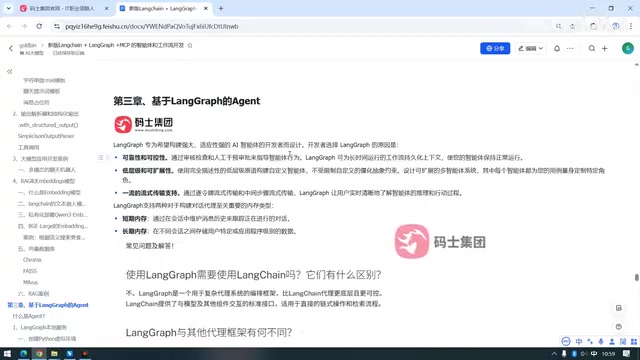
A comprehensive beginner's guide to LangGraph covering core advantages, common misconceptions, and deployment practices.
This article provides a systematic overview of LangGraph, the framework officially recommended by LangChain for AI agent development. It covers three core advantages—Human-in-the-Loop reliability, low-level primitives for flexibility, and high-performance async architecture based on FastAPI. The guide also clarifies common misconceptions about LangGraph's relationship with LangChain, explains short-term and long-term storage mechanisms, and details deployment strategies for both development and production environments.
Introduction: A Paradigm Shift in Agent Development
LangChain has officially stated: Agent development has fully migrated to the LangGraph framework. This means that in the next LangChain version, the original agent-related code may be removed. For engineers currently working on or planning AI agent development, mastering LangGraph is no longer optional—it's essential.
This article systematically covers LangGraph's core advantages, its relationship with LangChain, common misconceptions, and deployment solutions to help developers quickly build a comprehensive understanding of LangGraph.
Three Core Advantages of LangGraph
Reliability and Controllability: Human-in-the-Loop Mechanism
LangGraph supports guiding agent behavior through review checks and human intervention approvals. This is critical in real enterprise scenarios—imagine your agent needs to call sensitive tools (such as database writes, financial operations, etc.), and must receive human approval before execution can proceed.
This Human-in-the-Loop (HITL) mechanism is an indispensable safety guarantee for production-grade agents. HITL is a design pattern that embeds human judgment into automated processes, originating from industrial control systems and military decision-making domains. In AI agent scenarios, the core idea of HITL is: when an agent faces high-risk decisions (involving funds, private data, or irreversible operations), it pauses automatic execution and hands decision-making authority back to human reviewers. Only after approval does the agent continue executing subsequent steps. This mechanism effectively addresses risks from LLM "hallucination" problems—even if the model generates incorrect tool-calling instructions, the human approval step can intercept them in time. In industries with high compliance requirements such as finance, healthcare, and law, HITL is virtually a prerequisite for deploying agents to production.
Low-Level Primitives: Flexibly Building Custom Agents
LangGraph uses fully descriptive low-level primitives to build custom agents. In plain terms, developers can build agents at a granular level rather than being constrained by the framework's high-level abstractions.
In software framework design, "primitives" refer to the most basic, indivisible operational units. Low-level primitives mean developers can directly control every fine-grained step of agent execution, including how state transitions, how nodes communicate, and how conditions are evaluated. In contrast, high-level abstractions (like LangChain's earlier AgentExecutor) encapsulate these details in a black box—developers only need to pass in a tool list and prompts to run, but once complex logic customization is needed (such as dynamic routing, parallel execution, or error retry strategies), the abstraction layer becomes severely limiting. LangGraph's graph structure—composed of Nodes, Edges, and State—is essentially a set of low-level primitives that developers can freely combine like building blocks.
Here we need to distinguish between two paths for agent development:
- Low-code/No-code approach: Using tools like Dify or Coze to build agents through drag-and-drop interfaces, suitable for simple scenarios
- Code-based approach: In the Python ecosystem, LangGraph is the preferred choice (rather than using LangChain directly), suitable for complex enterprise-level customization needs
LangGraph is not constrained by rigid abstractions—developers can freely extend multi-agent systems, tailor roles for each agent, and enjoy extremely high flexibility.
High Performance and Streaming: Async Architecture Based on FastAPI
LangGraph's deployment layer uses the fastest backend framework in Python—FastAPI. According to FastAPI's official description, its performance can "rival Node.js and Go," making it one of the fastest Python web frameworks available.
FastAPI is built on Python's ASGI (Asynchronous Server Gateway Interface) standard, uses the Starlette framework under the hood for HTTP request handling, and leverages uvicorn as an async server. Its high performance stems from the async/await coroutine mechanism introduced in Python 3.5+: when a request is waiting for I/O operations (such as waiting for an LLM API to return results), the event loop can switch to handle other requests instead of blocking like traditional synchronous frameworks (such as Flask's default mode). This is particularly important for agent scenarios, where the main time cost is waiting for LLM inference to return—the async architecture can serve many other user requests during the waiting period. Additionally, FastAPI natively supports Server-Sent Events (SSE) and WebSocket, which form the technical foundation for implementing streaming.
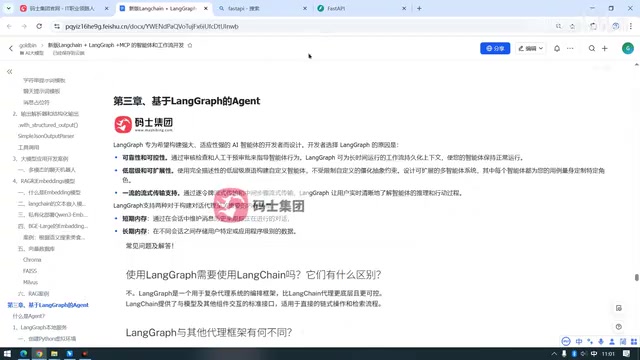
Specifically, the performance advantages LangGraph brings include:
- High concurrency: The async architecture based on FastAPI naturally supports a large number of concurrent requests
- Low latency: As long as the underlying model inference is fast enough, the entire agent's response can reach millisecond-level speeds
- First-class streaming support: For scenarios requiring real-time output (such as chatbots), streaming responses provide a better experience
- Significantly improved development efficiency: FastAPI's inherent development efficiency advantages are inherited, with feature development speed increasing approximately 200%-300%
LangGraph's Storage Mechanism: Short-term and Long-term Storage
LangGraph supports two storage modes, which are crucial for building agents with "memory":
Short-term Memory: Tracks the user's chat history and context information within the current session, helping the agent maintain coherence during a single conversation. For example, if you ask multiple questions in one conversation, the agent can remember the previous content.
Long-term Memory: Saves chat records across sessions. Just like when you use DeepSeek, conversation records from a week ago are still viewable today. Long-term storage can reside in memory or be persisted to relational databases, with the specific approach chosen flexibly based on business requirements.
In LangGraph, short-term storage is typically implemented through the Checkpointer mechanism. Each time the graph executes to a node, the current complete state is saved as a checkpoint. This not only supports in-session context memory but also makes Human-in-the-Loop possible—the agent can pause at a checkpoint, wait for human approval, and then resume execution from that checkpoint. Long-term storage involves more complex persistence strategies, with common approaches including: using relational databases like PostgreSQL to store structured conversation history, using Redis as a high-speed cache layer, or using vector databases to store semantically-encoded memory fragments to support relevance-based retrieval. Cross-session memory design directly impacts the agent's personalization capabilities and user experience.
Clarifying Common Misconceptions: The Relationship Between LangGraph and LangChain
This is the most confusing question for many developers. Let's clarify each point.
LangGraph Is an Independent Framework, Not a LangChain Submodule
LangGraph and LangChain are two independent frameworks. Using LangGraph does not require using LangChain. However, in practice, LangChain provides rich LLM calling interfaces and standardized components, making the combination more convenient. If you don't want to use LangChain's interfaces, you can write your own model-calling logic independently.
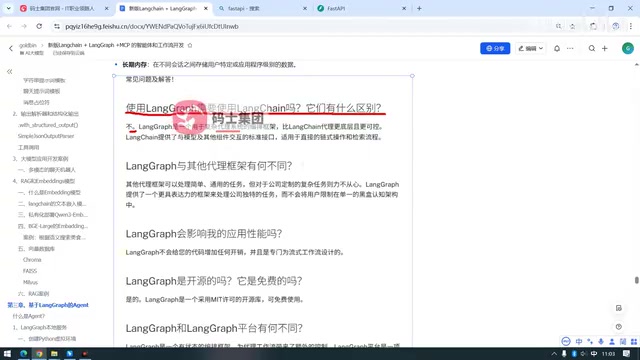
LangGraph vs Other Agent Frameworks
The official positioning is clear: other agent frameworks can handle simple, general-purpose tasks, but often fall short for complex enterprise-customized tasks. LangGraph provides a more expressive framework for handling complex scenarios. Simple tasks can be handled with tools like Dify; complex agent and workflow development is LangGraph's primary battlefield.
LangGraph Framework vs LangGraph Platform
These are two different concepts that must be clearly distinguished:
- LangGraph Framework: Open-source, under the MIT license (same as DeepSeek), with no copyright concerns for enterprise use
- LangGraph Platform: An officially provided managed runtime platform that is not open-source. You can deploy your developed agents to this platform, but you can also deploy them to your own private servers
The MIT license is one of the most permissive open-source licenses, allowing anyone to freely use, copy, modify, merge, publish, distribute, sublicense, and sell copies of the software. The only requirement is to include the copyright notice and license notice in all copies of the software. This means enterprises can commercialize agent products developed with the LangGraph framework without open-sourcing their own code or paying any fees to the LangChain team. In contrast, "copyleft" licenses like GPL require derivative works to also be open-sourced, which restricts commercial applications. The permissiveness of the MIT license is one of the key factors enabling LangGraph's rapid adoption in enterprise scenarios.
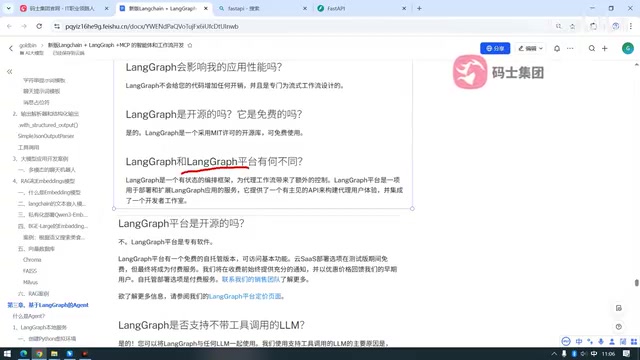
For domestic (Chinese) enterprises, due to data security considerations, they typically don't use the LangGraph Platform and instead opt for private deployment.
About the LangSmith Monitoring Tool
LangSmith is an official monitoring and debugging tool provided by LangChain. Using it requires registering for an API, and log data is uploaded to official servers. In Chinese enterprise environments, LangSmith is generally not used due to data security concerns. However, integration is very simple—just adding an environment variable.
Deployment Practices: Development and Production Environments
A complete LangGraph project needs to consider two deployment scenarios:
- Development environment deployment: Local testing and debugging, focusing on rapid iteration and debugging convenience
- Production environment deployment: Running on servers, involving Docker containerization and FastAPI service setup, requiring consideration of stability, scalability, and security
The Docker + FastAPI combination is currently the mainstream approach for LangGraph production deployment and the community-recommended best practice. Docker packages applications and all their dependencies into a standardized runtime unit through containerization technology, ensuring consistency between development and production environments while facilitating horizontal scaling—when concurrency increases, multiple container instances can be quickly launched and requests distributed through load balancing.
Summary: Recommended LangGraph Learning Path
For AI developers, LangGraph should be given high learning priority. It's not only the officially recommended agent development framework by LangChain but also provides comprehensive solutions in terms of performance, flexibility, and controllability.
Recommended learning path:
- First master LangChain basics and understand standard interfaces for LLM calls
- Learn LangGraph's core concepts: StateGraph, Nodes, Edges, and Conditional Routing. The StateGraph is LangGraph's core abstraction, modeling the agent's execution flow as a directed graph. Each node represents a processing step (such as calling an LLM or executing a tool), edges define the flow relationships between steps, and conditional routing dynamically determines which node to execute next based on the current state. This graph structure naturally supports loops (such as the "think-act-observe" loop in the ReAct pattern) and branching (such as routing to different processing subgraphs based on user intent)
- Start with single-agent systems and gradually transition to multi-agent collaboration systems
- Master the complete workflow for both local development deployment and production environment deployment
In today's rapidly evolving AI Agent landscape, choosing the right tech stack and framework can save you many detours on the path of agent development.
Related articles
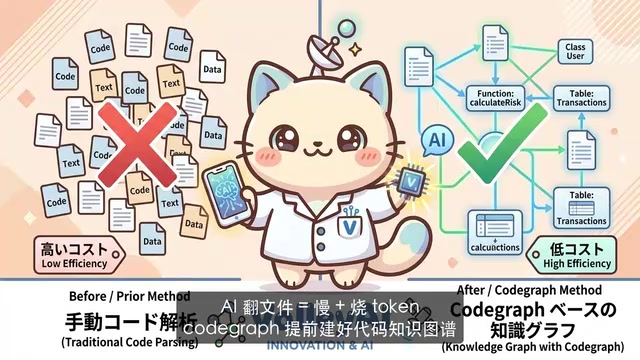
CodeGraph: The 50K-Star Open-Source Tool That Cuts AI Coding Token Usage in Half
CodeGraph is a 50K-star open-source tool that builds a code knowledge graph so AI coding assistants can locate code instantly—cutting Token usage by 47%, boosting speed by 22%, all running 100% locally.
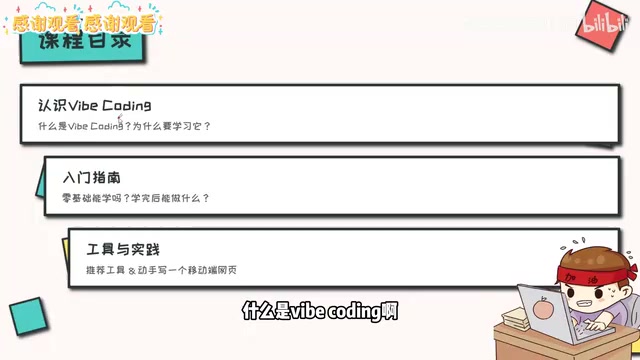
VibeCoding Beginner's Guide: A Complete Guide to Building Software with Natural Language from Scratch
VibeCoding lets anyone build software through natural language conversations with AI. Learn the core concepts, learning path, and practical methods to get started.
Using UU Accelerator to Speed Up Cursor: A Compliant Solution for Stable AI Coding in China
Learn how to use NetEase UU Accelerator to speed up Cursor AI coding tool in China, with step-by-step setup including node selection and launch configuration.