LangGraph vs LangChain: How to Choose Your Agent Development Framework

LangChain officially migrates all agent development to LangGraph—developers should switch early.
LangChain has officially migrated all agent development to the LangGraph framework, with agent-related code potentially being removed in the next version. LangGraph uses directed graph structures for workflow orchestration, supporting conditional branches, loops, and parallel execution, with Human-in-the-Loop mechanisms, low-level extensibility, and high-performance deployment powered by FastAPI. The framework is open-source under the MIT license, and enterprises are advised to adopt Docker + FastAPI private deployment for data compliance.
With the rapid development of AI agent development, LangChain has officially migrated all agent development to the LangGraph framework. This means if you're still building Agents with LangChain, you may soon face the risk of deprecated code. This article provides an in-depth analysis of LangGraph's core advantages, its relationship with LangChain, and key considerations for enterprise deployment.
Technical Background of AI Agents
AI agents are AI systems capable of perceiving their environment, making autonomous decisions, and executing actions. Their core lies in combining Large Language Models (LLMs) with tool calling, memory management, and planning capabilities. Unlike traditional single-turn Q&A, Agents can decompose complex tasks, call external APIs, execute code, and dynamically adjust strategies based on execution results. A typical Agent architecture includes the ReAct (Reasoning + Acting) pattern, where the model alternates between reasoning and acting until the goal is achieved. As models like GPT-4 and Claude have grown more capable, Agents have moved from the lab to production environments, bringing higher demands for framework reliability, observability, and controllability—which is precisely why LangGraph was created.
What Is LangGraph? How Does It Relate to LangChain?
A key fact: In the next version of LangChain, agent-related code may be removed. LangChain has made it clear that the future of agent development belongs to LangGraph.
This doesn't mean LangChain will disappear. LangChain still provides standard interfaces for interacting with large models and other components, suitable for direct inference operations and retrieval pipelines. But if you need to build complex agents or workflows, LangGraph is the officially recommended framework.
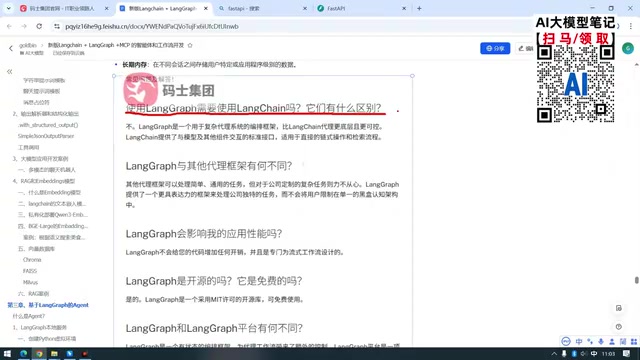
A common misconception needs clarification: LangGraph and LangChain are two independent frameworks, not a parent-child relationship. You can use LangChain's model calling interfaces within LangGraph (which is more convenient), or develop entirely independently without LangChain.
The "Graph" in LangGraph's name is no coincidence—it uses directed graphs as the core abstraction for workflows. In traditional chain structures, execution paths are linear, making it difficult to express conditional branches, loops, and parallel execution. In a graph structure, nodes represent specific processing steps (such as calling an LLM or executing a tool), edges represent flow relationships between nodes, and conditional edges can dynamically select the next node based on runtime state. This design allows complex multi-step, multi-branch agent workflows to be elegantly expressed, representing a fundamental breakthrough in expressiveness compared to LangChain's traditional Agent approach. The concept of a state machine runs throughout—each node can read and modify the global state, enabling truly stateful agents.
Three Core Advantages of LangGraph
Reliability and Controllability
LangGraph supports guiding agent behavior through moderation checks and human approval interventions. Consider a practical scenario: your agent can call multiple tools, but certain critical tools (such as those involving financial operations or data deletion) require human approval before execution. This "Human-in-the-Loop" mechanism is crucial for enterprise applications.
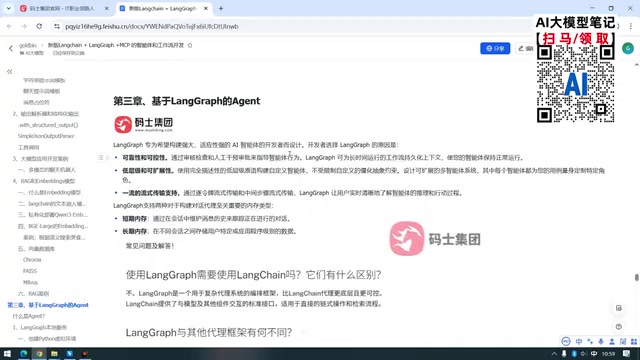
In LangGraph, Human-in-the-Loop is implemented through "Breakpoint" and "Interrupt" primitives: when the agent reaches a node requiring human approval, the framework pauses execution and persists the current state, waiting for human input before resuming. Unlike traditional synchronous approval processes, LangGraph's implementation is asynchronous—the agent can handle other tasks while waiting for approval, and after approval is complete, it precisely resumes from the interruption point without losing any context. This mechanism is particularly important in high-risk scenarios such as financial risk control, medical decision-making, and legal compliance, and is one of LangGraph's core enterprise features that distinguishes it from simple prompt chains.
Low-Level Control and Extensibility
This is arguably LangGraph's most important feature. "Low-level" means developers can use fully descriptive low-level primitives to build custom agents—in simple terms, building agents from scratch.
Currently, there are two mainstream approaches to building agents:
- Visual tools: Such as Dify, Coze, etc., built through drag-and-drop interfaces, suitable for simple scenarios
- Code development: In the Python ecosystem, LangGraph is the top choice (note: not LangChain)
LangGraph is not constrained by rigid abstractions, allowing developers to flexibly extend multi-agent systems and customize roles and behavioral logic for each agent.
Exceptional Performance
LangGraph's deployment layer uses the fastest backend framework in Python—FastAPI. FastAPI officially claims its performance is comparable to Node.js and Go, making it one of the fastest web frameworks in the Python ecosystem.
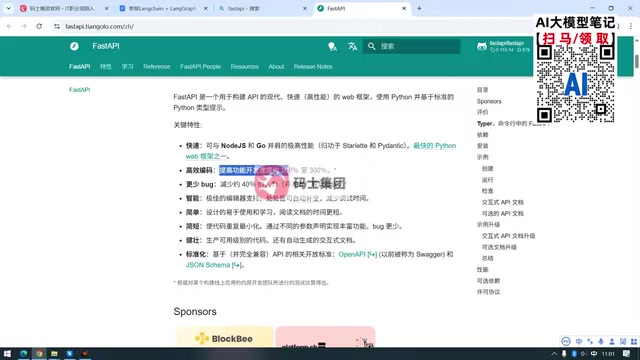
FastAPI achieves such performance through two key technologies: first, it's built on Starlette, Python's async IO framework, using asyncio for non-blocking concurrent processing, avoiding the thread-blocking issues of traditional synchronous frameworks (like Flask and Django) under high concurrency; second, it uses Pydantic for data validation, leveraging Rust-based underlying libraries for ultra-fast data serialization and deserialization. In AI agent scenarios, most operations are IO-intensive (waiting for LLM responses, calling external APIs), and async processing can significantly improve throughput.
This brings two direct benefits:
- High concurrency capability: FastAPI natively supports async processing, handling enterprise-level concurrent requests
- Millisecond-level response: As long as the underlying model's inference speed is fast enough, the entire agent's response time can reach millisecond levels
According to FastAPI's official data, using this framework can increase feature development speed by 200% to 300%.
Storage Mechanisms: Short-term and Long-term Memory
LangGraph supports two storage modes, which are crucial for building stateful agents. This design draws from cognitive science's classification framework for human memory:
Short-term Storage (Short-term Memory): Saves all context information within a single session. Technically, this corresponds to "Session State," typically maintained as a message list preserving conversation history. The agent tracks chat history and context to make decisions. Similar to how ChatGPT remembers what you said earlier in a conversation. Note that due to LLM context window length limitations, overly long histories need to be compressed through summarization or sliding window strategies.
Long-term Storage (Long-term Memory): Persistent storage across sessions. Like how when you use DeepSeek, chat records from a week ago or earlier are still viewable today. LangGraph supports multiple backends: relational databases (like PostgreSQL) for structured data, vector databases (like Pinecone, Chroma) for semantic retrieval, and key-value stores (like Redis) for high-speed caching. The coordinated use of both memory types allows agents to maintain current conversation coherence while accumulating user preferences and domain knowledge across sessions—the technical foundation for building personalized enterprise AI assistants.
LangGraph Framework vs. LangGraph Platform
This is another easily confused concept:
- LangGraph Framework: An open-source development framework under the MIT license (same as DeepSeek), with no copyright concerns for enterprise use
- LangGraph Platform: An officially provided managed runtime environment for deploying your LangGraph applications, not open-source
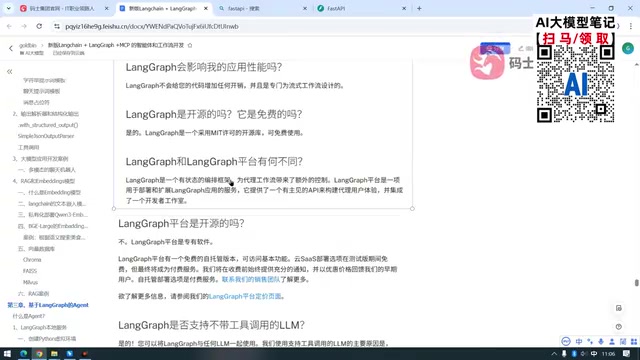
The MIT license is one of the most permissive licenses in open-source software, allowing anyone to freely use, copy, modify, merge, publish, distribute, sublicense, and even use for commercial purposes, with the only requirement being to retain the original copyright notice. This fundamentally differs from GPL (GNU General Public License)—GPL requires derivative works to also be open-sourced (i.e., "copyleft"), which poses legal risks in enterprise private deployments. LangGraph's MIT license means enterprises can confidently integrate it into proprietary products without worrying about code disclosure obligations.
For domestic (Chinese) enterprises, due to data security considerations, the LangGraph Platform is typically not used (data would be uploaded to official servers). Under compliance requirements of the Data Security Law and Personal Information Protection Law, enterprises dealing with sensitive business data usually need to choose private deployment. For the same reason, LangSmith (LangChain's monitoring tool) is also rarely used by domestic enterprises.
The typical enterprise deployment approach is: using Docker + FastAPI on self-hosted servers, ensuring both data security and full utilization of LangGraph's performance advantages.
Summary and Migration Recommendations
If you're currently working on or planning to develop AI agents, here are key points to consider:
- Migrate to LangGraph early: Agent functionality in LangChain is about to be removed—the sooner you switch, the better
- LangChain still has value: As a standard interface layer for model calls and component interactions, LangChain remains a great companion to LangGraph
- Choose private deployment for enterprises: Avoid using LangGraph Platform and LangSmith; adopt the Docker + FastAPI approach
- Use low-code for simple tasks, LangGraph for complex ones: Tools like Dify are suitable for rapid prototype validation, but enterprise-level complex agents require code-level control
LangGraph represents the trend in agent development moving from "framework abstraction" to "low-level controllability." Its graph-structured workflow orchestration, async high-performance FastAPI foundation, flexible dual-layer memory system, and enterprise-grade Human-in-the-Loop mechanism together form a complete solution for production environments. For enterprise developers pursuing flexibility, performance, and security, this is undoubtedly the most worthwhile Agent development framework to invest in learning today.
Related articles
 Tutorials
Cursor + Codex Dual-IDE Collaboration: A Practical Methodology for Open-Source Project Customization
A complete methodology for open-source project customization based on real-world experience, detailing the Cursor+Codex dual-IDE workflow, seven-stage process, MVP validation, and AI source code reading techniques.
 Tutorials
Cursor Multi-Agent in Practice: Building a Full-Stack Next.js Blog in 50 Minutes
Build a full-stack blog in 50 minutes using Cursor IDE's multi-Agent mode with Next.js, Clerk auth, and Supabase. Learn the 4-phase AI Agent workflow and key integration pitfalls.
 Tutorials
Building an AI Software Factory from Scratch: A Cursor Engineer's Hands-On Experience with Multi-Agent Collaboration
Cursor engineer Eric shares practical insights on building an AI software factory: automation levels, guardrail design, parallel Agent management, and scaling to 1000+ Agents for 24/7 development.