Learning LLM Application Development from Scratch: A Complete Roadmap from RAG to Agent

A complete beginner's guide and learning roadmap for LLM application development
The LLM industry has shifted from algorithm research to application development, making it accessible to beginners. By learning Python, API calling, and frameworks like LangChain, anyone can get started. Core development directions include API calling with Prompt Engineering, RAG knowledge base construction, and Agent building — progressing from simple to complex. The recommended learning path is RAG → Agent → Model Fine-tuning, combined with hands-on projects.
The LLM Industry Is Undergoing a Fundamental Shift
Over the past two years, the explosion of AI large language models like ChatGPT and Qwen has driven nearly every internet company, tech firm, and even traditional enterprise to explore how to integrate LLMs into their business. But many people have a lingering question: Can I break into this industry without an AI background or algorithm expertise?
The answer is absolutely yes — and now is the best time to start.
The reason is that the LLM industry has transitioned from an early "algorithm research phase" into an "application development phase." In the early days of AI, the work was primarily done by algorithm engineers researching deep learning, training neural networks, and tuning model parameters — work that genuinely required strong foundations in mathematics and algorithms. But now, enterprise needs have shifted — companies don't need to train their own large models. Instead, they want people who can take existing LLM capabilities and deploy them into real-world applications.
This has given rise to a new role: LLM Application Developer. The core of this role isn't training models — it's building applications powered by large models.
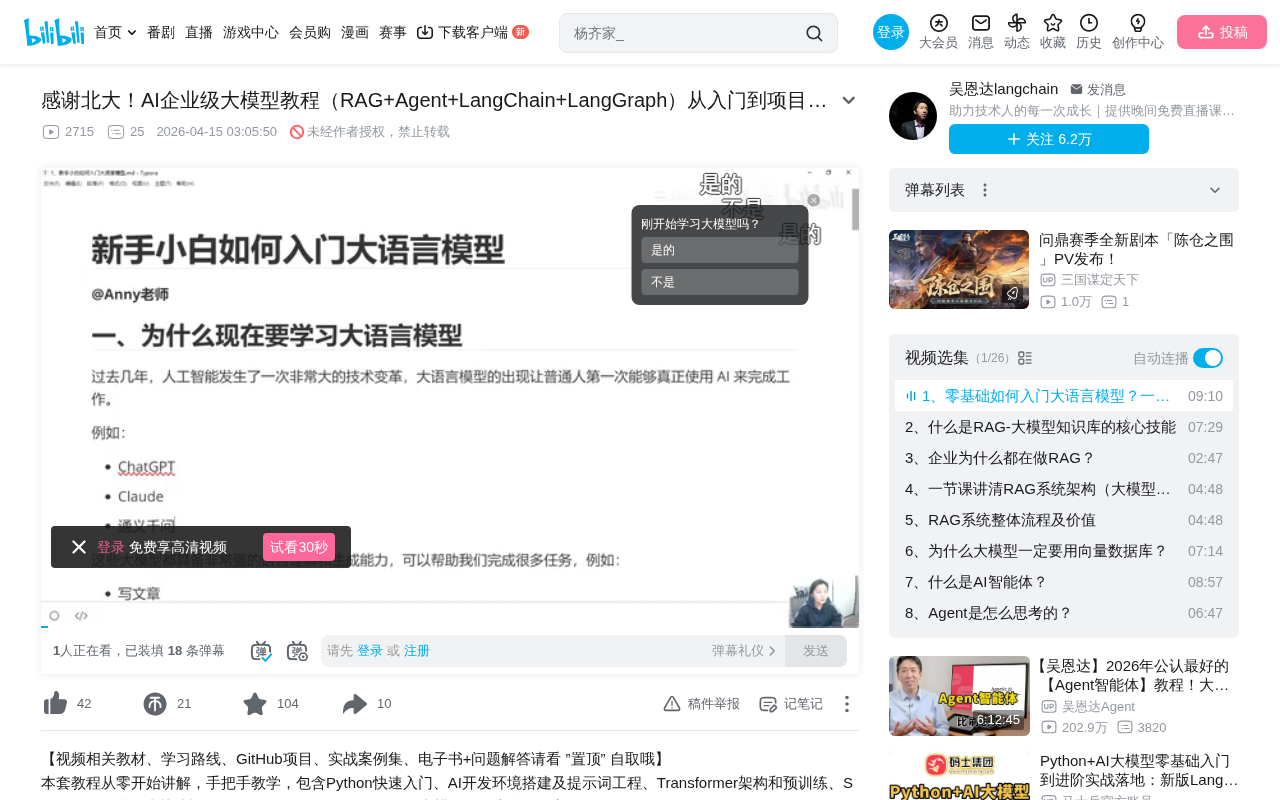
What Is a Large Language Model? Explained in One Sentence
Many people find "large language model" intimidating, but it's actually simple to explain in one sentence: An LLM is an AI system that can understand language and generate language. After being trained on massive amounts of data, it can comprehend natural human language and generate content based on instructions.
From a technical perspective, Large Language Models (LLMs) are essentially deep neural networks based on the Transformer architecture, acquiring language understanding and generation capabilities through self-supervised pre-training on trillions of tokens of text data. Google proposed the Transformer architecture in 2017, OpenAI released GPT-1 in 2018, and by late 2022, ChatGPT burst onto the scene — completing the industry's historic leap from academic research to mainstream application. It's precisely this leap that enables ordinary developers to harness these powerful language capabilities through API calls without needing to understand the model's internal workings.
LLMs can do far more than you might imagine:
- Answering questions: Serving as intelligent customer service or knowledge assistants
- Content creation: Writing articles, generating code, producing reports
- Information processing: Summarizing content, translation, data analysis
Any task related to language can involve LLMs. This is why the industry calls large language models a "general-purpose capability platform" — unlike traditional software that does only one thing, LLMs can be applied across numerous different scenarios.
Three Core Directions in LLM Application Development
Once you enter this field, the work generally falls into three directions, representing a progression from simple to complex.
Direction 1: Calling LLM APIs
This is the most fundamental direction. Currently, all major LLM providers offer API interfaces that allow developers to programmatically call models for various tasks — generating articles, automated replies, building AI assistants, creating intelligent customer service, and more. The core competency at this level is understanding how to use APIs and learning how to communicate effectively with LLMs through Prompt design.
Prompt Engineering is the essential skill for this direction. A well-crafted Prompt can significantly improve model output quality. Common techniques include: Few-shot Prompting, Chain-of-Thought prompting, Role Prompting, and more. Understanding the concept of Tokens is equally important — models charge by Token and calculate context length in Tokens. One Token equals approximately 0.75 English words or 0.5 Chinese characters. Managing Token usage effectively directly impacts an application's cost and performance.
Direction 2: Building RAG Knowledge Base Systems
Every enterprise has its own private data: product documentation, company materials, technical manuals, etc. The LLM doesn't inherently know this information. To enable an LLM to answer questions based on enterprise data, you need RAG (Retrieval-Augmented Generation) technology.
RAG was first systematically proposed by Meta AI in a 2020 paper. Its core idea is to combine parametric knowledge stored in model weights with non-parametric knowledge from external databases, effectively solving the LLM's knowledge cutoff date problem and "hallucination" issue (where the model confidently fabricates non-existent information). In engineering implementation, RAG typically relies on vector databases (such as Chroma, Pinecone, Milvus) to convert documents into high-dimensional vectors, retrieves the most relevant text chunks through semantic similarity search, and then injects them as context into the Prompt to guide the model in generating well-grounded answers.
The working principle of RAG isn't complicated: first retrieve relevant content from the knowledge base, then have the LLM generate answers based on that material. This technology is currently the most widely deployed in enterprise settings and is an essential skill for LLM application developers.
Direction 3: Building Agent Systems
When application scenarios become more complex, we're no longer satisfied with AI doing simple Q&A. We want AI to autonomously complete tasks — calling tools on its own, making decisions, and executing multi-step operations.
The concept of an Agent originates from reinforcement learning, referring to an autonomous system capable of perceiving its environment, making decisions, and executing actions. In the LLM era, Agent implementation relies on prompting frameworks like ReAct (Reasoning + Acting), which allows the model to alternate between thinking and tool calling during the reasoning process. Typical tools include search engines, code executors, database query interfaces, and more. Since 2023, the release of official capabilities like OpenAI Function Calling and Anthropic Tool Use has moved Agent development from theory into mature engineering practice.
Here's an example: A user asks AI to help create a report. The Agent can independently search for materials, organize and synthesize them, and finally generate a complete report. This kind of system is an Agent — it truly transforms LLMs from "AI that can talk" into "AI assistants that can take action."
What Prerequisites Do Beginners Need for LLM Development?
Many people worry the barrier to entry is too high, but the foundational knowledge required is actually less than you might think. There are mainly three areas:
Python Programming Basics
Currently, the vast majority of AI development frameworks are built on Python, and the entire AI ecosystem is built on Python. Mainstream frameworks like LangChain and LlamaIndex are all implemented in Python, making Python the first essential hurdle to clear. Python's syntax is concise with a gentle learning curve. For complete beginners, mastering core concepts like variables, functions, lists, dictionaries, and classes, along with pip package management and virtual environment usage, typically requires only 2-4 weeks of focused study.
LLM API Calling Skills
This mainly involves understanding the basic usage of LLMs, including Prompt design, the Token concept, and model parameter configuration. Essentially, it's learning how to communicate correctly with large models. Key parameters to understand include: Temperature (controls output randomness — higher means more creative, lower means more deterministic), Max Tokens (limits output length), System Message (sets the model's role and behavioral guidelines), and more.
Application Development Frameworks
Building everything from scratch would be extremely costly. The industry has produced numerous frameworks to help developers build AI applications. LangChain was created by Harrison Chase in October 2022 and is currently the most popular LLM application development framework, with over 90,000 GitHub stars. It provides core abstractions including Chain (sequential calls), Memory (conversation memory), Tools (tool integration), and Agents (intelligent agents). LangGraph is an advanced framework from the LangChain team, specifically designed for building stateful, multi-step Agent workflows with support for cyclic graph structures, suitable for complex task orchestration. LlamaIndex focuses on data indexing and RAG scenarios, offering more granular control for enterprise knowledge base construction. These frameworks help manage model calls, tool integration, knowledge base connectivity, and Agent system construction.
Recommended Learning Roadmap for LLM Application Development
For beginners starting from scratch, the following phased progression is recommended:
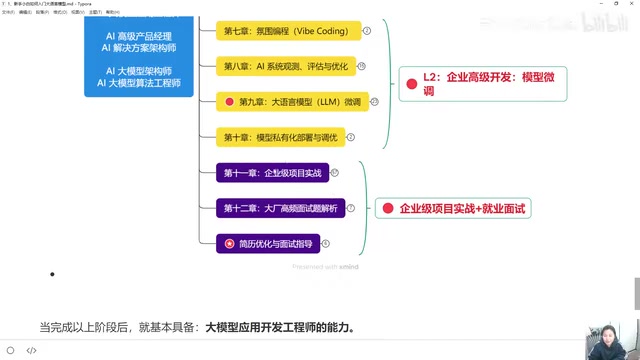
Phase 1 (L1): Foundations to Application, ~1 Month
- AI Fundamentals: Understand the basic concepts and principles of large models
- RAG Knowledge Base Development: Master Retrieval-Augmented Generation and learn to build enterprise knowledge bases
- Agent Development: Learn to build AI systems that can autonomously execute tasks
Phase 2 (L2): Advanced Skills
- Model Fine-tuning: Learn how to fine-tune models for specific scenarios. Fine-tuning refers to secondary training of a pre-trained large model using domain-specific labeled data. Since full fine-tuning is extremely expensive, the industry widely adopts Parameter-Efficient Fine-Tuning (PEFT) methods, with LoRA (Low-Rank Adaptation) being the most popular — it approximates full fine-tuning effects by adding low-rank decomposition matrices alongside the original weight matrices, reducing trainable parameters by over 99%. For application developers, fine-tuning is typically an advanced technique used only when RAG cannot meet requirements (such as when you need to change the model's output style or inject large amounts of domain expertise).
- Project Practice: Accumulate hands-on experience through enterprise-level projects
After mastering all the above, you'll essentially have the core competencies of an LLM application developer.
Final Thoughts: Get In Early, Build Your Advantage
In the AI era, technology changes rapidly and new roles are constantly emerging — from LLM Application Developers to Agent Engineers, AI Product Managers, and LangChain Engineers. The window of opportunity is opening fast.
For those looking to transition into the AI industry, what matters most isn't what you studied before, but whether you're willing to enter this field as early as possible. In the tech industry, those who enter earliest often accumulate experience and advantages most easily. Large language models are still in their early stages of development — it's not too late to start learning now.
Follow the roadmap of "RAG → Agent → Model Fine-tuning" step by step, and you'll have every opportunity to enter this industry and participate in the wave of AI technological advancement.
Key Takeaways
- The LLM industry has shifted from algorithm research to application development — beginners can absolutely get started
- Three core directions in LLM application development: API calling, RAG knowledge base construction, Agent building
- Only three prerequisites needed: Python programming, LLM API calling, application frameworks (like LangChain)
- Recommended learning path: Start with RAG, then Agent, then model fine-tuning, combined with project practice
- LLMs are still in early stages — getting in early is the best strategy for building competitive advantage
Related articles
 Tutorials
Cursor + Codex Dual-IDE Collaboration: A Practical Methodology for Open-Source Project Customization
A complete methodology for open-source project customization based on real-world experience, detailing the Cursor+Codex dual-IDE workflow, seven-stage process, MVP validation, and AI source code reading techniques.
 Tutorials
Cursor Multi-Agent in Practice: Building a Full-Stack Next.js Blog in 50 Minutes
Build a full-stack blog in 50 minutes using Cursor IDE's multi-Agent mode with Next.js, Clerk auth, and Supabase. Learn the 4-phase AI Agent workflow and key integration pitfalls.
 Tutorials
Building an AI Software Factory from Scratch: A Cursor Engineer's Hands-On Experience with Multi-Agent Collaboration
Cursor engineer Eric shares practical insights on building an AI software factory: automation levels, guardrail design, parallel Agent management, and scaling to 1000+ Agents for 24/7 development.