LLM Learning Roadmap: A Complete Guide from Beginner to Project Implementation Across Seven Core Modules
LLM Learning Roadmap: A Complete Guide…
Breaking down the seven key learning modules for mastering LLM development from basics to project implementation.
This article deconstructs a 600-episode LLM tutorial series organized into seven progressive modules: environment setup, Prompt Engineering, RAG, Agents, development frameworks, model fine-tuning/deployment, and hands-on projects. Following a beginner-to-advanced logic that aligns with enterprise needs, the article advises learners to prioritize fundamentals, practice hands-on, leverage open-source ecosystems, and selectively study based on personal goals.
Overview
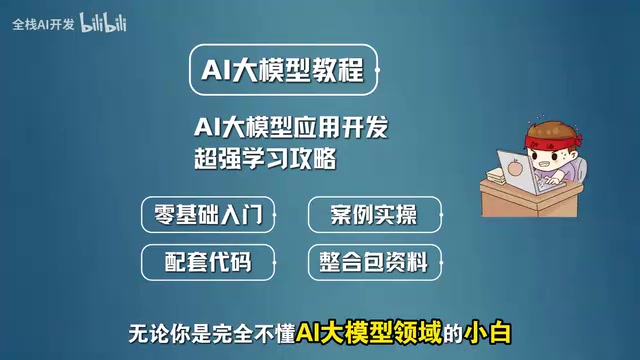
As large model technology rapidly penetrates various industries, an increasing number of developers and tech enthusiasts are looking to systematically master the core skills in this field. A tutorial series on Bilibili (a Chinese video platform) claiming 600 episodes and 196 hours of comprehensive LLM content has attracted widespread attention. Covering everything from environment setup to project deployment, it spans the complete development pipeline for large models. This article breaks down the curriculum structure of this tutorial series to help readers understand the core framework of an LLM learning roadmap.
Seven Modules: Building a Complete LLM Knowledge System
This tutorial divides LLM learning into seven progressive modules, forming a clear learning path from infrastructure setup to final project implementation.
Module 1: Environment Setup
Environment setup is the starting point for all AI development and the stage where many beginners get stuck. This module typically covers Python environment configuration, GPU driver installation, CUDA/cuDNN deployment, and the installation and debugging of mainstream frameworks (such as PyTorch and Transformers). CUDA (Compute Unified Device Architecture) is NVIDIA's parallel computing platform, while cuDNN is a GPU-accelerated library optimized specifically for deep neural networks. Version compatibility issues between these two are the most common stumbling block for beginners. While seemingly basic, a stable and reliable development environment is the prerequisite for all subsequent learning.
Module 2: Prompt Engineering
Prompt Engineering is one of the most practically valuable skills in current LLM applications. Its rise stems from the "Emergent Abilities" of large language models — when model parameter scale exceeds a certain threshold, models begin to exhibit complex reasoning capabilities never seen in smaller-scale models. This discovery made researchers realize that through carefully designed input text, model potential can be significantly unlocked without modifying model weights.
Through well-crafted prompts, developers can significantly improve model output quality without modifying model parameters. Few-shot Prompting guides model output format by providing a small number of examples in the prompt. Chain-of-Thought, proposed by the Google Brain team in 2022, significantly improved accuracy in mathematical reasoning and logical inference by guiding models to "think step by step." The core of this module lies in understanding how large models "think" and mastering classic prompting strategies such as Few-shot, Chain-of-Thought, and role-setting.
Module 3: RAG (Retrieval-Augmented Generation)
RAG (Retrieval-Augmented Generation) was formally proposed by the Meta AI research team in 2020 in their paper Retrieval-Augmented Generation for Knowledge-Intensive NLP Tasks. It is one of the most mainstream technical architectures in enterprise-level LLM applications today. The core idea is to combine an information retrieval system with a generative language model: user queries are first converted into high-dimensional vectors (Embeddings), then similarity search is performed in vector databases (such as Faiss, Chroma, or Milvus). The retrieved relevant document fragments are injected as context into the model's prompt, and the LLM then generates the final answer.
This architecture effectively addresses two core pain points of models: first, the "hallucination" problem (models fabricating non-existent facts), and second, the knowledge cutoff date problem (models cannot access new knowledge beyond their training data). Learning RAG requires mastering a series of technologies including vector databases, document chunking, Embedding models, and retrieval strategies. Among these, chunking strategies and Embedding model selection have a decisive impact on the final effectiveness of a RAG system.
Module 4: Agent Applications
Agents represent the critical leap of LLMs from "conversational tools" to "autonomous executors." The theoretical foundation comes from the ReAct (Reasoning + Acting) framework, jointly proposed by Princeton University and Google Brain in 2022. This framework enables LLMs to alternate between "reasoning" (generating thinking steps) and "acting" (calling external tools or APIs) during task execution, forming a perception-decision-execution loop.
The core components of modern Agent systems include: a planning module (decomposing complex tasks into subtasks), a memory module (short-term context memory and long-term vector storage), a tool-calling module (Function Calling/Tool Use), and a reflection module (self-evaluation and error correction of execution results). Multi-Agent collaboration frameworks (such as AutoGen and CrewAI) further organize multiple specialized Agents into collaborative teams, handling more complex task scenarios through role division. This module represents one of the most cutting-edge directions in current AI applications.
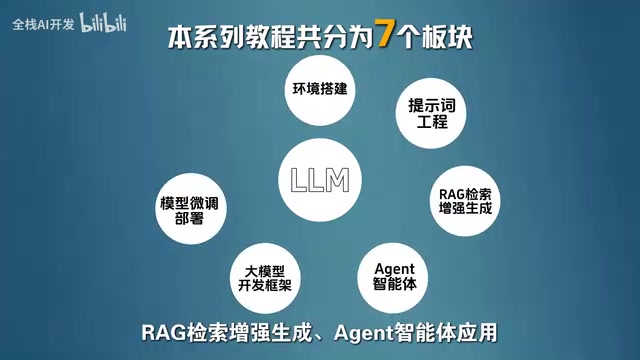
Module 5: LLM Development Frameworks
Mainstream LLM development frameworks each have different focuses and positioning. LangChain, released by Harrison Chase in October 2022, is currently the most complete ecosystem for LLM application development. It provides core abstractions such as chain calls, memory management, and Agent tools, making it suitable for developers with programming backgrounds to build complex applications — though its high level of abstraction creates a relatively steep learning curve. LlamaIndex focuses on data indexing and retrieval scenarios, offering more granular control in RAG application development, particularly suitable for enterprise knowledge base scenarios requiring complex document structure handling. Dify is a visual LLM application development platform designed for non-technical users, lowering the barrier to building AI applications through a drag-and-drop interface while supporting private deployment, gaining widespread adoption in the Chinese enterprise market. Proficiency with these open-source tools can significantly lower development barriers, enabling rapid prototyping and iterative optimization.
Module 6: Model Fine-tuning and Deployment
When general-purpose LLMs cannot meet specific business requirements, fine-tuning becomes a necessary approach. LoRA (Low-Rank Adaptation), proposed by Microsoft Research in 2021, is based on the core insight that weight changes during fine-tuning exhibit "low-rank" characteristics. Therefore, weight updates can be approximated by the product of two small matrices, reducing trainable parameters by over 99%. QLoRA (Quantized LoRA) further introduces 4-bit quantization technology on top of this, compressing model weights from 32-bit floating-point numbers to 4-bit integer storage. This makes it possible to fine-tune models with 65 billion parameters on a single RTX 3090/4090 with 24GB of VRAM. These two technologies have dramatically lowered the hardware barrier for individual developers and small-to-medium enterprises to customize models. The deployment phase involves engineering practices such as model quantization, inference acceleration, and API service deployment.
Module 7: Hands-on Project Implementation
Theory must ultimately be grounded in practice. Through complete project walkthroughs, learners can integrate knowledge from the previous six modules and understand the full process from requirements analysis to architecture design to code implementation.
Analysis of the Learning Roadmap's Rationality
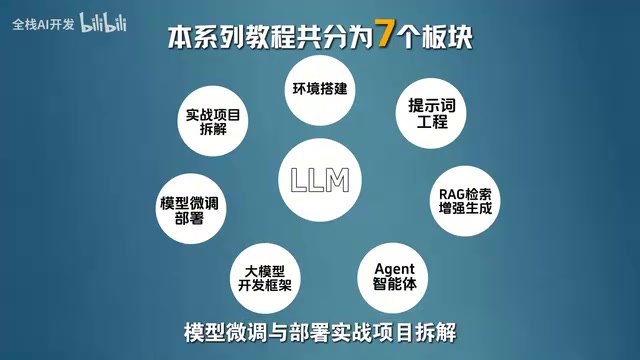
From a curriculum design perspective, the arrangement of these seven modules follows a progressive, theory-to-practice pedagogical logic. Environment setup and Prompt Engineering are entry-level content, RAG and Agents belong to the advanced application layer, fine-tuning and deployment touch on deep model-level customization, and finally project implementation completes the knowledge loop.
This roadmap aligns closely with current enterprise demand for LLM talent. Based on industry observations, the most sought-after LLM skills in enterprises are, in order: RAG application development, Agent system building, and model fine-tuning/deployment — which correspond precisely to the curriculum's core modules.
Practical Advice for Learning LLMs
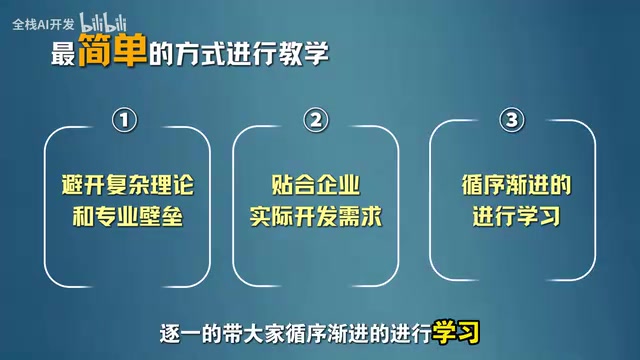
For developers looking to systematically learn about large models, the following suggestions are worth considering:
-
Don't skip the fundamentals: Environment setup and Prompt Engineering may seem simple, but they are the foundation for everything that follows. Many problems encountered during RAG or Agent development often trace back to insufficient understanding of basic concepts.
-
Learn by doing, prioritize hands-on practice: Knowledge in the LLM field iterates extremely fast. Watching videos without hands-on practice easily leads to the trap of "understanding but not being able to do." It's recommended to complete a small project after finishing each module to consolidate your learning.
-
Leverage the open-source ecosystem: There are abundant high-quality open-source projects and models on HuggingFace and GitHub. HuggingFace currently hosts over 500,000 pre-trained models and 100,000 datasets, making it one of the most important open-source communities in the LLM field. Combining these resources with tutorial learning can yield twice the results with half the effort.
-
Maintain critical thinking: While a 600-episode tutorial series is certainly content-rich, learners should selectively study based on their own foundation and goals rather than blindly pursuing "watching everything."
Conclusion
LLM technology is transitioning from the laboratory to industrial deployment, and a systematic learning roadmap is crucial for developers to quickly establish their knowledge framework. The seven modules covered in this tutorial series — from environment setup, Prompt Engineering, RAG, and Agents, to development frameworks, model fine-tuning/deployment, and project implementation — essentially cover the core skill stack for LLM development. Regardless of which learning resources you ultimately choose, the key lies in establishing a clear knowledge framework and transforming theory into real development capabilities through continuous practice.
Key Takeaways
- The tutorial divides LLM learning into seven modules: environment setup, Prompt Engineering, RAG, Agents, development frameworks, model fine-tuning/deployment, and hands-on projects
- RAG and Agents are the two most critical technical directions in current enterprise-level LLM applications
- The curriculum follows a progressive logic that closely aligns with actual enterprise demand for LLM talent
- Systematic LLM learning requires learning by doing — avoid pure theoretical study without hands-on practice
- Learners should selectively study based on their own foundation; building a clear knowledge framework matters more than pursuing content volume
Related articles
 Tutorials
Cursor + Codex Dual-IDE Collaboration: A Practical Methodology for Open-Source Project Customization
A complete methodology for open-source project customization based on real-world experience, detailing the Cursor+Codex dual-IDE workflow, seven-stage process, MVP validation, and AI source code reading techniques.
 Tutorials
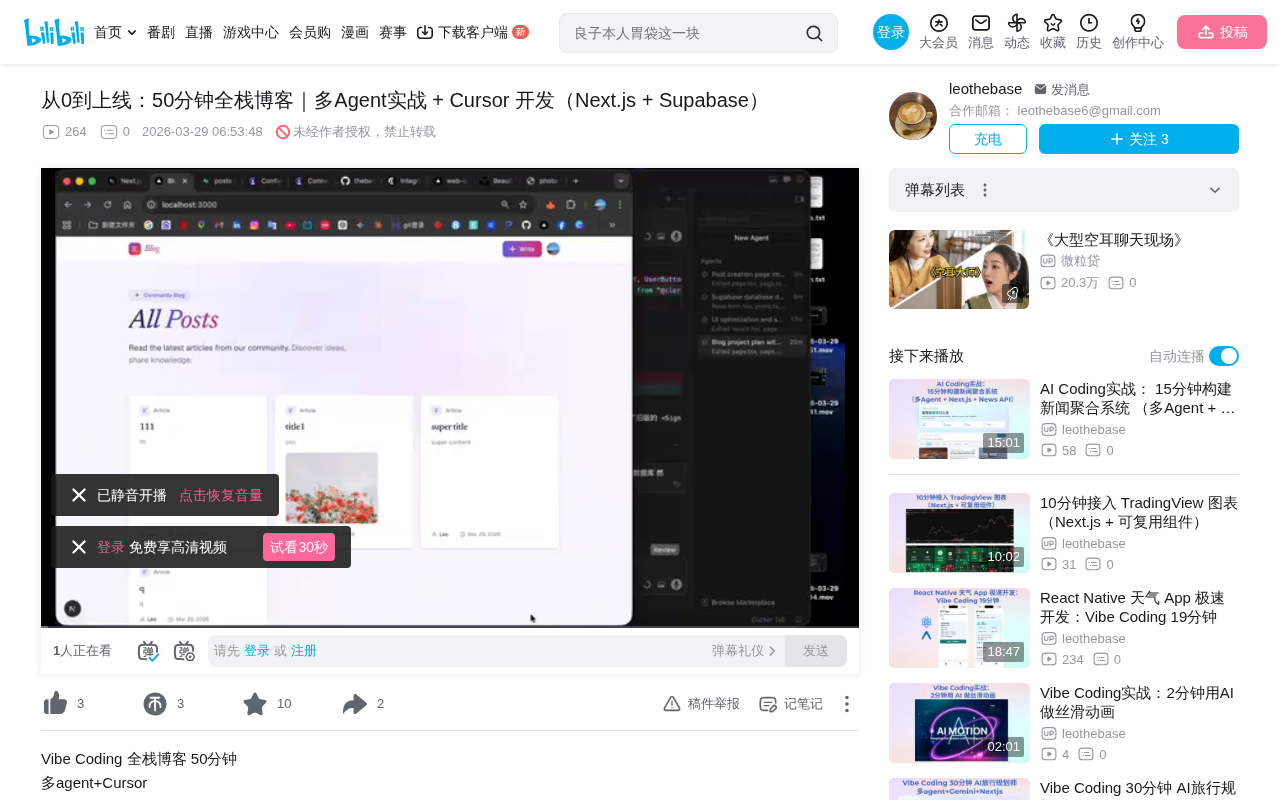
Cursor Multi-Agent in Practice: Building a Full-Stack Next.js Blog in 50 Minutes
Build a full-stack blog in 50 minutes using Cursor IDE's multi-Agent mode with Next.js, Clerk auth, and Supabase. Learn the 4-phase AI Agent workflow and key integration pitfalls.
 Tutorials
Building an AI Software Factory from Scratch: A Cursor Engineer's Hands-On Experience with Multi-Agent Collaboration
Cursor engineer Eric shares practical insights on building an AI software factory: automation levels, guardrail design, parallel Agent management, and scaling to 1000+ Agents for 24/7 development.