Manus AI Agent Side Hustle Monetization Guide: From Knowledge Base to Personalized Path Planning
Manus AI Agent Side Hustle Monetizatio…
Use the Manus AI agent to build a personal knowledge base and generate personalized side hustle plans.
This article explains how to use the Manus AI agent for personalized side hustle planning. The core method involves structuring personal information — career background, skills, personality traits — into a knowledge base powered by RAG technology, then combining it with structured prompts to generate short-term, medium-term, and long-term monetization paths. Manus's Agent mode, built on the ReAct framework, enables multi-step reasoning and execution for highly personalized plans with iterative optimization support.
How AI Agents Can Help You Find Your Side Hustle Direction
As AI tools become increasingly accessible, more and more people are thinking about how to leverage AI to generate extra income. But the core problem most people face is: not knowing which side hustle suits them best. Traditional side hustle recommendations tend to be one-size-fits-all, lacking in-depth analysis of individual circumstances.
The Manus AI agent offers a completely new approach — by building a personal knowledge base, it allows AI to truly "understand" you, and then output highly personalized monetization plans. This article provides a detailed walkthrough of the complete process and the logic behind it.
What Is an AI Agent? From Q&A Chatbots to Autonomous Execution Systems
AI Agents represent a major evolution in large language model applications in recent years. Unlike traditional single-turn Q&A AI, agents possess a closed-loop capability of "perceive-plan-execute": they can break down complex goals into multiple subtasks, invoke external tools (such as search engines, code executors, and file systems), and dynamically adjust strategies based on intermediate results. This architecture is known as the ReAct (Reasoning + Acting) framework, proposed by Google researchers in 2022.
Manus is built on this very concept as a multi-step task execution system, capable of "thinking before acting" like a human project manager, rather than simply producing a one-shot answer. This is the fundamental reason why it significantly outperforms ordinary chat AI in scenarios requiring deep analysis, such as side hustle planning.
Three Working Modes of the Manus Agent
Before getting started, it's important to understand the three core modes Manus offers, as they determine how AI processes tasks and the quality of results.
Adaptive Mode
This is Manus's default mode. The system automatically assesses the complexity of the user's query and switches to the most appropriate processing method. For most users, this mode is sufficient for everyday needs.
Agent Mode (Project Mode)
When you need to complete complex tasks — such as designing a game, writing an industry research report, or the side hustle path planning covered in this article — Agent mode activates more powerful reasoning and tool-chain capabilities. Manus acts like a project manager, thinking through problems step by step, executing tasks, and presenting results.
Notably, Agent mode displays the AI's reasoning process in real time. This design stems from the Chain-of-Thought (CoT) technique in the large language model field. Chain-of-Thought was proposed by the Google Brain team in 2022, with the core finding that having models reason step by step before giving a final answer significantly improves accuracy on complex tasks — with improvements exceeding 50% in scenarios like logical analysis. For users, the visible reasoning process not only builds trust but also helps you spot deviations in the AI's reasoning and correct them in time — this is precisely the theoretical foundation for iterative optimization through multi-turn dialogue. OpenAI's o1 series models and DeepSeek-R1 also employ similar explicit reasoning mechanisms.
Chat Mode (Quick Q&A)
Similar to everyday use of AI tools like DeepSeek or Doubao for simple conversations — asking a question, doing a translation — without invoking complex functionality, resulting in faster response times.
Core Step: Building Your Personal Knowledge Base
The quality of your side hustle plan depends on how well the AI understands you. Manus's "Knowledge Base" feature is the key to achieving personalized recommendations.
The Technology Behind the Knowledge Base: RAG (Retrieval-Augmented Generation)
Before learning how to fill in the knowledge base, it's worth understanding how it works. Behind Manus's knowledge base feature lies RAG (Retrieval-Augmented Generation) technology. The core idea of RAG is: user-provided private information is pre-stored as vector indices, and when the AI processes a new task, the system automatically retrieves the most relevant knowledge fragments and injects them into the prompt context, allowing the large model to "remember" the user's personalized information.
This solves the inherent "stateless" problem of large language models — the model itself doesn't store user data, but through the RAG mechanism, it can achieve an effect similar to long-term memory. This is why the more detailed and well-structured your knowledge base content is, the higher the degree of personalization in the AI's output.
What Should the Knowledge Base Include?
A comprehensive personal knowledge base should cover the following dimensions:
- Professional background: Current occupation, industry experience, years of work
- Education & skills: Area of specialization, core competencies
- Past work: Existing creative outputs or project experience
- Personality assessments: Such as MBTI personality type reports, helping AI understand your behavioral preferences
- Creative preferences: Preferred content formats (text, video, audio, etc.)
- Available time: Hours per week you can dedicate to a side hustle
- Existing resources: Network, equipment, capital, etc.
Regarding MBTI, it is one of the most widely used personality classification tools globally, categorizing personalities into 16 types across four dimensions: Introversion/Extraversion (I/E), Intuition/Sensing (N/S), Thinking/Feeling (T/F), and Judging/Perceiving (J/P). In side hustle planning scenarios, MBTI data helps AI infer your work preferences: for example, INTJ personality types typically excel at systematic thinking and are well-suited for knowledge-based monetization or strategic consulting side hustles; ENFP types are better suited for content creation and community management. Including personality assessment results in the knowledge base is like giving the AI a "behavioral preference manual," upgrading recommendations from skill-matching to dual matching of personality and skills.
The more detailed this information is, the better the AI's side hustle recommendations will fit your situation.
How to Add Knowledge in Manus
On the left side of the Manus homepage, click the lightbulb-like "Knowledge" icon. On the knowledge page, click "Add Knowledge." Each knowledge entry requires three fields:
- Knowledge name: e.g., "MBTI Personality Report," "Personal Skills Inventory"
- Usage conditions: Tell Manus under what circumstances to use this knowledge, e.g., "Use when asked to design plans based on my actual situation"
- Knowledge content: Paste the specific text information
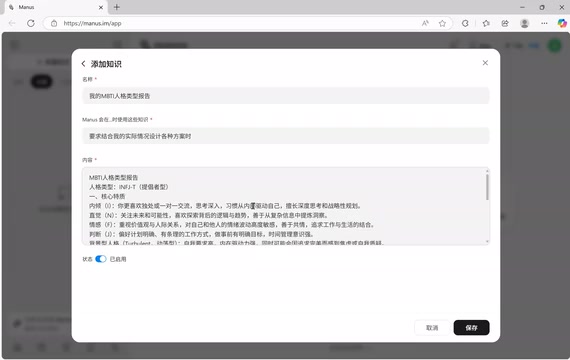
Once saved, this knowledge forms Manus's "long-term memory." From then on, regardless of what task you assign, the AI will automatically reference this information to ensure outputs are highly aligned with your personal characteristics.
Hands-On: Generating a Side Hustle Monetization Path Report
Once the knowledge base is set up, you can move on to the actual side hustle planning phase.
Prompt Design Tips
Prompt Engineering refers to the technical practice of carefully designing input text to guide large language models toward high-quality outputs. Research shows that structured prompts (with clearly defined roles, tasks, constraints, and output formats) can improve output quality by over 30% compared to natural language descriptions.
A high-quality prompt should include clear time dimensions and output requirements, following these key principles: ① Define time dimensions (short/medium/long-term) to help AI establish a temporal framework; ② Specify output structure (platforms, formats, revenue timelines) to prevent the model from being too generic; ③ Re-emphasize key information beyond what's in the knowledge base, leveraging "contextual salience" to boost the AI's attention weight. Here's a tested reference template:
Based on my personal information and actual situation, please design three side hustle monetization paths targeting:
- Short-term: Quickly generating revenue
- Medium-term: Building personal influence
- Long-term: Creating a sustainable personal IP
For each path, please include specific platform recommendations, content formats, expected revenue timelines, and required investment.
Also include basic information: education, major, core competencies, interest areas, available time, existing resources, etc. Even if some of this information is already in the knowledge base, re-emphasizing key points in the prompt helps the AI focus more precisely.
Interpreting the Output
After sending the prompt, Manus enters a thinking state. In Agent mode, the right panel displays the AI's thinking process in real time — this transparency lets you clearly see how the AI reasons step by step.
The final generated report typically includes the following structure:
- Personal information summary: AI's analysis of your core strengths and weaknesses
- Short-term path: Such as skill monetization (freelancing, consulting), knowledge products (courses, templates), etc., emphasizing quick starts
- Medium-term path: Such as content creation (WeChat Official Accounts, Xiaohongshu, Bilibili), community management, etc., focusing on influence building
- Long-term path: Such as personal brand IP development, productized services, automated income systems, etc.
These three paths actually correspond to the "monetization funnel" model in the internet content creation space: short-term skill monetization (e.g., freelancing on platforms like Zhubajie or Fiverr) relies on immediate supply-demand matching, with low entry barriers but an obvious ceiling; the core asset of medium-term content creation is audience trust, which typically takes 6-18 months to develop stable traffic; long-term IP development transforms personal branding into replicable products or service systems with passive income attributes. The value of AI in this framework lies in its ability to quickly identify the "path of least resistance" based on your personal data — that is, which track has the highest compatibility with your existing resource endowment, thereby reducing trial-and-error costs.
Each path provides specific recommendations tailored to your actual situation, rather than generic one-size-fits-all advice.
Further Extending the Report
After the report is generated, you can continue making additional requests to Manus:
- Convert the report into a PPT presentation
- Generate a shareable web version
- Deep-dive into a specific path with a detailed execution plan
- Generate a concrete action checklist for the first week
Manus's Agent capabilities enable it to not only "think" but also "do," significantly lowering the barrier from planning to execution.
Usage Tips and Considerations
Network environment: Currently, Manus recommends logging in using IP addresses from Singapore, the UK, or similar regions. Direct connections from mainland China may experience unstable access.
Knowledge base maintenance: As your skills and experience evolve, remember to regularly update your knowledge base content to keep the AI's "understanding" of you current. Since RAG systems rely on stored text for retrieval, outdated information may cause the AI to give advice that's disconnected from reality.
Iterative optimization: The first generated plan may not be perfect. You can refine it through multiple rounds of dialogue. Tell the AI which suggestions you find feasible and which don't match your reality, and it will adjust its output accordingly. This human-AI collaborative iteration is the greatest practical value of Chain-of-Thought technology in real-world applications.
Conclusion
The core logic of using the Manus agent for side hustle planning is essentially structuring personal information and then leveraging AI's analytical capabilities to find the optimal match. From a technical perspective, this is a synergistic application of three technologies: RAG retrieval augmentation, Chain-of-Thought reasoning, and structured prompt engineering. From a practical perspective, it compresses what would normally take a career consultant hours of personalized analysis into just a few minutes.
The value of this approach lies not only in saving time and effort, but also in its ability to uncover advantage combinations you might have overlooked. When AI knows you well enough, its suggestions are often more objective and systematic than "asking a friend."
Of course, AI is just a tool — actual execution and persistence still depend on you. But at the very least, with a tailor-made roadmap in hand, getting started becomes much easier.
Key Takeaways
- The Manus agent is built on the ReAct framework, offering three modes — Adaptive, Agent, and Chat — that flexibly switch based on task complexity
- The knowledge base feature leverages RAG (Retrieval-Augmented Generation) technology, transforming personal information into AI's "long-term memory" for highly personalized output
- Incorporating personality assessment data like MBTI into the knowledge base upgrades recommendations from skill-matching to dual matching of personality and skills
- Structured prompts follow three key principles — defining time dimensions, specifying output formats, and emphasizing key information — to significantly improve output quality
- The generated short/medium/long-term paths correspond to the monetization funnel model, helping identify the track with the highest compatibility with your personal resource endowment
- Reports can be further converted into PPT, web pages, and other formats, with support for continuous optimization through multi-turn dialogue; the knowledge base should be regularly updated and maintained
Related articles
 Tutorials
Cursor + Codex Dual-IDE Collaboration: A Practical Methodology for Open-Source Project Customization
A complete methodology for open-source project customization based on real-world experience, detailing the Cursor+Codex dual-IDE workflow, seven-stage process, MVP validation, and AI source code reading techniques.
 Tutorials
Cursor Multi-Agent in Practice: Building a Full-Stack Next.js Blog in 50 Minutes
Build a full-stack blog in 50 minutes using Cursor IDE's multi-Agent mode with Next.js, Clerk auth, and Supabase. Learn the 4-phase AI Agent workflow and key integration pitfalls.
 Tutorials
Building an AI Software Factory from Scratch: A Cursor Engineer's Hands-On Experience with Multi-Agent Collaboration
Cursor engineer Eric shares practical insights on building an AI software factory: automation levels, guardrail design, parallel Agent management, and scaling to 1000+ Agents for 24/7 development.