Master Git Without Coding: 5 Plain-Language Commands to Let AI Handle Version Control for You

Non-programmers can handle all core Git operations with 5 plain-language commands through AI
Bilibili creator Jiaman demonstrated how non-programmers can complete all core Git operations using just 5 natural language commands (initialize, save, rollback, branch, push to GitHub) through an AI terminal assistant. This reveals the trend of AI reducing professional tool barriers to nearly zero—expressing intent in plain language replaces memorizing complex commands, enabling version control, safe rollback, and cloud backup.
Introduction: Why Do Non-Programmers Need Git?
For people who don't write code, one of the most painful aspects of project work is chaotic file management—files scattered everywhere, with global search as the only way to find anything, wasting time and energy. Git, the standard tool for programmers, is no longer exclusive to technical professionals thanks to AI.
Git is a distributed version control system created by Linux creator Linus Torvalds in 2005. It was originally designed to manage Linux kernel development, handling scenarios where thousands of developers collaborate simultaneously. Unlike earlier centralized version control systems (such as SVN), every local copy of Git contains the complete project history, meaning you can perform version management operations even without an internet connection. This distributed architecture gives Git significant advantages in speed, data integrity, and support for non-linear development workflows—and now, these advantages are no longer reserved for programmers alone.
Bilibili creator Jiaman (Jima) shared how she, as a complete coding beginner, managed to complete all core Git operations using just 5 natural language commands through an AI assistant. This approach is well worth learning for anyone using AI for project work.

Core Method: 5 Plain-Language Commands to Handle All Git Operations
Step 1: Initialize — "Help me initialize Git"
The process is incredibly simple: create a new folder on your desktop (say, myproject), open the terminal, drag the folder in, and tell the AI "Help me initialize Git." The AI automatically executes the git init command, and the whole process takes less than two seconds.
This step is essentially telling the system: "From now on, track all changes in this folder." What git init actually does is create a hidden .git directory in your folder—this directory is Git's "brain," storing all version history, branch information, and configuration.
The AI terminal assistants used here (tools like Cursor, Warp, etc.) essentially integrate large language models deeply with the command-line environment. When users describe their intent in natural language, the AI parses it into the corresponding Shell commands and executes them directly in the terminal after user confirmation. These tools typically have context awareness—they can read the current directory structure, Git status, and other information to generate more precise commands. This differs from purely chat-based AI, which can only tell you what commands to type, while the former can directly execute them for you.
Step 2: Save — "Help me save a snapshot"
When the AI has written your code (say, a simple hello world page) and you've confirmed it works, just say "Help me save a snapshot." The AI automatically executes git add and git commit, completing your first version save.
This is like a save point in a video game—it's the safety net for all subsequent operations.
Git's commit mechanism is far more efficient than simple file copying. Each time you commit, Git doesn't copy all files again. Instead, it generates a unique fingerprint for each file using the SHA-1 hash algorithm. If a file hasn't changed, Git only stores a reference pointing to the previous version; only files that have actually been modified are stored again. This design means that even with thousands of saves, the disk space used is far less than thousands of complete copies. Each commit also records the author, timestamp, and a description message, forming a complete project timeline. So you don't need to worry about frequent saves "blowing up" your hard drive.
Step 3: Undo — "Go back to the previous version"
This is one of Git's most practical features. When the AI breaks your code—say, hello world turns into a mess of garbled text and the page won't display at all—don't panic. Because you have a save point, just tell the AI "Go back to the previous version," and it will execute git checkout or git revert, instantly restoring you to the previous working state.
Once you learn this step, you'll feel much more at ease. No more worrying about AI "helping" by breaking your project.
It's worth knowing that Git provides multiple rollback strategies for different scenarios. git checkout switches your working directory to a specified version's state without modifying the commit history; git revert creates a new commit that "reverse-undoes" a specific change, preserving the complete history; while git reset is more aggressive, directly moving the branch pointer back to a previous position. For non-programmers, the AI automatically selects the safest strategy based on your description—usually revert, because it doesn't lose any historical records, and even the rollback operation itself can be undone. You don't need to understand these differences; the AI will make the right choice for you.
Step 4: Save As — "Make a copy and try a new design"
Everyone has encountered this scenario: you want to try a different design approach for your project but are afraid of breaking the version that already works. It's like editing a Word document where you're afraid to modify the original.
Git's branch feature perfectly solves this problem. Just say "Make a copy and try a new design," and the AI will create a new branch for you. You can experiment freely on the new branch—say, turning a static hello world into a flashy animated effect—without affecting the original version at all.
If you like the result, merge it back; if not, discard it. The two versions never interfere with each other.
Git branches are extremely lightweight at the implementation level—creating a new branch only creates a 41-byte file (containing a SHA-1 hash pointing to a specific commit). This is completely different from the traditional approach of "copying the entire project folder"—it takes virtually no extra space, and creation and switching happen in milliseconds. In professional development, branches are widely used for feature development (feature branch), bug fixes (hotfix branch), and version releases (release branch). For non-programmers, think of it as parallel universes—you can explore multiple directions simultaneously and ultimately keep only the one you're most satisfied with. This ability to "experiment at zero cost" is something traditional file management simply cannot provide.
Step 5: Cloud Backup — "Push to GitHub"
What happens to your local code if your computer breaks down one day? That's when you need to push your project to GitHub. Just tell the AI "Push to GitHub," and it will guide you through the following choices:
- Create a new repository or use an existing one
- Choose Public or Private
Note that even if you choose Private, it's not recommended to upload truly sensitive information. For genuinely confidential data, the safest approach is still to save it to an external hard drive.
It's necessary to clarify a common confusion here: Git and GitHub are two different things. Git is a locally-running version control tool, while GitHub is a cloud hosting platform built on Git, acquired by Microsoft in 2018 for $7.5 billion. Beyond code storage, GitHub also provides collaboration features (Pull Requests), project management (Issues, Projects), automation workflows (GitHub Actions), and a rich ecosystem. Similar platforms include GitLab and Bitbucket. For individual users, GitHub's free account already provides unlimited private repositories, more than enough for daily project backup needs. When you say "Push to GitHub," the AI actually executes two steps: git remote add (linking the remote repository) and git push (uploading local history).
Deeper Value: AI Lowers the Barrier to Tool Usage
Looking back at the entire process, Jiaman used nothing but natural language—not a single command needed to be memorized or manually typed. This reveals an important trend: AI is reducing the barrier to using professional tools to nearly zero.
In the past, learning Git required memorizing a bunch of commands: git init, git add ., git commit -m, git branch, git push... For non-programmers, just understanding these terms was headache-inducing enough. But now, you only need to express your intent in plain language, and AI translates it into the correct operations.
The essence of this shift is a revolution in interaction paradigms. Traditional human-computer interaction required humans to learn the machine's language (command lines, keyboard shortcuts, menu hierarchies), while AI-era interaction lets machines understand human language. This isn't just about Git alone—from Photoshop to Excel, from database queries to server operations, virtually all professional tools are undergoing the same "natural language-ification" process. By mastering the meta-skill of "directing AI to operate professional tools using plain language," you've essentially gained a master key that opens doors to all professional domains.
More importantly, Git brings not just an improvement in technical capability, but also a change in thinking patterns. After using Git, your project workflow becomes as clear and organized as a mind map—what state each version is in, what changes were made, the ability to trace back at any time. This sense of control is completely impossible to experience when file management is chaotic.
Practical Recommendations
If you'd like to try using AI to operate Git, here are some suggestions:
- Choose the right AI tool: The video uses an in-terminal AI assistant (like Cursor), and AI that can directly execute commands is the most efficient. Current mainstream options include Cursor (a code editor with integrated AI), Warp (an AI-native terminal), and GitHub Copilot CLI (a command-line AI assistant). The selection criterion is: can it directly execute commands in the terminal for you, rather than just giving you text suggestions?
- Build a saving habit: Save after completing each small feature—the more frequently you save, the more precise your undo capability. A good rule of thumb: save whenever you feel "this state looks good."
- Use branches boldly: Always create a branch first when trying a new approach—it's zero-cost experimentation. Remember, creating a branch only takes 41 bytes, far less costly than the time you spend hesitating.
- Push to GitHub regularly: Don't wait until the project is complete to push—pushing as you go is the safest approach. Push at least once at the end of each workday, so even if your computer has problems, you lose at most one day's work.
Not knowing how to code isn't a barrier. With AI at hand, plain language is the best programming language.
Related articles
 Tutorials
Cursor + Codex Dual-IDE Collaboration: A Practical Methodology for Open-Source Project Customization
A complete methodology for open-source project customization based on real-world experience, detailing the Cursor+Codex dual-IDE workflow, seven-stage process, MVP validation, and AI source code reading techniques.
 Tutorials
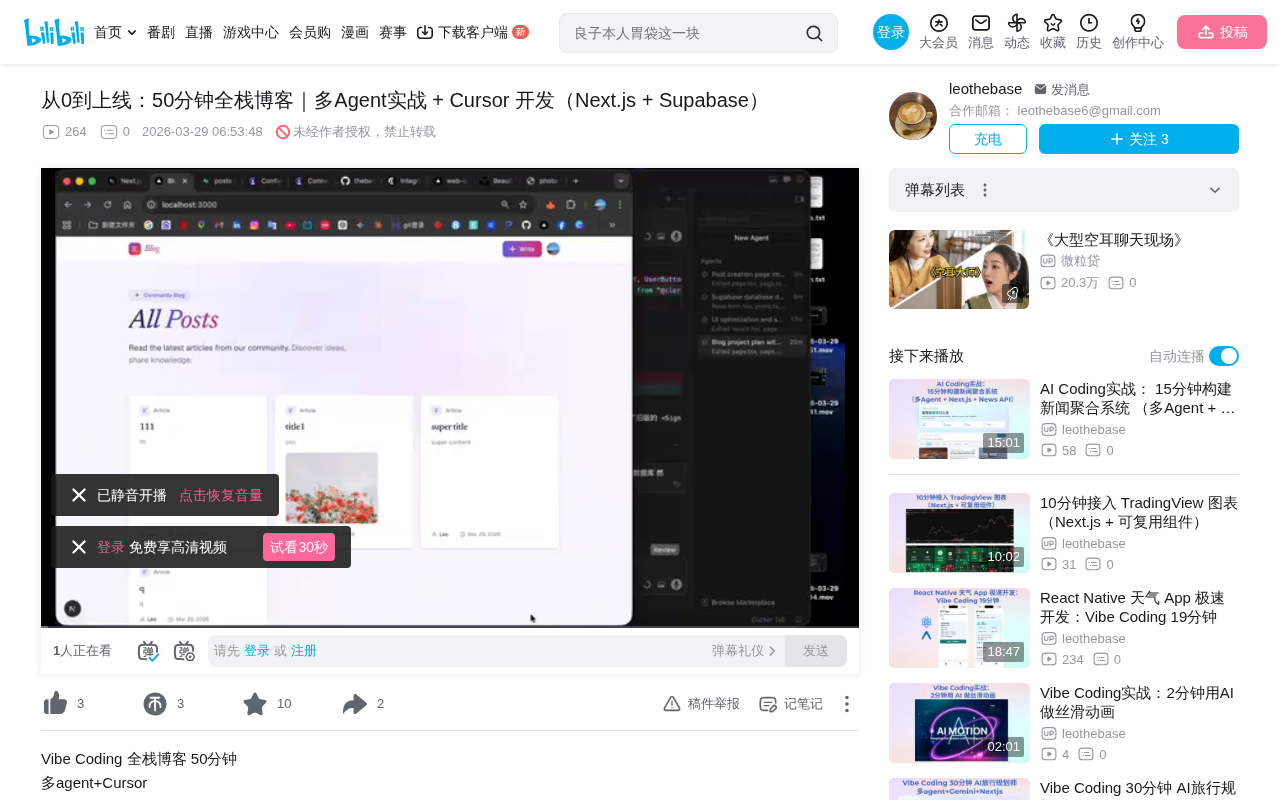
Cursor Multi-Agent in Practice: Building a Full-Stack Next.js Blog in 50 Minutes
Build a full-stack blog in 50 minutes using Cursor IDE's multi-Agent mode with Next.js, Clerk auth, and Supabase. Learn the 4-phase AI Agent workflow and key integration pitfalls.
 Tutorials
Building an AI Software Factory from Scratch: A Cursor Engineer's Hands-On Experience with Multi-Agent Collaboration
Cursor engineer Eric shares practical insights on building an AI software factory: automation levels, guardrail design, parallel Agent management, and scaling to 1000+ Agents for 24/7 development.