MCP Protocol Explained: The USB-C of the AI World
MCP is the unified open standard for connecting AI to external tools—the USB-C of the AI world.
MCP (Model Context Protocol) is an open standard released by Anthropic, built on JSON-RPC 2.0, that unifies how AI models connect to external tools and data sources through a Client-Server architecture. Compared to proprietary Function Calling solutions from individual vendors, MCP achieves "write once, reuse across platforms." The ecosystem exploded in 2025 with over 5,000 Servers available, but security auditing lags far behind—misconfigured permissions can lead to sensitive data leaks, making the Principle of Least Privilege essential.
What is MCP?
Imagine this scenario: you ask an AI Agent to book a flight for you, but how does it know where your calendar is? How does it call the airline API? It needs a "standard plug" to connect to these external tools and data—that's MCP.
MCP, short for Model Context Protocol, is an open standard released by Anthropic in late 2024. Its core objective is singular: to enable AI models to connect to external data sources and tools in a unified way.
The most intuitive analogy: MCP is the USB-C of the AI world. Previously, every AI company had its own proprietary interface—like the old days when Apple used Lightning and Android used Micro-USB, each going its own way. MCP's emergence aims to connect all tools with a single cable.
It's worth noting that MCP is built on JSON-RPC 2.0 at the technical layer—a lightweight remote procedure call specification that natively supports bidirectional communication and asynchronous messaging. Anthropic's choice of this foundation was no accident: JSON-RPC's stateless nature and language-agnostic design mean MCP Servers can be implemented in Python, TypeScript, Go, or any other language, dramatically lowering the barrier to entry for developers. This pragmatic technical choice is one of the key reasons MCP has been able to spawn such a massive ecosystem in such a short time.
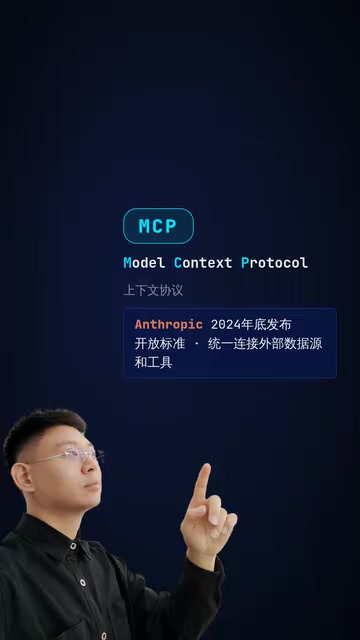
How MCP Works
MCP's architecture is elegantly simple, consisting of two core roles:
MCP Server: The Capability Provider
An MCP Server is responsible for exposing specific capabilities. For example:
- Reading files: Enabling AI to access local or cloud-based documents
- Querying databases: Fetching structured data directly from databases
- Searching GitHub: Retrieving code repositories, Issues, PRs, and more
- Calling various APIs: Weather, flights, calendars, and other third-party services
Each MCP Server is like a "capability plugin"—packaging specific functionality and waiting to be called.
MCP Client: The Capability Consumer
The MCP Client is the AI model itself (or the application hosting the AI model). Once a Client connects to a Server, it can directly use the various capabilities the Server provides, without writing custom integration code for each tool.
This Client-Server separation architecture completely decouples capability provision from consumption. Developers only need to write an MCP Server once, and all AI models supporting the MCP protocol can call it. This design philosophy is highly consistent with the "service registration and discovery" concept in microservices architecture—each Server self-describes its capability boundaries, Clients dynamically discover and invoke as needed, giving the entire system exceptional scalability.
The Explosive Growth of the MCP Ecosystem
Entering 2025, the MCP ecosystem is experiencing explosive growth. Mainstream tools and platforms including GitHub, Slack, various databases, and file systems have all released corresponding MCP Servers. According to community statistics, there are now over 5,000 MCP Servers available for use.

At the application level, mainstream AI tools like Cursor and Claude Desktop have fully embraced the MCP protocol. This means users can directly connect to various MCP Servers within these tools, dramatically expanding AI's capability boundaries.
The speed of this ecosystem's flourishing validates, to some extent, the correctness of MCP's design philosophy—the network effects brought by standardization are accelerating the maturation of the entire AI toolchain. This mirrors the historical pattern of TCP/IP unifying network communication and HTTP unifying web access: once a standard crosses a critical threshold and gains endorsement from major platforms, the ecosystem's snowball effect becomes self-reinforcing, and the switching costs for latecomers rise sharply.
Security Risks: Traps That Cannot Be Ignored
However, behind the ecosystem's prosperity lurk serious security risks. A misconfigured MCP Server could allow AI to access data it shouldn't see.

Specifically, risks are concentrated in the following areas:
- Database password leaks: If an MCP Server's permission configuration is too permissive, AI might read sensitive database credentials
- Private file exposure: File system MCP Servers without proper directory isolation could allow AI to read private files
- Token theft: Authentication tokens from other applications could be indirectly accessed through insecure MCP Servers
To address these risks, the information security field has a time-tested fundamental principle—the Principle of Least Privilege (PoLP): every component in a system should only be granted the minimum permissions necessary to complete its task. In the MCP context, this means a Server that only needs to read calendars should never have write access to the file system. In engineering practice, this principle can be implemented through container sandbox isolation, fine-grained ACLs (Access Control Lists), and runtime permission auditing.
The current reality is: The number of MCP Servers is growing rapidly, but security auditing is far from keeping pace. Many developers deploying MCP Servers haven't adequately considered the principle of least privilege or proper security boundary definitions. This is currently the biggest weakness of the entire MCP ecosystem.
MCP vs Function Calling: The Fundamental Difference
Many people confuse MCP with Function Calling—they do solve similar problems: enabling AI to call external tools. But the fundamental difference lies in the degree of standardization.

Function Calling is each vendor's proprietary solution. Function Calling was first officially introduced by OpenAI in June 2023 within the GPT-4 API, allowing developers to describe function signatures in JSON Schema format so models could decide when to call external functions during conversations. Subsequently, Anthropic launched Tool Use and Google launched Function Declarations—three systems that differ in parameter formats, error handling, parallel invocation, and other details. If developers want their tools to support multiple AI platforms simultaneously, they need to adapt for each platform separately, multiplying the workload and consuming enormous effort on "glue code" with zero business value.
MCP is a unified open standard. Write an MCP Server once, and all AI systems supporting the MCP protocol can call it. It's like the evolution of charging cables—previously you needed one for Apple and one for Android, now USB-C handles everything.
| Comparison | Function Calling | MCP |
|---|---|---|
| Standardization | Vendor-proprietary | Unified open standard |
| Adaptation cost | Separate adaptation per platform | Write once, use everywhere |
| Ecosystem effect | Platform lock-in | Cross-platform reuse |
| Development trend | Gradually converging toward MCP | Becoming industry consensus |
Summary and Outlook
The emergence of MCP marks a critical turning point in AI tool integration—from fragmentation to unified standards. It reduces integration costs for developers, expands the capability boundaries of AI models, and paves the way for the real-world deployment of AI Agents.
But we must also clearly recognize that while standardization brings convenience, it also amplifies the impact surface of security risks. A security vulnerability in a universal protocol doesn't affect just one product—it affects the entire ecosystem. While enjoying the convenience MCP brings, security auditing and permission management must keep pace.
For developers, now is the best time to learn and embrace MCP. The 5,000+ Server ecosystem is already rich enough, and mainstream tool support is in place. But when deploying your own MCP Server, be sure to follow the Principle of Least Privilege and configure security properly.
Related articles
 Deep Dives
Deep Dive into How OpenClaw (Open-Source Crayfish) AI Agent Works
Deep analysis of OpenClaw AI Agent internals: System Prompt, tool calling, SubAgents, Skill system, memory, and Context Engineering explained.
 Deep Dives
Demystifying Transformer: A Word-Continuation Function, Deconstructed
Understand Transformer through the lens of word continuation. Breaking down language generation into Embedding, Transformer Block, and Probability output modules for intuitive understanding.
 Deep Dives
Five Core Differences Between Claude Code and Regular AI Chat
A detailed comparison of Claude Code vs regular AI chat across five dimensions: interaction, context understanding, execution, memory, and tool integration.