Meta Muse Spark Released: A Comprehensive Analysis of the Native Multimodal Reasoning Model
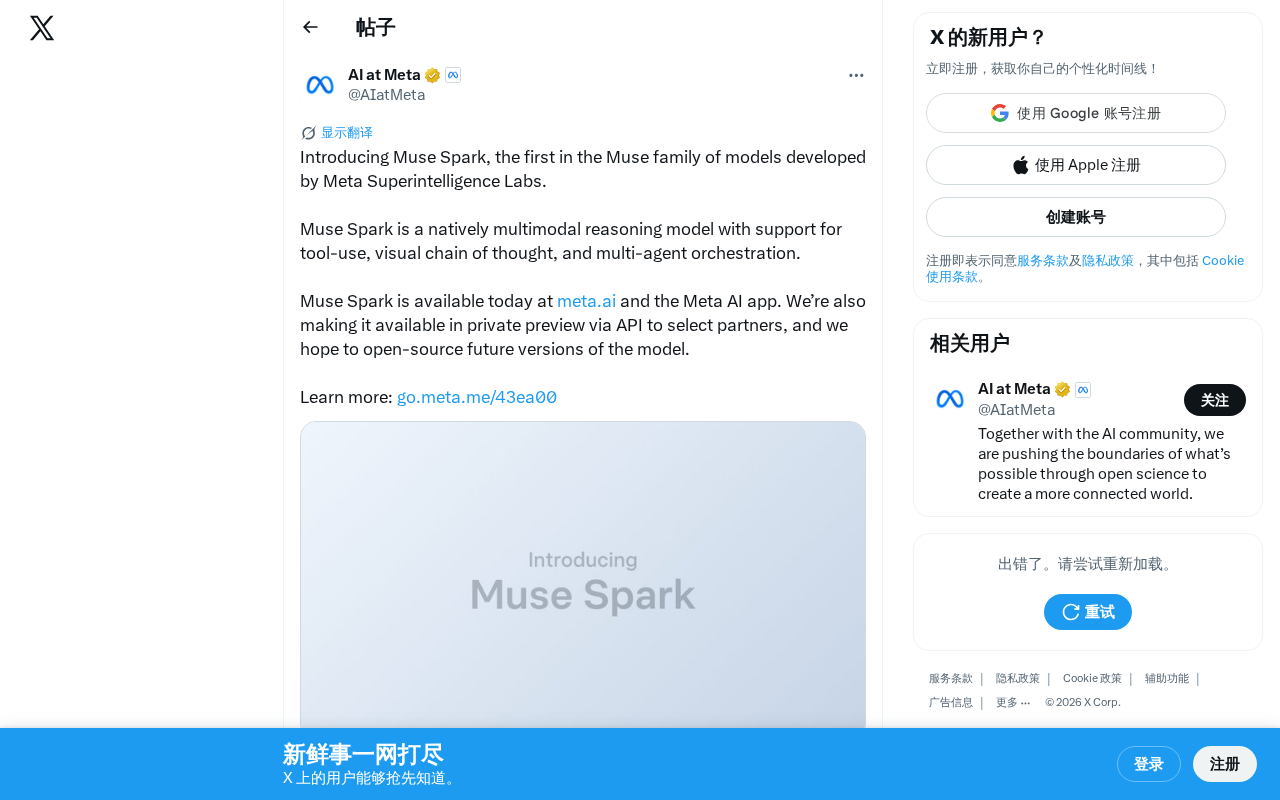
Meta Superintelligence Labs launches Muse Spark, its first native multimodal reasoning model.
Meta Superintelligence Labs officially launches Muse Spark, the first model in the Muse family, featuring native multimodal reasoning, visual chain of thought, and multi-agent orchestration. The model is live on meta.ai with API preview available to partners, and Meta commits to future open-sourcing. Muse Spark's release signals Meta's shift from follower to multimodal AI paradigm definer, competing directly with GPT-4o and Gemini.
Meta Superintelligence Labs' Strategic Vision
Meta Superintelligence Labs has officially launched the first product in its Muse model family — Muse Spark. This is a native multimodal reasoning model that supports tool-use, visual chain of thought, and multi-agent orchestration, marking a significant step forward for Meta in the multimodal AI space.
Notably, the term "Superintelligence" was systematically articulated by philosopher Nick Bostrom in his 2014 book Superintelligence: Paths, Dangers, Strategies, and has long been associated more with AI safety research and philosophical discourse than commercial product branding. Meta's decision to name its new lab "Superintelligence Labs" is a highly strategic branding move — it not only directly matches OpenAI in terms of technical ambition but also sends a clear signal to capital markets and top research talent: Meta is no longer content to play catch-up; it aims to dominate the definition of next-generation AI paradigms. This naming also aligns with recent public statements from Meta CEO Mark Zuckerberg, who has said Meta's goal is to "build general intelligence and make it widely available."
Three Core Capabilities of Muse Spark
Based on Meta's official disclosures, Muse Spark features three core capabilities:
Natively Multimodal Reasoning: Unlike many "stitched-together" multimodal models, Muse Spark is multimodal at the architectural level. Understanding this distinction requires tracing back to representation learning theory in deep learning: early multimodal systems (such as CLIP+GPT combinations) typically employed a two-stage "perception-understanding" pipeline — a visual encoder converts images into vectors, which are then fed into a language model for comprehension. The bottleneck of this approach lies in information loss; when visual features are converted into tokens that language models can understand, a significant amount of fine-grained spatial and semantic information is compressed and lost. Native multimodal architectures, by contrast, mix-train on data from multiple modalities — images, text, etc. — from the pre-training stage, allowing the model's attention mechanism to directly establish connections between tokens of different modalities, achieving true cross-modal reasoning. Google's Gemini series represents this approach, with its papers explicitly emphasizing the performance gains from "multimodal training from scratch." This means Muse Spark can perform deeper fusion reasoning when processing information across different modalities like images and text, rather than simply chaining visual and language modules together.
Visual Chain of Thought: This is a noteworthy feature. Chain of Thought (CoT) was formally introduced by the Google Brain team in their 2022 paper Chain-of-Thought Prompting Elicits Reasoning in Large Language Models. The core idea is to have models explicitly output intermediate reasoning steps before providing a final answer, significantly improving accuracy on complex reasoning tasks. Traditional chain of thought unfolds the reasoning process primarily in text form, while visual chain of thought extends this concept to multimodal scenarios — the model not only needs to describe its reasoning process in words but also needs to dynamically "look" during the reasoning chain, such as highlighting specific regions of an image during problem-solving, generating auxiliary diagrams, or conducting step-by-step analysis of visual content. This closely mirrors the cognitive process humans use when solving visual problems. If Muse Spark can achieve true visual chain of thought, it will have significant advantages in scenarios like mathematical diagram parsing, medical image analysis, and engineering drawing comprehension, making the reasoning process for complex problems more intuitive and interpretable.
Tool-use & Multi-agent Orchestration: The theoretical foundations of Multi-Agent Systems (MAS) can be traced back to distributed artificial intelligence research in the 1980s, but with the explosion of large language model capabilities, multi-agent orchestration experienced a surge in engineering practice during 2023-2024. The successive emergence of frameworks like AutoGPT, LangChain, CrewAI, and Microsoft AutoGen has demonstrated the enormous potential of the "multiple AI agents collaborating" paradigm for solving complex tasks. Traditional single models often hit limitations when facing long-process, multi-step tasks due to context window length and single-inference depth constraints; multi-agent architectures allow complex tasks to be decomposed into subtasks, processed in parallel by specialized agents, with results integrated by an Orchestrator. Muse Spark builds multi-agent orchestration as a native capability rather than relying on external frameworks, meaning lower latency and tighter capability integration, providing infrastructure-level support for building complex AI workflows.
Meta Superintelligence Labs' Product Strategy
Muse is positioned as a model "family," with Spark being just the first release. This naming strategy suggests Meta plans to roll out Muse variants of different scales and focuses, gradually building a complete multimodal AI product matrix.
Drawing from the success of the Llama series in the open-source LLM space, Meta will likely replicate a similar strategy. Meta's open-source AI efforts can be traced back to the release of the PyTorch framework in 2016 — a decision that fundamentally changed the tooling ecosystem for deep learning research, enabling PyTorch to gradually surpass TensorFlow as the most mainstream framework in academia. In the large language model era, Meta released the LLaMA series in February 2023 and has continued iterating since, building one of the world's most active open-source LLM ecosystems. The open-source strategy has delivered multiple benefits for Meta: accelerating model iteration through community contributions, establishing developer mindshare, and shaping a "responsible openness" image on the regulatory front.
Open Strategy: API Preview and Open-Source Commitment
In terms of availability, Muse Spark adopts a tiered openness strategy:
- Immediately available: Users can experience Muse Spark right now through the meta.ai website and the Meta AI app
- API private preview: API access is available to select partners, with developer ecosystem building already underway
- Future open-source: Meta has explicitly stated it "hopes to open-source future versions of the model," consistent with its longstanding open-source strategy
The phrasing "hope to open-source" is slightly more conservative compared to the firm stance taken during the Llama era, and there are deeper reasons behind this: open-sourcing multimodal models faces more complex challenges than pure text models, as visual content generation capabilities could be misused for deepfakes and other scenarios, which explains why Meta is more cautious in its open-source commitment for Muse Spark. This likely reflects additional considerations around safety and compliance for multimodal models. However, given Meta's accumulated open-source experience and community influence from Llama, the open-sourcing of the Muse series is almost certainly expected.
Muse Spark's Position in the Competitive Landscape
The release of Muse Spark further intensifies competition in the multimodal AI space. Currently, OpenAI's GPT-4o, Google's Gemini series, and Anthropic's Claude are all continuously iterating on multimodal capabilities. Muse Spark's differentiated advantages are primarily reflected in three areas:
- Native multimodal architecture rather than post-hoc stitching, theoretically enabling better cross-modal understanding
- Native support for multi-agent orchestration, which is uncommon among competitors
- Ecosystem advantages from the open-source commitment, which is Meta's unique weapon against closed-source competitors
However, Meta has not yet published detailed benchmark data for Muse Spark, and its actual performance remains to be broadly validated by the community. Judging from the "Spark" naming, this is likely a relatively lightweight version, with heavier-weight Muse models potentially still on the way.
Summary and Outlook
The release of Muse Spark marks Meta's official new play in the multimodal AI space. The combination of native multimodal reasoning, visual chain of thought, and multi-agent orchestration demonstrates Meta's unique understanding of next-generation AI systems. From PyTorch to LLaMA to the Muse series today, Meta has consistently leveraged "openness" as the core pillar of its technology ecosystem strategy. As API access gradually expands and future versions are open-sourced, the Muse series is poised to become a significant force in the multimodal AI ecosystem. For developers and researchers, now is a good time to start paying attention to and tracking this model family.
Key Takeaways
- Meta Superintelligence Labs releases Muse Spark, the first model in the Muse family and a native multimodal reasoning model
- Muse Spark supports three core capabilities: tool-use, Visual Chain of Thought (Visual CoT), and multi-agent orchestration
- The model is live on meta.ai and the Meta AI app, with API private preview available to select partners
- Meta commits to open-sourcing future Muse models, continuing the open-source tradition from PyTorch to LLaMA, though with more cautious wording than before
- Muse Spark's release intensifies competition in the multimodal AI space, directly competing with GPT-4o, Gemini, and others
Related articles
 Tech Frontiers
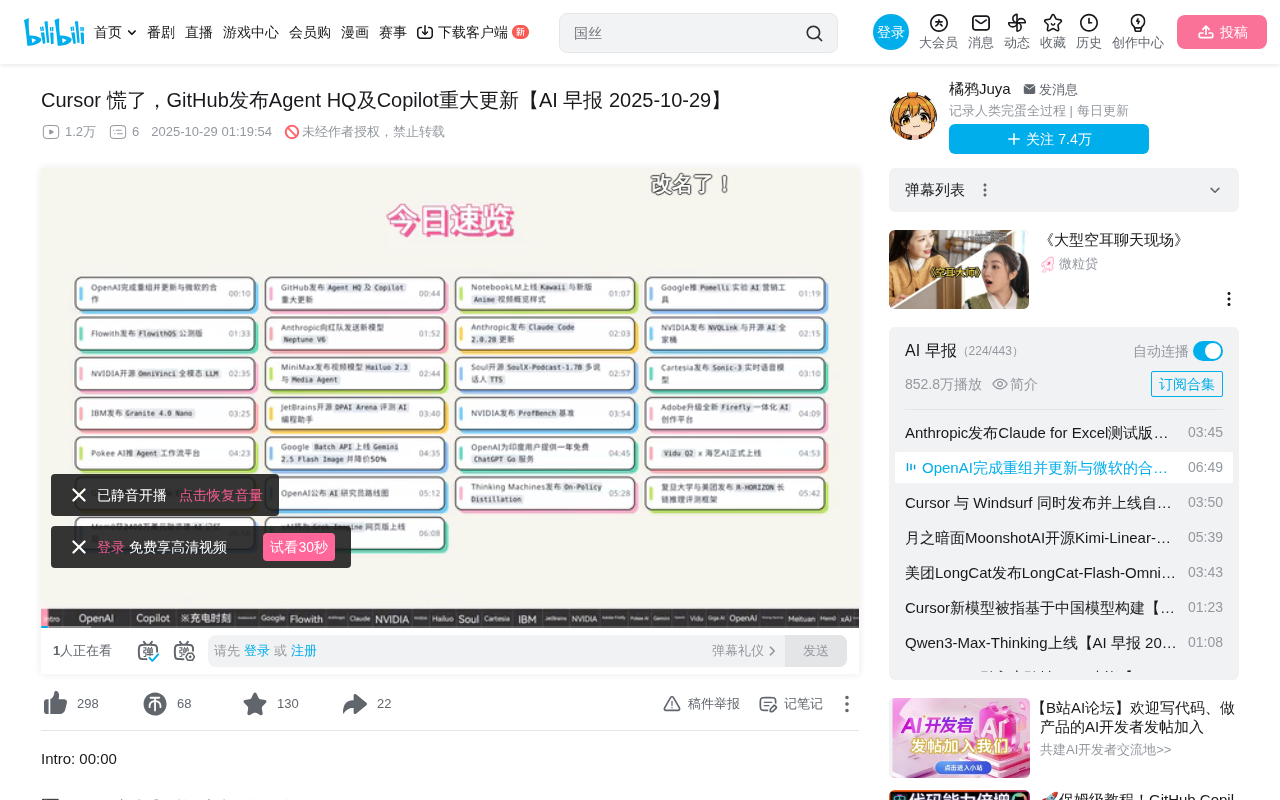
GitHub Agent HQ Launch: AI Coding Tools Enter the Era of Platform Competition
GitHub Universe unveils Agent HQ platform for unified coding agent management, Copilot upgrades with multi-model support. OpenAI completes restructuring, Anthropic tests new model, NVIDIA open-sources AI models.
 Tech Frontiers
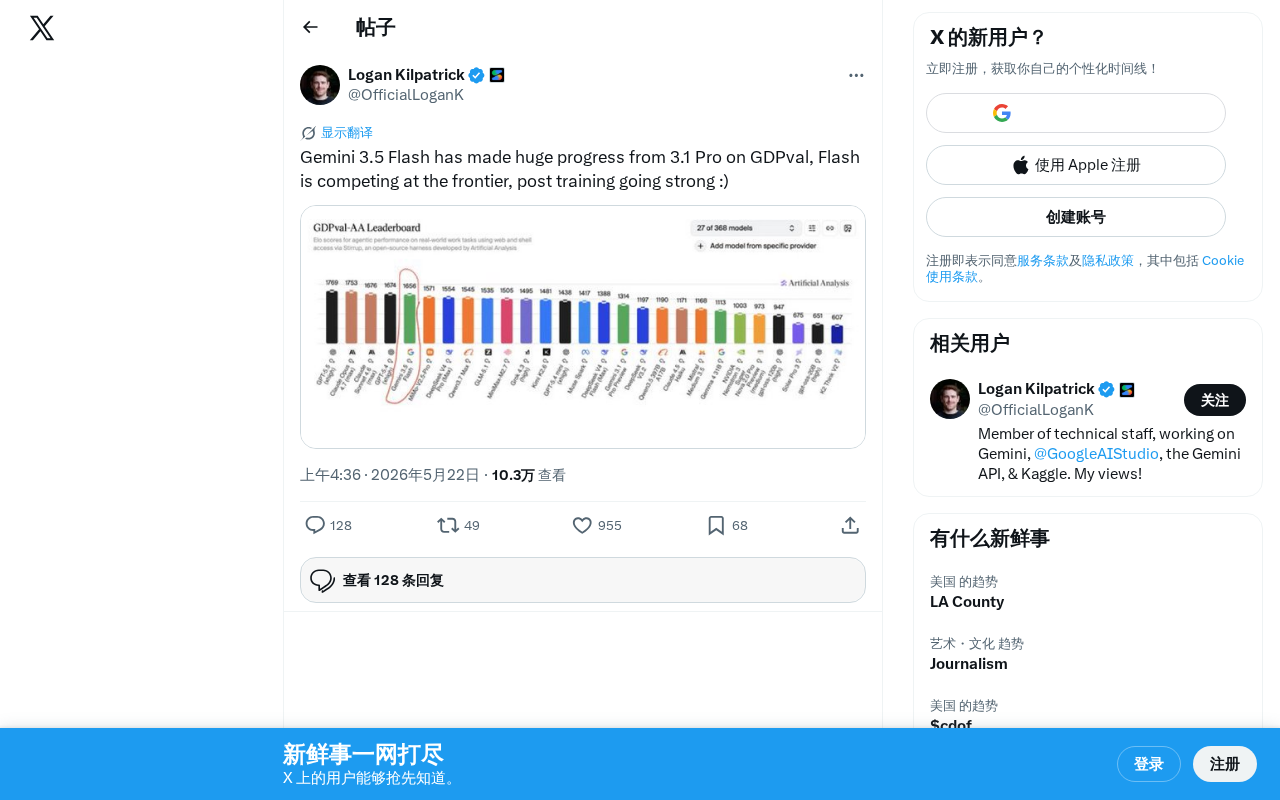
Gemini 3.5 Flash Achieves a Massive Leap on the GDPval Benchmark
Google Gemini 3.5 Flash surpasses Gemini 3.1 Pro on the GDPval benchmark. The lightweight Flash model leverages post-training techniques to approach frontier-level performance, redefining the balance between quality and cost.
 Tech Frontiers
Google Gemini Antigravity Weekly Quota Tripled — AI Coding Without Limits
Google Gemini triples Antigravity weekly quotas following a prior daily quota boost. Analyzing the impact on developers and its strategic significance in AI coding.