MixupMP: How Data Augmentation Fixes the Uncertainty Quantification Flaws of Deep Ensembles

MixupMP fixes Deep Ensembles' uncertainty quantification flaws through data augmentation.
The AISTATS 2024 paper proposes MixupMP, which uses a predictive framework to reveal that Deep Ensembles implicitly assume future data only appears on the training distribution's support—a fundamental flaw. By leveraging Mixup data augmentation to expand the predictive distribution's support and grounding the method in Martingale Posterior theory for Bayesian guarantees, MixupMP serves as a drop-in replacement for Deep Ensembles, achieving superior calibration and OOD detection on multiple image classification benchmarks.
Why Uncertainty Quantification Matters in Deep Learning
In real-world deep learning deployments, models need to do more than just produce predictions—they need to tell us "how confident they are." This is the core problem of Uncertainty Quantification (UQ).
In machine learning, uncertainty is typically divided into two categories: Epistemic Uncertainty and Aleatoric Uncertainty. Epistemic uncertainty stems from uncertainty in model parameters, reflecting insufficient training data or limited model capacity—theoretically reducible by collecting more data. Aleatoric uncertainty arises from inherent noise and randomness in the data itself, which cannot be eliminated even with infinite data. Deep ensemble methods primarily model epistemic uncertainty, which is one fundamental reason they underperform on out-of-distribution data.
Whether in autonomous driving, medical diagnosis, or financial risk management, a model that cannot assess its own confidence can lead to catastrophic consequences.
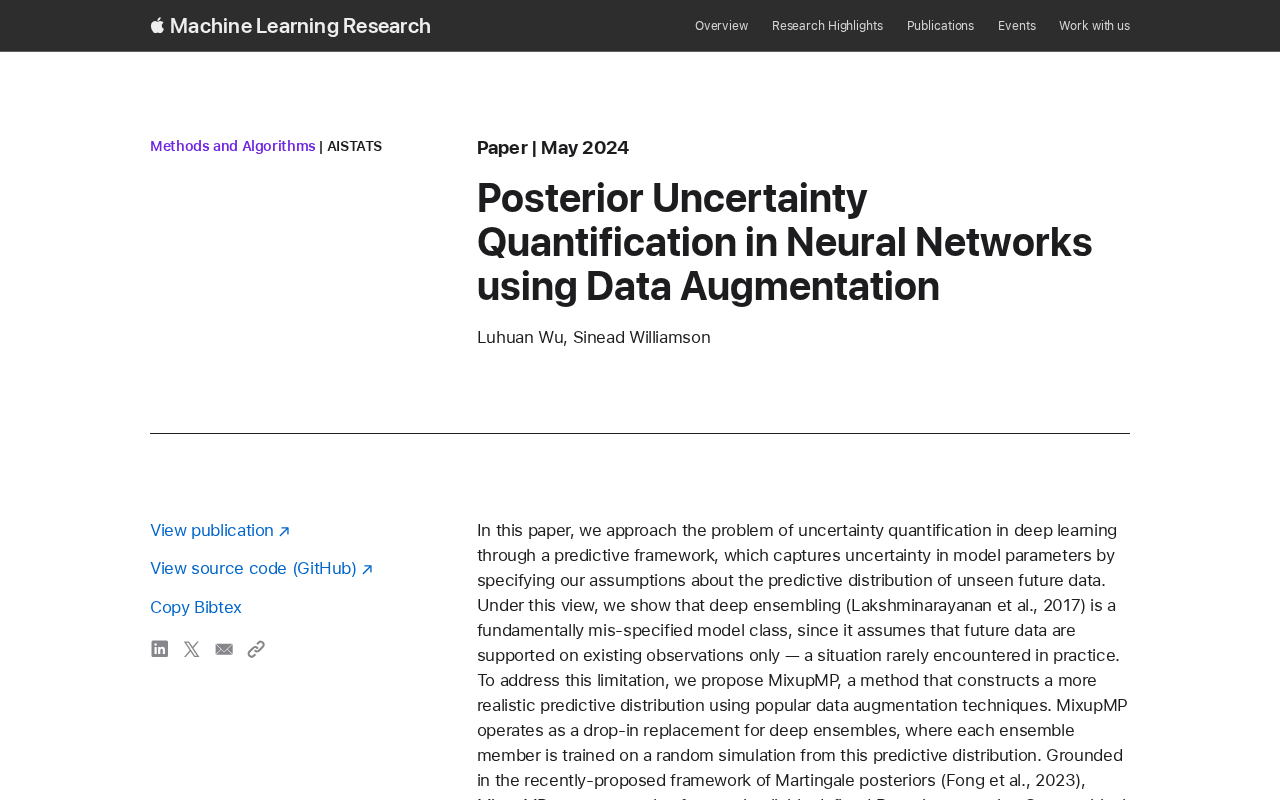
A paper from AISTATS 2024 proposes a new method called MixupMP that re-examines the fundamental flaws of Deep Ensembles from a predictive framework perspective, using data augmentation techniques to construct more reasonable predictive distributions. It achieves superior performance over existing Bayesian and non-Bayesian methods across multiple image classification benchmarks.
The Fundamental Flaw of Deep Ensembles: A Re-examination Through the Predictive Framework
What the Predictive Framework Reveals
The paper's authors, Luhuan Wu and Sinead Williamson, adopt a Predictive Framework to analyze the uncertainty quantification problem. Unlike traditional parametric posterior inference, this framework characterizes uncertainty in model parameters through predictive distributions over unseen data.
From this perspective, the authors reveal an important finding: Deep Ensembles are essentially a mis-specified model class. Specifically, Deep Ensembles implicitly assume that future data is supported only on existing observations—that future data points will only appear in regions already covered by the training set. This is almost never true in practice.
Why This Assumption Doesn't Hold
Deep Ensembles were proposed by Lakshminarayanan et al. in 2017. The core idea is to estimate uncertainty by training multiple randomly initialized neural networks and aggregating their predictions. While this approach performs well in practice, its miscalibration issues are particularly pronounced on out-of-distribution data.
Imagine a Deep Ensemble model trained on a cat-vs-dog classification dataset. When presented with a photo of a cat taken from a never-before-seen angle, the model might produce overconfident or completely incorrect uncertainty estimates because the data point is far from the training distribution. Deep Ensembles quantify uncertainty by training multiple independent networks and aggregating their predictions, but if every ensemble member is based on the same limited training data, their ability to cover out-of-distribution regions is inherently constrained.
This theoretical analysis provides a clear explanation for the miscalibration phenomenon frequently observed with Deep Ensembles in practice.
The Core Idea of MixupMP: Expanding Predictive Distributions Through Data Augmentation
Directly Addressing Deep Ensembles' Pain Point
MixupMP's design philosophy is straightforward: since the problem lies in the predictive distribution's support being too narrow, use data augmentation techniques to construct predictive distributions that better reflect real-world scenarios.
Specifically, MixupMP leverages data augmentation methods like Mixup to generate reasonable "virtual" data points based on existing data, thereby expanding the support of the predictive distribution. Each ensemble member is no longer trained on the original training set, but rather on data randomly sampled from this augmented predictive distribution.
Mixup was proposed by Zhang et al. in 2018. Its core operation is linear interpolation of training samples: mixing the feature vectors and labels of two samples according to a random ratio λ to generate new virtual training samples. This approach not only expands the coverage of the data distribution but also introduces smooth transitions between samples, enabling the model to make reasonable predictions for intermediate regions of the input space. From an uncertainty quantification perspective, the interpolated samples generated by Mixup act as anchors planted in the "blank spaces" between training data, guiding the model to establish reasonable confidence estimates for these regions rather than simply extrapolating or collapsing.
Martingale Posterior: The Theoretical Foundation of MixupMP
MixupMP is not merely an engineering trick—it has solid theoretical underpinnings. The method is built upon the Martingale Posterior Framework proposed by Fong, Holmes, and Walker in 2023.
The Martingale Posterior is a Bayesian inference framework based on predictive sequence consistency. Its core idea differs fundamentally from traditional Bayesian methods: traditional approaches start from the parameter posterior distribution and then derive the predictive distribution, while the Martingale Posterior directly models the predictive distribution of observation sequences, requiring predictions to satisfy Exchangeability conditions—meaning prediction results do not depend on the ordering of the data. This property bypasses the problem of likelihood misspecification, providing a novel path for nonparametric Bayesian inference. Under this framework, the samples returned by MixupMP come from an implicitly defined Bayesian posterior distribution.
This means MixupMP simultaneously possesses advantages from both sides:
- Theoretical guarantees of Bayesian methods: Consistency of posterior inference and soundness of uncertainty quantification
- Engineering practicality of Deep Ensembles: Serves as a drop-in replacement for Deep Ensembles, requiring no modifications to network architecture or core training procedures
Extremely Simple Engineering Implementation
From an engineering perspective, MixupMP has a very low implementation barrier. Users simply need to replace the training data for each ensemble member in a standard Deep Ensemble with data sampled from the augmented predictive distribution. This design allows existing systems using Deep Ensembles to migrate to MixupMP at low cost without major code refactoring.
Experimental Results: Dual Validation of Predictive Performance and Uncertainty Quantification
The paper conducts comprehensive empirical analysis across multiple image classification datasets, evaluating MixupMP along two dimensions:
In terms of predictive performance, MixupMP matches or exceeds the best baseline methods in classification accuracy. The regularization effect brought by data augmentation improves the model's generalization ability on test sets.
In terms of uncertainty quantification, MixupMP demonstrates significant advantages. Compared to standard Deep Ensembles, MC Dropout, variational inference, and other existing methods, MixupMP achieves better results on the following metrics:
-
Calibration Error: Smaller deviation between predicted probabilities and actual accuracy. Calibration error is typically measured by Expected Calibration Error (ECE), which is computed by binning predictions by confidence level and calculating the weighted average deviation between model confidence and actual accuracy within each bin. Lower ECE means that when a model "says it's 80% confident," it actually has approximately 80% probability of being correct—crucial for safety-critical systems.
-
Out-of-Distribution (OOD) Detection: Stronger ability to identify data from unknown classes. OOD detection evaluates a model's ability to recognize inputs outside the training distribution—an ideal model should output high uncertainty rather than high-confidence incorrect predictions when encountering data types it has never seen. This capability is particularly critical for scenarios like autonomous driving (recognizing rare road conditions) and medical diagnosis (identifying rare cases). Together, these two metrics constitute the standard evaluation framework for uncertainty quantification methods, and MixupMP's simultaneous improvement on both validates the effectiveness of its theoretical design.
These experimental results confirm the theoretical analysis's predictions: by expanding the support of the predictive distribution, models can more accurately estimate their own uncertainty.
Methodological Insights and Future Directions
The Deep Connection Between Data Augmentation and Uncertainty Estimation
MixupMP reveals a profound insight: data augmentation is not just a tool for improving model performance—it's a key mechanism for improving uncertainty estimation. Traditionally, data augmentation has been viewed as a regularization technique; under the predictive framework, it becomes a way to construct reasonable prior assumptions—we express our beliefs about "what future data might look like" through data augmentation.
This connection has important theoretical implications: different data augmentation strategies actually correspond to different prior assumptions. Mixup's linear interpolation assumes the data manifold is convex; rotation augmentation assumes rotational invariance of targets; color jittering assumes the model should not over-rely on color information. Choosing an augmentation strategy is essentially expressing domain knowledge about the data-generating process, and MixupMP directly encodes this domain knowledge into the uncertainty estimation process.
Cross-Domain Application Potential
Although the paper focuses on image classification tasks, MixupMP's framework has good generality. Any domain-specific data augmentation technique can be incorporated into this framework, for example:
- Natural Language Processing: Text back-translation, synonym replacement, and other text augmentation strategies
- Time Series Analysis: Window sliding, time warping, and other sequence augmentation methods
- Medical Imaging: Rotation, elastic deformation, and other targeted augmentation techniques
Furthermore, with the widespread deployment of Large Language Models (LLMs), the need for uncertainty quantification is increasingly urgent. The hallucination problem in LLMs is essentially a failure of uncertainty estimation—the model assigns excessive confidence to incorrect answers. The approach demonstrated by MixupMP—"improving uncertainty quantification through predictive distribution modeling"—may provide new technical pathways for LLM hallucination detection and reliability assessment: by constructing reasonable interpolation augmentation strategies in text space, language models can be guided to exhibit more honest uncertainty at knowledge boundaries.
Conclusion
MixupMP is a work that combines theoretical depth with practical value. Starting from the predictive framework, it reveals the fundamental flaw of Deep Ensembles in uncertainty quantification and provides an elegant and effective solution based on Martingale Posterior theory. For any deep learning application requiring reliable uncertainty estimates—from autonomous driving to medical AI—MixupMP deserves serious consideration. The paper's source code is open-sourced on GitHub, providing convenience for researchers and engineers to reproduce and apply the method.
Key Takeaways
- Deep Ensembles suffer from a fundamental model misspecification problem, implicitly assuming future data only appears on the support of existing observations
- MixupMP leverages Mixup and other data augmentation techniques to construct more realistic predictive distributions, serving as a drop-in replacement for Deep Ensembles
- The method is grounded in the Martingale Posterior framework, returning implicitly defined Bayesian posterior samples with both theoretical guarantees and practical utility
- Across multiple image classification datasets, MixupMP outperforms existing Bayesian and non-Bayesian methods in both predictive performance and uncertainty quantification
- Reveals the deep connection between data augmentation and uncertainty quantification, offering new perspectives for broader application scenarios
Related articles
New Species Discovered in New York's C…
New Species Discovered in New York's Central Park? Inside the Urban Insect Hunting Project
Scientists set up insect traps in NYC's Central Park and Prospect Park to discover unknown species. With 90% of Earth's species still unnamed, urban biodiversity research is becoming a new trend in ecology.
The Full Story of the Higgs Boson Disc…
The Full Story of the Higgs Boson Discovery: An Insider's Account of the 'God Particle'
A Fermilab physicist's insider account of the Higgs boson discovery: the transatlantic race with CERN, behind-the-scenes details of the 2012 announcement, 14 years of verification, and the true origin of the 'God Particle' name.
 Research
SciMDR: How a 7B Small Model Rivals GPT-5 in Scientific Reasoning
Yale and other institutions introduce SciMDR, a two-stage data synthesis pipeline enabling a 7B model to match GPT-5 level performance in scientific literature comprehension.