Model Router Prism Integrates Fable 5: 30% Cost Reduction Without Quality Loss
Prism model router integrates Fable 5, cutting per-task costs up to 30% without sacrificing quality.
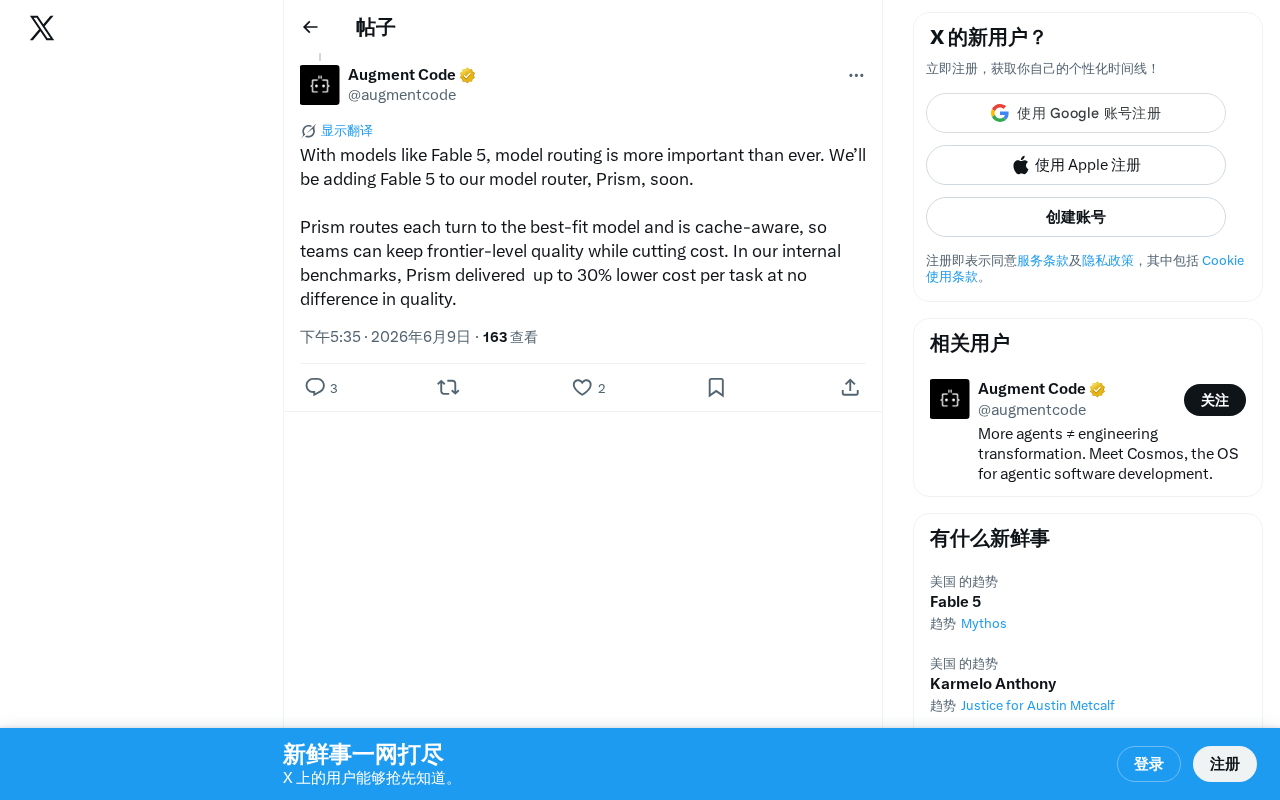
AI model router Prism announces upcoming integration of the Fable 5 model, leveraging per-turn intelligent routing and cache-aware technology to achieve up to 30% cost reduction per task while maintaining frontier-model output quality. The article analyzes Prism's core mechanisms, cost optimization principles, and the broader model routing industry trend toward multi-model orchestration as a standard AI infrastructure layer.
The Era of Model Routing: Why It Matters More Than Ever
With the release of next-generation AI models like Fable 5, the large model ecosystem is becoming increasingly diverse. Different models excel at different tasks, and choosing the most suitable model for each conversation has become a critical challenge for enterprises looking to reduce costs and boost efficiency. Model routing technology has emerged to fill this need and is becoming an indispensable part of AI infrastructure.
The concept of model routing originates from the routing paradigm in computer networks — data packets select the optimal path based on their destination and network conditions. In the AI domain, this concept is applied at the scheduling layer for large language models. As companies like OpenAI, Anthropic, Google, and Meta have successively released models of varying scales and capabilities — from lightweight models with billions of parameters to frontier models with hundreds of billions — a single-model strategy can no longer meet enterprise demands for cost efficiency. A model router is essentially a meta-decision system that must complete task complexity assessment and model matching in an extremely short time (typically at the millisecond level), which itself involves the inference capabilities of lightweight classifiers or small language models.
Recently, the Prism AI model router team announced that it will soon integrate the Fable 5 model, sharing impressive results from internal benchmarks: up to 30% cost reduction per task without any loss in quality.
Prism's Core Mechanism: Per-Turn Intelligent Routing
What Is Model Routing?
The core idea behind model routing is straightforward — not every task requires the most powerful (and most expensive) model. A simple Q&A can be perfectly handled by a lightweight model, while complex reasoning tasks call for a frontier model. The router's job is to automatically assess task complexity at each turn of a conversation and dispatch the request to the best-matching model.
Prism's Technical Highlights
Prism's design features two key characteristics:
- Per-turn Best-fit Routing: Rather than locking in a single model for an entire session, Prism dynamically evaluates each turn of interaction and routes that specific request to the most suitable model. This means that during a complex conversation, the first few turns might use a lightweight model, automatically switching to a frontier model when a difficult problem arises.
Traditional AI application architectures typically bind a fixed model at the start of a session, sending all requests throughout the conversation to the same endpoint. This design is simple but wasteful — in a long conversation, 90% of turns might be simple information confirmations or formatting requests, with only 10% requiring deep reasoning. Per-turn routing breaks this binding. It requires the router to have real-time semantic understanding capabilities, distinguishing the fundamental difference between "format this text for me" and "analyze the anomalies in this financial report and provide investment recommendations." Implementing this fine-grained scheduling strategy requires solving challenges such as context passing and state synchronization between models.
- Cache-aware: Prism considers cache state when making routing decisions. If a model has already cached relevant context, the router will prefer to continue using that model, avoiding the additional overhead of redundant computation. This design is particularly critical in multi-turn conversation scenarios.
In large language model inference, KV Cache (key-value cache) is a critical performance optimization technique. When a model processes multi-turn conversations, the attention computation results from previous turns can be cached, so subsequent turns only need to compute attention for newly added tokens rather than reprocessing the entire context window. This means that if the router switches a request to a different model mid-conversation, the new model must process the entire conversation history from scratch, not only increasing Time to First Token (TTFT) but also generating additional computational costs. Prism's cache-aware design essentially performs a dynamic trade-off between "selecting the optimal model" and "leveraging existing cache" — a classic multi-objective optimization problem.
What Does 30% Cost Savings Mean?
According to internal benchmark data published by the Prism team, using the Prism router can achieve up to 30% cost reduction per task while maintaining output quality consistent with frontier models.
This figure is highly significant for enterprise teams deploying AI at scale. For a team processing an average of one million API calls per day, a 30% cost reduction could mean tens of thousands or even hundreds of thousands of dollars in monthly savings. More importantly, these savings require no quality compromises — user experience remains completely unaffected.
Current pricing for mainstream large model APIs varies dramatically. Using 2024-2025 market prices as a reference, frontier models (GPT-4 tier) typically price input tokens at $2-15 per million tokens, while lightweight models (GPT-4o-mini tier) may cost only $0.1-0.5. This means that if the router can divert 60-70% of simple requests to lightweight models, even if the remaining complex requests still use expensive models, overall costs can drop significantly. A 30% cost saving is entirely reasonable within this pricing gradient — and may even be a conservative estimate. The key lies in the router's classification accuracy: incorrectly routing complex tasks to lightweight models leads to quality degradation, while routing simple tasks to expensive models wastes budget.
The Strategic Significance of Fable 5 Joining Prism
Adding Fable 5 to Prism's model pool reflects an important trend in the model routing ecosystem: a router's value is proportional to the diversity of available models. The more models available and the more differentiated their capabilities, the greater the optimization potential that intelligent routing can deliver.
This principle can be understood through an analogy with portfolio theory. In finance, the more diversified the investable assets, the higher the risk-adjusted returns of a portfolio. Similarly, when a router's model pool includes more differentiated models, it becomes more likely to find the "just right" optimal solution for each specific task. The addition of new models like Fable 5 not only expands the selection space but, more importantly, these models may have unique advantages along specific capability dimensions (such as particular languages, domain knowledge, or reasoning patterns). These advantages might not stand out when used in isolation, but within a routing system, they can be precisely leveraged.
As a next-generation model, Fable 5 may have unique advantages in specific tasks. Once incorporated into the routing pool, Prism can prioritize Fable 5 in those specific scenarios while continuing to use more cost-effective options in others, further amplifying overall optimization.
Industry Outlook for Model Routing
The rise of model routing technology signals that AI applications are shifting from "pick the best model" to "use a system to intelligently orchestrate multiple models." This paradigm shift will drive development in several directions:
- Accelerated model specialization: More models optimized for specific tasks will emerge, as routers ensure they are used in the scenarios where they excel
- Lower cost barriers: Small and mid-sized teams can access frontier model capabilities through routers without bearing the high costs of full-volume calls
- Infrastructure standardization: The model routing layer is poised to become a standard component in the AI technology stack
The current enterprise AI tech stack is undergoing a standardization process similar to early cloud computing. Just as load balancers, API gateways, and service meshes have become standard layers in microservices architecture, the model routing layer is becoming standard middleware in AI-native application architectures. Open-source and commercial projects like LiteLLM, Martian, and Unify are all positioning themselves in this space. This standardization trend is also driving improved API compatibility among model providers — when models can be seamlessly switched by routers, competition among providers will focus more on differentiated capabilities rather than ecosystem lock-in.
For teams using AI at scale, now is the time to seriously evaluate model routing solutions.
Key Takeaways
Related articles
AI Agent Core Architecture Breakdown: From Concept to Enterprise-Grade Intelligent Agent Development
Deep dive into AI Agent architecture: perception, brain, and action modules. Covers RAG memory systems, tool calling mechanisms, Chain of Thought reasoning, and enterprise agent development roadmap.
Hands-On Tutorial: Build an AI Agent from Scratch with 200 Lines of Python
Build an AI Agent from scratch with 200 lines of Python, covering prompts, memory, tool calling, RAG, and Skills — a practical guide for developers.
Anthropic Reverses Controversial Policy of Secretly Throttling AI Researchers Using Claude
Anthropic reverses its controversial policy of secretly throttling Claude Fable/Mythos responses to frontier LLM development requests after community backlash, raising critical questions about AI transparency.