Multi-Model AI Development in Practice: A Guide to Unified API Gateway Architecture Design
Multi-Model AI Development in Practice…
Unified API gateways solve multi-model integration challenges, enabling high-availability AI collaboration.
This article highlights the capability ceilings and stability risks of relying on a single AI model, while acknowledging that multi-model development introduces high integration costs, complex key management, and fragmented monitoring. A unified API gateway aggregates multiple model capabilities through a standardized interface, providing intelligent routing, automatic failover, and data visualization. Combined with application-layer strategies like task routing, degradation policies, and A/B testing, it enables low-cost, highly reliable multi-model collaborative development.
The Dilemma of Single-Model Development
As powerful models like OpenAI Codex continue to iterate, more and more developers are adopting a single model as the "primary engine" for their projects. OpenAI Codex is a model fine-tuned specifically for code tasks based on the GPT-3 architecture, and it was once the underlying engine for GitHub Copilot. With the successive releases of next-generation models like GPT-4, Claude 3, and Gemini Ultra, the AI model ecosystem has evolved from a single-player dominance to a multi-polar competitive landscape—each model backed by different training data, architectural designs, and optimization objectives. For example, Anthropic's Claude series excels at long-context processing and safety alignment, Google Gemini has advantages in multimodal understanding, while OpenAI's GPT-4o stands out in general reasoning and tool calling. However, once a project is actually deployed and running, an unavoidable problem surfaces—relying on a single model directly limits the project's capability ceiling.
Different AI models have their own strengths in code generation, text comprehension, reasoning analysis, and more. Putting all tasks on a single model not only fails to leverage each model's best capabilities but also creates obvious quality bottlenecks in areas where the model is weak.
More critically, official API endpoints commonly suffer from the following stability issues:
- Unstable connections: Response latency increases significantly during peak hours
- Strict rate limiting: Rate limits are triggered even with slightly higher concurrency
- No fallback for sudden failures: Once an endpoint goes down, the project is directly interrupted with no remediation plan
It's worth noting that Rate Limiting is a standard mechanism across all major AI API providers, typically enforced along two dimensions: RPM (Requests Per Minute) and TPM (Tokens Per Minute). Taking OpenAI as an example, even for paid users at Tier 1, the RPM cap for GPT-4 is only 500 requests/minute. When concurrent requests exceed the threshold, the API returns a 429 error code, forcing the caller to implement Exponential Backoff retry logic. For high-concurrency production environments, a single model's rate limit ceiling often becomes a hard bottleneck for system throughput.

For projects running in production, any API interruption could mean user churn and business losses. This isn't a risk that "might happen"—it's a problem you "will inevitably encounter."
Real-World Challenges of Multi-Model Development
Since single-model approaches have limitations, mixing multiple models seems like the obvious solution. But in practice, the engineering complexity of multi-model development far exceeds expectations.
High Integration Costs
Each model provider (OpenAI, Anthropic, Google, etc.) has its own independent API specification, authentication method, and request format. Integrating N models means maintaining N sets of interface logic, causing code coupling to skyrocket. Different providers vary in request body structure, streaming response formats (SSE vs WebSocket), and error code definitions—every detail can become a hidden pitfall during integration.
Tedious Key and Configuration Management
Multiple API Keys, multiple Base URLs, different billing systems… Key management and environment variable configuration alone are enough to give developers headaches. Once a key expires or a quota is exhausted, the time cost of troubleshooting is not to be underestimated.
Lack of Unified Monitoring Perspective
Usage statistics from each platform are scattered across different dashboards, making it impossible to get a clear overview of overall call volume, token consumption, and cost distribution—resulting in low operational management efficiency.
Unified API Gateway: A One-Stop Solution for Multi-Model Access
To address these pain points, the unified AI API gateway was born. Its core philosophy is: aggregate all mainstream model capabilities through a single standardized interface.
An API Gateway is essentially a reverse proxy layer sitting between clients and backend services, responsible for request routing, protocol translation, authentication, and traffic management. In the context of unified AI gateways, the core technical challenge lies in "interface standardization"—a well-designed AI gateway encapsulates provider differences within an internal Adapter Layer while exposing a unified OpenAI-compatible interface specification externally, allowing developers to call all models using just one SDK.
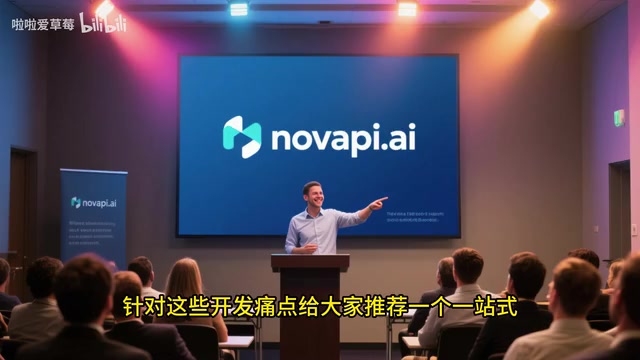
Taking this type of solution as an example, its core advantages are reflected in the following aspects:
Single Entry Point for Free Model Switching
Through a single unified Base URL, you can access all mainstream AI capabilities including Anthropic, OpenAI, and Google Gemini. Developers don't need to repeatedly integrate different platforms—simply modifying the model parameter completes the switch, dramatically reducing development costs.
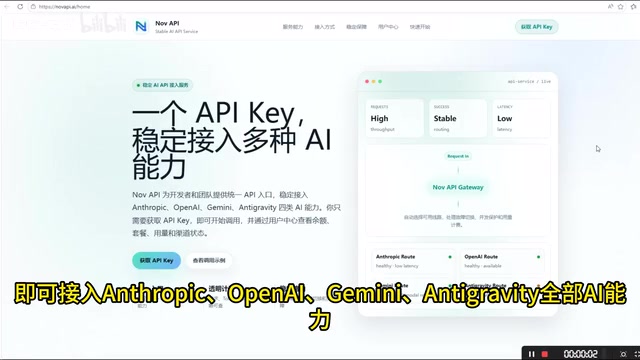
This means your code architecture can remain clean and unified, with model selection becoming a configuration item rather than a refactoring effort.
Automatic Route Optimization and Failover Mechanism
At the platform level, intelligent routing capabilities are provided with automatic route optimization. High-availability routing systems are typically built on Health Check and Circuit Breaker Pattern foundations—the circuit breaker continuously monitors metrics like success rate and P99 latency for each route. When a route's error rate exceeds the threshold, it automatically "trips," switching traffic to healthy routes, and attempts a "half-open" state probe after a cooldown period to detect recovery. This pattern originates from the microservices architecture domain and was popularized by Netflix's Hystrix library. When a route experiences lag, timeouts, or even crashes, the system can seamlessly switch to backup routes, ensuring call continuity. For production projects, this is equivalent to gaining a layer of "free high-availability protection."
Transparent Data Visualization Dashboard
The backend provides a complete operational data dashboard, including:
- Balance and token consumption tracked in real-time
- Order records and plan details fully queryable
- Channel operational status and call success rates displayed in real-time
All call activity is transparent and controllable, enabling both developers and team leads to clearly understand the cost and quality of AI calls.
Four Practical Strategies for Multi-Model Collaboration
Adopting a unified API gateway is only an infrastructure-level optimization. To truly unlock the value of multiple models, you also need well-designed strategies at the application layer:
-
Task Routing: Choose the most capable model based on task type. For example, use Codex/Claude for code generation, Gemini for long-text comprehension, and GPT-4o-mini for quick Q&A—achieving "the right model for the right job."
-
Degradation Strategy: Set up model fallback chains for critical tasks. When the primary model is unavailable, automatically switch to an alternative model to ensure business continuity.
-
Cost Optimization: Use more cost-effective models for batch tasks that are latency-insensitive, and faster-responding models for real-time interaction scenarios—finding the balance between quality and cost.
-
A/B Testing: Leverage the convenience of a unified interface to compare different models' performance on the same task, driving model selection decisions with data. For model A/B testing in AI applications, the industry typically employs the following evaluation frameworks: rule-based automated evaluation (e.g., code execution pass rate), LLM-as-Judge methods (using a strong model to score other models' outputs), and comparison against human-annotated golden datasets. The real value lies in establishing an evaluation metric system aligned with business objectives—for example, in customer service scenarios, focus on issue resolution rate rather than mere BLEU scores, thereby achieving data-driven model selection decisions.
Conclusion
The era of single-model development is passing. As the AI model ecosystem grows increasingly rich, multi-model collaboration has become the mainstream AI development paradigm. By solving three core problems—interface fragmentation, stability assurance, and operational visibility—unified API gateways provide developers with a low-cost, highly reliable path to multi-model integration.
If your project is still plagued by a single model's capability ceiling and API stability issues, consider introducing a unified API gateway to fundamentally solve these problems at the architectural level.
Key Takeaways
- Relying on a single AI model limits project capability ceilings and exposes you to risks of unstable connections, rate limiting, and no failover
- While multi-model development is the trend, the engineering cost of integrating multiple interfaces and maintaining multiple keys is extremely high
- Unified API gateway solutions aggregate multiple model capabilities through a single Base URL, supporting parameter-level model switching
- Intelligent route optimization and seamless failover mechanisms (based on the Circuit Breaker Pattern) provide high-availability guarantees for production projects
- Multi-model collaboration requires application-layer strategies like task routing, degradation policies, and cost optimization to deliver maximum value
Related articles
 Tutorials
Cursor + Codex Dual-IDE Collaboration: A Practical Methodology for Open-Source Project Customization
A complete methodology for open-source project customization based on real-world experience, detailing the Cursor+Codex dual-IDE workflow, seven-stage process, MVP validation, and AI source code reading techniques.
 Tutorials
Cursor Multi-Agent in Practice: Building a Full-Stack Next.js Blog in 50 Minutes
Build a full-stack blog in 50 minutes using Cursor IDE's multi-Agent mode with Next.js, Clerk auth, and Supabase. Learn the 4-phase AI Agent workflow and key integration pitfalls.
 Tutorials
Building an AI Software Factory from Scratch: A Cursor Engineer's Hands-On Experience with Multi-Agent Collaboration
Cursor engineer Eric shares practical insights on building an AI software factory: automation levels, guardrail design, parallel Agent management, and scaling to 1000+ Agents for 24/7 development.