N2 Model as a Free Claude Code Alternative: Does Voice-Driven AI Coding Actually Work?
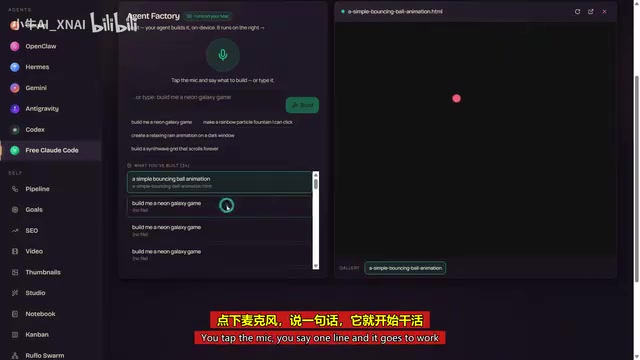
Free N2 model plugs into Claude Code, enabling voice-driven AI coding with AgentOS multi-agent collaboration.
The N2 model, built on Alibaba's Qwen 3.5 architecture, offers a completely free API that integrates directly into the Claude Code framework. Real-world testing demonstrates generating complete landing pages from single voice commands. When paired with AgentOS — an agent operating system featuring shared memory, unified workspaces, and multi-model collaboration — N2 becomes a powerful zero-cost AI programming solution for individual developers and small teams.
Can the Free AI Coding Model N2 Really Replace Claude Code?
Recently, a free API model called N2 quietly launched and quickly caught the attention of the AI coding community. Built on the Qwen 3.5 architecture, it supports both text and image inputs, is designed specifically for coding tool scenarios, features an extra-large context window, and is well-suited for deep research and long-running complex tasks.
Qwen is a large language model series developed by Alibaba's DAMO Academy. Since its initial release in 2023, it has undergone multiple iterations. Qwen 3.5, a major version in the series, brings significant improvements in code comprehension, mathematical reasoning, and multilingual processing. Its architecture uses an improved Transformer variant that incorporates cutting-edge techniques such as Grouped Query Attention (GQA) and Rotary Position Embedding (RoPE), dramatically expanding context processing capabilities while maintaining inference efficiency. The Qwen series' deep optimization for Chinese-language corpora gives the N2 model a natural advantage when handling Chinese programming requirements and technical documentation.
The most critical point: it's completely free, and it can be plugged directly into the Claude Code framework. This means you get to enjoy Claude Code's powerful toolchain and interactive experience, but with the underlying inference engine swapped out for the zero-cost N2 model.
It's worth explaining Claude Code's technical architecture here. Claude Code is a command-line AI coding assistant developed by Anthropic that allows developers to engage in interactive programming collaboration directly from the terminal. Unlike traditional code completion tools, Claude Code can understand an entire project's context, perform file read/write operations, execute commands, search codebases, and more — essentially functioning as an AI coding agent with system-level operational capabilities. Its architecture features an open model interface layer, meaning the underlying inference model can be swapped out — this is precisely the technical foundation that enables N2 to plug into its framework. Claude Code's toolchain includes modules for code indexing, context management, permission control, and session memory, all of which are decoupled from the specific inference model, making third-party model integration possible.
For individual developers and small teams, this is undoubtedly an extremely attractive proposition. But how does a free model actually perform in practice? Can it truly handle everyday development tasks? A Bilibili content creator put it to the test by integrating N2 into their custom-built Agent Operating System (AgentOS), running a series of hands-on demonstrations.
N2 Model Core Capabilities: What Can a Free API Actually Do?
N2 was officially released in June 2025. Despite being available for only a short time, it has already been widely adopted across multiple platforms including Claude Code and Hermes agents. Its core features include:
- Built on the Qwen 3.5 architecture, with outstanding Chinese language comprehension and generation capabilities
- Supports text + image multimodal input — it can not only write code but also understand screenshots and design mockups
- Extra-large context window, suitable for processing long code files and complex projects
- Optimized specifically for coding tools, with excellent performance in code generation, debugging, and refactoring scenarios
- Completely free API access, dramatically lowering the cost barrier for AI-assisted development
The multimodal input capability deserves special attention. Multimodal refers to an AI model's ability to simultaneously process and understand multiple types of input data, such as text, images, audio, and video. In coding scenarios, this means developers can directly feed the model UI design mockup screenshots, error message screenshots, or even hand-drawn interface sketches, and the model can "see" this visual information and generate corresponding code. This capability is typically achieved through deep integration of a vision encoder (such as the ViT architecture) with the language model, requiring the model to be exposed to large amounts of image-text paired data during training to establish mappings between visual elements and code structures.
From a positioning standpoint, N2 is not a general-purpose chat model but rather a specialized model explicitly targeting the developer toolchain. This vertical design philosophy means its performance in coding scenarios may be more stable and efficient than some general-purpose large models.
Hands-On Demo: Generating a Complete Landing Page with a Single Voice Command
In the hands-on test, the creator demonstrated a typical use case: using a voice command to have N2 automatically generate a complete business landing page.
The actual operation was remarkably simple — click the microphone button and say one sentence:
"Build me a landing page that showcases how AI automation saves people hours every week, and encourages more people to join."
After receiving this natural language prompt, N2 immediately began writing frontend code with zero manual intervention required. From page structure and styling to content copy, a single sentence completed the entire journey from requirement to delivery.
The core value of this demo isn't how polished the generated page looks, but rather the entirely new development paradigm it showcases: replacing traditional coding with natural language, compressing the "idea to product" pipeline down to just a few minutes.
AgentOS: Unleashing the Full Power of a Free Model
Using N2's API on its own is just the first step. What the creator really wanted to demonstrate was the productivity unleashed when N2 is integrated into a complete Agent Operating System (AgentOS).
AgentOS represents an emerging paradigm in AI application architecture — the agent operating system. Traditional operating systems manage hardware resources and applications; AgentOS manages the coordination, scheduling, and resource sharing of multiple AI agents. In this architecture, each AI model is treated as an independent "agent process," sharing a unified file system (workspace), memory (memory system), and communication protocols. This concept originates from the research field of Multi-Agent Systems and has recently transitioned from academic theory to actual products as large language model capabilities have improved. The core value of AgentOS lies in solving the "model silo" problem — when you use multiple AI tools, their context and work outputs can flow seamlessly between them instead of operating in isolation.
Unified Dashboard for Managing All AI Tools
AgentOS provides a centralized dashboard interface where all functional modules are visible at a glance: real-time chat panels, voice-activated agents (similar to Iron Man's Jarvis), image/voice/video studios, and a complete project workspace.
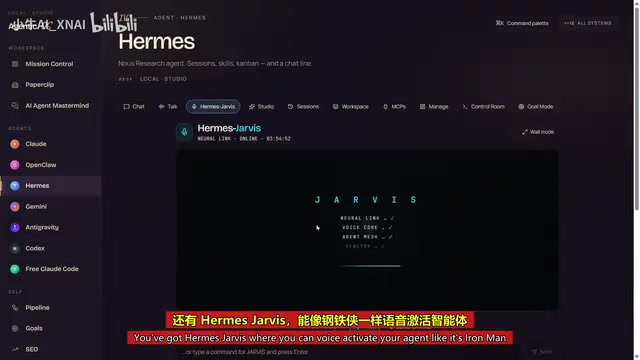
Switching to the N2 engine requires just a single toggle — switch the engine to N2 in the Claude Code configuration and click confirm. The entire process requires no code or configuration file modifications.
Workspace Management: No More Scattered Files
When traditionally using Claude Code in the terminal, a common pain point is work outputs scattered everywhere — generated files spread across different directories, making it nearly impossible to find previous work after a few days.
AgentOS solves this with a unified workspace. All code, pages, and tools generated by N2 are automatically archived into their corresponding project folders, available for review at any time.
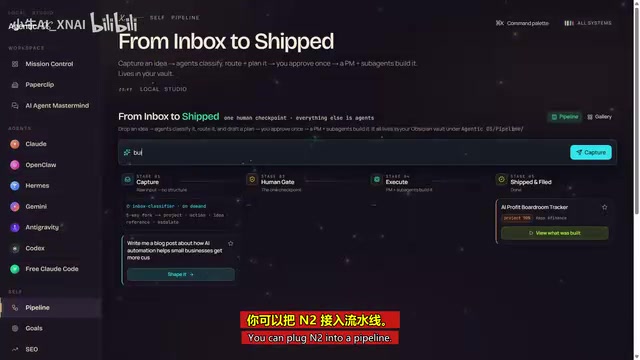
Shared Memory System: The Key to Multi-Model Collaboration
This is one of AgentOS's most technically impressive design features. The system includes a built-in shared memory mechanism — every conversation you have with N2 is automatically saved to a memory store, and all connected agents (Claude, Hermes, N2, etc.) can share the same contextual memory.
From a technical implementation perspective, shared memory systems typically consist of two layers: short-term memory and long-term memory. Short-term memory stores the current session's contextual information, usually kept in memory as conversation history. Long-term memory converts important interaction content into high-dimensional vectors through Vector Embedding technology, stored in vector databases (such as Pinecone, Milvus, or ChromaDB). When a new agent needs to access historical context, the system uses Semantic Search to retrieve the most relevant information fragments from the memory store and injects them into the current conversation's prompt. This mechanism is similar to human associative memory — rather than recalling all history verbatim, it intelligently retrieves the most useful background knowledge based on semantic relevance to the current task.
This means:
- The prototype you built with N2 in the morning is already fully understood by Claude when you switch to it for optimization in the afternoon
- Multiple agents collaborating don't require repeated requirement descriptions
- The more models you connect, the stronger the entire system's contextual understanding becomes
Skill Extensions: Beyond Code to Video Production
Even more interesting is the ability to "teach" N2 additional skills. For example, after granting it video production capabilities, it can not only generate code but also automatically create demo videos.
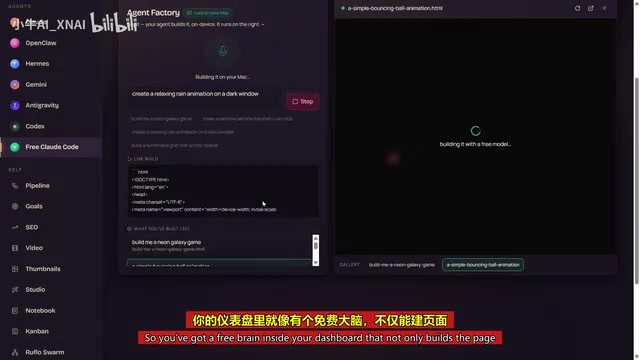
In the demo, the creator asked N2 to build a visual interface, and it went ahead and generated a complete demo video. One sentence, one agent, completing both development and demonstration simultaneously.
A Sober Assessment: Where Are the Limits of Free AI Coding?
Despite the impressive demo results, we need to rationally evaluate this solution's actual scope of applicability.
Scenarios well-suited for the free N2 approach:
- Rapid prototyping and MVP validation — MVP (Minimum Viable Product) is a core concept in lean startup methodology, systematically articulated by Eric Ries in The Lean Startup. The core idea is to build a product version with minimal resources and time that includes core functionality, quickly launch it to validate hypotheses, then iterate based on user feedback. In traditional development workflows, even a simple MVP might require days to weeks of development time, while AI coding tools like N2 compress the MVP build cycle from "days" to "minutes," fundamentally impacting how fast startup teams can validate business hypotheses.
- Building personal projects and small utilities
- Enabling non-technical users to complete simple development tasks through natural language
- Lowering the entry barrier and cost of AI-assisted programming
Aspects requiring careful consideration:
- The stability and rate limits of the free API remain to be validated over time. Free models typically face request rate limiting and service availability fluctuations, potentially experiencing response delays or even service interruptions under high-concurrency scenarios. For production environments requiring continuous stable operation, this is a risk factor that cannot be ignored.
- There may be a gap between N2 (based on Qwen 3.5) and Claude's native models in complex reasoning. Claude series models (especially Claude 3.5 Sonnet and Claude 4) have undergone extensive RLHF (Reinforcement Learning from Human Feedback) training for long-chain logical reasoning, complex code architecture design, and edge case handling. These capability gaps may not be apparent in simple tasks but could become evident when handling complex refactoring of large projects or subtle concurrency bugs.
- As a third-party tool, AgentOS's security and data privacy need to be assessed by users themselves
- For production-grade projects, well-validated paid solutions are still recommended
Conclusion: The Barrier to AI Coding Tools Is Dropping Fast
The emergence of the N2 model, combined with the maturation of agent management systems like AgentOS, is making AI-assisted programming increasingly accessible to everyone. You don't need deep programming expertise, you don't need expensive API subscriptions, and you don't even need to open a terminal — as long as you can speak, you can have AI turn your ideas into working applications.
Of course, this doesn't mean developers will be replaced. Quite the opposite — these tools free developers from repetitive work, allowing them to focus on more creative architecture design and business logic. And for entrepreneurs and business professionals without technical backgrounds, this may be the first time they truly have the ability to "build it themselves."
Competition among AI coding tools is shifting from "who's more powerful" to "who's cheaper and easier to use." N2's free strategy may well be a microcosm of this transformation. From a broader perspective, this trend is aligned with the spirit of the open-source movement — when the cost of accessing foundational tools approaches zero, the real competitive moat shifts to creativity, execution, and deep understanding of user needs.
Related articles

A Systematic Guide to Claude Code: From Deployment to Architectural Analysis of 510K Lines of Source Code
A systematic guide to Claude Code covering environment deployment, domestic model integration, six core systems (memory, multi-Agent, etc.), a full-stack ChatBot project, and eight design patterns from 510K lines of open-source code.
Claude Code Skills Mechanism Explained: On-Demand Loading for Token Savings and Better Performance
Deep dive into Claude Code's Skills mechanism: on-demand loading replaces bulk context dumping, cutting Token costs and boosting output quality with modular expertise.

Multi-Agent Cost-Cutting Guide: 4 Documents to Slash 60-80% of Your Token Spending
Multi-agent bills out of control? This article breaks down two core token cost pain points and provides 4 actionable documents to cut multi-agent task costs by 60-80%.