Open-Source MCP Tool: A Definitive Solution to AI Coding Hallucinations
Open-Source MCP Tool: A Definitive Sol…
Open-source MCP tool solves AI coding hallucinations by fetching real-time official documentation
AI coding tools often hallucinate by fabricating APIs and using outdated functions, severely impacting development efficiency. An open-source tool based on the MCP (Model Context Protocol) solves this by having AI fetch official documentation and examples in real time before generating code, eliminating hallucinations at the source. With 20.4K GitHub Stars within days of launch, support for Cursor and VS Code, simple configuration, and significantly improved code accuracy, it marks AI coding's transition from merely "usable" to truly "good to use" in the toolchain era.
The Core Pain Point of AI Coding: Hallucinations
Developers using AI coding tools like Cursor and VS Code have almost universally encountered the same frustrating problem — AI hallucinations. The AI fabricates non-existent API endpoints, uses outdated library functions, and even writes code that's syntactically correct but logically completely wrong. These "hallucination" issues severely slow down development, turning what should be a productivity booster into a debugging nightmare.
This "hallucination" phenomenon has deep technical roots: large language models are pre-trained on massive amounts of code and documentation, with knowledge compressed and encoded into billions of parameter weights. When the model encounters uncertain questions, it "completes" the most statistically probable answer rather than admitting it doesn't know. This mechanism works excellently for natural language generation, but produces catastrophic results in code generation scenarios that demand precision — the model generates seemingly reasonable but actually non-existent APIs with extremely high "confidence," and developers often spend considerable time before discovering the problem.
Recently, an open-source tool based on the MCP (Model Context Protocol) has emerged to fundamentally solve this problem. Within just days of launch, its GitHub Stars skyrocketed to 20.4K, demonstrating the developer community's strong endorsement.

What Is MCP? Why Can It Solve AI Hallucinations?
Core Principles of the MCP Protocol
MCP (Model Context Protocol) is a standardized communication protocol proposed and open-sourced by Anthropic in late 2024. It essentially defines the specification for how AI models (clients) send requests to external data services (MCP Servers) and retrieve structured data. Each MCP Server can encapsulate a specific data source, such as a framework's official documentation, database schema, or real-time API. This design transforms AI's "knowledge acquisition" from static training data to dynamic real-time queries, building a bridge between AI coding assistants and real technical documentation.
Traditional AI coding assistants rely on knowledge from training data to generate code, but training data has inherent limitations in timeliness and completeness. When the framework or library you're using releases a new version, the AI may still generate code based on old version APIs, causing various errors.
With the MCP protocol, before generating code, the AI first fetches the latest official documentation and examples for the libraries you're using, then writes code based on this real, accurate information. This eliminates the "making things up" problem at its source.
How MCP Differs from Traditional RAG Solutions
You might ask: how is MCP different from RAG (Retrieval-Augmented Generation)? RAG is a mainstream AI knowledge enhancement approach proposed by Meta AI in 2020. Its core idea is to retrieve relevant document fragments from an external knowledge base before generating answers, then feed these fragments as context to the language model. However, RAG has a relatively high implementation barrier: developers need to handle document crawling, cleaning, vectorization, and index building themselves, plus maintain vector databases (such as Pinecone, Weaviate, etc.).
The key differences between MCP and RAG are:
- RAG typically requires you to build and maintain your own knowledge base, has a higher barrier to entry, and vector retrieval quality heavily depends on data preprocessing quality
- MCP provides a standardized protocol interface, encapsulating complexity on the Server side. The community has already pre-built numerous data sources for mainstream frameworks and libraries, ready to use out of the box
- MCP's data sources connect directly to official documentation, ensuring information authority and timeliness without requiring developers to maintain their own knowledge bases
Real-World Results: Dramatically Improved Code Accuracy
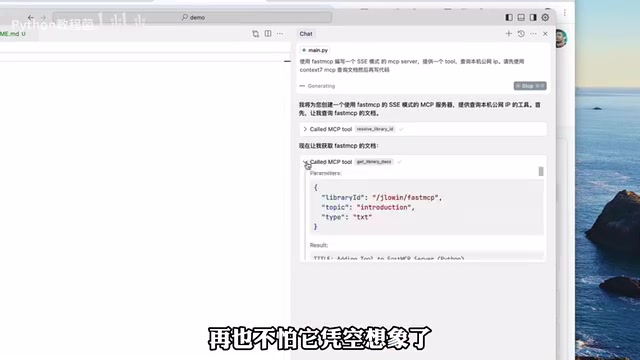
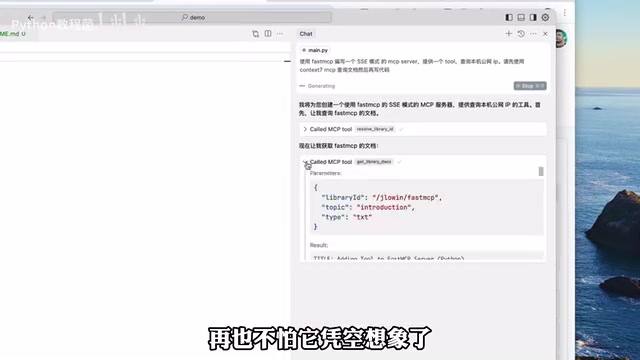
After configuring MCP, the AI coding experience undergoes a qualitative leap. When you trigger an MCP query in your prompt, the AI first retrieves relevant official documentation and code examples before generating code.
Specific improvements include:
- Accurate API calls: No more non-existent function names or parameters
- Correct version matching: Automatically matches the library versions used in your project
- Best practices followed: Generates code based on officially recommended patterns
- Directly runnable code: Significantly improved code correctness, reducing time spent on repeated debugging
Installation & Configuration Tutorial: Done in Five Minutes
One of the biggest advantages of this MCP tool is that installation is extremely simple. The author provides detailed installation tutorials for different editors.
Cursor Configuration
- Open Cursor's MCP settings panel
- Paste the configuration code provided by the project
- Restart the editor to activate
VS Code Configuration
- Install the corresponding MCP extension
- Add MCP server configuration in settings
- Auto-connects after saving
The entire process takes no more than five minutes with no complex environment setup required. Once configured, you just need to slightly adjust your prompts, and the AI will automatically query relevant documentation through the MCP protocol.
Deep Analysis: Why This Type of MCP Tool Is Exploding in Popularity
AI Coding Is Entering the Toolchain Era
The growth rate to 20.4K Stars itself is worth reflecting on. GitHub Star count is an important indicator of open-source community recognition, but what's more valuable is the growth speed — many excellent open-source tools take months or even years to accumulate the same level of attention. This explosive growth typically occurs when a tool precisely hits developers' core pain points. The AI hallucination problem has plagued virtually all developers using AI coding tools, and this tool provides a low-barrier, high-impact solution, naturally triggering strong community resonance.
This phenomenon also reveals a deeper trend: developer demands for AI coding have shifted from "usable" to "good to use." Simple code generation is no longer enough — developers need a complete toolchain to ensure the quality of AI output.
The development of AI coding tools has gone through distinct evolutionary stages: the first stage was code completion tools represented by GitHub Copilot, solving the "from zero to something" problem; the second stage was AI-native IDEs represented by Cursor and Windsurf, achieving multi-file context understanding and conversational programming; we're now entering the third stage — toolchain integration, where the core challenge is how to ensure the quality and reliability of AI output. The rise of the MCP ecosystem is a typical product of this stage, signaling that AI-assisted programming is moving toward engineering rigor and standardization.
The emergence of the MCP protocol essentially establishes a reliable information channel between AI models and real-world knowledge. This approach isn't limited to programming — similar solutions will likely emerge in document writing, data analysis, and other fields in the future.
The Driving Force of the Open-Source Community
This tool's rapid recognition is inseparable from open-source community contributions. Community members continuously add MCP data sources for new frameworks and libraries, steadily expanding the tool's coverage. This crowdsourcing model ensures the tool can keep pace with the rapid evolution of the technology ecosystem — fundamentally different from the traditional commercial software model where a single team maintains the documentation database. The community-driven approach has natural advantages in both coverage breadth and update speed.
Conclusion: An Essential Efficiency Tool for AI Coding
The "hallucination" problem in AI coding has been a key barrier to its large-scale adoption. This open-source tool based on the MCP protocol provides an elegant and practical solution by enabling AI to access official documentation in real time. For developers who regularly use Cursor or VS Code for AI-assisted programming, this is virtually an essential efficiency tool.
If you're still frustrated by frequent errors in AI-generated code, take a few minutes to configure it and experience the joy of coding where "AI no longer makes things up."
Related articles
 Tutorials
Cursor + Codex Dual-IDE Collaboration: A Practical Methodology for Open-Source Project Customization
A complete methodology for open-source project customization based on real-world experience, detailing the Cursor+Codex dual-IDE workflow, seven-stage process, MVP validation, and AI source code reading techniques.
 Tutorials
Cursor Multi-Agent in Practice: Building a Full-Stack Next.js Blog in 50 Minutes
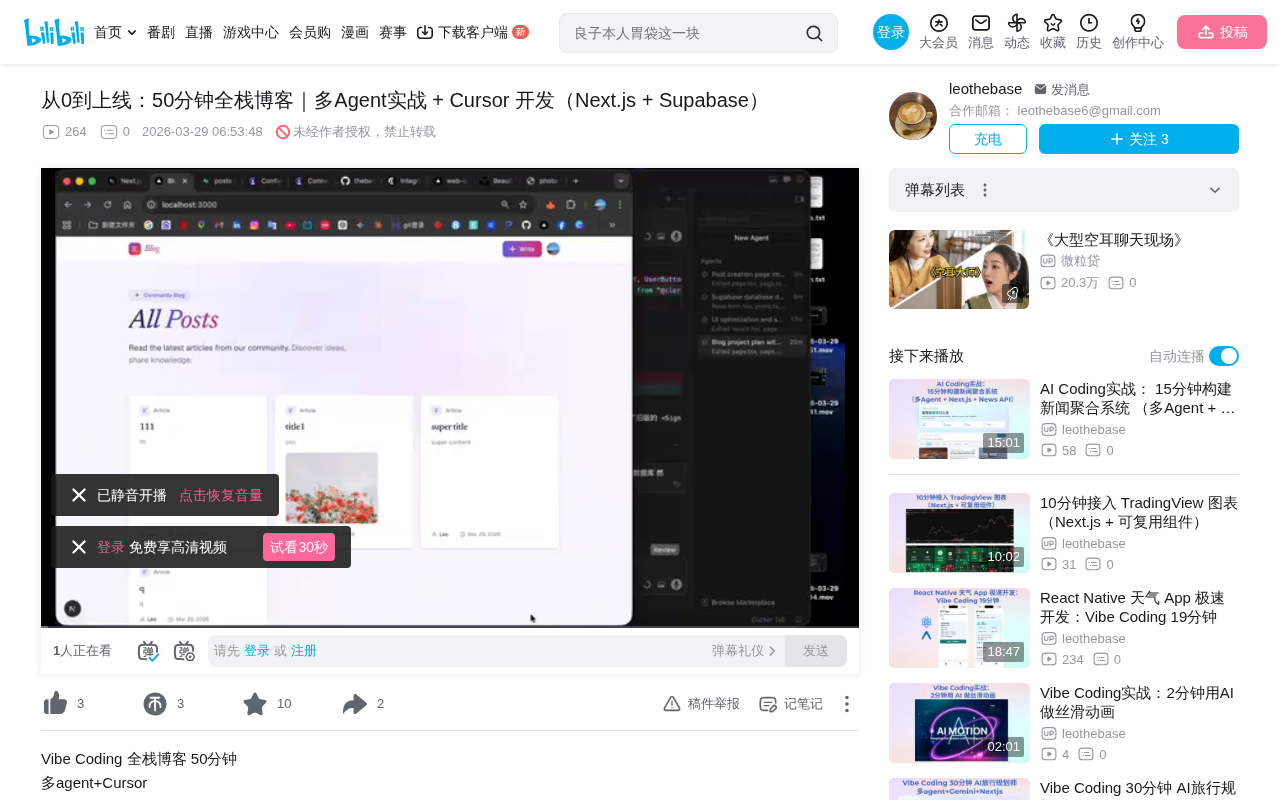
Build a full-stack blog in 50 minutes using Cursor IDE's multi-Agent mode with Next.js, Clerk auth, and Supabase. Learn the 4-phase AI Agent workflow and key integration pitfalls.
 Tutorials
Building an AI Software Factory from Scratch: A Cursor Engineer's Hands-On Experience with Multi-Agent Collaboration
Cursor engineer Eric shares practical insights on building an AI software factory: automation levels, guardrail design, parallel Agent management, and scaling to 1000+ Agents for 24/7 development.