OpenAI Launches Rosalind Biodefense Program: How AI Is Reshaping Public Health Security
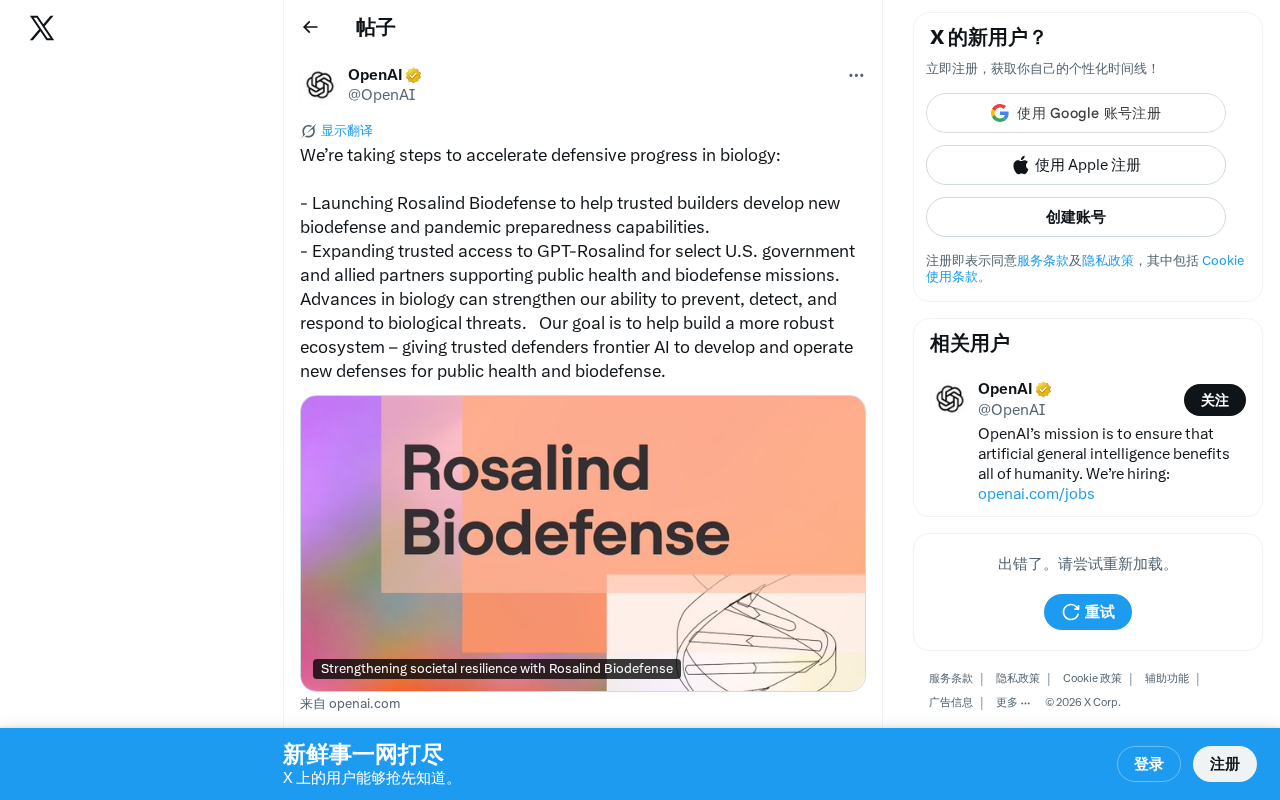
OpenAI launches Rosalind Biodefense to accelerate pandemic preparedness with AI.
OpenAI has launched the Rosalind Biodefense program, offering targeted access to GPT-Rosalind for vetted U.S. government agencies and allied nation partners, focusing on preventing, detecting, and responding to biological threats. AI holds significant value in accelerating pathogen identification, speeding up vaccine development, and building collaborative defense ecosystems, but also faces controversies around dual-use risks and the geopoliticization of technology.
OpenAI recently announced the launch of Rosalind Biodefense, a program designed to leverage cutting-edge AI technology to accelerate biodefense and pandemic preparedness capabilities. This initiative marks a significant step forward in the application of AI to public health and national security.
Rosalind Biodefense: AI-Powered Biological Defense
Rosalind Biodefense is a new project from OpenAI specifically targeting the biodefense domain. Its core objective is to help "trusted builders" develop new biodefense and pandemic preparedness capabilities. These "trusted builders" refer to rigorously vetted research institutions, government agencies, and partners — not the general public.
The project is named in honor of Rosalind Franklin, the British scientist who made critical contributions to the discovery of DNA's double helix structure. Franklin (1920–1958) was one of the 20th century's most important yet long-underrecognized scientists. Her "Photo 51," captured using X-ray crystallography, provided the key evidence revealing DNA's double helix structure. However, Watson and Crick obtained this photograph without her consent and published their paper on the DNA double helix structure in 1953, ultimately winning the Nobel Prize in 1962 — four years after Franklin had died of ovarian cancer, and the Nobel Prize is not awarded posthumously. Her story has become a landmark case of gender inequality and academic injustice in the history of science, making her a spiritual icon for women in science. By naming this biodefense project after her, OpenAI pays tribute to her scientific legacy while also invoking the metaphor of "overlooked defensive power." This naming choice signals OpenAI's ambitions in the life sciences — using AI technology to drive breakthrough advances in biology, but with a focus on defense rather than offense.
GPT-Rosalind: A Dedicated AI Tool for Government
OpenAI simultaneously announced the expansion of trusted access to GPT-Rosalind, opening it to specific U.S. government agencies and allied nation partners. These partners must meet one core requirement: they must be actively engaged in public health and biodefense missions.
Several key signals emerge from this deployment strategy:
- Targeted access rather than universal availability: GPT-Rosalind is not available to all users but strictly limited to government and allied nation levels, reflecting OpenAI's strong emphasis on the safety of AI applications in the biological domain.
- National security dimension: Including allied nation partners in the access scope indicates that this tool has risen to the level of international security cooperation, not merely a technology product. In recent years, the U.S. government has attempted to build "technology alliance" barriers around core AI technologies through policies such as the CHIPS and Science Act and export controls. In the biosecurity domain, the U.S. has already established multilateral biodefense cooperation frameworks with allies including the UK, Australia, and Canada. OpenAI's move aligns closely with this policy direction, effectively embedding commercial AI capabilities into the national security cooperation system.
- Capabilities focused on the defensive end: OpenAI explicitly emphasizes a "defense" positioning — the ability to prevent, detect, and respond to biological threats.
Why AI Is Critical in Biodefense
The COVID-19 pandemic made the world acutely aware of serious deficiencies in traditional pandemic preparedness systems. From pathogen identification and vaccine development to public health response, every stage requires faster and more precise tools.
AI's potential in this domain is primarily reflected in three areas:
Accelerating Pathogen Identification and Surveillance
Bioinformatics is an interdisciplinary field combining biology, computer science, and statistics. Its core task is processing and analyzing massive biological datasets, including genomic sequences, protein structures, and epidemiological data. While traditional bioinformatics tools are powerful, they have limitations in handling unstructured data (such as medical literature and clinical reports) and cross-modal reasoning. The introduction of large language models (LLMs) is changing this landscape: AlphaFold2 can already predict protein 3D structures at near-experimental accuracy, while GPT-class models can integrate literature knowledge, assist in hypothesis generation, and support experimental design. In pathogen surveillance, AI can analyze multi-source data from hospitals worldwide, social media, and environmental sensors in real time, compressing anomaly signal identification from weeks to hours — a decisive advantage for early warning of emerging infectious diseases.
Advancing Defensive Technology R&D
Traditional vaccine development cycles typically require 10–15 years. During the COVID-19 pandemic, mRNA vaccines were developed in under a year, partly thanks to the deep involvement of AI tools. At the technical level, AI contributes across multiple stages: during antigen design, AI can predict immunogenic epitopes on pathogen proteins and screen for optimal targets; during antibody screening, machine learning models can rapidly identify high-affinity antibodies from billions of candidate molecules; during clinical trial design, AI can optimize patient grouping and dosage protocols to improve trial efficiency. If Rosalind Biodefense can systematically provide these capabilities to government agencies and research partners, it means that during the next pandemic outbreak, defensive response times could be dramatically compressed once again.
Building a Collaborative Defense Ecosystem
OpenAI specifically mentioned in its announcement that the goal is to "help build a more robust ecosystem." This means Rosalind Biodefense is not merely a tool but a platform connecting governments, research institutions, and international partners, aimed at forming a collaborative defense network.
Controversy and Challenges: Balancing Safety and Openness
Despite OpenAI's emphasis on a defensive positioning, AI applications in the biological domain are always accompanied by "double-edged sword" controversies. The dual-use problem of AI in biology has drawn intense attention from both academia and policymakers. In 2023, multiple biosecurity experts published warnings in top journals such as Nature that large language models could lower the technical barriers to bioweapon development, making dangerous experiments that previously required specialized laboratories more accessible. The U.S. government issued an executive order in 2023 requiring AI companies to conduct safety assessments and report to the government when developing models with biological risks. OpenAI itself explicitly prohibits the use of AI for bioweapon-related purposes in its Usage Policy and has established red-team testing mechanisms specifically to evaluate potential risks of its models in the biosecurity domain. The "trusted builders" mechanism of Rosalind Biodefense is essentially a governance design combining access control with accountability binding — through identity verification and mission constraints, high-risk capabilities are confined to traceable, accountable entities. This represents one of the mainstream approaches in current AI safety governance.
Furthermore, restricting cutting-edge AI tools to the U.S. government and its allies has also sparked discussions about technological equity and geopoliticization. Critics argue that this "technology bloc" approach could exacerbate global inequalities in public health resources — in the next global pandemic, countries lacking advanced AI tools will be at an even greater disadvantage in their defensive posture. Finding the balance between safety and openness will remain a core challenge for OpenAI and the entire industry.
Industry Trend: AI Companies Accelerating Their Push into Security
The launch of Rosalind Biodefense is yet another landmark event in AI companies expanding from purely commercial applications into national security and public health domains. As AI capabilities advance rapidly, ensuring these capabilities are used to protect rather than harm humanity is becoming one of the industry's most important issues.
OpenAI's move also demonstrates that beyond fierce commercial competition, leading AI companies are proactively taking on greater social responsibility, attempting through institutional design and technical measures to make AI a "shield" rather than a "sword" for human security. This model brings OpenAI government contracts and strategic positioning while also saddling it with greater political responsibility regarding technology exports and access control — marking a new phase of deep integration between top AI labs and national security systems.
Key Takeaways
- OpenAI has launched the Rosalind Biodefense program to help trusted builders develop biodefense and pandemic preparedness capabilities
- GPT-Rosalind will expand access to specific U.S. government agencies and allied nation partners, focusing on public health and biodefense missions
- AI's core value in biodefense is reflected in three areas: accelerating pathogen identification, advancing defensive technology R&D, and building collaborative defense ecosystems
- The project adopts a targeted access strategy rather than a universal model, reflecting strong emphasis on the safety of AI applications in the biological domain
- The dual-use nature of AI in biology and the geopoliticization of technology remain ongoing challenges
Related articles
 Tech Frontiers
GitHub Agent HQ Launch: AI Coding Tools Enter the Era of Platform Competition
GitHub Universe unveils Agent HQ platform for unified coding agent management, Copilot upgrades with multi-model support. OpenAI completes restructuring, Anthropic tests new model, NVIDIA open-sources AI models.
 Tech Frontiers
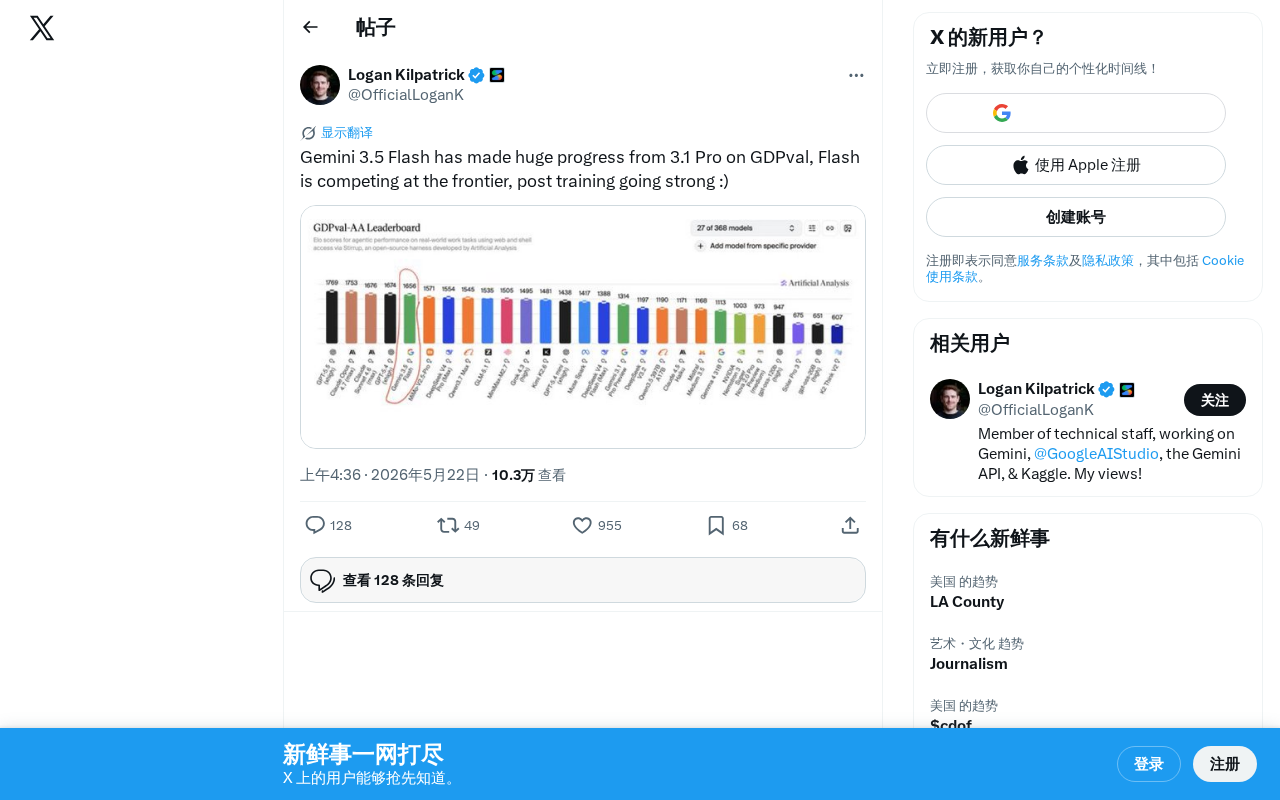
Gemini 3.5 Flash Achieves a Massive Leap on the GDPval Benchmark
Google Gemini 3.5 Flash surpasses Gemini 3.1 Pro on the GDPval benchmark. The lightweight Flash model leverages post-training techniques to approach frontier-level performance, redefining the balance between quality and cost.
 Tech Frontiers
Google Gemini Antigravity Weekly Quota Tripled — AI Coding Without Limits
Google Gemini triples Antigravity weekly quotas following a prior daily quota boost. Analyzing the impact on developers and its strategic significance in AI coding.