Opus 4.7 Fast Mode Lands on Windsurf: 2.5x Speed Boost with No Loss in Intelligence
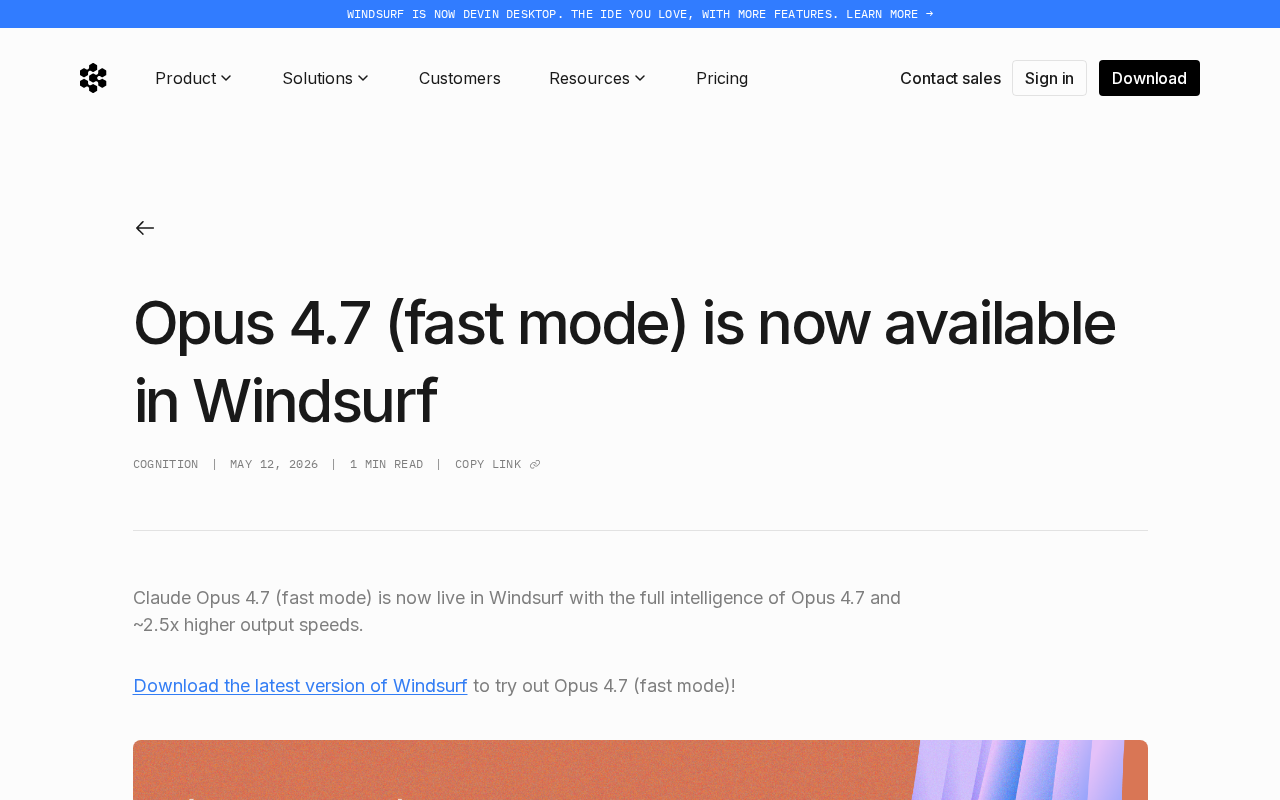
Claude Opus 4.7 fast mode launches on Windsurf with 2.5x speed and full intelligence retained.
Claude Opus 4.7's fast mode is now officially available on the Windsurf coding tool, delivering approximately 2.5x faster output while maintaining full intellectual capabilities. This update resolves the long-standing tradeoff between model power and response speed in AI programming, allowing developers to confidently use top-tier reasoning for complex code refactoring and architecture design without settling for weaker models due to wait times.
Core Update: Full Intelligence, Double the Speed
Claude Opus 4.7's fast mode is now officially available in the Windsurf coding tool. According to multiple sources, this mode delivers approximately 2.5x faster output while maintaining Opus 4.7's full intellectual capabilities.
Claude Opus 4.7 is Anthropic's flagship large language model released in 2025, representing the highest capability tier in the Claude 4 series. In Anthropic's model naming hierarchy, Opus represents the most powerful version (alongside Sonnet as the mid-tier and Haiku as the lightweight version). Opus 4.7 excels in code generation, complex reasoning, and long-context understanding, achieving leading scores on software engineering benchmarks like SWE-bench. However, stronger reasoning capabilities typically mean more computational steps and longer chains of thought, which directly increases response latency — precisely the problem that fast mode aims to solve.
For developers who use Windsurf daily for AI-assisted programming, this update means significantly faster response times without sacrificing code quality.
What Pain Points Does Fast Mode Address?
The Long-Standing Speed vs. Quality Tradeoff
In AI-assisted programming, developers face a persistent tradeoff: choosing a more powerful model means longer wait times, while choosing a faster model may sacrifice code quality and comprehension depth. As Anthropic's flagship model, Opus 4.7 is renowned for its exceptional reasoning capabilities and code generation quality, but slower response speeds have always been a bottleneck in practical use.
This tradeoff is particularly acute in AI programming. Developers are in a highly focused "flow" state while coding, and every pause can break their chain of thought. Research shows that when tool response times exceed 10 seconds, user attention significantly fragments, while responses under 4 seconds maintain cognitive continuity. This explains why a 2.5x speed improvement carries such significant practical value.
The launch of fast mode directly targets this pain point. A roughly 2.5x speed boost means:
- Responses that previously took 10 seconds now complete in about 4 seconds
- Multi-turn conversational programming workflows become much smoother
- Developers' thought continuity is better preserved
The "Full Intelligence" Promise
Interestingly, Windsurf explicitly emphasizes that fast mode retains Opus 4.7's "full intelligence." This means the speed improvement isn't achieved through simple model downgrading or output truncation, but more likely through reasoning optimization and infrastructure acceleration.
From a technical perspective, LLM inference acceleration typically follows several paths: Speculative Decoding uses a smaller model to predict the larger model's output tokens for parallel verification; KV Cache optimization reduces redundant computation overhead; and infrastructure-level optimizations include more efficient batching strategies, custom hardware acceleration, and network transmission optimization. Anthropic previously demonstrated similar speed optimization capabilities with Claude 3.5 Sonnet, achieving significant acceleration through engineering methods without changing model weights. Fast mode's claim of retaining "full intelligence" suggests it likely relies primarily on inference infrastructure optimization rather than model compression or quantization — which is why Anthropic can confidently make this promise.
Windsurf's Competitive Strategy Analysis
As a major player in the AI coding tool space, Windsurf (formerly Codeium) has been consistently pushing forward on model integration. Windsurf is an AI coding IDE developed by Codeium, rebranded from the Codeium name in late 2024. Unlike competitors such as Cursor and GitHub Copilot, Windsurf emphasizes the "Agentic IDE" concept — where AI doesn't just provide code completion but can proactively understand project context, make cross-file collaborative edits, execute terminal commands, and more. Quickly integrating Opus 4.7's fast mode reflects its competitive positioning in several areas:
Model Diversity: Offering users multiple model choices to meet different scenario needs — standard mode for deep reasoning, fast mode when efficiency is the priority. Windsurf supports switching between multiple underlying models including the Claude series, GPT series, and open-source models, letting developers flexibly choose the most appropriate tool based on task complexity.
Experience First: As AI coding tools become increasingly homogeneous, response speed has become a key factor in user retention. A 2.5x speed improvement is enough to deliver a qualitative change in perceived experience.
Staying on the Cutting Edge: Integrating the latest model capabilities immediately maintains technical competitiveness against Cursor, GitHub Copilot, and other rivals. The 2025 AI coding tool market has formed a multi-player competitive landscape — Cursor holds first-mover advantage with its deeply integrated code editing experience and powerful context understanding; GitHub Copilot commands the largest user base through Microsoft and GitHub's ecosystem advantages; while Windsurf differentiates itself with agentic workflows and flexible multi-model switching. In this space, whoever can most quickly integrate the newest and strongest models while providing the best user experience wins developer loyalty.
Practical Impact for Developers
For developers already using Windsurf, the practical value of this update is clear: you can now confidently use an Opus 4.7-level model in daily coding without settling for weaker models due to speed concerns. This is especially important when handling complex code refactoring, architecture design discussions, multi-file coordinated changes, and other scenarios requiring strong reasoning capabilities.
Specifically, Opus 4.7's strong reasoning capabilities offer clear advantages in these development scenarios: large-scale codebase refactoring requires the model to understand cross-file dependencies and design patterns; complex bug localization requires multi-step logical reasoning; and architecture evaluation requires the model to comprehensively consider performance, maintainability, scalability, and other multidimensional factors. In these scenarios, using a weaker model may lead to inaccurate suggestions or missed critical details, while previously using an Opus-level model came at the cost of lengthy waits. Fast mode's arrival means developers no longer need to compromise between these two options.
As major AI coding tools continue competing on model integration speed and optimization depth, developers will be the ultimate beneficiaries — faster, smarter AI coding assistants are becoming reality.
Key Takeaways
- Claude Opus 4.7 fast mode is now officially live on Windsurf
- Fast mode output speed is approximately 2.5x that of standard mode
- The official promise is that fast mode retains Opus 4.7's full intelligence level
- This update resolves the tradeoff between model capability and response speed in AI programming
Related articles
 Tech Frontiers
GitHub Agent HQ Launch: AI Coding Tools Enter the Era of Platform Competition
GitHub Universe unveils Agent HQ platform for unified coding agent management, Copilot upgrades with multi-model support. OpenAI completes restructuring, Anthropic tests new model, NVIDIA open-sources AI models.
 Tech Frontiers
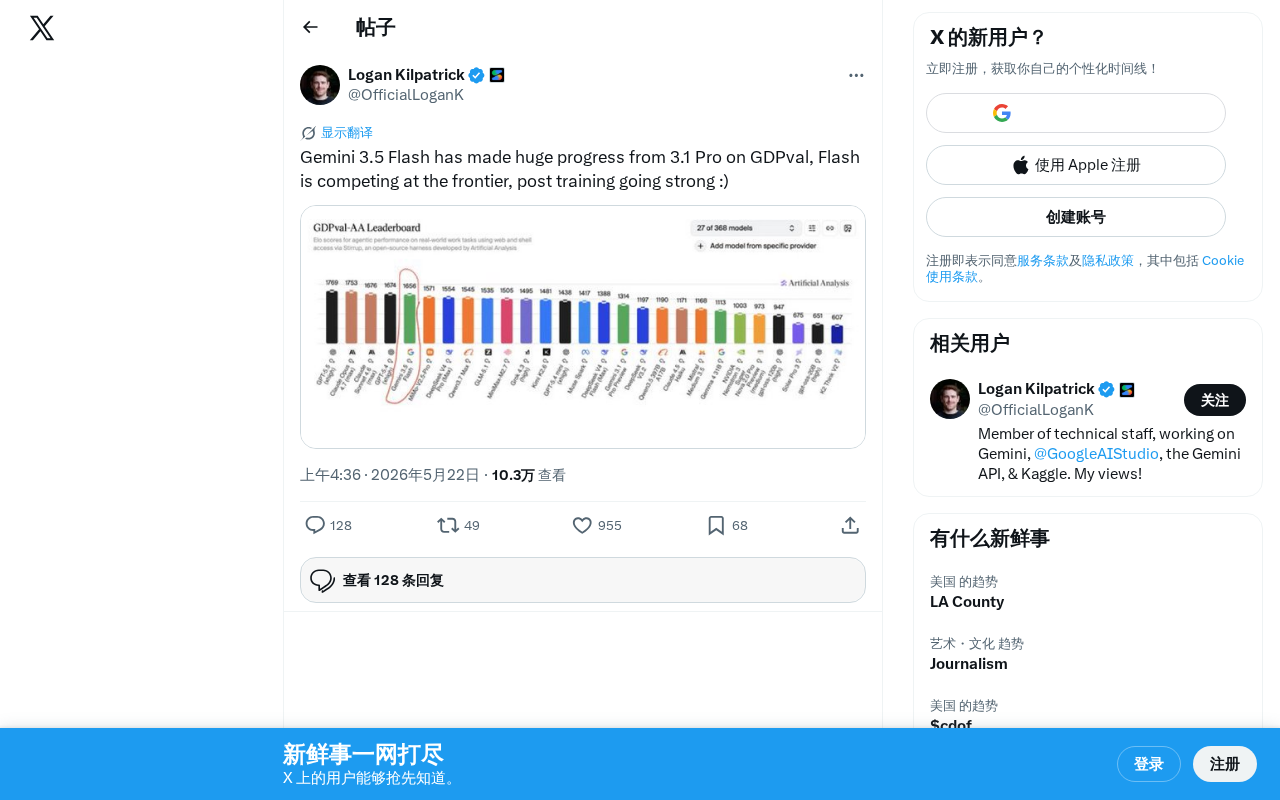
Gemini 3.5 Flash Achieves a Massive Leap on the GDPval Benchmark
Google Gemini 3.5 Flash surpasses Gemini 3.1 Pro on the GDPval benchmark. The lightweight Flash model leverages post-training techniques to approach frontier-level performance, redefining the balance between quality and cost.
 Tech Frontiers
Google Gemini Antigravity Weekly Quota Tripled — AI Coding Without Limits
Google Gemini triples Antigravity weekly quotas following a prior daily quota boost. Analyzing the impact on developers and its strategic significance in AI coding.