Perplexity Computer: An AI-Powered Startup Operating System to Create and Run Companies from Scratch
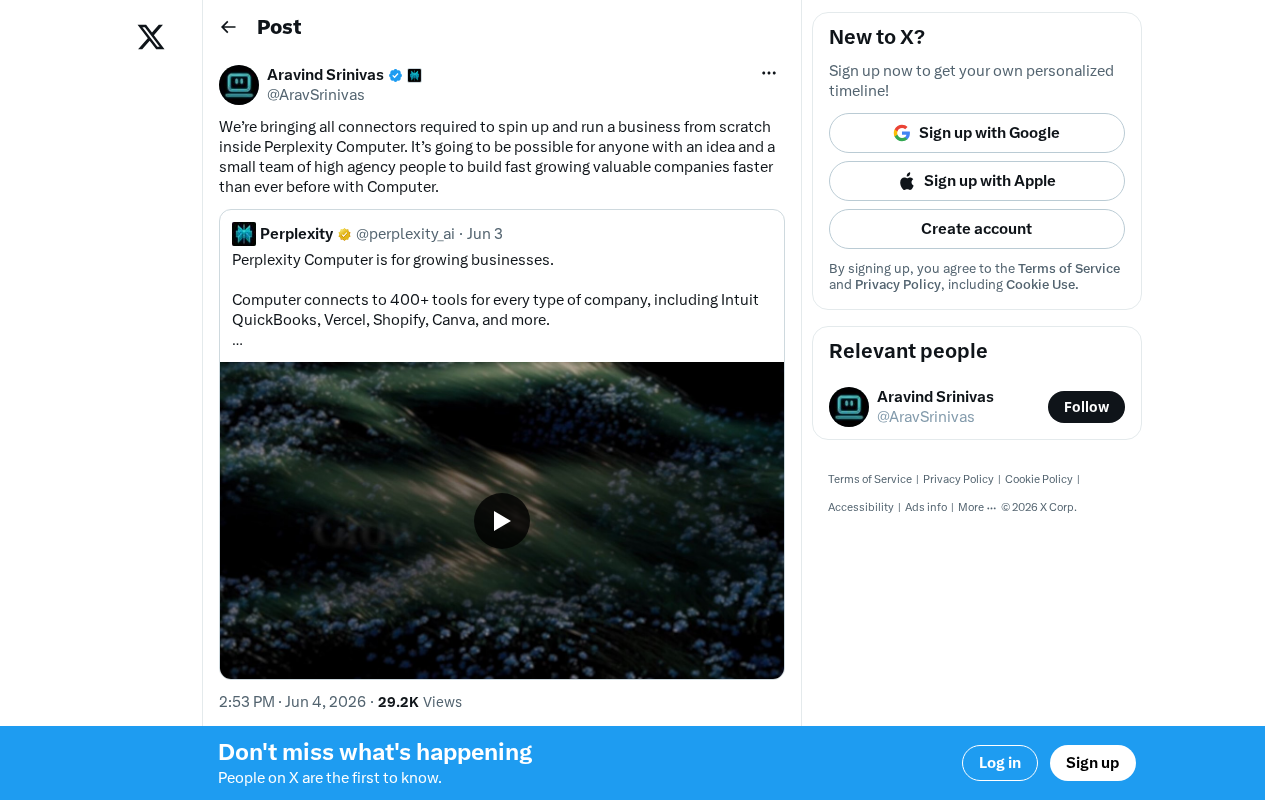
Perplexity Computer aims to be an AI-powered operating system for starting and running entire companies.
Perplexity CEO Aravind Srinivas announced Perplexity Computer, an AI-powered computing environment that integrates business connectors to let users create and run companies from scratch. Moving beyond AI search into a full-stack business operating system, it aims to unify SaaS tools across legal, finance, marketing, and development into one AI-native platform, fundamentally lowering startup barriers while facing challenges in reliability, ecosystem integration, and user trust.
Perplexity's New Ambition: Making AI the Infrastructure for Entrepreneurship
Perplexity CEO Aravind Srinivas recently announced an extremely ambitious plan on social media — Perplexity Computer will integrate all necessary connectors, enabling users to create and run a company entirely from scratch.
This statement signals that Perplexity is evolving from an AI search engine into a full-stack AI business operating system. If this vision materializes, it will redefine both the barrier to entry and the speed of starting a business.
What Is Perplexity Computer?
Based on the information disclosed so far, Perplexity Computer is not a physical computer but rather an AI-powered computing environment, similar in concept to Anthropic's Computer Use — enabling AI agents to operate software interfaces and execute complex task workflows just like a human would.
Computer Use is a breakthrough feature Anthropic launched in October 2024 that allows AI models to directly observe screen content, move the mouse, click buttons, and type text. The technology is built on multimodal visual understanding and action planning capabilities — the AI takes screenshots to identify interface elements and then generates corresponding operation commands. Previously, AI interaction with software relied primarily on API interfaces, but Computer Use opened a new paradigm: even software without APIs can be operated by AI through the GUI, expanding AI's capability boundary from "what APIs can it call" to "what software can a human operate."
Perplexity takes this a step further by planning to integrate connectors for various business tools. These "connectors" can be understood as API integration interfaces with third-party services, covering every aspect needed to start a business:
- Company Registration & Legal: Automated company formation workflows
- Finance & Payments: Bank accounts, payment gateways, bookkeeping systems
- Product Development: Code generation, deployment, project management
- Marketing & Customer Acquisition: Ad placement, social media management, SEO optimization
- Team Collaboration: Communication tools, document management, HR systems
From a technical architecture perspective, modern businesses typically use 15–30 different SaaS tools — Stripe for payments, Salesforce for customer management, QuickBooks for accounting, Slack for communication, and so on. Traditionally, data flow between these tools relies on integration platforms like Zapier and Make, but these often require manual configuration and offer limited flexibility. Perplexity's "connectors" essentially establish a unified interface abstraction layer at the AI Agent level, allowing the AI to understand business intent and automatically invoke the right combination of services — similar to the role of device drivers in an operating system: abstracting away underlying complexity and providing unified operational semantics to the layer above.
This "all-in-one" approach is fundamentally about letting AI agents execute various operational tasks end-to-end throughout the entrepreneurial process, unifying scattered SaaS tools into a single AI-native platform.
Why Perplexity Computer Deserves Attention
A Fundamental Lowering of the Startup Barrier
Aravind Srinivas stated explicitly in his post: Anyone with an idea, paired with a small, high-execution team, can build a fast-growing, valuable company faster than ever before.
This is not an empty vision. Looking back at history, the lowering of startup barriers has been a trend spanning decades: in 2006, AWS launched cloud computing services, reducing server costs from tens of thousands of dollars to just a few dozen per month; in the 2010s, Shopify made it possible to open an online store without a technical team, and Stripe shortened payment integration from months to a few lines of code; in the early 2020s, collaboration tools like Notion and Figma further compressed team operational costs. Each wave of tooling innovation gave rise to new types of entrepreneurs — from "needing a technical co-founder" to "indie hackers" to today's "AI-native entrepreneurs."
Over the past few years, AI tools have been progressively lowering the technical barriers to entrepreneurship — Cursor enables non-professional programmers to write code, Midjourney drives design costs toward zero, and various no-code tools allow product prototypes to be completed in hours. What Perplexity Computer aims to do is unify these scattered capabilities into a single AI-native operating platform, forming true startup infrastructure. This represents the latest leap in the tool democratization trend: from lowering the barrier at individual stages to eliminating friction across all stages at once.
The Leap from "AI Search Engine" to "AI Business Operating System"
Perplexity originally started with AI search, establishing its market position through a high-quality answer engine. For context, Perplexity AI was founded in 2022 by former OpenAI researcher Aravind Srinivas. Unlike traditional search engines that return lists of links, it directly generates structured answers with cited sources. By the end of 2024, the company's valuation had exceeded $9 billion with over 15 million monthly active users, proving the market viability of the AI search model.
But search is fundamentally an information retrieval tool with a limited growth ceiling. Expanding toward "Computer" means Perplexity is moving from the information layer to the execution layer — not just telling you the answer, but actually getting things done for you.
This aligns closely with the broader trend in the AI industry. OpenAI, Google, and Anthropic are all pushing the boundaries of AI Agent capabilities, while Perplexity has chosen a very specific entry point: business operations. This positioning offers both differentiation and enormous commercial potential.
A Differentiated Track in the AI Agent Race
AI Agents are one of the most active research and product directions in the AI field today. Unlike traditional Q&A-style AI, agents possess capabilities for goal decomposition, tool invocation, environment perception, and autonomous decision-making. Technically, modern AI Agents typically use large language models as their "brain," combined with the ReAct (Reasoning + Acting) framework to achieve alternating cycles of reasoning and action — breaking complex tasks into sub-goals, executing them step by step, and adjusting strategies based on environmental feedback. Since 2024, the industry has been evolving from single agents to multi-agent collaborative systems, where multiple specialized AI agents handle different domains and coordinate through protocols.
The competitive landscape in the AI Agent space is taking shape rapidly:
- OpenAI is exploring general-purpose agents through ChatGPT's plugin ecosystem and Operator
- Anthropic has entered desktop operation automation with Computer Use
- Google is leveraging Gemini to integrate its vast service matrix
- Perplexity is targeting the vertical scenario of entrepreneurship and business operations
Vertical strategies are often easier to execute. Compared to a general-purpose agent that "can do everything," an AI system focused on "helping you start and run a company" is much easier to optimize in terms of product design and user experience. This also aligns well with multi-agent collaborative architectures — different connectors can be backed by different specialized agents, each responsible for finance, legal, marketing, and other domains, collaborating to complete end-to-end business operations.
Potential Challenges and Uncertainties
Realizing this vision still faces significant challenges:
On technical reliability, having AI execute operations involving funds, legal matters, and compliance demands extremely high accuracy and security. A slight deviation in a search result is tolerable, but an erroneous bank transfer or a flawed legal document carries entirely different consequences. Even the most advanced AI models today still suffer from "hallucination" issues in complex reasoning tasks, and achieving near-100% reliability in high-risk operations is an enormous engineering challenge.
On ecosystem integration, "all connectors" means establishing deep integrations with a large number of third-party services. This is not just technical work — it also involves business partnerships, data security agreements, and other complex issues. Historically, products that attempted to become "super apps" or "one-stop platforms" have mostly faced resistance from ecosystem partners — when you try to become the gateway to all services, those services themselves may view you as a competitor.
On user trust, having AI agents handle core business operations requires an extremely high level of user trust. Building this trust takes time and requires robust permission controls and human review mechanisms. A progressive trust-building strategy — starting with low-risk operations and gradually expanding to high-risk areas — is likely the more realistic path.
The Era of AI Startup Infrastructure Is Accelerating
Perplexity Computer's strategic positioning represents an important directional signal in the AI industry: AI is evolving from an assistive tool into infrastructure. If entrepreneurship in the past required "people + capital + tools," the future formula may become "people + ideas + AI Computer."
Although the specific product form and launch timeline have not yet been announced, from a strategic intent perspective alone, Perplexity is playing a very ambitious game. For entrepreneurs and tech professionals, this is a direction worth watching closely — it could fundamentally change how companies are created and operated.
Related articles

The Era of Managed Agents: Anthropic vs. Google's Two Diverging Approaches
Deep analysis of Anthropic vs Google's Managed Agent architectures, pricing strategies, and selection guidance. Managed Agents are emerging as a new AI infrastructure product category.
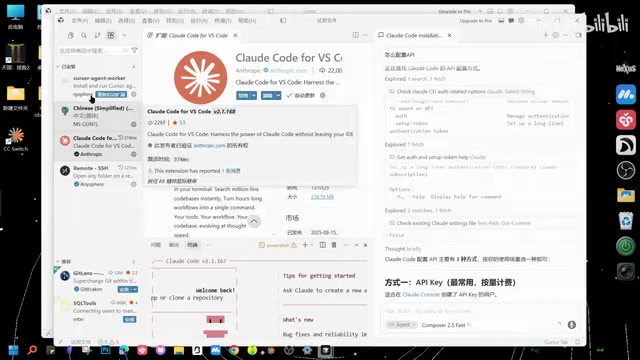
Setting Up Claude Code from Scratch: An Installation & Configuration Troubleshooting Guide
A complete guide for beginners to set up Claude Code, covering VS Code installation, plugin troubleshooting, API configuration, model switching pitfalls, and practical usage tips.
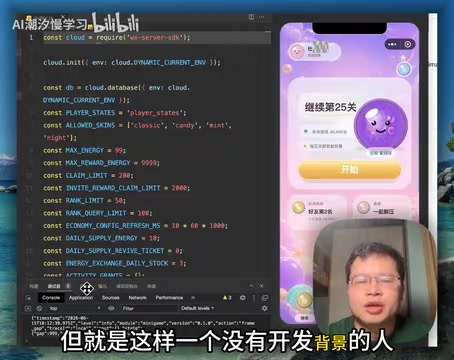
AI Summoning Power: Insights and Practices from Zero-Code Game Development with AI
A creator with no coding experience built a complete game using only AI prompts. Explore AI summoning power, zero-code development, and what it means for PMs, developers, and everyone.