Practical Guide to Using Claude Opus 4.7 from China via Compliant Access Methods

Access Claude Opus 4.7 and other overseas AI models from China via API aggregation platforms — no VPN needed.
For Chinese users facing KYC verification, VPN requirements, and overseas payment barriers when accessing foreign AI models, this article introduces API aggregation platforms as a relay solution. These platforms enable VPN-free, verification-free access to Claude Opus 4.7, GPT-5, Gemini, and more with RMB payments. Setup takes just three steps: get an API Key, configure environment variables, and connect your dev tools. The article also highlights important considerations around data security, service stability, and compliance risks.
Background: Opus 4.7 Launches, but Chinese Users Face Multiple Barriers
Anthropic recently released its latest Claude Opus 4.7 model, widely regarded as one of the most powerful coding and reasoning models available today. However, for users in China, accessing the official service directly presents significant challenges: the official website now requires KYC identity verification with facial recognition, a foreign credit card must be linked after verification, a VPN is needed throughout the process, and accounts are at constant risk of being banned.
KYC (Know Your Customer) is an identity verification mechanism originating from the financial industry, requiring service providers to verify a user's real identity before granting access. Overseas AI companies like Anthropic have introduced KYC processes primarily for regulatory compliance and abuse prevention — the U.S. government has increasingly strict controls on AI technology exports, particularly targeting users in specific countries and regions. This trend has accelerated notably between 2024 and 2025, with OpenAI, Google, and other companies also tightening access policies for certain regions. For users in China, KYC means not only providing overseas identity documents but potentially undergoing live facial recognition and other biometric verification, which poses substantial obstacles at both the technical and legal levels.
These barriers have deterred many developers. A Bilibili content creator named Xiao Liu shared an alternative solution he's been using — accessing top overseas models through an API aggregation platform, with no VPN required and domestic payment methods accepted. The entire setup takes just three minutes.

Core Solution: How API Aggregation Platforms Work
The solution introduced in the video uses an API aggregation platform called "Jiekou AI" (接口AI). The core logic is straightforward: the platform connects to overseas models like Claude, GPT, and Gemini through official API channels, then exposes them to Chinese users via a unified API interface. Users don't need to deal with overseas service providers directly, nor do they need VPN tools.
From a technical architecture perspective, an API aggregation platform is essentially a reverse proxy plus load balancing middleware layer. The platform deploys server nodes overseas and holds official API accounts with major model providers. When a Chinese user initiates a request, it first reaches the platform's domestic entry node, then gets forwarded through the platform's overseas nodes to the target model's official API endpoint. This architecture is similar to how a CDN (Content Delivery Network) works, except it handles API requests rather than static content. These platforms typically implement an OpenAI-compatible API protocol format, meaning any client tool that supports the OpenAI API standard can seamlessly connect — just by changing the Base URL. This is also why a single Key can switch between multiple models — the platform handles the adaptation and unification of different vendors' API protocols on the backend.
Advantages of This Type of Platform
- No VPN required: Works directly within China's network environment
- No KYC verification: No overseas identity verification or facial recognition needed
- Domestic payment: Supports RMB top-ups — pay as you go
- Multi-model aggregation: One API Key to switch between multiple domestic and international models
- 24/7 stable operation: Connected through official channels with no sudden interruptions
Model Coverage
Based on what the video demonstrates, the platform offers quite comprehensive model coverage:
- Claude series: From Haiku to Sonnet to Opus, including the latest Opus 4.7, all available immediately upon release
- OpenAI series: The full GPT-5 lineup, including the latest GPT-5.4
- Google series: The Gemini series, with Gemini 3.1 Pro praised by the creator as "extremely useful"
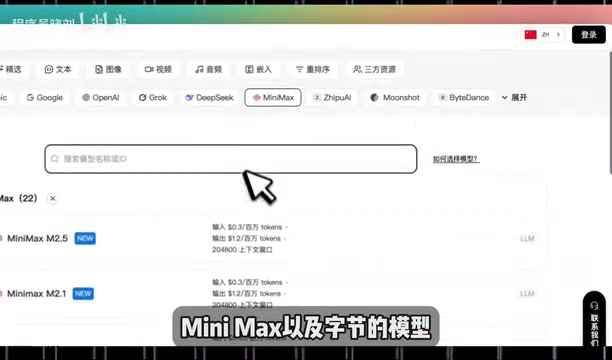
- Domestic models: DeepSeek, MiniMax, ByteDance, and other mainstream Chinese models are also supported
Setup Tutorial: Three Steps to Access Opus 4.7
The entire configuration process is very straightforward, broken down into three steps:
Step 1: Register an Account and Get Your API Key
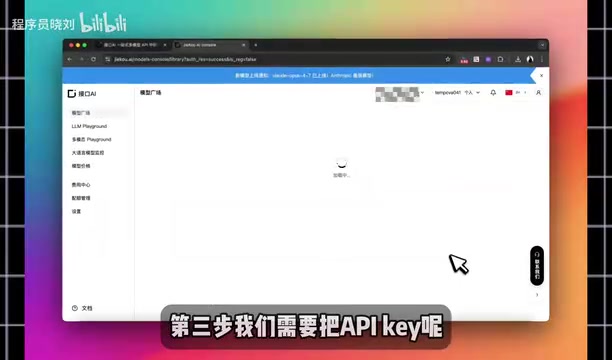
After registering on the platform, go to the console to obtain your dedicated API Key. According to the video, registering with an invitation code grants free trial credits for testing Opus 4.7's development capabilities.
Step 2: Configure Environment Variables
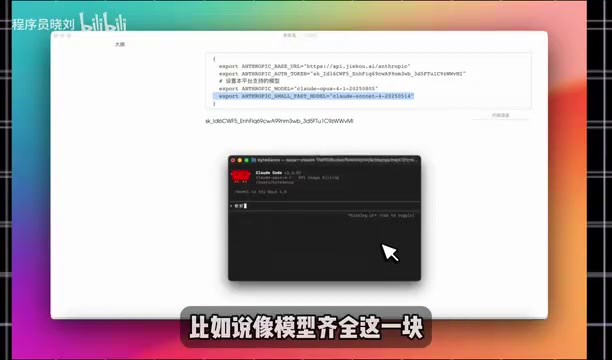
Using Claude Code (a command-line tool) as an example, you need to set three environment variables in the terminal:
- Base URL: The API endpoint address provided by the platform
- API Token/Key: The secret key obtained from the console
- Model: Select the model you want to use — in this case, the latest Claude Opus 4.7
Claude Code is a command-line programming assistant tool released by Anthropic that allows developers to interact directly with Claude models in a terminal environment for code generation, debugging, refactoring, and more. Similar tools include Cursor (a VS Code-based AI-enhanced editor), GitHub Copilot, Windsurf, and others. These tools share a common trait: they communicate with backend LLMs via API, and therefore all support custom API endpoints — which is precisely the technical foundation that enables seamless integration with API aggregation platforms. Since 2025, AI coding tools have evolved from simple code completion to Agent mode, capable of understanding entire project contexts and executing multi-step programming tasks. Opus 4.7's reasoning capability improvements are particularly notable in this scenario, which is why it has attracted such intense interest from the developer community.
Step 3: Use It in Your Development Tools
Whether you're using Cursor, Cherry Studio, or any other client that supports custom API addresses, the configuration method is the same — just enter the platform address and your Key. This unified access approach significantly reduces the cost of switching between models.
Cost Analysis: How's the Value?
Regarding pricing, the content creator shared his actual usage experience:
- Light package: 20 million tokens for just ¥15.9, suitable for everyday use
- Pro package: Designed for developers with higher usage volumes, also offering solid value
It's worth explaining the token billing mechanism here. A token is the basic unit of measurement for how large language models process text, but it doesn't equate to a single Chinese character or English word. For English text, one token corresponds to roughly 4 characters or 0.75 words. For Chinese text, due to different encoding methods, a single Chinese character is typically split into 1.5–2 tokens. This means that for the same semantic content, Chinese consumes more tokens than English. Taking 20 million tokens as an example, that's roughly enough to process 10–13 million Chinese characters of total input and output. It's important to note that API billing typically distinguishes between input tokens (Prompt) and output tokens (Completion), with output token pricing often 3–5 times higher than input. Therefore, actual usage costs depend not only on total token count but also on the input-to-output ratio.
Compared to using official services directly (which require USD payments with exchange rate losses), domestic platforms offer a clear price advantage. The creator mentioned that "you pay for what you use, with essentially zero exchange rate loss" — a genuine cost saving for developers who frequently call APIs.
Real-World Results: Building an Expense Tracker with Opus 4.7
At the beginning of the video, the creator showcased an expense tracking mini-app he built using Opus 4.7. From the results, the model capabilities accessed through the API aggregation platform are identical to a direct official connection — because the underlying model being called is exactly the same. This is the core advantage of the API relay approach: the model capabilities are completely identical; only the access method differs.
Caveats and a Balanced Perspective
While API aggregation platforms do address real pain points for Chinese users, there are several points to keep in mind:
- Data security: Your conversation data passes through a third-party platform, so scenarios involving sensitive information require careful evaluation
- Service stability: A third-party platform's reliability depends on its own operational health and its relationship with upstream API providers
- Compliance: Although the video claims the approach is "fully compliant," users should still familiarize themselves with relevant policies and regulations
- Price fluctuations: API pricing may adjust as upstream costs change
Regarding data security risks, a deeper analysis is warranted. The risks in an API relay scenario manifest across three layers: transport security, storage security, and compliance risk. At the transport layer, user data passes through the relay platform's servers before reaching the target model — if the platform hasn't strictly implemented end-to-end encryption or TLS transport encryption, data could potentially be intercepted. At the storage layer, some platforms may cache or log user requests and responses for debugging or auditing purposes, meaning your code snippets, business logic, and other information could be retained by a third party. At the compliance layer, under China's Data Security Law and Personal Information Protection Law, transmitting content involving personal information or important data to overseas servers may trigger data cross-border security assessment requirements. Therefore, enterprise users are advised to anonymize their data before using such services and to carefully review the platform's privacy policy and data processing agreements.
Overall, for developers who need convenient access to top overseas AI models from within China, API aggregation platforms are currently one of the most pragmatic solutions available. As AI model iteration speeds continue to accelerate, being able to quickly switch between and experience the latest models through a single unified entry point is itself a productivity boost.
Related articles
 Tutorials
Cursor + Codex Dual-IDE Collaboration: A Practical Methodology for Open-Source Project Customization
A complete methodology for open-source project customization based on real-world experience, detailing the Cursor+Codex dual-IDE workflow, seven-stage process, MVP validation, and AI source code reading techniques.
 Tutorials
Cursor Multi-Agent in Practice: Building a Full-Stack Next.js Blog in 50 Minutes
Build a full-stack blog in 50 minutes using Cursor IDE's multi-Agent mode with Next.js, Clerk auth, and Supabase. Learn the 4-phase AI Agent workflow and key integration pitfalls.
 Tutorials
Building an AI Software Factory from Scratch: A Cursor Engineer's Hands-On Experience with Multi-Agent Collaboration
Cursor engineer Eric shares practical insights on building an AI software factory: automation levels, guardrail design, parallel Agent management, and scaling to 1000+ Agents for 24/7 development.