Deep Dive into a 198-Hour Python Zero-to-Hero Course: Is This Learning Path Worth Following?
Deep Dive into a 198-Hour Python Zero-…
An objective breakdown of a 198-hour Python beginner course with practical learning advice.
This article analyzes a 198-hour Python+AI course for absolute beginners on Bilibili, breaking down its three-phase learning path (fundamentals, intermediate, and project-based sections). It highlights the course's strengths — comprehensive knowledge system and rich resources — while pointing out limitations such as daunting length, unrealistic job-readiness claims, and limited AI depth. It concludes with four practical tips: make a study plan, prioritize hands-on coding, specialize in one direction, and learn to read official documentation.
Course Overview: A 198-Hour Systematic Python Learning Plan
Recently, a Python+AI comprehensive tutorial for absolute beginners was released on Bilibili (China's leading video platform), claiming to be the "most detailed and complete" course available. With a total duration of 198 hours, it covers Python core syntax, AI applications, web scraping, data analysis, and more. The course targets complete beginners, aiming to take learners from novice to developers capable of freelancing and landing jobs.
Since its creation by Guido van Rossum in 1991, Python has consistently ranked among the top languages on the TIOBE Programming Language Index, holding the #1 spot throughout 2024. The core reason Python is the go-to language for beginners lies in its "readability-first" design philosophy — Python uses indentation rather than curly braces to organize code blocks, and its syntax closely resembles natural English, significantly lowering the barrier to entry. Additionally, Python boasts over 400,000 third-party libraries (distributed via the PyPI package management platform), covering virtually every technical domain including web development, scientific computing, machine learning, and DevOps. This ecosystem advantage allows learners to tackle multiple career paths with a single language.
As a technical learning resource, this course's design philosophy deserves in-depth analysis — is it truly suitable for absolute beginners? Is the course structure well-designed? Let's break it down piece by piece.
Course Structure Breakdown: A Three-Phase Learning Path
Fundamentals: Building the Foundation from Environment Setup
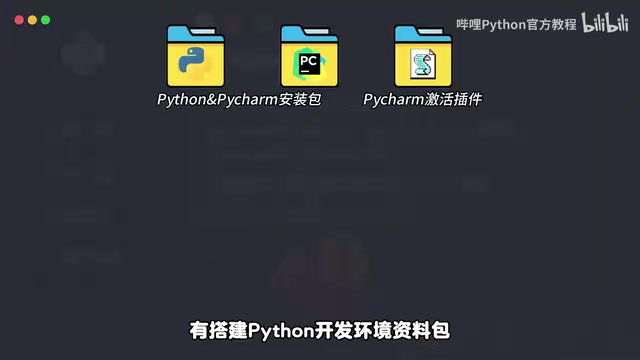
The fundamentals section starts from the very basics of environment setup, including:
- Python installation and development environment configuration
- Variables and data types
- Control structures (conditionals, loops)
- Function definition and invocation
This ground-up approach is essential for learners with zero programming experience. The first obstacle many beginners encounter isn't the syntax itself, but environment configuration — a poorly configured development environment can cause newcomers to give up before writing their first line of code.
Python development environment setup involves multiple steps: interpreter installation, package manager (pip) configuration, virtual environment creation, and IDE selection. The mainstream Python IDEs currently include PyCharm (a professional-grade IDE by JetBrains), VS Code (Microsoft's open-source lightweight editor with full Python support via extensions), and Jupyter Notebook (an interactive programming environment particularly suited for data analysis and machine learning scenarios). Virtual environments (venv or conda) are an important concept in Python development — they allow developers to create isolated dependency environments for different projects, preventing library version conflicts. For beginners, the Anaconda distribution is a hassle-free choice, as it comes pre-installed with hundreds of commonly used scientific computing libraries and provides a graphical environment management tool.
Intermediate: Tackling Core Concepts Like Object-Oriented Programming
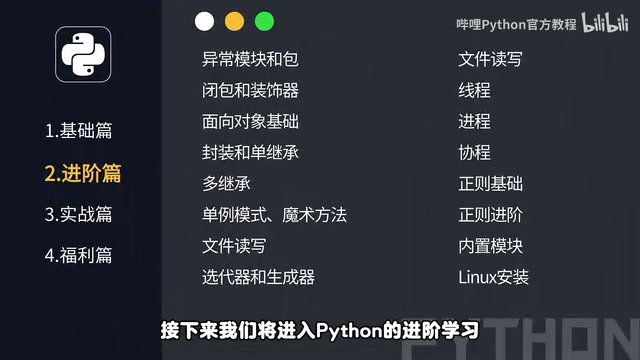
The intermediate section covers more critical concepts in Python development:
- Advanced data structures: List comprehensions, advanced dictionary usage, set operations, etc.
- Object-Oriented Programming (OOP): Classes and objects, inheritance, polymorphism, encapsulation
- File operations: Reading and writing files, path handling, data persistence
Object-oriented programming is a watershed moment for many Python beginners. Whether you can understand and proficiently apply OOP concepts often determines whether a developer can progress from "writing scripts" to "building projects." Object-Oriented Programming (OOP) is a programming paradigm centered on "objects," with the concept first proposed by Alan Kay in the 1960s. The four core OOP characteristics — encapsulation, inheritance, polymorphism, and abstraction — are essentially software representations of how we model the real world. Encapsulation binds data and the methods that operate on it together while hiding internal implementation details; inheritance allows subclasses to reuse parent class attributes and methods, reducing code duplication; polymorphism enables objects of different classes to invoke their own implementations through a common interface. Python's OOP implementation is more flexible than languages like Java, supporting multiple inheritance, duck typing, and other features. Understanding OOP is not only key to mastering Python but also a prerequisite for understanding the architectural design of mainstream web frameworks like Django and Flask, as well as AI frameworks like TensorFlow and PyTorch.
The course also provides accompanying mind maps at this stage to help learners organize their knowledge system.
Project-Based Learning: Web Scraping, Office Automation, and Data Analysis
The project-based section is the core selling point of this course, featuring multiple real-world projects:
- Web scraping: Scraping images, videos, and other resources to master data collection skills
- Office automation: Developing Python scripts to boost work efficiency
- Data storage and analysis: Data mining and visualization projects
The Python web scraping tech stack typically includes: the requests library (for sending HTTP requests), BeautifulSoup or lxml (for parsing HTML/XML documents), Scrapy (an industrial-grade scraping framework), and Selenium or Playwright (for handling JavaScript-rendered dynamic pages). Web scrapers work by simulating a browser to send requests to target servers, then extracting desired data from the retrieved page source code using parsers. It's important to emphasize that web scraping has clear legal boundaries: China's Data Security Law, Personal Information Protection Law, and Article 285 of the Criminal Law (crime of illegally obtaining computer information system data) impose strict regulations on data collection activities. When practicing scraping techniques, learners should comply with target websites' robots.txt protocols, avoid collecting personal privacy data, control request frequency to prevent server overload, and only use the technology in lawful and compliant scenarios.
On the data analysis front, Python's data analysis ecosystem revolves around the "scientific computing trio": NumPy provides high-performance multidimensional array computation capabilities and serves as the cornerstone of the entire data science stack; Pandas builds on NumPy and offers the DataFrame data structure, making tabular data cleaning, transformation, and aggregation operations extremely convenient; Matplotlib and Seaborn handle data visualization, capable of generating everything from basic line charts to complex statistical graphics. In real-world work scenarios, a data analyst's typical workflow involves: reading raw data from CSV, Excel, or databases using Pandas, performing data preprocessing operations such as missing value handling, outlier detection, and feature engineering, then extracting insights through statistical analysis or machine learning models (scikit-learn library), and finally presenting results with visualization tools. Jupyter Notebook, with its integrated "code + documentation + charts" capabilities, has become the de facto standard working environment in the data analysis field.
From a learning path design perspective, this "theory + practice" model is indeed the mainstream methodology in programming education today. It's very difficult to truly master a programming language by studying syntax alone without hands-on practice.
Objective Analysis: Strengths and Limitations of This Python Course
Three Key Strengths
- Comprehensive knowledge system: From environment setup to project-based practice, it forms a complete Python learning loop
- Rich supplementary resources: Provides mind maps, study planners, e-books, courseware, and other supporting materials
- Broad coverage of directions: Covers today's hottest fields including AI applications, web scraping, and data analysis
Three Issues to Keep in Mind
- 198 hours is a double-edged sword: For self-learners, maintaining learning momentum and motivation is a real challenge
- "Job-ready after completion" promises should be taken with a grain of salt: Developing programming skills requires extensive practice and project experience — watching videos alone is unlikely to reach employment-level proficiency
- The depth of AI content is questionable: Covering both Python fundamentals and AI applications within 198 hours likely means the AI portion is only an introductory overview, still far from real AI development capabilities
Current "Python+AI" learning typically involves two levels: first, the AI application layer, which involves calling existing AI model APIs (such as OpenAI's GPT interface or Baidu's ERNIE Bot interface) to build intelligent applications — this level has lower math requirements and focuses more on engineering implementation skills; second, the AI development layer, which involves training models from scratch using deep learning frameworks like PyTorch or TensorFlow — this requires a solid foundation in linear algebra, probability and statistics, and calculus. A 198-hour comprehensive course most likely focuses on the former. It's worth noting that since 2023, the explosion of Large Language Models (LLMs) has spawned emerging frameworks like LangChain and LlamaIndex, enabling Python developers to relatively easily build RAG (Retrieval-Augmented Generation) applications, AI Agents, and other intelligent systems. This provides Python learners with an AI career path that has a relatively low barrier to entry but strong market demand.
Learning Python from Scratch: Four Tips for Making the Most of Video Courses
For absolute beginners looking to learn Python, the following tips can help you make more efficient use of course resources like this one:
- Create an actionable study plan: Don't try to binge-watch all the videos at once. Dedicate 1-2 hours per day, combined with hands-on practice, and progress gradually
- Prioritize practice over watching: The ratio of video-watching time to hands-on coding time should be at least 1:2 — the more you write, the faster you improve
- Pick one direction and go deep: You don't need to master web scraping, data analysis, and AI applications all at once — going deep in one direction makes it easier to build a competitive edge
- Develop the habit of reading official documentation: Video tutorials are a great way to get started, but the ability to read official documentation is indispensable for becoming a competent Python developer
From a cognitive science perspective, learning to program involves acquiring "procedural knowledge" — this type of knowledge cannot be obtained through reading or watching alone; it must be internalized as a skill through repeated practice, similar to learning to ride a bicycle or play the piano. Research shows that a significant "spacing effect" exists in programming learning: distributing study sessions across multiple time periods is more beneficial for long-term memory formation than cramming. This is the scientific basis for recommending 1-2 hours of daily study rather than 10-hour weekend marathons. Furthermore, "active recall" is several times more effective than passively watching videos — closing the video and attempting to reproduce the code independently, then reviewing only when stuck, is a slightly "painful" learning approach that actually accelerates skill acquisition significantly.
Conclusion: The Course Is Just the Starting Point — Consistent Practice Is What Matters
This 198-hour systematic Python course offers solid value in terms of content coverage and structural design, making it a useful introductory guide for absolute beginners. However, it's important to maintain a clear-eyed perspective: there are no shortcuts in learning to program, and any course is merely a starting point, not the finish line. Real skill improvement comes from consistent coding practice, project-based work, and the process of solving problems independently.
Rather than agonizing over which course to pick, open your editor and write your first line of code — taking action is the most important step in learning Python well.
Related articles
 Tutorials
Cursor + Codex Dual-IDE Collaboration: A Practical Methodology for Open-Source Project Customization
A complete methodology for open-source project customization based on real-world experience, detailing the Cursor+Codex dual-IDE workflow, seven-stage process, MVP validation, and AI source code reading techniques.
 Tutorials
Cursor Multi-Agent in Practice: Building a Full-Stack Next.js Blog in 50 Minutes
Build a full-stack blog in 50 minutes using Cursor IDE's multi-Agent mode with Next.js, Clerk auth, and Supabase. Learn the 4-phase AI Agent workflow and key integration pitfalls.
 Tutorials
Building an AI Software Factory from Scratch: A Cursor Engineer's Hands-On Experience with Multi-Agent Collaboration
Cursor engineer Eric shares practical insights on building an AI software factory: automation levels, guardrail design, parallel Agent management, and scaling to 1000+ Agents for 24/7 development.