Python Learning Path: A Three-Stage Systematic Approach from Zero to Practical Projects
Python Learning Path: A Three-Stage Sy…
Master Python through a structured three-stage approach combining systematic learning with hands-on practice.
This article explores a systematic Python learning methodology, identifying the "tutorial trap" rooted in the illusion of competence and lack of structured planning. Using a 368-episode course as an example, it analyzes a three-stage framework: syntax fundamentals (building programming thinking), advanced syntax (OOP, exception handling, regular expressions), and practical applications (web scraping, data analysis, office automation, machine learning). It emphasizes that a realistic learning cycle is 2-3 months, and that code practice and project work are irreplaceable.
Why Python Learning Requires Systematic Planning
Among programming languages, Python has become the top choice for many beginners due to its clean syntax and wide range of applications. However, a large number of learners fall into the "tutorial trap" during the introductory stage — they watch countless videos and write a few lines of Hello World, yet remain unable to independently complete a project.
This phenomenon is widely discussed in programming learning communities, and it has deep roots in cognitive science. The psychological concept of the "Illusion of Competence" explains this predicament: when we watch someone else fluently write code, our brain produces a false sense of "I understand it too," but this perception hasn't undergone genuine cognitive processing and memory consolidation. Neuroscience research shows that true skill acquisition requires completing the full loop of "encoding-retrieval-application." Merely watching only completes the encoding phase; without the reinforcement of retrieval and application, knowledge is rapidly forgotten within 72 hours.
The root of the problem often isn't a lack of resources, but rather a lack of systematic learning path planning.
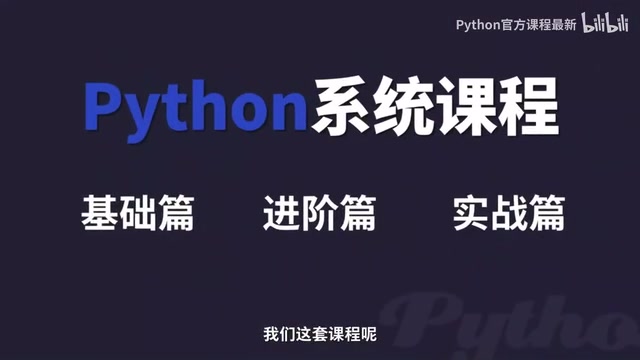
Recently, a 368-episode complete Python tutorial series on Bilibili has attracted considerable attention. Its curriculum adopts a classic three-stage progressive learning framework. Setting aside marketing rhetoric, the structural design of this course is worth in-depth analysis — the learning path it presents actually represents a mainstream methodology for learning Python.
Stage One: Python Syntax Fundamentals — Building the Foundation of Programming Thinking
Learning any programming language inevitably starts with basic syntax, and Python is no exception. The core goal of this stage isn't to "memorize all syntax" but to establish programming thinking.
The course covers the following key modules in the introductory stage:
- Environment Setup: Python installation and development environment configuration
- Variables and Data Types: Understanding how data is stored in programs
- Operators and Control Structures: Conditional statements, loops, and other program flow controls
- Functions: The basic unit of code reuse
For absolute beginners, the most common mistake at this stage is "watching without practicing." It's recommended to complete at least 3-5 small exercises after learning each concept. For example, after learning loops, try printing a multiplication table with a for loop, or implement a number-guessing game with a while loop. These seemingly simple exercises are the key steps in converting syntax knowledge into programming intuition — they force the brain to complete the "retrieval-application" cycle, truly consolidating memory.
Recommended duration: 2-3 weeks, investing 1-2 hours per day. Don't rush — a weak foundation will cost you double later on.
Stage Two: Advanced Python Syntax — From "Can Write" to "Write Well"
After the basics, many learners enter an awkward "middle ground": they understand basic syntax but feel helpless when facing slightly complex problems. The advanced stage is designed to break through this bottleneck.
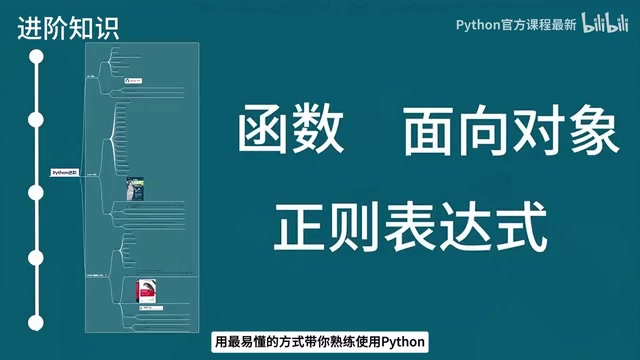
The course focuses on three core topics at this stage:
Object-Oriented Programming (OOP)
This is the watershed between "writing scripts" and "building engineering projects." Object-oriented programming originated in the 1960s with the Simula language and was championed by Alan Kay in Smalltalk. Its core idea is abstracting real-world entities as "objects." In engineering practice, OOP addresses the maintainability of large-scale codebases: Encapsulation hides internal implementation details, Inheritance enables code reuse, and Polymorphism provides flexible interface extension.
As a multi-paradigm language, Python supports object-oriented, functional, and procedural programming simultaneously. Understanding concepts like classes, objects, inheritance, encapsulation, and polymorphism allows your code to evolve from a pile of scattered functions into a well-structured program architecture. More importantly, understanding when to choose OOP is an important marker distinguishing junior from intermediate developers.
Exception Handling and Defensive Programming
Real-world programs must gracefully handle errors. Defensive Programming is an important practice philosophy in software engineering, with its core ideas systematically articulated by Bertrand Meyer in his "Design by Contract" theory. Python's try-except mechanism embodies the EAFP (Easier to Ask Forgiveness than Permission) programming style — execute the operation first, handle errors if they occur, rather than checking all conditions beforehand.
In production environments, good exception handling means more than just preventing crashes. It also includes: logging sufficient error context information, passing meaningful error messages to upper-level callers, and handling exceptions at the appropriate abstraction level. These practical skills can only be truly developed through debugging experiences in real projects, which is why video courses cannot fully replace hands-on project work.
Regular Expressions
The Swiss Army knife of text processing. The theoretical foundation of Regular Expressions comes from mathematician Stephen Kleene's regular language theory proposed in the 1950s, with its underlying implementation relying on Finite State Automata (FSA). Python's re module implements a subset of the PCRE (Perl Compatible Regular Expressions) standard, supporting advanced features like greedy matching, non-greedy matching, and lookahead assertions.
Whether it's data cleaning, log analysis, or web scraping, regular expressions are an indispensable tool. It's worth noting that regular expressions have performance pitfalls like "catastrophic backtracking," which is why understanding the underlying principles rather than just knowing the syntax is crucial.
The key learning point at this stage is understanding "why" rather than just "how." For example, when learning OOP, don't just mechanically define classes — think about: Why organize code with classes? In what scenarios is OOP more appropriate than functional programming? Learning with these questions in mind will dramatically improve your efficiency.
Stage Three: Python Practical Applications — Making Skills Generate Value
The ultimate purpose of learning programming is to solve real problems. The third stage of the course covers Python's four most popular application directions:
Python Web Scraping
Starting with web data extraction, you'll learn tools like requests, BeautifulSoup, and Scrapy. This is one of Python's most "immediately rewarding" application scenarios, quickly giving learners a sense of accomplishment. Web scraping also involves understanding HTTP protocols, HTML document parsing, anti-scraping countermeasures, and other dimensions, making it an excellent practice ground for comprehensively applying foundational knowledge.
Python Data Analysis
The rise of Python's data science ecosystem was no accident. In the early 2000s, the scientific computing community began adopting Python as an open-source alternative to MATLAB. The emergence of NumPy (2006) laid the foundation for high-performance numerical computing, with its core being the multidimensional array object ndarray implemented in C, breaking through the performance bottleneck of Python's native lists for numerical computation. Pandas (2008) was developed by Wes McKinney while working at hedge fund AQR, specifically designed for financial data analysis, introducing the DataFrame as its core data structure.
The maturation of this ecosystem, combined with Jupyter Notebook's interactive development experience, ultimately enabled Python to surpass R in the 2010s as the dominant tool in data science. Mastering core data science libraries like Pandas, NumPy, and Matplotlib, and learning to extract insights from data — this skill is in demand across virtually all industries.
Python Office Automation
Using Python to process Excel, Word, PDF, and other office documents to automate repetitive work. For professionals in non-programming roles, this may be the skill with the highest return on investment — even without switching to a development career, mastering office automation can significantly boost work efficiency and establish a differentiated competitive advantage in the workplace.
Introduction to Python Machine Learning
scikit-learn (sklearn) was initiated by David Cournapeau in 2007 as a Google Summer of Code project. Its design philosophy provides a unified API interface (fit/predict/transform), allowing users to invoke machine learning models without deeply understanding the mathematical principles behind algorithms. However, this "black box" convenience also carries risks: those who merely call packages without understanding model assumptions, feature engineering principles, and evaluation metrics often find themselves helpless when facing real business problems.
It's recommended that beginners gradually build intuitive understanding of algorithm principles while using sklearn to experience the training and prediction workflow of AI models — this is the key leap from "knowing how to use" to "using well."
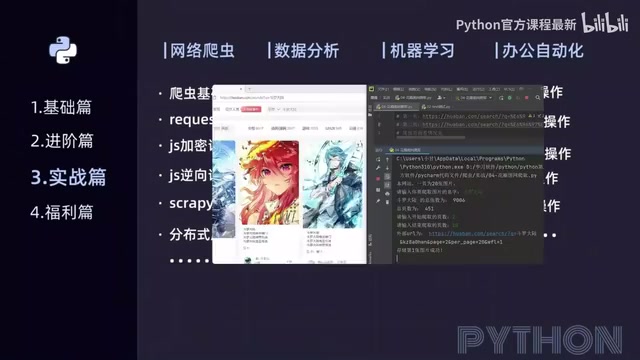
It's particularly important to note that learning all four directions simultaneously is not recommended during the practical stage. A wiser strategy is to first dive deep into one direction based on your career plans or interests, complete 2-3 full projects, and then expand horizontally. A complete project worthy of putting on your resume is far more valuable than superficial exposure to all four directions.
Rational Assessment: Strengths and Limitations of This Type of Python Course
Strengths
- Complete system: A full path from zero to practical application, preventing learners from getting lost in fragmented resources
- Low barrier to entry: Chinese instruction with step-by-step demonstrations, suitable for complete beginners
- Clear direction: Covers mainstream application scenarios, helping learners find their interests
Limitations
- "Finish in one week" is unrealistic: Even if each of the 368 episodes is 10 minutes long, that's 60+ hours of pure viewing time. Adding practice and digestion, you'll need at least 1-2 months
- Limited depth: Courses targeting beginners can hardly achieve sufficient depth in any single direction
- Lack of feedback mechanism: Video courses cannot replace the debugging and problem-solving skills developed through project practice. True programming ability is forged through repeated battles with error messages — an experience that passive watching simply cannot provide
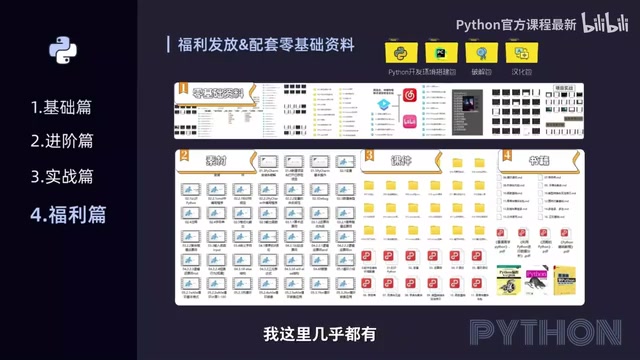
5 Practical Tips for Python Beginners
- Set a realistic schedule: Don't be misled by "learn in one week" titles — give yourself a 2-3 month learning period
- Code volume is a hard metric: Write at least 50 lines of code by hand every day. Just watching videos equals not learning — remember, only "retrieval-application" truly consolidates memory
- Start projects early: You can attempt small projects after learning basic syntax — no need to wait until you've "finished everything"
- Leverage AI-assisted learning: When encountering errors, try solving them yourself first, then use tools like ChatGPT to aid understanding. The process of independently solving problems is itself the most valuable learning experience
- Join a learning community: Find study partners to motivate and exchange ideas with each other
There are no shortcuts in learning programming, but there are methods. Choose a systematically complete course as your main thread, combine it with extensive hands-on practice and project work — this is the correct path from zero foundation to Python proficiency.
Key Takeaways
- Systematic Python learning is divided into three progressive stages: syntax fundamentals, advanced syntax, and practical applications
- The introductory stage focuses on building programming thinking; the advanced stage requires understanding core concepts like OOP, exception handling, and regular expressions
- The practical stage covers four directions — web scraping, data analysis, office automation, and machine learning — with the recommendation to go deep in one direction first
- "Finishing 368 episodes in one week" is unrealistic; a reasonable learning cycle is 2-3 months, with code practice volume being the key
- Video courses must be combined with extensive hands-on practice and project development to truly master programming skills
Related articles
 Tutorials
Cursor + Codex Dual-IDE Collaboration: A Practical Methodology for Open-Source Project Customization
A complete methodology for open-source project customization based on real-world experience, detailing the Cursor+Codex dual-IDE workflow, seven-stage process, MVP validation, and AI source code reading techniques.
 Tutorials
Cursor Multi-Agent in Practice: Building a Full-Stack Next.js Blog in 50 Minutes
Build a full-stack blog in 50 minutes using Cursor IDE's multi-Agent mode with Next.js, Clerk auth, and Supabase. Learn the 4-phase AI Agent workflow and key integration pitfalls.
 Tutorials
Building an AI Software Factory from Scratch: A Cursor Engineer's Hands-On Experience with Multi-Agent Collaboration
Cursor engineer Eric shares practical insights on building an AI software factory: automation levels, guardrail design, parallel Agent management, and scaling to 1000+ Agents for 24/7 development.