Enterprise Claude Code Workflows: Five Core Components for Taming Million-Line Codebases
Enterprise Claude Code Workflows: Five…
Enterprise AI coding efficiency depends on the engineering harness around the model, not the model itself.
Anthropic's official blog reveals that AI coding failures in large codebases stem not from insufficient model capability, but from a lack of proper engineering scaffolding (Harness). Traditional RAG fails in active codebases due to index lag, so Claude Code uses Agentic Search to operate directly on the local file system. Around this approach, teams need five core components (layered CLAUDE.md, Hooks, Skills, Plugins, MCP servers) and two advanced capabilities (LSP integration, Subagents), deployed through three patterns: precise configuration, regular maintenance, and dedicated organizational ownership.
When facing million-line legacy codebases, AI coding tools frequently fall flat — they can't find the right context, reference deleted functions, or mangle perfectly good code. Many blame insufficient model capabilities and pin their hopes on the next-generation LLM. But a recent hardcore blog post from Anthropic reveals an inconvenient truth: What determines the upper limit of AI coding efficiency isn't just the model itself — it's the engineering ecosystem you build around it.
This ecosystem is called a "Harness" (scaffolding), comprising five core components and two advanced capabilities. Based on a deep analysis of this official blog by Bilibili creator "为什么叫QQ," this article systematically breaks down how to make Claude Code truly effective in enterprise-scale codebases.
Why Traditional RAG Fails in Large Codebases
Most AI coding tools rely on RAG (Retrieval-Augmented Generation): vectorizing the codebase into a database and searching for relevant code snippets when queried. This works fine for small projects, but hits fatal flaws in large-scale team collaboration.
Imagine a codebase with thousands of engineers and thousands of commits per day — RAG's index simply can't keep up with the pace of code changes. What you retrieve in the afternoon might be two-week-old code where the function name is the same but the logic has completely changed. Even worse, you might retrieve a function that was deleted last month. The AI can't tell it's "dead," references it directly, and the code blows up at runtime.
This is RAG's core problem in active large codebases: index lag leads to stale information.
Claude Code takes a fundamentally different approach — Agentic Search. It doesn't rely on any central index. Instead, it operates like a real engineer directly on the local file system: using grep to search, tracing reference chains, and opening files to inspect them. This means the AI always sees the latest code — no delays, no stale indexes.
But this approach has a prerequisite: The AI must have enough context to know where to look. Without sufficient guidance, it searches aimlessly until the context window overflows. This is exactly the problem the five core components are designed to solve.
Five Core Components: Building the AI's Navigation System
1. CLAUDE.md: Layered Project Context Configuration
CLAUDE.md is a project context file that Claude Code automatically loads at the start of every session. Smart teams don't dump all their rules into the root directory — they write them in layers:
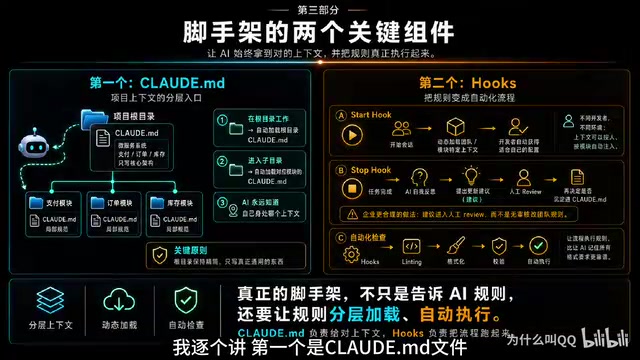
- Root CLAUDE.md: Contains only the most essential architectural information, such as "This is a microservices system divided into payment, order, and inventory modules"
- Subdirectory CLAUDE.md: Contains local conventions and details, like module-specific coding standards and testing requirements
Claude automatically loads the CLAUDE.md in the current working directory and traverses upward to load parent directory configurations. The key principle is to keep the root lean — avoid loading a pile of irrelevant information that wastes precious context window space on every session.
2. Hooks: From Interceptors to a Self-Evolving Engine
Many people treat Hooks as simple interceptors to prevent AI mistakes. But the truly advanced approach uses Hooks to drive knowledge accumulation and automated workflows:
- Stop Hook: Triggers after the AI completes a task, prompting it to self-reflect — what did it do, what pitfalls did it encounter, are there rules that should be codified into CLAUDE.md? The official guidance emphasizes that these suggestions should go through human review rather than letting the AI modify team rules without oversight.
- Start Hook: Dynamically loads team-specific context based on the developer's working environment, enabling personalized configuration automation.
- Automated checks: Having Hooks automatically run linting and formatting is far more reliable than asking the AI to remember a bunch of formatting rules.
This mechanism allows a team's AI coding capabilities to continuously accumulate — every session paves the way for the next one.
3. Skills: On-Demand Professional Knowledge Modules
Task types in large projects are incredibly diverse — security audits, performance optimization, documentation updates, database migrations — each requiring specialized knowledge. If you feed everything to the AI at once, the context window instantly overflows.
Skills adopt an on-demand loading approach: load the security Skill during security audits, load the documentation Skill during doc updates. Even smarter, Skills can be bound to specific directories — the payment team's deployment Skill is bound to the payment directory. The AI never loads it when working elsewhere, but it automatically appears when entering the payment module.
This design ensures the AI gets precise, specialized knowledge for each scenario without being distracted by irrelevant information.
4. Plugins: The Key to Team Knowledge Distribution
A common problem in large companies: great configurations often remain one small team's secret weapon while other teams fumble around independently, leading to severe knowledge fragmentation.
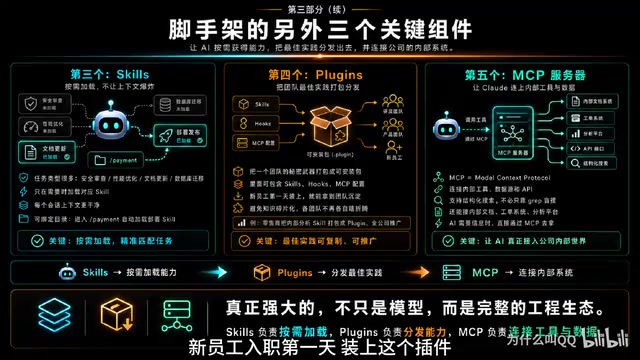
Plugins package a team's best practices into installable bundles — including Skills, Hooks, and MCP configurations, all bundled together. A new hire can install the plugin on day one and immediately access the team's accumulated context and capabilities.
The official post mentions a typical case: a large retailer built a Skill connecting Claude to their internal analytics platform, allowing business analysts to pull data directly within Claude. They packaged this Skill as a Plugin and rolled it out company-wide, significantly boosting cross-team data analysis efficiency.
5. MCP Servers: Bridging Internal Systems
MCP (Model Context Protocol) lets Claude Code connect to internal tools, data sources, and APIs. The most advanced teams even build MCP servers to expose structured search capabilities — instead of the AI running grep searches itself, it directly calls MCP tools for precise retrieval.
Other teams connect Claude to internal documentation systems, ticketing systems, and analytics platforms, letting the AI fetch whatever information it needs directly through MCP. This integration approach transforms AI coding from an isolated tool into an integral part of the enterprise technology stack.
Two Advanced Capabilities: LSP Integration and Subagents
LSP Integration: Precise Navigation in Large Codebases
LSP (Language Server Protocol) solves the problem of precise navigation in large codebases. In large C++ or Java projects, there might be hundreds of functions with the same name — relying on string search alone inevitably leads to errors. With LSP, the AI can jump precisely to symbol definitions, just like a developer pressing Ctrl+Click.
The official post mentions a collaboration with a large enterprise software company that deployed LSP integration configuration company-wide before rolling out Claude Code — the ROI was exceptionally high.
Subagents: Separating Exploration from Editing
Subagents are independent Claude instances with their own context windows. They can take on a task, complete the work, and return only the final results to the main Agent.
A typical use case is having a Subagent map out a subsystem, write its findings to a file, and then the main Agent uses that file as context for code editing — achieving separation of exploration and editing. This architecture effectively prevents a single context window from being overwhelmed by exploratory information.
Three Successful Deployment Patterns
Pattern 1: Precise Navigability Configuration
The AI's capability ceiling depends on the quality of context it can find. Too much context degrades performance; too little and the AI guesses blindly. The balanced approach:
- Keep CLAUDE.md lean and layered to avoid information overload
- Initialize in subdirectories rather than the root (Claude automatically loads parent configurations upward)
- Configure test and lint commands per subdirectory — when you change one service, only run that service's tests
- Use ignore/deny rules to exclude generated files, build artifacts, and third-party code
Pattern 2: Regularly Maintain Configurations as Models Evolve
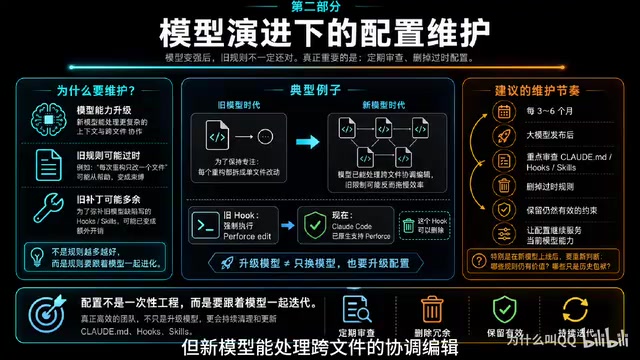
When new models are released, previous rules may become outdated. For example, a rule like "break every refactor into single-file changes" might have been designed to help older models stay focused, but when a new model can handle coordinated cross-file edits, that rule becomes a constraint.
The official recommendation is to conduct a configuration review every 3–6 months, especially after major model releases. Promptly clearing outdated restrictive rules is essential to fully unleash new model capabilities.
Pattern 3: Dedicated Ownership at the Organizational Level
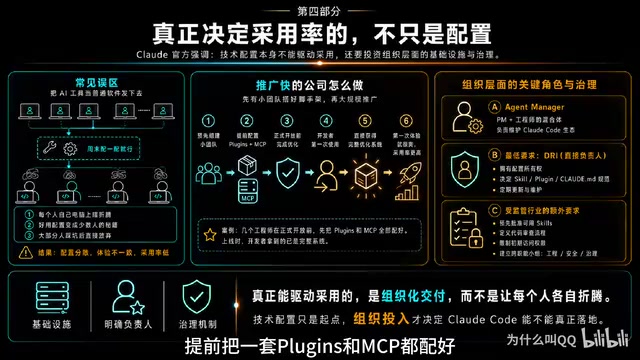
The fastest-adopting companies share one thing in common: before large-scale rollout, a dedicated small team builds the infrastructure in advance. Some companies have even created an "Agent Manager" role — a hybrid of PM and engineer — specifically responsible for maintaining the entire Claude Code ecosystem.
At minimum, there should be a DRI (Directly Responsible Individual) who owns the Claude Code configuration and regularly updates and maintains it. In regulated industries, you also need to pre-define which Skills are approved, how code review processes work, and how to restrict initial access.
Final Thoughts
As codebases grow ever larger, the core challenge we face is no longer "writing code" but "how to manage AI writing code." Teams that are first to establish robust AI scaffolding and codify individual experience into organizational plugins will gain clear advantages in adoption speed, context reuse, and best practice propagation.
You may not have noticed, but the official recommendations primarily target conventional software engineering environments — where engineers are the main code contributors, repos use Git, and directory structures are standard. If your scenario involves game engines, large binary assets, or unconventional version control, additional judgment and adaptation will be needed.
Core action item: Stop mindlessly feeding code to the AI. Build an enterprise-grade scaffold for your AI with layered CLAUDE.md files, on-demand Skills, and precise LSP integration — and most importantly, assign a person or small team to maintain that scaffold, turning great configurations into a company-wide asset.
Related articles
 Tutorials
Cursor + Codex Dual-IDE Collaboration: A Practical Methodology for Open-Source Project Customization
A complete methodology for open-source project customization based on real-world experience, detailing the Cursor+Codex dual-IDE workflow, seven-stage process, MVP validation, and AI source code reading techniques.
 Tutorials
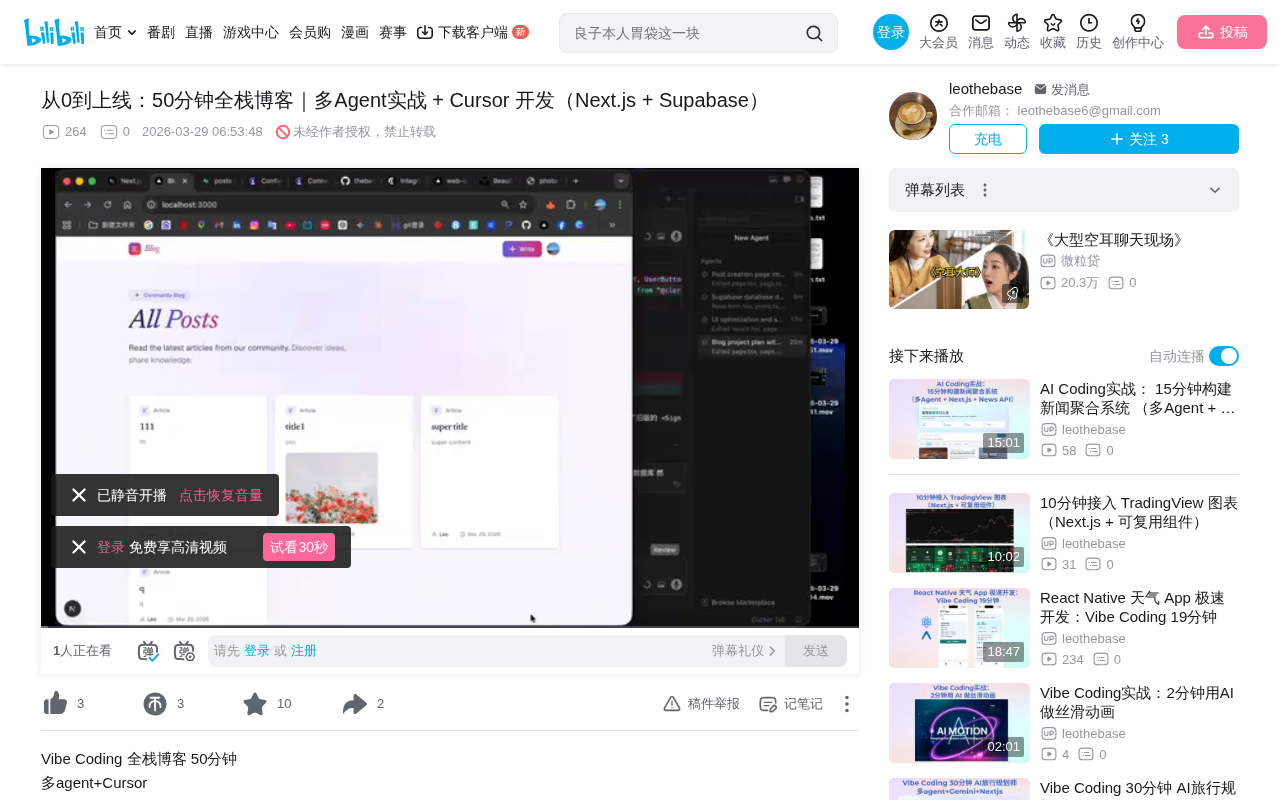
Cursor Multi-Agent in Practice: Building a Full-Stack Next.js Blog in 50 Minutes
Build a full-stack blog in 50 minutes using Cursor IDE's multi-Agent mode with Next.js, Clerk auth, and Supabase. Learn the 4-phase AI Agent workflow and key integration pitfalls.
 Tutorials
Building an AI Software Factory from Scratch: A Cursor Engineer's Hands-On Experience with Multi-Agent Collaboration
Cursor engineer Eric shares practical insights on building an AI software factory: automation levels, guardrail design, parallel Agent management, and scaling to 1000+ Agents for 24/7 development.