How Enterprise Text-to-SQL Breaks the 90% Accuracy Barrier: A Practical Guide to Agent Architecture
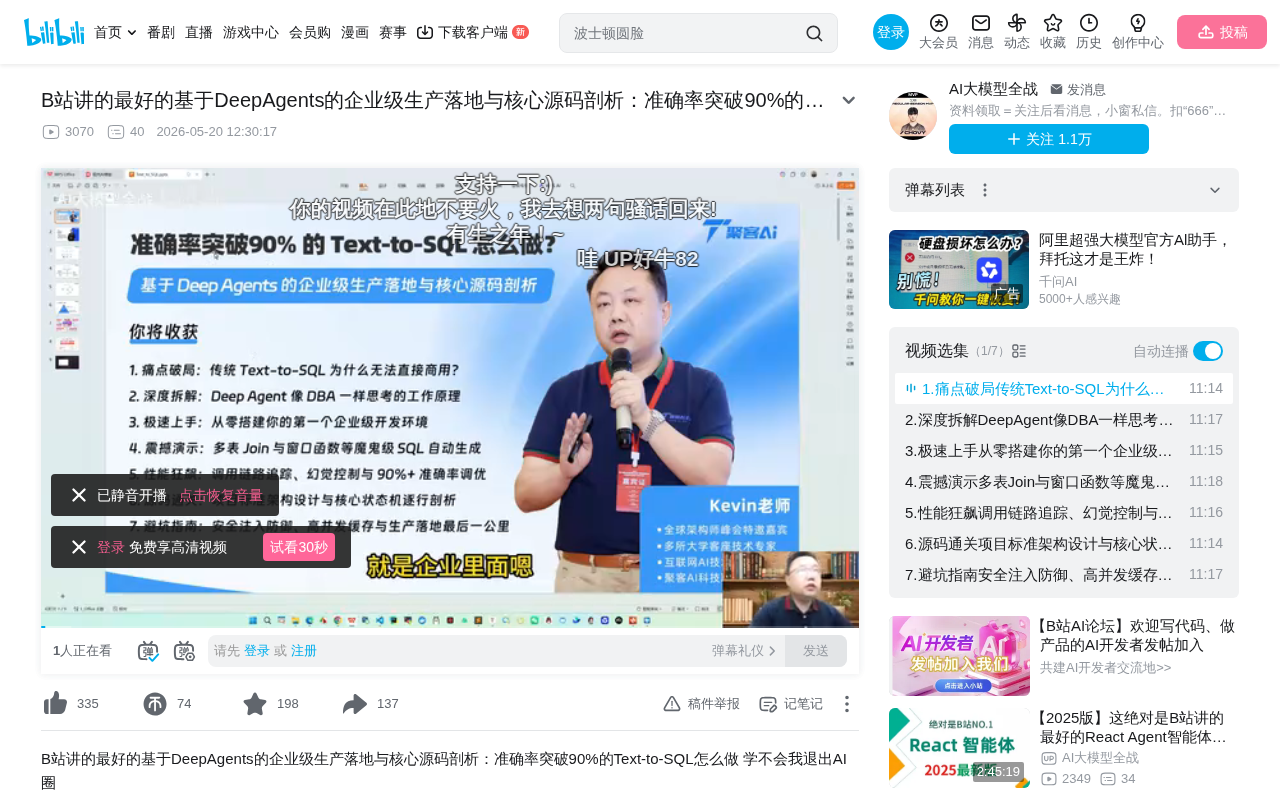
Enterprise Text-to-SQL breaks 90% accuracy through Agent architecture and AI engineering practices.
Enterprise Text-to-SQL faces critical challenges including schema context explosion, hallucination, and high failure rates in multi-table joins, making traditional end-to-end approaches impractical for production. The core breakthrough lies not in more powerful models but in AI engineering: using DeepAgents' multi-layered Agent architecture to decompose tasks into intent understanding, schema matching, SQL generation, and validation/repair sub-tasks, combined with domain knowledge injection and self-correction mechanisms, accuracy can exceed 90%.
Introduction: Why Text-to-SQL Is the First Frontier of Enterprise AI Adoption
Text-to-SQL (also known as NL-to-SQL) — generating SQL queries directly from natural language — is one of the most valuable use cases in enterprise AI adoption today. It transforms the traditional approach of developers hardcoding SQL into an interactive, natural-language-driven "ask your data" experience, enabling business users to query databases without knowing SQL syntax.
However, this seemingly simple requirement faces enormous challenges in real-world enterprise environments. Traditional approaches have consistently fallen short of the accuracy needed for production use. It wasn't until deep AI engineering practices and the evolution of Agent architectures that this field saw a qualitative breakthrough — with accuracy rates now capable of exceeding 90%.
This article takes a hands-on enterprise perspective to dissect the core pain points of Text-to-SQL, the solution strategies, and engineering-ready implementation approaches based on DeepAgents.
Why Traditional Text-to-SQL Isn't Production-Ready
The fundamental reason traditional Text-to-SQL solutions can't be deployed in production is simple: accuracy isn't good enough, and the error rate in generated SQL is too high. Here are the key pain points:
Pain Point 1: Context Explosion and Hallucination in Complex Business Tables
Real-world enterprise databases routinely contain dozens or even hundreds of tables, with individual tables potentially having hundreds of columns. To make matters worse, table and column names are often riddled with internal abbreviations or legacy naming conventions that only insiders understand — especially in specialized industries like security and public safety, where naming conventions completely ignore standard English word norms.
When we dump all this massive schema information into an LLM at once, two problems immediately arise:
- Context window limitations: Even as model context windows continue to grow, they still struggle with schema information spanning hundreds of columns
- Hallucination: Even if the schema fits within the window, the LLM tends to "hallucinate" when faced with a massive number of fields — sometimes even misattributing columns from Table A to Table B
This isn't a problem you can solve simply by switching to a more powerful model. It requires systematic optimization at the engineering architecture level.
Pain Point 2: High Failure Rates in Multi-Table Joins and Nested Queries
Anyone who's done backend development knows that complex multi-table JOIN queries and nested subqueries are challenging even for senior developers. When an LLM faces complex business queries requiring multi-table joins and nested aggregations, the difficulty of generating correct SQL increases exponentially.
Traditional end-to-end approaches that attempt to generate complete SQL directly from natural language in a single step may work for simple queries, but for enterprise-grade complex query scenarios, failure is virtually guaranteed.
From End-to-End to Agent Architecture: Engineering Is the Core Breakthrough
A critical insight: Improving Text-to-SQL accuracy has less to do with the LLM's inherent capabilities and more to do with AI engineering practices.
From early end-to-end conversational approaches to today's hierarchical Agent-based architectures, it's the step-by-step evolution of engineering practices that has driven continuous improvements in Text-to-SQL accuracy.
Core Engineering Strategies for Breaking the 90% Accuracy Barrier
To break through 90% accuracy, the core strategies can be summarized as follows:
- Precise Schema Retrieval: Instead of feeding all table structures to the model at once, use intelligent retrieval mechanisms to extract only the tables and columns relevant to the current query, dramatically reducing context noise
- Task Decomposition and Multi-Step Reasoning: Break down the complex SQL generation task into multiple sub-steps, each with clear objectives and verification mechanisms
- Self-Correction and Validation: Rather than returning generated SQL directly, apply multiple layers of automatic error correction through execution validation, syntax checking, and result reasonableness assessment
- Domain Knowledge Injection: Systematically inject domain knowledge — including business term mappings, column descriptions, and common query patterns — into the Agent workflow
Multi-Layered Architecture Design Based on DeepAgents
The DeepAgents framework provides a multi-layered Agent collaboration architecture for Text-to-SQL. Unlike traditional single-model invocations, this architecture decomposes the entire SQL generation process into multiple specialized Agents working in concert:
- Intent Understanding Agent: Parses the user's natural language query, identifying query intent and key entities
- Schema Matching Agent: Based on the query intent, precisely matches relevant tables and columns from database metadata
- SQL Generation Agent: Generates SQL statements based on the streamlined schema information and query intent
- Validation and Repair Agent: Performs syntax checking, execution testing, and result validation on the generated SQL, automatically fixing any issues found
This divide-and-conquer strategy allows each Agent to focus solely on the sub-task it specializes in, dramatically reducing the error probability at each stage.
AI Coding Tools in Text-to-SQL Projects
It's worth noting that code development for the entire Text-to-SQL project has fully entered the era of Vibe Coding (AI-assisted programming). This isn't just a productivity tool — it's a must-have skill for AI roles today.
Major tech companies including Alibaba, Huawei, and Tencent already rely on AI coding tools for the majority of their technical output. For real-world project development, the recommended tool combinations include:
| Phase | Tool Combination | Use Case |
|---|---|---|
| Project Initialization | Claude Code CLI + Opus | Greenfield projects, architecture design |
| Code Refinement | VS Code + Claude Plugin | Fine-tuning, feature iteration |
| Lightweight Development | Open Code + Leading Chinese Models | Day-to-day development, rapid prototyping |
| Beginner-Friendly | Trae (ByteDance) | Learning phase, simple projects |
Among these, the project initialization phase is the most critical — how you set up Claude MD files, define project development guidelines, and configure various Skills directly determines the efficiency and code quality of all subsequent development.
Enterprise Implementation Recommendations and Roadmap
Four Key Elements for Enterprise Deployment
- Don't over-rely on model capabilities: 80% of accuracy improvement comes from engineering, and 20% from model capability. Focus your energy on architecture design and workflow optimization
- Prioritize structuring domain knowledge: Systematically organize and inject business glossaries, column descriptions, and common query patterns
- Establish a continuous optimization feedback loop: Collect production failure cases and continuously feed them into test suites and knowledge bases
- Adopt a phased approach: Start with simple query scenarios and gradually expand to complex multi-table join scenarios
Why Text-to-SQL Is the Best Entry Point for Enterprise AI Adoption
Text-to-SQL is considered the most sought-after scenario for enterprise AI adoption not only because of its enormous business value, but because it serves as a connection point — once this scenario is unlocked, a whole chain of downstream AI applications including data analysis, report generation, and intelligent decision-making becomes accessible.
From a technology evolution perspective, the engineering practices developed for Text-to-SQL also provide reusable methodologies for other complex AI application scenarios: task decomposition, multi-Agent collaboration, and self-validation with error correction — patterns equally applicable to code generation, document processing, and beyond.
Conclusion
Breaking the 90% accuracy barrier in enterprise Text-to-SQL isn't about choosing a more powerful LLM — it's about systematic AI engineering practices. By leveraging DeepAgents' multi-layered Agent architecture to decompose complex tasks into specialized sub-tasks like schema retrieval, intent understanding, SQL generation, and validation/repair, combined with deep domain knowledge injection, production-grade accuracy becomes achievable. At the same time, proficiency with AI coding tools has become an essential skill for technical professionals — representing not just a productivity boost, but a fundamental shift in the entire development paradigm.
Related articles
 Tutorials
Cursor + Codex Dual-IDE Collaboration: A Practical Methodology for Open-Source Project Customization
A complete methodology for open-source project customization based on real-world experience, detailing the Cursor+Codex dual-IDE workflow, seven-stage process, MVP validation, and AI source code reading techniques.
 Tutorials
Cursor Multi-Agent in Practice: Building a Full-Stack Next.js Blog in 50 Minutes
Build a full-stack blog in 50 minutes using Cursor IDE's multi-Agent mode with Next.js, Clerk auth, and Supabase. Learn the 4-phase AI Agent workflow and key integration pitfalls.
 Tutorials
Building an AI Software Factory from Scratch: A Cursor Engineer's Hands-On Experience with Multi-Agent Collaboration
Cursor engineer Eric shares practical insights on building an AI software factory: automation levels, guardrail design, parallel Agent management, and scaling to 1000+ Agents for 24/7 development.