Red Alert Eye of the Void Map Guide: Spy Infiltration & Rhino Tank Winning Tactics
Red Alert Eye of the Void Map Guide: S…
Engineer factory steals and spy-promoted Rhino Tanks are the keys to winning Eye of the Void.
This guide details winning strategies for Red Alert 2's "Eye of the Void" multiplayer map. Open by capturing oil derricks and raiding the neighbor's War Factory to cripple their armor production. Mid-game, seize the high-value central gem field while exploiting "first-mover disadvantage" to develop peacefully. The decisive turning point is using Gap Generator cover to infiltrate a spy into the enemy War Factory, granting Rhino Tanks a 30-40% veteran combat boost that dominates the endgame.
Map Overview: The Unique Design of Eye of the Void
"Eye of the Void" is a distinctive multiplayer map in Red Alert. From a satellite view, the colorful ore field in the center resembles a giant eye gazing at every player—hence the map's name. The central area is rich in colored ore (gems), making it the core battleground for mid-to-late game economic competition.
Red Alert 2 (Command & Conquer: Red Alert 2) was developed by Westwood Studios in 2000, and its multiplayer map design follows the classic RTS resource-contestation philosophy. Map designers typically place high-value resource zones at the map center, creating natural conflict focal points. This design philosophy is known as the "central resource trap"—forcing players to choose between safe development and aggressive expansion. Gem ore is worth significantly more than regular ore with better harvesting efficiency, so controlling the central ore field directly determines late-game economic ceiling.
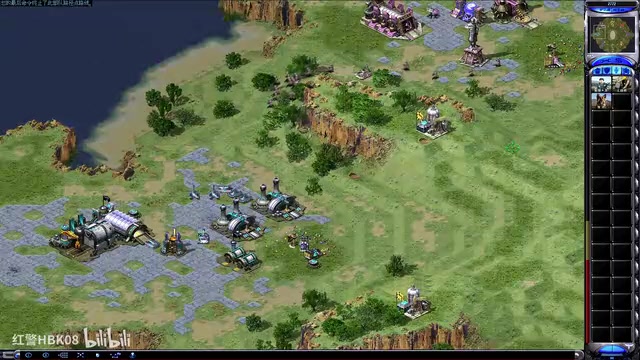
Each player has an oil derrick behind and in front of their base. At the start, you can quickly capture both oil derricks with engineers to establish an early economic advantage. The map's key principle: whoever controls the central ore field first gains the late-game initiative. Distance differences between spawn points and the central area also shape each player's strategic options.
Opening Strategy: Engineer Raids That Decide the Game
Rapid Oil Derrick Capture
The first step is to train six engineers and quickly capture your front and rear oil derricks to secure your economic foundation. Meanwhile, pre-place bunkers near your War Factory for anti-steal defense, and deploy attack dogs at key positions for scouting.
The Engineer is one of the most strategically deep units in the Red Alert series. Its core ability is capturing neutral buildings (oil derricks, hospitals) and enemy buildings. Capturing an enemy War Factory—known as "stealing the factory" in competitive play—not only strips your opponent of tank production capability but adds that building to your own production system, yielding double benefits. Engineers cost only about 500 credits yet can destroy core buildings worth thousands, offering an extremely high return on investment. This is why in high-level matches, both sides place bunkers and attack dogs around their War Factories for anti-steal protection.
Raiding the Neighbor's War Factory
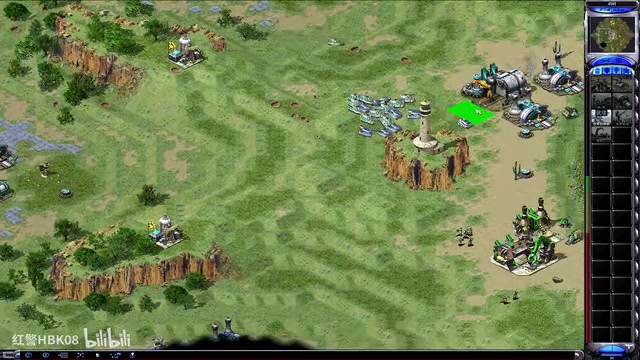
The highlight of this match is the consecutive raids on the neighboring pink Soviet player. The tactical core:
- Feint attack: Use engineers to fake an assault on the opponent's base, forcing them to pack up and move their MCV
- Real target: While their attention is diverted, engineers go straight for the War Factory
- Continuous pressure: After stealing the War Factory, the opponent can't produce tanks and can only spam Conscripts
- Second raid: Steal their rebuilt War Factory again, completely paralyzing their armor production
The pink player, stripped of two War Factories, fell into the predicament of "troops without tanks" and was easily eliminated. This operation not only removed a neighbor but also unlocked Rhino Tank production through the captured Soviet War Factory.
Mid-Game Development: Seizing the Central Ore Field
The Critical Moment of Economic Transition
As home base ore depletes, all surviving players inevitably turn their eyes toward the central "Eye of the Void." Strategic judgment here is crucial: the central ore is abundant and won't be exhausted quickly—rushing into battle only benefits third parties.
In multi-player RTS matches, game theory's "Nash Equilibrium" has direct practical applications. When multiple players covet central resources, the first to attack often gets exploited by a third party due to attrition—known as "first-mover disadvantage" in game theory. Thus, high-level players form a tacit "cold war state": all parties mine the center simultaneously, deterring each other without engaging. The trigger that breaks this equilibrium is typically a provocative act (like spy infiltration), which provides the aggressor with moral justification while signaling to other players that the attack is targeted retaliation rather than full expansion, thus avoiding a multi-front war.
The wise choice is to move harvesters to the center, deploy two refineries for improved mining efficiency, and set up bunkers for defense. In a delicate balance of power, peaceful mining and quiet development is the best strategy.
The Spy Game
However, the balance was soon broken—the blue player sent a spy to steal our tech. This was an intolerable provocation, as veteran-promoted tanks far outclass standard ones. An immediate counterattack was launched directly into blue's base, destroying their War Factory, Barracks, and Battle Lab, crippling them entirely.
Key Turning Point: Spy Infiltration for Rhino Tank Promotion
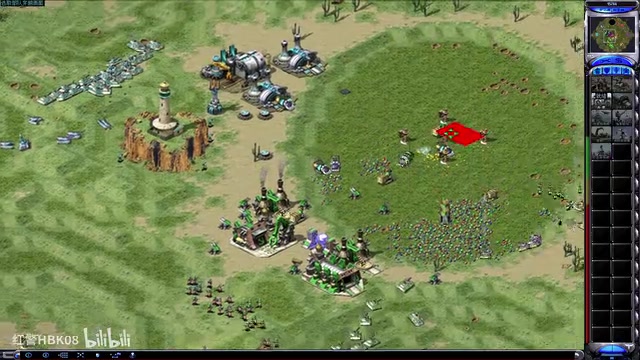
After eliminating blue, using Gap Generator cover along a central route, a spy disguised as an enemy Conscript successfully infiltrated the green player's War Factory. This was the decisive move of the entire match—Rhino Tanks with veteran promotion underwent a qualitative leap in combat power.
The Spy is a special Allied infantry unit whose core ability is disguising as any enemy infantry unit and triggering different effects upon infiltrating enemy buildings. Infiltrating an enemy War Factory grants veteran promotion to all tanks of that type produced thereafter. In Red Alert 2's game mechanics, tank promotion (Veteran/Elite) significantly boosts attack power, armor, and range. At Veteran (one-star) status, a Rhino Tank's overall combat effectiveness increases by approximately 30-40%, meaning promoted tanks almost always win in equal-number engagements. This mechanic stems from Westwood's unit progression system design, intended to reward players who keep units alive, but spy infiltration provides a "shortcut," making it a core tactical node in competitive play.
Key operational points for spy infiltration:
- Deploy Gap Generators in the middle area to conceal the spy's movement route
- Disguise the spy as an enemy Conscript and infiltrate from unexpected angles
- Act when the opponent's attention is divided (e.g., during standoffs with other players)
The Gap Generator is an Allied defensive support structure that creates fog of war in the surrounding area, concealing friendly units and buildings from enemy view. In multiplayer matches, the Gap Generator's strategic value extends far beyond defense—deploying it in neutral areas or at the edge of enemy vision creates "stealth corridors" for covert units like spies and engineers. This aggressive Gap Generator usage requires deep understanding of map vision mechanics: enemy units must enter the gap area to detect units within it, and since spies already have disguise capability, the double concealment dramatically increases infiltration success rates. This tactic is known as "Gap-Spy combo" in high-level play and is a signature Allied tactical combination.
Final Battle: Veteran Rhino Tanks Dominate
Defeating Green's Main Force
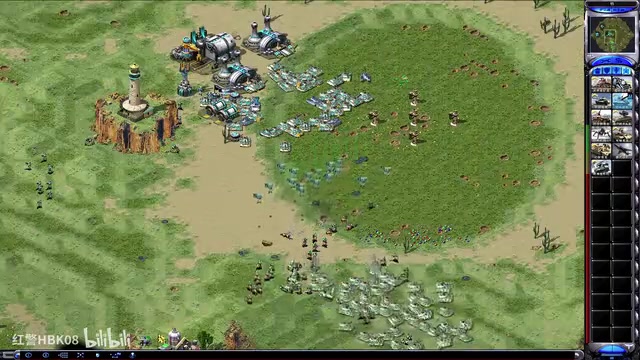
The green player had more tanks in sheer numbers, but all were unpromoted. Against veteran Rhino Tanks, their numerical advantage was completely negated by the quality gap. The tactical approach combined Rocketeers with tanks for multi-dimensional strikes:
- Rocketeers lead: Destroy the enemy's Iron Curtain device, eliminating the invincibility shield threat
- Tanks push frontally: Leverage veteran advantage for a head-on crush
- Focus fire AA: Prioritize destroying anti-air facilities to create space for Rocketeers
As the commentary noted: "With equal tank numbers, unpromoted tanks simply cannot beat veteran Rhinos—the opponent needs more than double the numbers to stand a chance."
Mopping Up
After defeating green, the remaining orange and yellow players were helpless. Rocketeers dismantled buildings while tanks flattened bases. The final victory came after finding orange's last bunker hidden near a yacht in a secluded corner, completing the total elimination.
Tactical Summary: The Path to Victory on Eye of the Void
This Eye of the Void match demonstrated several core tactical principles in Red Alert:
- Engineers are the most cost-effective unit: One engineer stealing a War Factory equals destroying the opponent's entire armor production line
- Spy promotion is a qualitative turning point: The combat power boost from veteran status far exceeds expectations—approximately 30-40% overall combat effectiveness increase is enough to change the outcome
- Diplomatic judgment determines survival: Knowing when to fight and when to develop peacefully matters more than micro; understanding "first-mover disadvantage" in multi-party games is a core skill of high-level players
- Gap Generators are strategic-level equipment: Concealing critical action routes and creating conditions for spy infiltration, the "Gap-Spy combo" is a signature Allied tactical combination
The core of Eye of the Void lies in the contestation and coexistence dynamics around the central ore field. The player who finds the optimal moment to strike amid complex multi-party situations is the ultimate winner.
Core Takeaways
- The central gem ore field on Eye of the Void is high-value; timing your mining correctly matters more than blindly fighting
- Engineer raids on enemy War Factories are a key opening tactic; feint attacks greatly improve success rates
- Spy infiltration of enemy War Factories for tank promotion is the match-deciding move—veteran Rhino Tanks gain ~30-40% combat effectiveness over unpromoted units
- Gap Generators combined with spy disguise enable double-concealment infiltration from unexpected routes
- Multi-player matches follow "first-mover disadvantage" dynamics; choosing the right timing and target for aggression determines the final outcome
Related articles
 Tutorials
Cursor + Codex Dual-IDE Collaboration: A Practical Methodology for Open-Source Project Customization
A complete methodology for open-source project customization based on real-world experience, detailing the Cursor+Codex dual-IDE workflow, seven-stage process, MVP validation, and AI source code reading techniques.
 Tutorials
Cursor Multi-Agent in Practice: Building a Full-Stack Next.js Blog in 50 Minutes
Build a full-stack blog in 50 minutes using Cursor IDE's multi-Agent mode with Next.js, Clerk auth, and Supabase. Learn the 4-phase AI Agent workflow and key integration pitfalls.
 Tutorials
Building an AI Software Factory from Scratch: A Cursor Engineer's Hands-On Experience with Multi-Agent Collaboration
Cursor engineer Eric shares practical insights on building an AI software factory: automation levels, guardrail design, parallel Agent management, and scaling to 1000+ Agents for 24/7 development.