Replit Partners with Socket Security to Defend Against Supply Chain Attacks: A New Security Paradigm for the AI Era
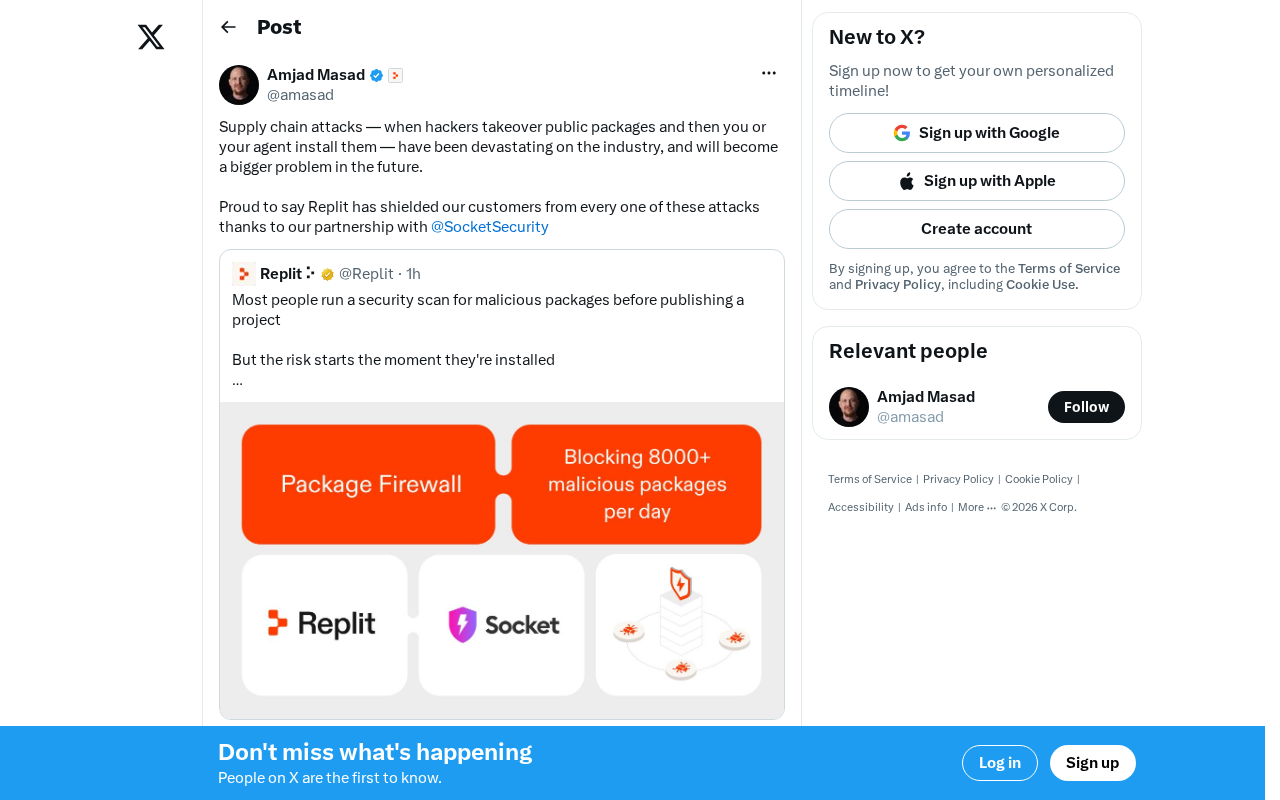
Replit and Socket Security team up to defend developers against supply chain attacks in the AI coding era.
Replit has partnered with Socket Security to provide platform-level protection against software supply chain attacks, which are increasingly dangerous as AI coding agents amplify the attack surface. By integrating real-time behavioral analysis, dependency risk assessment, and proactive interception, the collaboration shields millions of developers — including those using AI assistants — from malicious packages without requiring manual security configuration.
Supply Chain Attacks: The Invisible Threat of the AI Era
Supply chain attacks are becoming one of the most severe security challenges facing the software industry. When hackers take over public software packages and developers or AI agents unknowingly install these compromised dependencies, catastrophic consequences follow.
Replit's CEO recently stated on social media that supply chain attacks have been "devastating to the industry and will become an even bigger problem in the future." He also announced that through its partnership with security firm Socket Security, Replit has successfully defended its users against every such attack.
Why Supply Chain Attacks Are Becoming Increasingly Dangerous
Dependency Risks in Traditional Development
Modern software development is heavily reliant on the open-source ecosystem. According to Synopsys' Open Source Security and Risk Analysis Report, over 96% of commercial codebases contain open-source components, with each project depending on hundreds of third-party packages on average. npm (the JavaScript ecosystem) hosts over 2 million packages, while PyPI (the Python ecosystem) has more than 500,000. This highly interconnected dependency landscape forms complex "dependency trees" — a single top-level package can indirectly pull in dozens of layers of nested dependencies. Developers often lack visibility into deep dependencies, which is precisely the structural reason supply chain attacks can spread so stealthily.
When attackers gain control of a public package through social engineering, account hijacking, or typosquatting, every project that depends on that package is at risk. Typosquatting is one of the most common techniques in supply chain attacks — attackers register malicious package names that closely resemble popular ones, exploiting developers' typos to trick them into installation. For example, misspelling "requests" as "reqeusts" or "request." In 2022, security researchers discovered over 29 such malicious packages on PyPI, some of which had been downloaded thousands of times before detection. A more advanced variant is the dependency confusion attack, where attackers publish malicious packages on public repositories with the same name as a company's internal private packages, exploiting package manager priority mechanisms to achieve automatic substitution.
Major package management platforms like npm and PyPI frequently report malicious package incidents, affecting everyone from individual developers to large enterprises. These attacks are extremely stealthy and are often only discovered after real damage has been done.
How AI Agents Amplify the Supply Chain Attack Surface
With the proliferation of AI coding assistants and automated agents, the risk of supply chain attacks is being significantly amplified. AI coding assistants (such as GitHub Copilot, Cursor, Replit Agent, etc.) automatically recommend or directly install required third-party dependency packages based on code logic when generating code. This process is typically completed automatically by parsing import statements or project configuration files. Unlike human developers, AI agents select dependencies primarily through pattern matching from training data, lacking the ability to make comprehensive judgments based on "soft signals" such as maintainer reputation, recent update history, and abnormal download volume fluctuations.
More critically, AI agents may "hallucinate" non-existent package names, and attackers can pre-register these hallucinated names to carry out attacks. This novel attack vector, known as a "package hallucination attack," means attackers don't even need to hijack existing legitimate packages — they simply lie in wait for AI agents to automatically direct users to malicious packages.
When AI coding tools automatically generate code and install dependencies for users, without an effective security layer, attackers can more easily inject malicious code into the development workflow. This transforms supply chain attacks from "attacks targeting humans" into "attacks targeting machines," dramatically increasing attack efficiency.
Replit and Socket Security's Defense Strategy
Socket Security's Core Security Capabilities
Replit chose to partner with Socket Security to address this challenge. Socket Security is a company focused on open-source supply chain security, and its technical approach differs fundamentally from traditional dependency security tools. Traditional tools primarily rely on CVE (Common Vulnerabilities and Exposures) databases for known vulnerability matching — an approach with obvious latency issues, as it can only detect previously reported vulnerabilities. Socket Security instead adopts a zero-trust "guilty until proven innocent" approach, identifying potential threats through static analysis of a package's actual code behavior. Its core capabilities include:
- Real-time malicious package detection: Identifying suspicious dependencies through behavioral analysis rather than pure signature matching, specifically checking whether packages exhibit suspicious behaviors such as network callbacks, file system access, environment variable reading, and install script execution
- Dependency risk assessment: Comprehensive evaluation of metadata signals including package maintenance status, maintainer changes, sudden permission scope changes, and abnormal publishing frequency
- Proactive interception: Blocking malicious packages before they are installed rather than remediating after the fact, providing immediate protection during zero-day attacks (attacks that exploit vulnerabilities not yet publicly disclosed)
Real-World Impact of Platform-Level Security
As a cloud-based development platform with millions of users — many of whom use AI-assisted coding features — Replit can automatically intercept problematic packages when users or AI agents attempt to install them by integrating Socket Security's protection at the platform level, without requiring users to configure security tools themselves.
This "platform-level protection" model means that even beginners with limited security awareness can benefit from enterprise-grade supply chain security. Developers can focus on coding itself while leaving dependency security to the platform.
Industry Implications and Future Trends in Development Security
Supply chain security is shifting from a "nice-to-have" to a "must-have." With the explosive growth of AI coding tools, the following trends are worth watching:
-
Shift Left Security: Shift Left is a core principle in DevSecOps, referring to moving security practices from later stages of the software development lifecycle (such as deployment and operations) to earlier stages (such as coding and building). IBM's research shows that fixing security defects during the design phase costs only 1/100th of fixing them in production. In the context of supply chain security, this means security checks need to be embedded at the earliest stages of the development workflow — completing risk assessment and interception the moment a developer runs
npm installorpip install, rather than waiting until malicious code has already entered the codebase or even the production environment before initiating incident response. -
Elevated Platform Security Responsibility: Development platforms need to take on greater security protection responsibilities rather than shifting all risk to users. This trend aligns with the "Shared Responsibility Model" in cloud computing. As cloud-based IDEs and AI coding platforms rise, platform operators are beginning to assume security obligations similar to those of cloud service providers. The White House's 2023 National Cybersecurity Strategy also explicitly calls for shifting security responsibility to "the entities best positioned to bear it" — namely technology platforms and software vendors, not end users.
-
AI Security Collaboration Mechanisms: Dedicated security strategies for AI agents are needed to prevent automated tools from becoming attack entry points. This includes real-time security review of AI-generated dependency recommendations, establishing AI agent-specific package installation allowlist mechanisms, and developing protection tools capable of identifying AI-specific threats such as "package hallucination attacks."
In an era where AI agents are increasingly involved in code writing and dependency management, partnership models like the one between Replit and Socket Security may become an industry standard. Development platforms that cannot effectively defend against supply chain attacks will face serious user trust crises. For developers, choosing a platform with comprehensive supply chain security protection has become a critical decision.
Related articles
Five Common Claude Code Mistakes — How Many Are You Making?
Five common Claude Code mistakes developers make: copy-pasting code, skipping CLAUDE.md, inefficient prompting, ignoring docs, and poor context management — with fixes.
Andrew Ng's New Course Explained: A Practical Guide to Using OpenAI's O1 Reasoning Model
Deep dive into Andrew Ng and OpenAI's Reasoning with O1 course covering test-time scaling, new prompting paradigms, multi-model orchestration, and practical applications for developers.

Learning AI After College Entrance Exams: A Complete Path from Zero to Freelancing
How to efficiently learn AI skills during summer break after exams? A complete path from mastering prompts and hands-on projects to freelancing on platforms.