Runway's 4th AI Film Festival Reveals Top 10 Finalists: Dual Screenings in NYC and LA
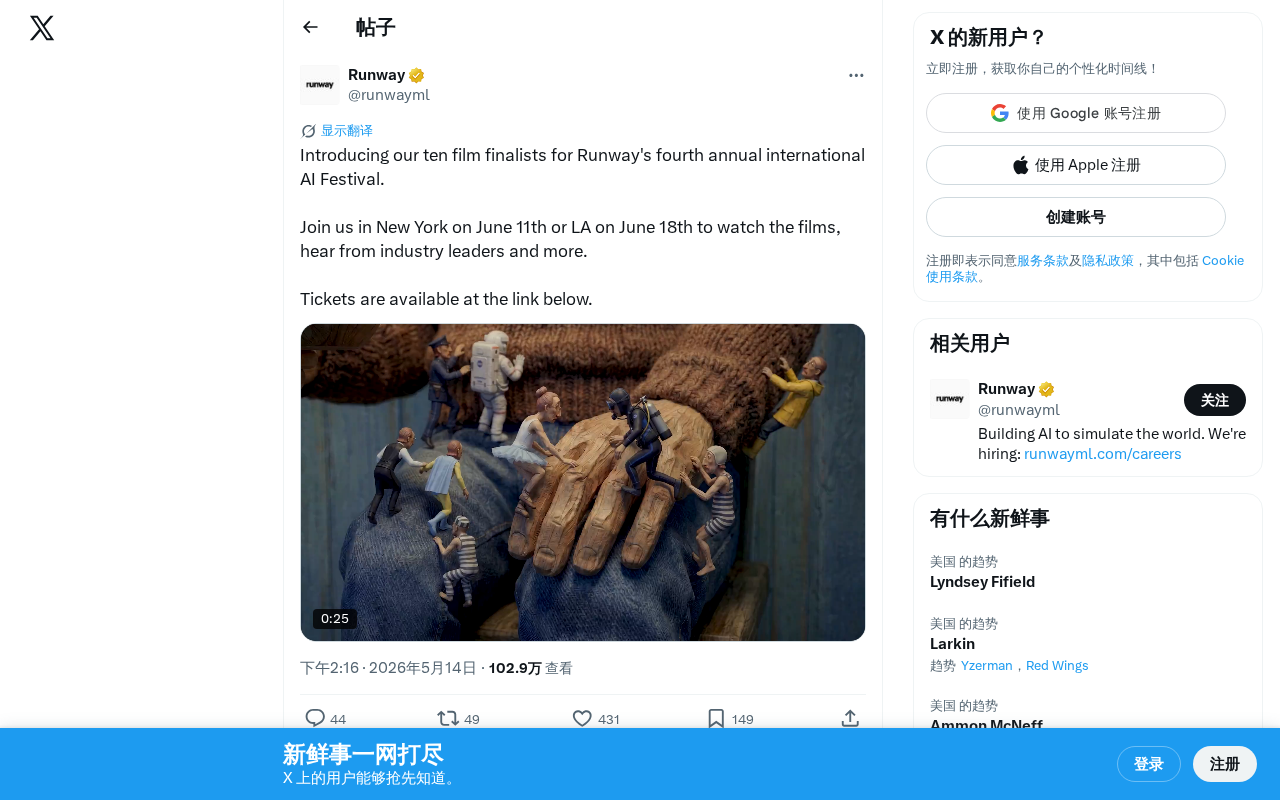
Runway unveils 4th AI Film Festival finalists with dual NYC/LA screenings in June.
Runway has revealed the ten finalists for its 4th International AI Film Festival, with in-person screenings in New York (June 11) and Los Angeles (June 18). The festival showcases the rapid evolution of AI video creation and is shaping artistic standards for the medium while building a creator ecosystem amid intensifying competition from Sora, Kling, and others.
Runway AI Film Festival Returns
Runway has officially announced the ten finalist works for its 4th International AI Film Festival, with in-person screenings scheduled for June 11 in New York and June 18 in Los Angeles.
As one of the most influential annual events in the AI creative space, the Runway AI Film Festival has run for four consecutive years, witnessing the evolution of AI-generated video from rough experiments to artistic expression. Runway itself is a benchmark company in AI video generation, founded in 2018 by Cristóbal Valenzuela and others. The company rose rapidly with its Gen-1 and Gen-2 text-to-video models and was also a key contributor to the early training of Stable Diffusion. With a valuation exceeding $4 billion and investment from tech giants like Google and NVIDIA, Runway's confidence in hosting this festival stems from its dual strength in technical R&D and industry influence.
Dual-City Screenings: The Significance of New York and Los Angeles
This year's festival chose two major cultural capitals — New York and Los Angeles — as screening locations, a deliberately meaningful arrangement. New York is a frontline hub for independent art and new media, while Los Angeles is the heartland of the traditional film industry. This dual-city approach perfectly embodies AI film's role as a bridge between artistic experimentation and commercial application.
The events go beyond film screenings, featuring talks and exchanges with industry leaders that offer creators and professionals opportunities for in-depth dialogue. Notably, the AI Film Festival differs fundamentally from traditional festivals like Cannes or Sundance — the latter evaluate outcomes of human collaboration among directors, actors, and cinematographers, while the AI Film Festival requires entirely new evaluation criteria: the creative depth of human-machine collaboration, the sophistication of prompt engineering, and how creators harness AI's randomness and generative properties to serve narrative goals. In a field with no unified industry standards yet, Runway's festival is functioning as a de facto standard-setter.
The Technical Evolution of AI Video Creation
From the first edition to the fourth, the Runway AI Film Festival itself serves as a chronicle of AI video technology evolution. Looking back at the progression over recent years:
- Early works relied heavily on simple image animation and style transfer
- Mid-period works began achieving breakthroughs in narrative coherence and character consistency
- Today's finalists can deliver complex emotional expression and cinema-grade visual language
This pace of improvement would be almost unimaginable in the history of traditional filmmaking technology. The underlying technical support comes from the deep integration of diffusion models with Transformer architectures. Diffusion models generate new content by learning the process of "recovering signal from noise," while video generation must simultaneously handle spatial dimensions (frame composition) and temporal dimensions (inter-frame coherence) — computational complexity orders of magnitude greater than static images. Runway's Gen-series models have continuously iterated on temporal consistency and motion naturalism, with each generation representing further breakthroughs on this technical challenge. The quality improvements in festival finalists are the most tangible external manifestation of these underlying technical advances.
Impact on the AI Creator Ecosystem
Lowering the Barrier to Visual Storytelling
By hosting the film festival, Runway is effectively building a complete AI creator ecosystem. The selection process for the ten finalists itself serves as a review of global AI creators, inspiring more people to attempt visual storytelling with AI tools.
Defining Artistic Standards for AI Film
The festival's selection criteria are implicitly defining what constitutes a "good AI film." This goes beyond mere technical showmanship — it demands a comprehensive consideration of narrative ability, emotional depth, and artistic sensibility. As the quality of finalists improves each year, AI film is transitioning from "technical spectacle" to "artistic work."
Outlook and Reflections
In an era where AI video models like Sora, Kling, and others are flourishing, Runway's decision to continue investing in the film festival as a cultural vehicle reveals an ambition to be more than just a tool provider — it aims to lead creative culture. Competition in the AI video generation space has become intensely fierce: OpenAI's Sora has generated buzz with long-form video generation and physical world simulation, Kuaishou's Kling represents the rise of Chinese players, and Pika Labs, Stability AI, and others are also actively positioning themselves. The competitive focus has shifted from pure visual quality to ecosystem building: whoever can first achieve a complete closed loop from tools to community to commercialization will dominate this emerging market. The creator community and cultural influence Runway is building through its film festival is a central piece of its ecosystem strategy.
For those following the AI creative industry, these two June events deserve close attention — the caliber of the finalists will directly reflect the current true ceiling of AI video creation.
Key Takeaways
Related articles

AI Aggregator Platforms Tested: A Complete Guide to Using GPT 5.5 and Other Top Models for Free
A hands-on guide to using GPT 5.5, Gemini 3.1 Pro, and Grok 4.2 for free via AI aggregator platforms, covering cross-model context memory, account pool mechanisms, and key security risks.
Vibe Coding in Practice: A Junior Student Uses Cursor to Build a Multi-Agent System with 51 AI Officials Based on the Three Departments and Six Ministries Framework
A junior student uses Cursor and Vibe Coding to build a multi-agent system with 51 AI officials modeled on China's Three Departments and Six Ministries, featuring task distribution, approval workflows, and Token cost visualization.

How to Connect Codex to DeepSeek Models: Free Switching via CC Switch
Learn how to connect OpenAI Codex to DeepSeek models via CC Switch, enabling free switching between DeepSeek and GPT with complete setup and routing guide.