Sam Altman's Three AGI Visions: From Scientific Breakthroughs to Personal AI Assistants
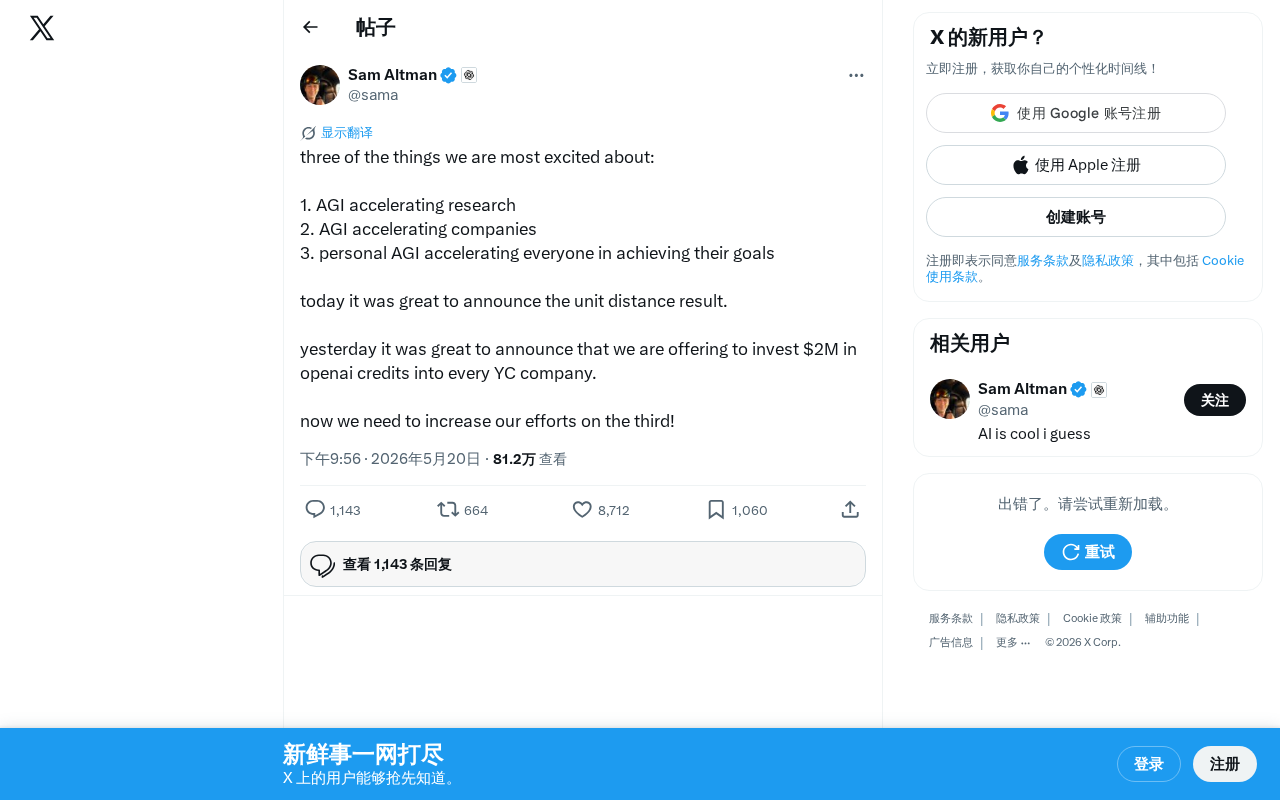
OpenAI outlines three AGI strategies: accelerating research, empowering businesses, and serving individuals.
Sam Altman outlines OpenAI's three-layered AGI vision: validating AGI's ability to accelerate research through a math breakthrough, deeply binding to the startup ecosystem by offering $2 million in credits to YC companies, and explicitly identifying personal AGI as the next strategic priority. The three-layered vision—from professional research to commercial applications to consumer-level adoption—follows the general pattern of technology diffusion.
OpenAI's Three Strategic Directions
OpenAI CEO Sam Altman recently shared on social media the three things they're most excited about right now, clearly outlining a three-layered vision for AGI (Artificial General Intelligence) applications:
- AGI accelerating scientific research
- AGI accelerating business growth
- Personal AGI helping everyone achieve their goals
These three directions span from macro to micro, from institutions to individuals, forming a complete pathway for AGI deployment. Two recent major developments correspond precisely to the first two directions.
What is AGI? AGI (Artificial General Intelligence) is fundamentally different from today's mainstream "Narrow AI." Narrow AI excels only at specific tasks like image recognition or language translation, while AGI could theoretically reason, learn, and solve problems across domains just like humans. The academic definition of AGI remains debated, but OpenAI characterizes it as "an AI system that surpasses humans at most economically valuable tasks." From the Turing Test to modern large language models, each leap in AI capability has made AGI discussions more concrete, and Sam Altman's three-layered vision is precisely about translating this abstract concept into actionable commercial and societal pathways.
AGI Accelerating Research: The Unit Distance Problem Breakthrough
The "unit distance result" Altman mentioned refers to a significant scientific breakthrough recently announced by OpenAI. The Unit Distance Problem originates from combinatorial geometry, posed by Hungarian mathematician Paul Erdős in 1946. The core question is: given n points placed on a plane, what is the maximum number of point pairs that can be exactly one unit apart? Despite its apparent simplicity, providing a precise upper bound has remained elusive for decades. Deeply intertwined with graph theory and algebraic geometry, it's considered one of the landmark problems in discrete geometry. AI's involvement in such pure mathematics problems signals that machines are no longer merely computational tools but are beginning to possess capabilities for formal reasoning and conjecture verification.
This is not an isolated case. The most representative precedent is DeepMind's AlphaFold, launched in 2020. This protein structure prediction system dominated the CASP14 competition, solving the protein folding problem that had stumped biologists for 50 years. Traditional experimental methods require months or even years to resolve a single protein structure, while AlphaFold2 can complete predictions in minutes with accuracy rivaling experimental results. By 2023, AlphaFold had predicted over 200 million protein structures, covering the proteomes of virtually all known organisms on Earth. This case profoundly changed the scientific community's perception of AI's role—AI is no longer just an auxiliary tool but a "virtual researcher" capable of independently advancing scientific frontiers. From AlphaFold to the unit distance problem to AI-assisted materials science discoveries, artificial intelligence is becoming a "super accelerator" for scientific research. OpenAI clearly aims to position AGI as core infrastructure for scientific discovery—not merely a tool, but an intelligent agent capable of independently pushing research boundaries.
The strategic significance of this direction lies in this: if AGI can consistently produce high-quality research outcomes, it will fundamentally prove its own value while creating a positive feedback loop for technological iteration—AI helps make better scientific discoveries, and those discoveries in turn improve AI itself.
AGI Accelerating Business: Deep Integration with YC
Altman simultaneously announced that OpenAI will provide up to $2 million in OpenAI credits as investment to every Y Combinator (YC) company. To understand the weight of this move, one must first appreciate YC's scale: founded in 2005, Y Combinator is the world's most influential startup accelerator, having incubated companies including Airbnb, Stripe, Dropbox, and Reddit. Its portfolio companies have a combined valuation exceeding $600 billion, with two batches per year, each accepting approximately 200-300 startups. Notably, Sam Altman himself served as YC President from 2014 to 2019, during which time he expanded YC's scale several-fold and championed the establishment of YC Research, which later evolved into a precursor institution to OpenAI. This history makes the OpenAI-YC collaboration far more than an ordinary business relationship—it's more like strategic synergy within the same ecosystem.
This move sends a clear signal: OpenAI is transitioning from a technology provider to foundational infrastructure for the startup ecosystem. This strategy can be understood on several levels:
- Ecosystem lock-in: Building an ecosystem moat through API credit subsidies is a classic competitive strategy for tech platforms—AWS attracted startups through free tiers early on, ultimately concentrating cloud computing infrastructure. For AI platforms, the lock-in logic is even stronger: once startups build core products on a specific model API, migration costs are extremely high, involving not just technical restructuring but comprehensive adjustments to prompt engineering, fine-tuning data, and user experience. OpenAI's move essentially establishes deep dependency relationships during the product formation stage, front-loading competitive barriers to the startup's technology selection phase.
- Scenario expansion: YC incubates hundreds of companies annually across all industries, and these companies become natural testing grounds for AGI deployment across different verticals
- Data flywheel: Feedback from numerous enterprise-level application scenarios will help OpenAI more precisely understand commercial needs and continuously optimize model capabilities
$2 million in credits represents a substantial resource for early-stage startups, sufficient to support extended periods of AI product development and experimentation.
Personal AGI: OpenAI's Next Major Battleground
At the end of his post, Altman specifically emphasized "now we need to increase our efforts on the third"—the need to invest more in the third direction. This statement reveals a key piece of information: personal AGI will be OpenAI's strategic focus going forward.
"Personal AGI" refers to an AI assistant that can deeply understand individual needs and help each person achieve their own goals. This is fundamentally different from ChatGPT's current general conversation mode—it's more like a truly knowledgeable intelligent agent that can proactively plan, execute, and optimize your work and life. The core technical foundation for this direction is AI Agents—AI systems capable of autonomously perceiving their environment, formulating plans, and executing multi-step tasks. Since 2023, the emergence of technologies like AutoGPT, LangChain, and OpenAI's Function Calling marks a paradigm shift in AI from "responder" to "executor." The core challenges for personal AGI lie in three dimensions: long-term memory management, cross-application tool invocation, and personalized preference modeling. Currently, ChatGPT's memory features, GPT-4o's real-time voice interaction, and enhanced Agent capabilities all represent OpenAI's incremental positioning in this direction.
From a product perspective, this likely means:
- Deep personalization: AI not only remembers your preferences but understands your long-term goals and proactively offers suggestions
- Upgraded Agent capabilities: Shifting from passively answering questions to proactively completing tasks, such as automatically managing schedules, handling emails, and coordinating projects
- Full-scenario coverage: Comprehensive empowerment spanning work productivity, personal growth, health management, learning planning, and more
When personal AGI truly matures, it will redefine the fundamental paradigm of human-computer interaction, evolving from "search engine-style queries" to an "always-on intelligent collaboration partner."
The Deeper Logic Behind the Three-Layered Vision
The three directions Altman outlines are essentially three stages of AGI value release: first proving capability in high-value scientific research, then achieving commercial scale through enterprise scenarios, and ultimately permeating into everyone's daily lives.
This also aligns with the general pattern of technology diffusion. Sociologist Everett Rogers proposed the Technology Diffusion Theory in 1962, categorizing technology adopters into innovators, early adopters, early majority, late majority, and laggards, forming the classic S-shaped diffusion curve. In digital technology, new technologies typically first validate feasibility in high-tolerance, high-value professional scenarios (such as research and finance), then achieve scaled commercial deployment through B2B enterprise applications, and finally penetrate mass markets in consumer product form—the internet, smartphones, and cloud computing all followed this path. OpenAI's three-layered vision closely mirrors this diffusion model, demonstrating Altman's clear-eyed understanding of technology commercialization timing. OpenAI is advancing all three tracks simultaneously, but based on Altman's statements, personal AGI will receive greater resource allocation.
For the AI industry as a whole, this means the competitive focus is shifting from "whose model is stronger" to "who can better serve individual users." When AGI truly becomes everyone's personal assistant, the market it creates will far exceed enterprise applications—and this explosion may arrive faster than the outside world expects. This is perhaps exactly why Altman is most excited.
Key Takeaways
- Sam Altman outlines three AGI visions: accelerating research, accelerating business, and empowering individuals
- OpenAI announces $2 million in credits investment for every YC company, deeply binding itself to the startup ecosystem
- OpenAI achieves a breakthrough on the unit distance math problem using AI, validating AGI's ability to accelerate scientific research
- Personal AGI is explicitly identified as the next strategic priority, shifting from general conversation to deeply personalized intelligent agents
- The three-layered vision follows technology diffusion patterns: from professional research to commercial applications to consumer-level adoption
Related articles
 Industry Insights
AI Product Development in Practice: Model Selection, Building Moats, and Paths to Commercialization
Practical strategies for AI product development: why not to train models from scratch, when to use APIs vs. fine-tuning, building product moats, and the full path from evaluation systems to commercialization.
 Industry Insights
No Product Fits Your Needs? Building It Yourself Is the Best Starting Point for Indie Developers
Can't find a product that fits? Building from personal pain points is the best entry for indie developers. Niche needs + AI tools = rapid product creation.
 Industry Insights
OpenAI Codex Tutorials Mass-Copied on Bilibili, Highlighting AI Content Farm Problem
At least 9 Bilibili accounts mass-published identical OpenAI Codex tutorial videos, exposing content farm operations in the AI tools space.