SGLang Enters Finance: How AI Inference Infrastructure Is Reshaping Wall Street

SGLang hosts a finance AI inference event, driving deep integration of inference infrastructure with Wall Street.
The SGLang team is hosting an "AI Infra in Finance" event during New York Tech Week, co-organized with Crusoe AI, Cloudflare, and others, expected to attract top quantitative firms like Jane Street, Citadel, and Two Sigma. The event focuses on AI inference applications in trading, research, compliance, and risk management, reflecting the broader trend of general-purpose AI inference frameworks moving toward deep adaptation for vertical industries like finance, as LLM inference technology enters the production-grade deployment phase.
When AI Inference Engines Meet Wall Street
The SGLang team has announced an upcoming event during New York Tech Week — an "AI Infra in Finance" Happy Hour that brings AI inference engineers and finance professionals together to explore the real-world deployment of inference infrastructure in the financial sector.
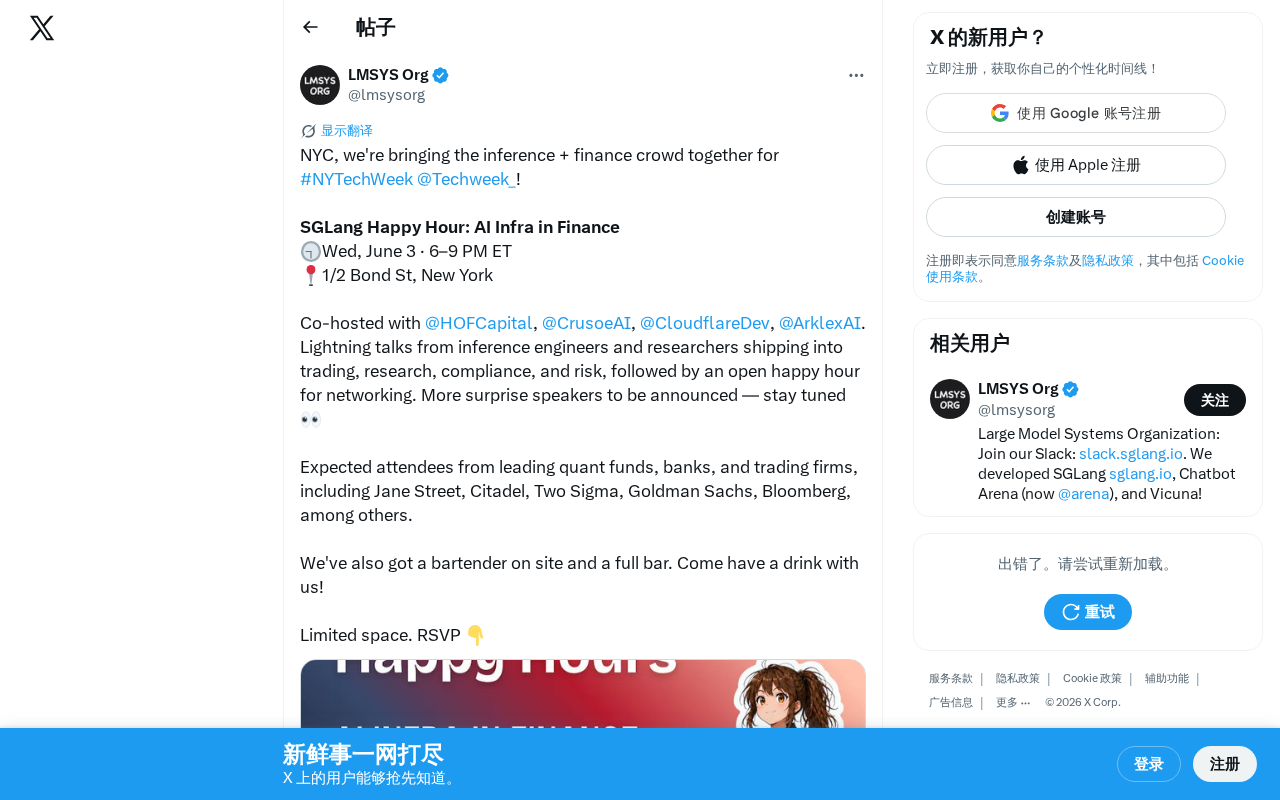
Scheduled for Wednesday, June 3rd from 6-9 PM at Bond Street in New York, the event is co-hosted by SGLang alongside HOF Capital, Crusoe AI, Cloudflare Dev, and Arklex AI. The format includes lightning talks and open networking, covering topics such as the practical applications of AI inference technology in trading, research, compliance, and risk management.
Why Does the Financial Industry Need High-Performance AI Inference?
Low Latency Is the Lifeblood of Financial AI
The financial industry's demand for AI inference is fundamentally different from other sectors. In high-frequency trading, real-time risk management, and compliance monitoring scenarios, millisecond-level latency differences can mean millions of dollars in profit or loss.
High-frequency trading (HFT) is one of the most latency-sensitive scenarios in finance, with top firms compressing trading system latency down to the nanosecond level. After introducing AI inference, end-to-end latency targets typically need to stay within single-digit milliseconds, placing extremely high demands on the inference framework's scheduling, batching strategies, and hardware affinity. Real-time risk management systems face similar constraints — each transaction must undergo fraud detection and compliance checks before clearing, and any inference latency directly impacts transaction throughput and capital security.
As one of the most closely watched open-source LLM inference frameworks today, SGLang is primarily developed by UC Berkeley's Sky Computing Lab. Its core innovation, RadixAttention, achieves automatic KV Cache reuse through a Radix Tree structure, boosting throughput by several times in multi-turn dialogue and batch inference scenarios. Compared to competitors like vLLM, SGLang has deeply optimized Continuous Batching and scheduling strategies, frequently topping mainstream benchmark rankings. These technical capabilities align perfectly with financial institutions' critical need for high-performance inference.
From the Lab to the Trading Desk
The event is expected to attract professionals from top quantitative funds, banks, and trading firms including Jane Street, Citadel, Two Sigma, Goldman Sachs, and Bloomberg. This lineup alone signals a clear trend: Wall Street's most elite institutions are seriously evaluating and deploying LLM inference infrastructure.
Top quantitative firms like Jane Street, Citadel, and Two Sigma have historically been early adopters of cutting-edge technology. Over the past decade, these institutions have deeply integrated machine learning into factor mining, execution algorithms, and risk modeling. Currently, LLMs are being used to parse earnings calls, regulatory filings, and news events, extracting structured signals to feed into quantitative models. The performance of inference infrastructure directly determines the timeliness of signal generation, which in turn affects a strategy's ability to capture alpha.
The lightning talk topics are also telling — Trading, Research, Compliance, and Risk cover virtually the entire core business chain of financial institutions. This means LLM inference is no longer just an auxiliary tool but is penetrating every critical link in financial operations.
It's worth noting that financial institutions also face strict regulatory constraints when deploying AI inference, including explainability requirements for algorithmic decisions under frameworks like SEC, FINRA (US), and MiFID II (Europe), as well as data security standards like SOC 2 and ISO 27001. This means inference deployment in financial scenarios typically favors on-premise deployment or dedicated cloud environments over public API calls, placing additional requirements on the inference framework's private deployment capabilities, audit logging, and access control.
Co-Host Lineup Reveals Industry Chain Positioning
The co-host lineup for this event is noteworthy:
- HOF Capital: A venture capital firm focused on early-stage tech investments, representing capital's bullish stance on the AI inference + finance track
- Crusoe AI: A company focused on AI computing infrastructure, providing GPU compute support
- Cloudflare Dev: A global edge computing giant whose inference deployment capabilities are crucial for the low-latency demands of financial scenarios. Cloudflare's edge computing network spans 300+ data centers worldwide, and its Workers AI platform can schedule inference tasks to the node closest to the user, compressing network round-trip time (RTT) to extremely low levels. For global financial institutions operating across time zones, edge inference deployment means that whether a trader is in New York, London, or Hong Kong, they receive consistently low-latency responses — particularly critical for globally unified deployment of real-time risk management and compliance monitoring.
- Arklex AI: A startup focused on financial AI applications
This combination of "inference framework + compute + edge deployment + vertical applications" outlines the complete technology stack and industry chain for AI inference in finance.
Industry Trend: Inference Infrastructure Moving Toward Vertical Deep Adaptation
This event reflects an important trend in AI infrastructure: general-purpose inference frameworks are moving toward deep adaptation for vertical industries.
Over the past year, SGLang has achieved significant breakthroughs in general LLM inference performance through technical innovations like RadixAttention and Continuous Batching. But to truly serve demanding industries like finance, general performance optimization alone is far from sufficient — it also requires understanding industry-specific latency constraints, data security requirements, compliance frameworks, and deployment architecture preferences. Financial institutions' strong preference for private deployment will also drive continued investment in enterprise-grade features such as multi-tenant isolation, model encryption, and audit trails.
From a broader perspective, when top quantitative firms begin seriously participating in AI inference community events, it signals that LLM inference technology has moved from the "interesting experiment" phase into the "production-grade deployment" phase. The financial industry has always been a bellwether for technology adoption — their extreme demands for performance, reliability, and security will in turn drive further evolution of inference frameworks.
Summary
While SGLang's event is casual in format (complete with a professional bartender and full bar), the signal it sends is quite clear: the deep integration of AI inference infrastructure with the financial industry is accelerating, and SGLang aims to be the bridge connecting these two worlds. For professionals tracking AI infrastructure investment and technology direction, this is a cross-disciplinary area worth close attention.
Key Takeaways
- SGLang is hosting an AI inference + finance themed event during New York Tech Week, co-hosted with Crusoe AI, Cloudflare, and others
- Expected to attract participation from top financial institutions including Jane Street, Citadel, Two Sigma, and Goldman Sachs
- The event focuses on AI inference applications across four core financial scenarios: trading, research, compliance, and risk management
- The co-host lineup covers the complete technology stack spanning inference frameworks, compute, edge deployment, and vertical applications
- Reflects the industry trend of general AI inference frameworks moving toward deep adaptation for vertical industries
Related articles
 Industry Insights
AI Product Development in Practice: Model Selection, Building Moats, and Paths to Commercialization
Practical strategies for AI product development: why not to train models from scratch, when to use APIs vs. fine-tuning, building product moats, and the full path from evaluation systems to commercialization.
 Industry Insights
No Product Fits Your Needs? Building It Yourself Is the Best Starting Point for Indie Developers
Can't find a product that fits? Building from personal pain points is the best entry for indie developers. Niche needs + AI tools = rapid product creation.
 Industry Insights
OpenAI Codex Tutorials Mass-Copied on Bilibili, Highlighting AI Content Farm Problem
At least 9 Bilibili accounts mass-published identical OpenAI Codex tutorial videos, exposing content farm operations in the AI tools space.